Category Archives: Radio history

Niela Goodelle, 1936

1936JulyRadioGuide

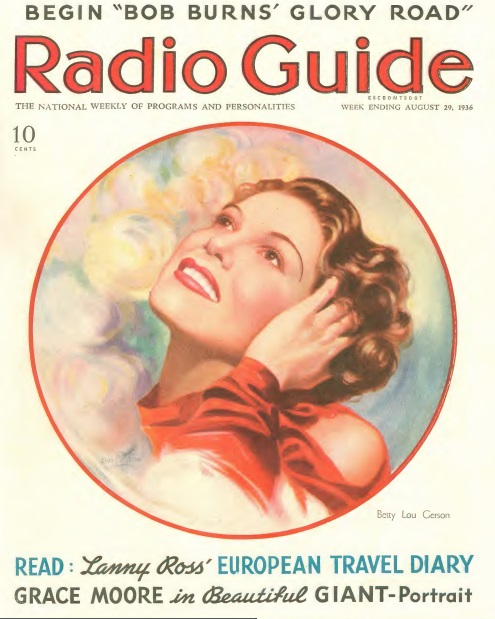
Eighty years ago, this day’s issue of Radio Guide magazine, July 18, 1936, featured Niela Goodelle.

Born Helen Goodell, a friend remarked that her name “reeked of the kitchen,” and suggested she change it.  She turned her first name around and spelled it the way it sounded, and added an “e” to her last name.  The magazine described her as a welcome addition to any broadcast who had carried herself to the topmost pinnacles of radio fame.

According to the Internet Movie Database, she died in New York in 1988.

Here, she performs “Ten Pretty Girls.”

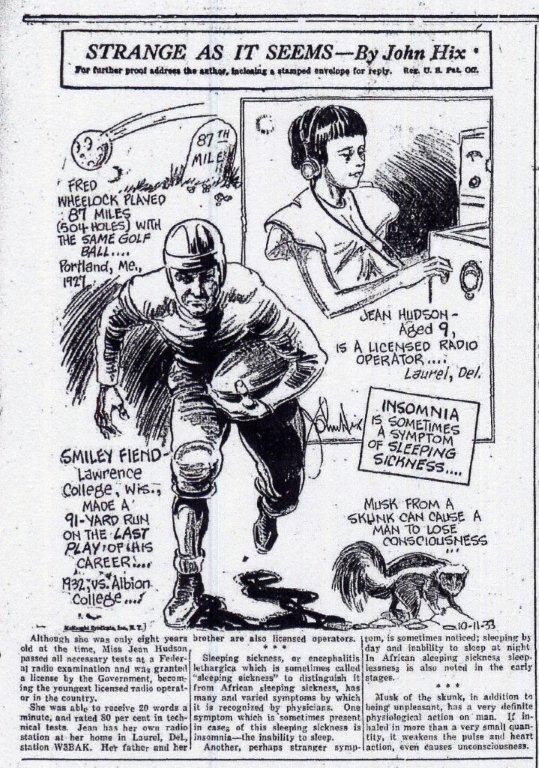
Click Here For Today’s Ripley’s Believe It Or Not Cartoon


First Televised Wedding, 1931

1931JulyTVNews

The first ever televised wedding took place 85 years ago, as shown here from the July-August 1931 issue of Television News.

The bride and groom, Grace Jones and Frank Du Vall were wed by Dr. A. Edwin Keigwin of the West End Presbyterian Church over the airwaves of W2XCR-WGBS. The video was transmitted over W2XCR, with the synchronized audio being transmitted over WGBS. The magazine reported that thousands of visualists were trilled by this marvel of modern science.  Du Vall was apparently a station engineer

The television studio and 500 watt transmitter were located at 655 Fifth Avenue, New York City. The station used a mechanical system employing a strong arc light with a rotating disc with a “flying spot” to do the scanning. The visual pickup consisted of fixed photocells. The more conventional system at the time placed the spinning disc in front of the photocell. The system used by W2XCR essentially consisted of a beam of light that scanned the subject, synchronized with the spinning disc on the receiver. The system used 60 lines and scanned 20 pictures per second.  The general idea is shown in the illustration here:

1931JulyTVNews2

The sound was sent by wire to WGBS at Astoria, Long Island.  According to the Spring-Summer 1931 issue of White’s Radio Log, WGBS operated on 600 kHz with 250 watts of power.  The station’s call sign represented its owner, Gimbel’s Department Store, and the station is the predecessor of WINS.

 W2XCR, licensed to Jenkins Television Corporation, operated on 2000-2100 kHz or 2750-2850 kHz.

According to the 1940 census, the couple was happily married and living in Essex, New Jersey, on their ninth anniversary.  The clergyman, Dr. Keigwin, appears to be the author of the 1899 hymn, The Someday By and By.

Click Here For Today’s Ripley’s Believe It Or Not Cartoon


1936 Code Oscillator

1936JulyPS11936JulyPS2Eighty years ago this month, the July 1936 issue of Popular Science contained the plans for this code practice oscillator.  The main feature was that it required neither headphones nor a battery, since it had sufficient volume to drive a speaker, and ran off household power.

As shown in the schematic, it used a single dual tube, a 12A7, with one half serving as rectifier and the other half as oscillator.  The 12 volts for the filament was supplied with a curtain burner line cord.

Click Here For Today’s Ripley’s Believe It Or Not Cartoon


1966 International Crystal Model MO-23 CB

1966JulyPEIntlMO23

When I first saw this ad from the Popular Electronics issue from 50 years ago this month, July 1966, I was amazed that they had achieved such a level of miniaturization, until I looked closer.  This is an ad for the Model MO-23 CB radio from International Crystal, which was so compact that it could hide under the dash, in the console, or in the glove compartment. As you can see, the radio isn’t much larger than the microphone.

Closer examination reveals that only the control head is inside the car. As with most two-way radio equipment of the 40’s through 60’s, the guts of the radio was in the trunk. The ad notes that “technically speaking, the MO-23 combines the best advantages of tubes and silicon transistors,” since the control head and power supply were transistorized, but the actual transmitter and receiver used tubes.

At least one example of this radio made it to market, since I did find this e-bay listing for one.  It shows the trunk unit, with at least nine tubes. Three transistors mounted at the back are probably part of the power supply to convert the car’s voltage to the B+ required by the tubes.

Click Here For Today’s Ripley’s Believe It Or Not Cartoon


1970 Broadcast Preamp

1970JulyEE

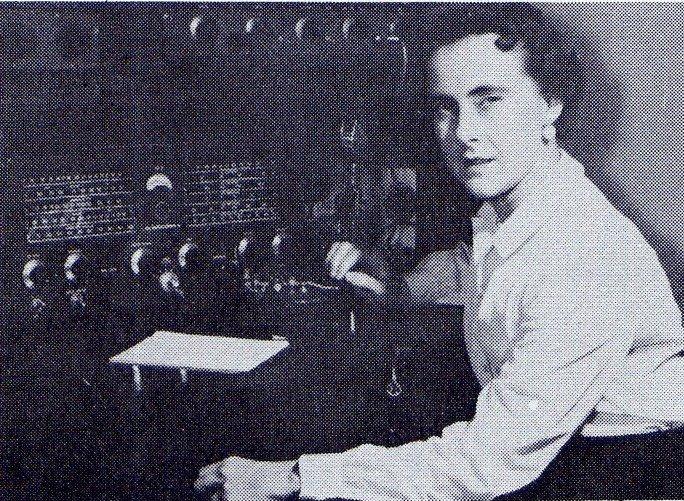
The listener shown here, on the cover of the July-August 1970 issue of Elementary Electronics, is listening to her Hallicrafters S-120A “Star Quest” receiver, which had just come out. It was a transistorized version of the S-120, and according to a sidebar in the magazine, it incorporated features found only on more complex and expensive receivers. It tuned the broadcast band, as well as 2-30 MHz shortwave, and included a BFO for tuning in CW and SSB.

But she wasn’t tuning the shortwave bands. She is actually listening to the broadcast band, and making use of the TennaBoost, the device sitting on top of the receiver, the plans for which were included in the magazine. The Tenna Boost was an external preamplifier. It was made from a commercial kit from International Crystal, but modified with the external ferrite loop. The amp was said to provide 30 dB gain, with the loopstick providing an additional 10 to 20 dB. The result was that you would hear a station every 10 kHz along the broadcast band. The article stressed the importance of making sure the case was completely shielded, since without the cabinet being securely screwed together, the amp and loopstick would break into oscillation.

Click Here For Today’s Ripley’s Believe It Or Not Cartoon


1936 Battery Merchandising

1936BatteryDisplay

The radio retailer 80 years ago was always looking for a way to add a few more sales, and with summer vacation season underway, one idea was this counter top battery display for the obligatory flashlight.  The display took up only 8-1/2 by 11 inches of counter space, but promised to keep customers shelling out for cells.

The ad, from the Bond Electric Corporation of New Haven, CT, appeared in the July 1936 issue of Radio Retailing magazine.

Click Here For Today’s Ripley’s Believe It Or Not Cartoon
Building an online therapy practice


1936 Tube Data

1936JulyRadioNews

If you’re looking for data on tubes from the mid-1930’s, then the July 1936 issue of Radio News is probably a good place to look, since the issue was devoted to tubes.

However, even if you don’t read it for the articles, you’ll enjoy the cover art, reproduced here.

Click Here For Today’s Ripley’s Believe It Or Not Cartoon


1941 Crystal Sets

1941JulyPMXtalSetsThe young gentlemen shown here are currently about 85 years old. They are shown in the July 1941 issue of Popular Mechanics demonstrating the operation of two of the seven crystal set circuits in the accompanying article.

The article noted that distant reception was possible under certain favorable and unusual conditions, but a crystal set was normally limited to a range of about ten miles. All of the circuits used a fixed detector. The simplest one was tuned by tapping the coil at various points. More complex circuits used various tricks to coax out as much signal as possible. The article stressed the importance of a long high antenna, and grounding to a cold water pipe.

Click Here For Today’s Ripley’s Believe It Or Not Cartoon


1936 Popular Science Regenerative Receiver

1936JulyPSThe plans for this simple one-tube regenerative shortwave receiver appeared in Popular Science 80 years ago this month, July 1936.

It used a single 6C5 metal triode.  The tube, as well as the other components, are readily available, although the modern components might have a slightly different look.  According to the author, the set’s volume and sensitivity equalled those of more complicated circuits.  From the author’s home in Nebraska, the set pulled in amateur, police, air-mail, and commercial shortwave stations from all around the country with excellent headphone volume.  The author was also able to pull in foreign stations, despite a relatively short antenna and being in the middle of a noisy business district.  The total cost of the parts was about five dollars.

The plans showed coil winding data for plug-in coils for 10 through 160 meters.

1936JulyPSschematic

Click Here For Today’s Ripley’s Believe It Or Not Cartoon


1941 Audio Amp

1941JulyPMAudioAmp

Bill is cheerful about it, but you have to wonder whether he’s questioning his wisdom in building the audio amplifier described 75 years ago this month in the July 1941 issue of Popular Mechanics.

The simple device used a single 117N7GT, a rectifier and beam-power tube, and ran right off AC power. The article described four uses for the little amp. First, it could be used to provide loudspeaker volume from a crystal set or one-tube radio. It could even be used as a B-battery eliminator for a set (although the article cautioned that if used in this way, the radio could not be directly grounded). Third, it could be used as a phonograph amplifier with a crystal pickup.

The fourth proposed use is how Bill wound up using his. With a micropone, “it becomes a serviceable low power public address unit. The speaker unit may be connected to long cabled leads between counter room and kitchen in small cafes and sandwich shops, or (as Bill wound up doing) between the basement and other rooms in the home.”

Bill undoubtedly reasoned that this would be the most convenient use for his amplifier.  But perhaps he’s having second thoughts.  He’s in the basement trying to fix a fan when the summons comes over the horn:  “Hi!  Bill bring up the screwdriver.”

Bill seems like a cheerful sort, and it looks like fixing the fan will have to wait.  But as he brings up the screwdriver, I wonder whether he’s thinking that he should have made himself a phonograph.

1941JulyPMAudioAmpSchematic

Click Here For Today’s Ripley’s Believe It Or Not Cartoon