Category Archives: Uncategorized

1951 Arvin 446P Portable

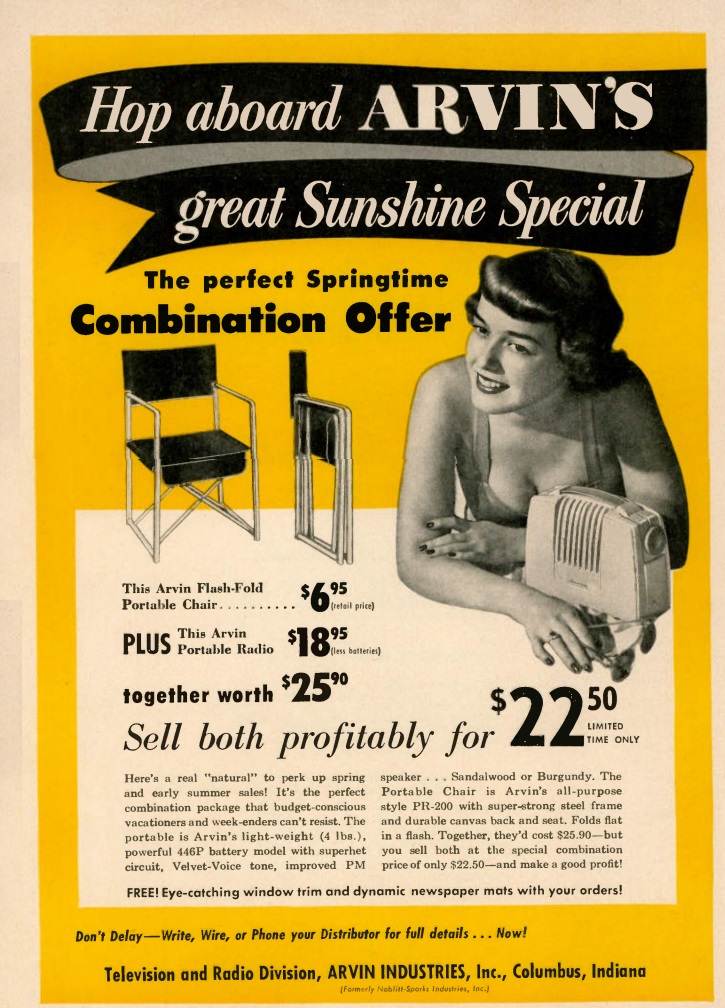
If you were a radio dealer 75 years ago, you were gearing up for the summer sales season. And for the radio dealer, that meant portables. As this ad points out, vacationers and week-enders would need entertainment during their outdoor activities, and this Arvin model 446P portable radio would fit the bill. It weighed in at only 4 pounds, and the superheterodyne circuit and improved PM speaker would pull in the stations and provide excellent tone.

But while listening to the radio outdoors, your customers would need someplace to sit, and for that, the Arvin model PR-200 folding chair would serve their needs well. Interestingly, Arvin did indeed make chairs, in addition to radios.  You could sell the radio and chair as a package deal for only $22.50, and still make a good profit.

The ad appeared in the May 1951 issue of Radio-TV Retailing.


1951 Hydrogen Warning

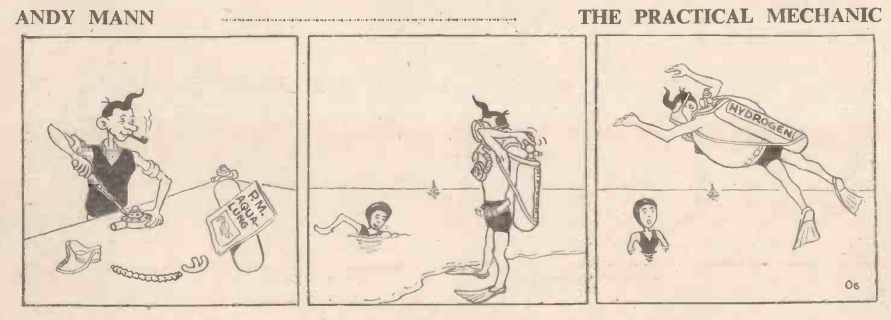
Seventy-five years ago this month, the May 1951 issue of the British Practical Mechanics carried this important warning about using compressed gasses. Always check and make sure you have the right one!


Re-Introducing MathDoctor.net

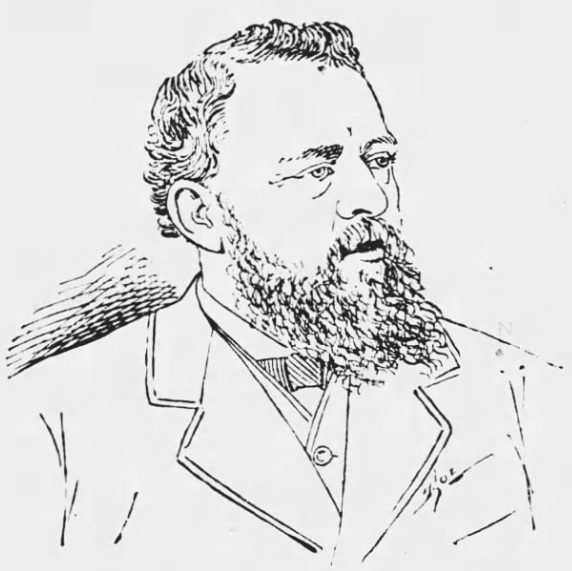
George Albert Wentworth.

George Albert Wentworth. Wikipedia image.

For about ten years, I have owned the domain MathDoctor.net.  When I first acquired it, I slapped some content there, planning to update it when I got a Round Tuit.  That time has finally come, and I’ve started putting some useful content there.  In particular, I now have a full course in Algebra 1, which I think is suitable for homeschoolers, or perhaps just parents wanting to brush up on basic principles in order to help their kids with homework.

The course is based upon the text written in the late 19th century by George A. Wentworth, pictured at the left.  You can view the original text at the Internet Archive at this link.  For most of the first half of the 20th century, most kids used this text to learn algebra.  And those kids are the ones who got us to the moon, so Ol’ Wentworth must have been doing something right.

The language has been updated somewhat.  And when Wentworth’s word problems talked about bushels of oats, we’ve done our best to make them more relevant.

The site is still under construction, and I hope I can update it faster than the last update took.  But the Algebra course is now ready to go, although I intend to add more exercises (and answers) for all of the chapters.  I will also add additional complete courses.  You can go directly to the Algebra course at this link.

If you know a parent who’s grappling with helping Junior with their algebra, please share the link.


Some links on this site are affiliate links, meaning that this site earns a small commission if you make a purchase after following the link.

Emergency Communications for the Railroads, 1926

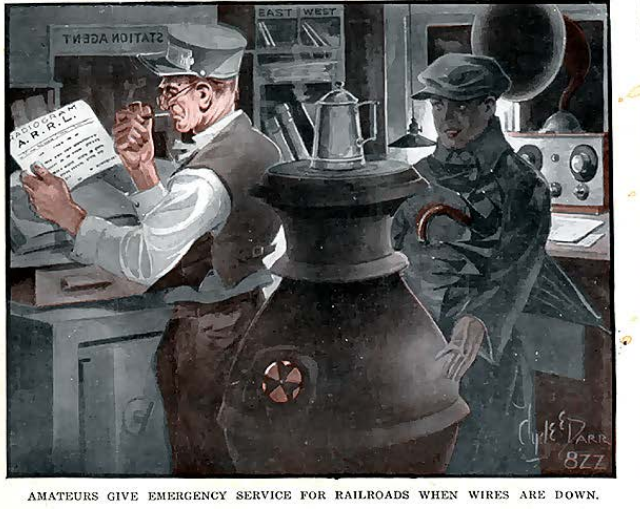
A hundred years ago, this railroad station agent was reviewing a message sent from another station via amateur radio. You need communications to run a radio–before sending a train down a westbound track, you better make sure that there’s not an eastbound train coming toward you. Normally, those orders go out via telegraph, but if the wires were down for any reason, that was a problem.

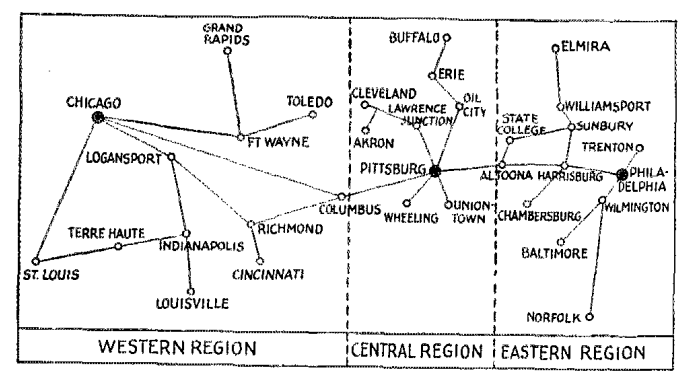
As late as the 1940s, you see occasional reports of amateur radio operators helping out the railroads with this vital traffic, such as during the 1949 Midwestern blizzard.  It is illustrated here on the cover of QST, May 1926. The accompanying article explains how the ARRL was approached by the Pennsylvania Railroad to set up a reliable backup system. Over the course of 10 weeks, tests were conducted to make sure there would be a smooth transition in case of emergency. All of the cities shown on the map below were represented, in most cases by multiple stations.


Michigan QSO Party

A couple of weekends ago, I operated the Michigan QSO party. I had originally planned to operate as a Rover in the Wisconsin QSO Party, but a late-season blizzard cancelled those plans. The original plan had been to start on Lake Michigan at the Wisconsin-Michigan border and work my way through the state’s northern tier of counties. Since that didn’t work out, I started at about the same spot, but instead activated the southern tier of counties of Michigan’s Upper Peninsula.

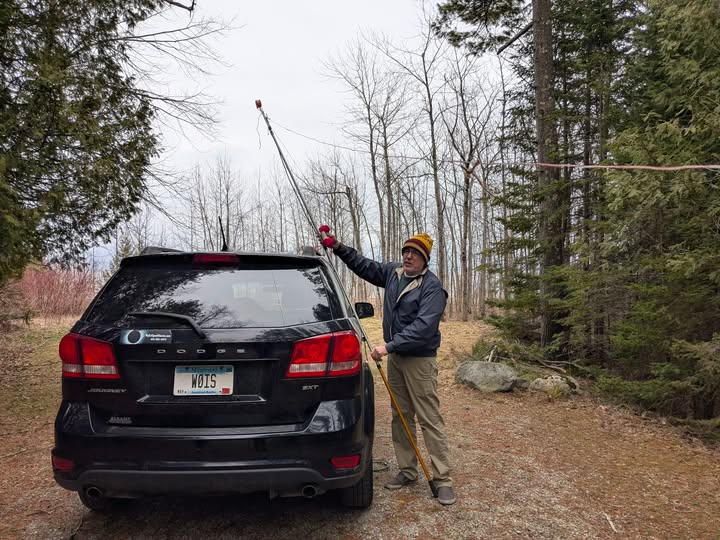
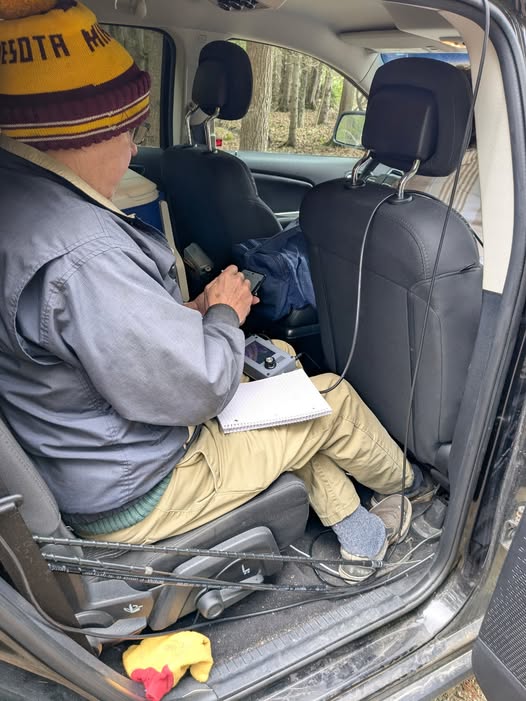
I started in Marinette County’s J.W. Wells State Park, where I did a POTA activation. The original plan was to set up a station on a picnic table. But the mid-April weather was still quite cold. After getting the dipole set up (using, of course, my trusty golf ball retriever , I didn’t fancy operating for an hour in the cold. So I operated instead from the mobile position in the back seat of the car, shown here.

Since most QSO’s were in motion and CW, I operated from this spot in the back seat, while my wife and daughter took turns driving.

I did activate another park, Bewabic State Park in Iron County. But instead of setting up the 40-meter dipole, I stayed on 20 meters an just used the Hamstick. Since I didn’t make it back to 40 meters after the first park, I had very few Michigan contacts, but I did manage to hand out some “rare” counties to other stations. My best DX was avid county hunter OM2VL in Slovakia.  I was QRP mobile, limited for most of the time to a single band, and didn’t plan on being a high scorer.  But I did manage just under 50 contacts in about 8 hours of operating, and had an enjoyable trip!!


some links on this site are affiliate links, meaning that this site earns a small commission if you make a purchase after using the link.

Life Imitates Art: 1966 Personal Stereo

Sixty years ago, this cartoon looked pretty far fetched–someone walking around with a personal stereo system, oblivious to the outside world. But it was only 13 years later that the Sony Walkman took the world by storm.  And even before that, in the 1970’s, more clunky headphone radios (usually not stereo, but often AM-FM), that looked a lot like the ones here, hit the market.

OF course today, it’s basically taken for granted that if you want to listen to music wherever you are, the device to provide it is in your pocket.

The cartoon appeared sixty years ago in the February-March 1966 issue of Radio-TV Experimenter.


1956 Code Practice Oscillator

Seventy years ago this month, the February 1956 issue of QST showed this circuit for a very simple code oscillator, using the venerable CK722 transistor. This was actually a simplification of an earlier circuit, which had been updated by George Carson, W0JV.  The oscillator runs on 1.5 volts, but for greater volume, that could be upped to 3 volts.

Carson was a professor at the University of Iowa, and his call is still held by the Iowa City Amateur Radio Club.


1956 TV Remote Control

Seventy years ago, remote control for your television was starting to become a thing, as demonstrated by this cartoon in the February 1956 issue of Radio Electronics.


1951 Pager

Seventy-five years ago, this New York physician was undoubtedly one of the first in the nation to carry a radio pager, described in the January 1951 issue of Popular Science. But it wasn’t quite as automatic as later models. It was simply a receiver for 43.58 MHz, and he had to remember to periodically turn it on and listen to a list of three-digit numbers. If his number was called, he would call his office to find out the emergency.

The number would be broadcast for an hour, and the list of numbers was recorded on 16 mm film. The service was provided by Telanserphone, Inc., and subscribers paid $12 per month. The service was said to have a service radius of 25 miles, and would work almost anywhere, other than the subway. The magazine gives the call sign of the transmitter, KEA627. Interestingly, according to the FCC record, that license was still active up through 2000 on the same frequency, most recently licensed by Metrocall USA, Inc.


Grant’s Department Store Radio Department, 1926

A hundred years ago, if you were in need of radio parts in San Antonio, then you couldn’t go wrong by heading to the Radio Department of Grant’s Department Store, 305-311 East Houston Street, where you could find tubes, B batteries, or even tuning condensers for just a dollar a piece. This ad appeared in the San Antonio (TX) Sun, January 8, 1926.