Monthly Archives: April 2026

Michigan QSO Party

A couple of weekends ago, I operated the Michigan QSO party. I had originally planned to operate as a Rover in the Wisconsin QSO Party, but a late-season blizzard cancelled those plans. The original plan had been to start on Lake Michigan at the Wisconsin-Michigan border and work my way through the state’s northern tier of counties. Since that didn’t work out, I started at about the same spot, but instead activated the southern tier of counties of Michigan’s Upper Peninsula.
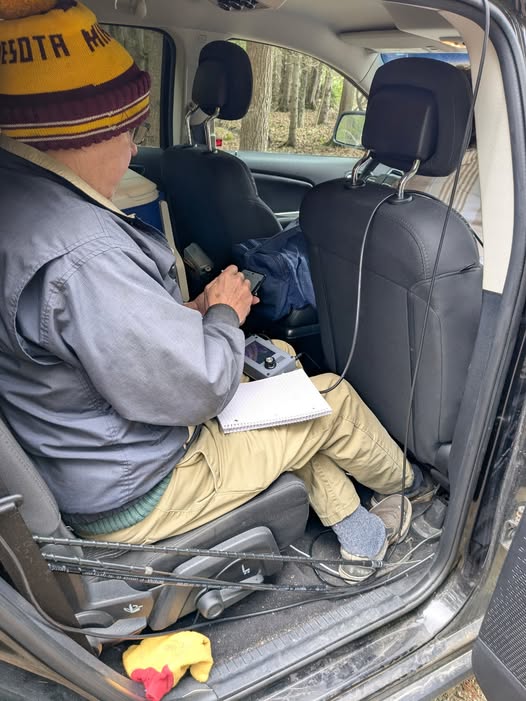
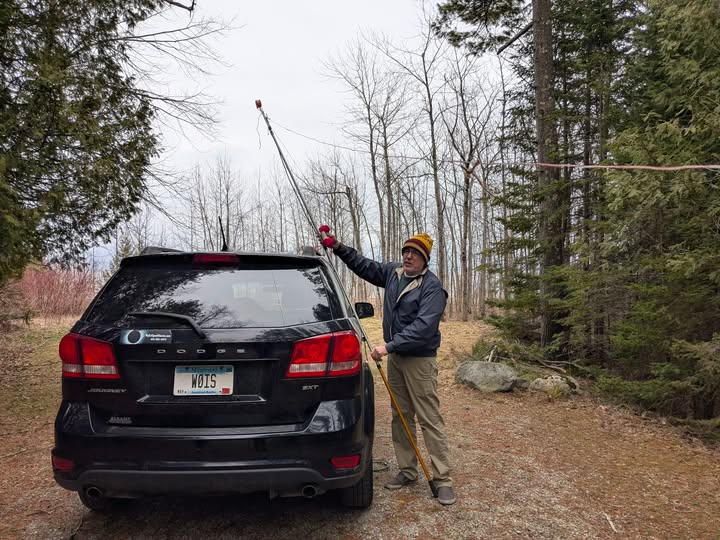
I started in Marinette County’s J.W. Wells State Park, where I did a POTA activation. The original plan was to set up a station on a picnic table. But the mid-April weather was still quite cold. After getting the dipole set up (using, of course, my trusty golf ball retriever , I didn’t fancy operating for an hour in the cold. So I operated instead from the mobile position in the back seat of the car, shown here.

Since most QSO’s were in motion and CW, I operated from this spot in the back seat, while my wife and daughter took turns driving.

I did activate another park, Bewabic State Park in Iron County. But instead of setting up the 40-meter dipole, I stayed on 20 meters an just used the Hamstick. Since I didn’t make it back to 40 meters after the first park, I had very few Michigan contacts, but I did manage to hand out some “rare” counties to other stations. My best DX was avid county hunter OM2VL in Slovakia.  I was QRP mobile, limited for most of the time to a single band, and didn’t plan on being a high scorer.  But I did manage just under 50 contacts in about 8 hours of operating, and had an enjoyable trip!!


some links on this site are affiliate links, meaning that this site earns a small commission if you make a purchase after using the link.
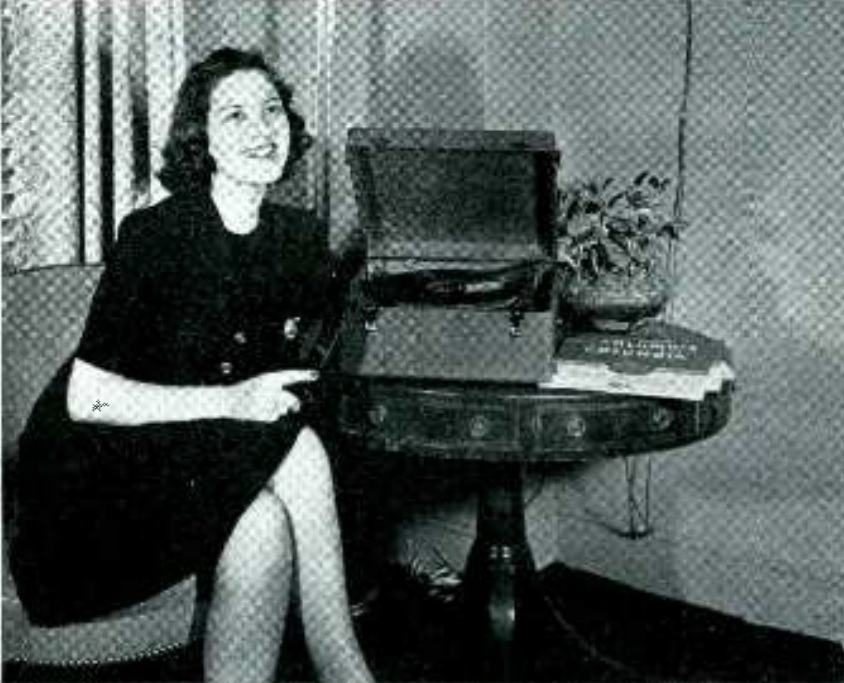
1941 Portables

Eighty-five years ago, this young woman is enjoying a favorite song from her portable phonograph. Hers was an electrical model, but there were many options for portable music, as detailed in the April 1941 issue of Radio Retailing.

The magazine noted that it was the perfect time of year to start marketing portables. Since April marked the beginning of the warm weather season, portables would get their greatest natural play. It also pointed out that since portables were still owned by relatively few people, they had a novelty factor that would help build store traffic.

Options included both radios and phonographs. While the unit shown above is electric, there were still many purely mechanical record players available, and the magazine provided an extensive directory of spring machines with no tubes. The least expensive was the Model 11 from Favorite Manufacturing Co., 105 E. 12th Street, New York, with a list price of $8.39.


1956 Custom Hi-Fi

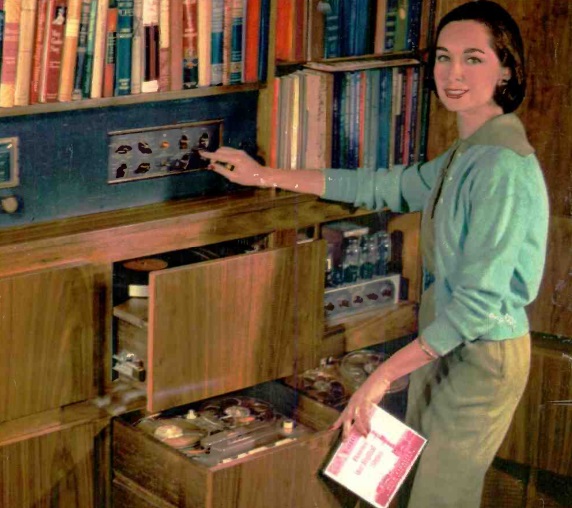
Seventy years ago this month, this high fidelity enthusiast was making adjustments to the H. H. Scott control panel of a custom installation, put together by Custom Sound Systems of Orange, New Jersey.  The two lower drawers contained a De Jur tape recorder and Audiosphere stereophonic tape player.  The upper drawers contained a Rek-O-Kut record player and an Altec amplifier.

This deluxe setup is in the home of one Robert Ossorio of New York City.  But while this young woman appears at ease with the equipment, she’s actually a model, Mona McHenry, hired for the photo shoot.  The photographer is by Dan Rubin, and the photo appeared on the cover of the April 1956 issue of Radio-Electronics.


Getting the Antenna Higher: 1941

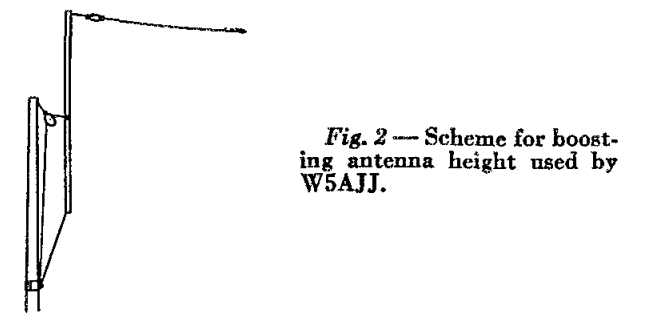
If you need to get the end of your antenna up a few more feet, you might try this idea sent into QST 85 years ago this month, April 1941. The idea is self-explanatory–you just hoist a new section of mast up your existing mast. The bottom of the new section contains a ring of heavy wire. The idea was submitted to Hints and Kinks by Bernard S. Shields, W5AJJ, who noted that if the guy wires are added to the top section, an appreciable height could be achieved.


Happy Arbor Day!

The official date for Arbor Day can vary from country to country, and even state to state. So for a website of international scope, we must decide on a date, and we’ve decided to go with Nebraska, which proudly proclaims that it is the home of Arbor Day, and where Arbor Day is a civic holiday. So today, the last Friday of April, we wish you a Happy Arbor Day!

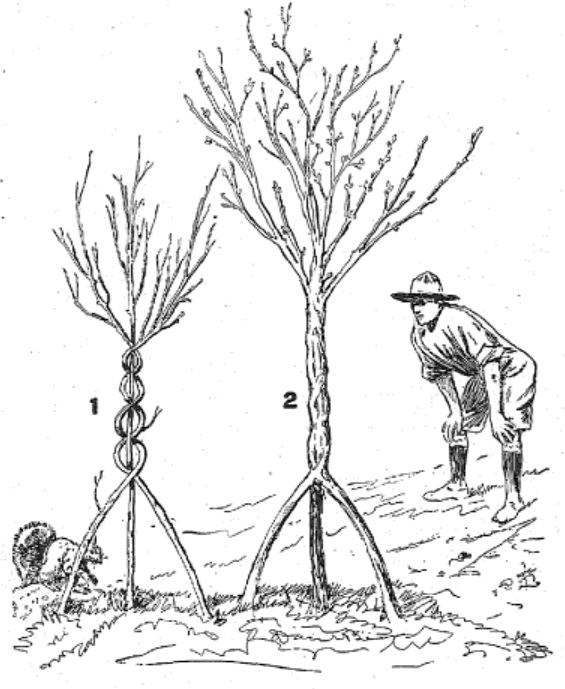
The illustration above is from Boys’ Life, April 1926, and is in the column of Dan Beard. Beard first discusses the possibility of every patrol in the country planting a walnut tree with a walnut from the grave of Theodore Roosevelt, and Beard had distributed thousands of such walnuts, ready for planting. The BSA was also working with the proper authorities to procure walnuts from the grave of George Washington, so that those could be planted as well. There are trees around the United States from walnuts from Mount Vernon, so with some inquiries, this project would probably be quite possible today. For those desiring faster satisfaction, you can purchase a number of heirloom flower seeds directly from the estate.

The other idea shown in Beard’s article is shown above. It’s rather self-explanatory, and involves weaving the trunks of small trees together. Beard recommends species with smooth bark, such as beech, willow, or soft maple. He had some success with chestnuts, but he noted that was the boundary, as species with a rougher bark would not cooperate. For students with a long timeframe, it might make a good science fair project, but “it only takes a few years to get results.” (Emphasis added.) The process is known scientifically as insoculation.


“The Chimps” 1951 Television Films

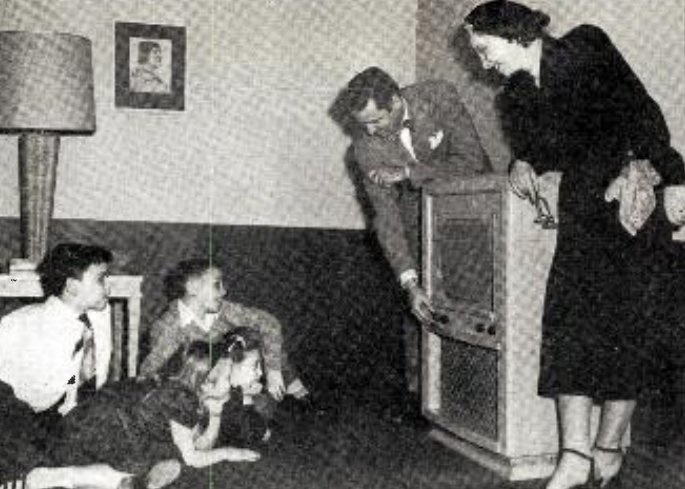
The youngsters in this picture are now octogenarians, but 75 years ago, they were the test audience for “The Chimps.” They are shown in the April 23, 1951, issue of Broadcasting, which explains that the series of 13 15-minute films had been produced by Bing Crosby Enterprises, and featured chimpanzees in “western and whodunit dramas.”

Try as we may, we have been unable to find much information about this early television program. We’ll keep looking, but if anyone has any information, we would be most interested in learning. And, of course, we would really love to watch an episode or two.


Build Your Own Scope: 1951

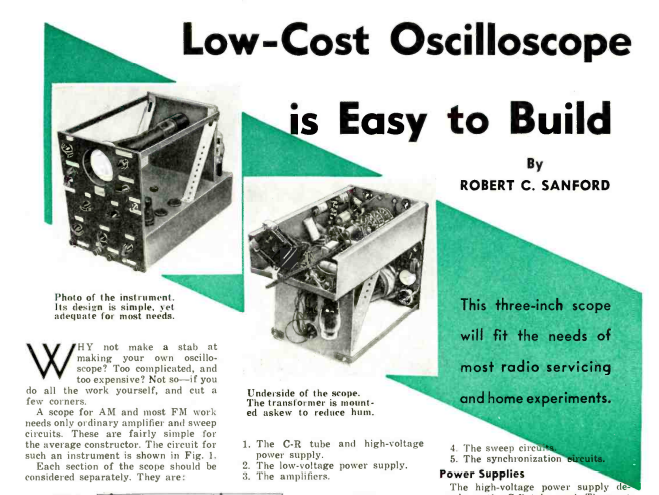
Seventy-five years ago, the April 1951 issue of Radio Electronics showed how to construct your own oscilloscope. The magazine pointed out that many were daunted by the prospect, but a basic scope for work on AM and FM radios was well within the capabilities of the average builder. The model they show used five tube, including rectifier, plus the CRT.

These days, you don’t need to break out the soldering iron or track down those five tubes. You can go to Amazon and get a pocket-sized version.


Some links on this site are affiliate links, meaning that this site earns a small commission if you make a purchase after using the link.
Motorola 3A5 “Playboy”, 1941

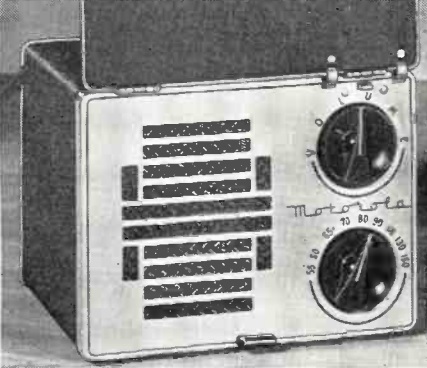
Eighty-five years ago this month, the April 1941 issue of Radio News showed the Motorola model 3A5 “Playboy.” The four tube (plus rectifier) portable radio was said to play anywhere, and the manufacturer backed up that promise: The set would play where other personal portables failed, or the customer’s money would be refunded.

The set measured 6-1/4 x 4-5/8 x 3-1/2 inches, and weighed in at 4-1/4 pounds. It started playing automatically when the lid was snapped open, and shut off when closed. It was “encased in a crackle finish metal case of modern design with shimmering chrome trim and a front cover of Polystyrene, the new plastic.”


1926: Los Angeles Airmail Service

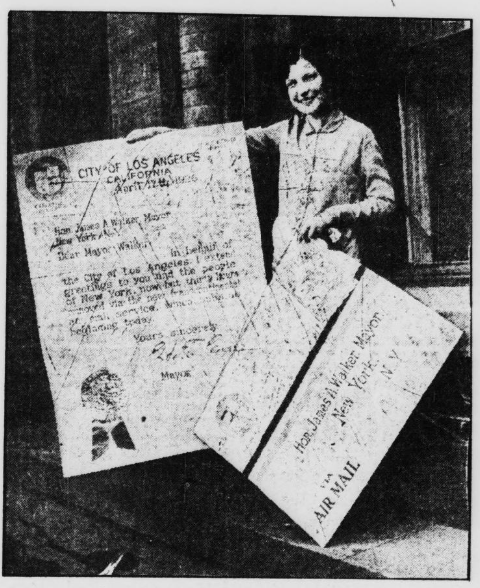
Shown here is Miss Marion Voss, private secretary to George E. Cryer, Mayor of Los Angeles. She is holding a letter to Mayor Jimmy Walker of New York. The letter is said to be the largest ever sent by U.S. Mail. It is being sent on the occasion of the first airmail flight from Los Angeles, and appeared 100 years ago today in the April 17, 1926, issue of the Washington Star.


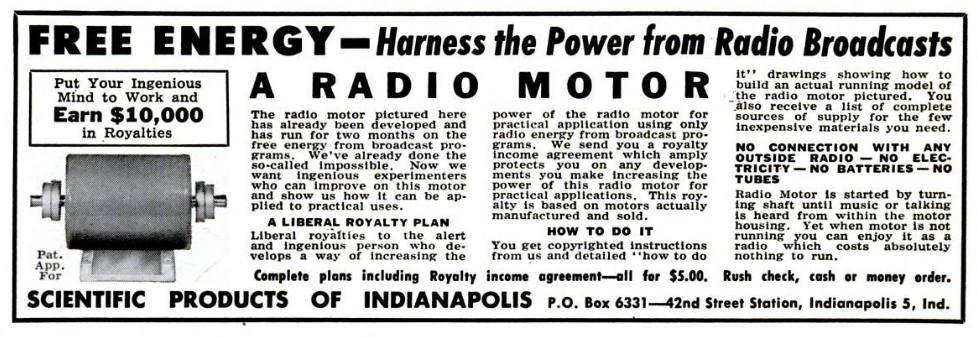
Free Energy–Harness the Power from Radio Broadcasts, 1951

Seventy-five years ago this month, this curious ad appeared in the April 1951 issue of Popular Science. It invites you to send $5 ($62.84 in 2026 dollars) to Scientific Products of Indianapolis (conveniently headquartered in a Post Office box), and they will send you copyrighted instructions showing you how to build this radio powered motor. You turn the motor until voices or music are heard from it, courtesy of the proverbial strong local station. At that point, you can listen to it like a radio, but it keeps spinning, thanks to the energy taken from that station.

The skeptic will note that this device doesn’t provide very much energy. It can keep feebly spinning, and you can probably listen to the broadcast at low volume indefinitely, assuming you’re close enough to the station. But they thought of that. They did the impossible by making the tiny prototype, and now it’s up to you to make it more practical. And you can earn “$10,000” if you can pull it off. They include a “royalty agreement,” meaning that if they can commercialize your idea, you will make money. And more importantly for them, they will make money from your hard work.

We’re sure that many of our readers have independently come up with the same idea–using power from a nearby radio station to power up a small device. But we also know that there’s a limit to it.  The only references to “Scientific Products of Indianapolis” were similar ads in other magazines during about the same time frame.  They must have had a bit of capital to run all of those ads.  Let’s hope that not too many suckers sent them $5.