Category Archives: Indiana History

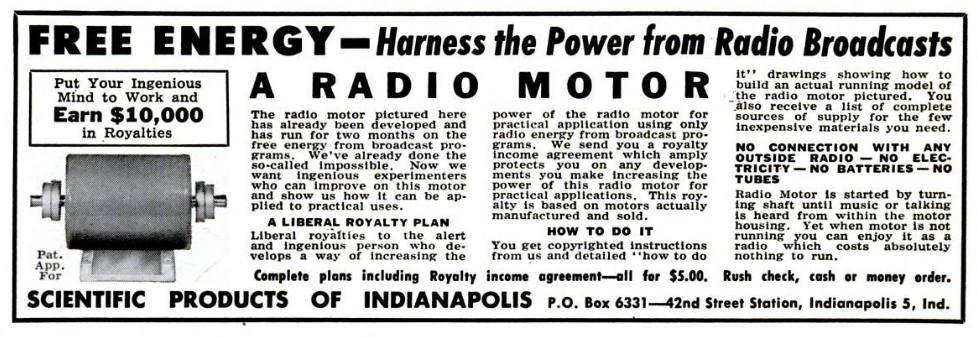
Free Energy–Harness the Power from Radio Broadcasts, 1951

Seventy-five years ago this month, this curious ad appeared in the April 1951 issue of Popular Science. It invites you to send $5 ($62.84 in 2026 dollars) to Scientific Products of Indianapolis (conveniently headquartered in a Post Office box), and they will send you copyrighted instructions showing you how to build this radio powered motor. You turn the motor until voices or music are heard from it, courtesy of the proverbial strong local station. At that point, you can listen to it like a radio, but it keeps spinning, thanks to the energy taken from that station.

The skeptic will note that this device doesn’t provide very much energy. It can keep feebly spinning, and you can probably listen to the broadcast at low volume indefinitely, assuming you’re close enough to the station. But they thought of that. They did the impossible by making the tiny prototype, and now it’s up to you to make it more practical. And you can earn “$10,000” if you can pull it off. They include a “royalty agreement,” meaning that if they can commercialize your idea, you will make money. And more importantly for them, they will make money from your hard work.

We’re sure that many of our readers have independently come up with the same idea–using power from a nearby radio station to power up a small device. But we also know that there’s a limit to it.  The only references to “Scientific Products of Indianapolis” were similar ads in other magazines during about the same time frame.  They must have had a bit of capital to run all of those ads.  Let’s hope that not too many suckers sent them $5.


1926 Grocery Prices

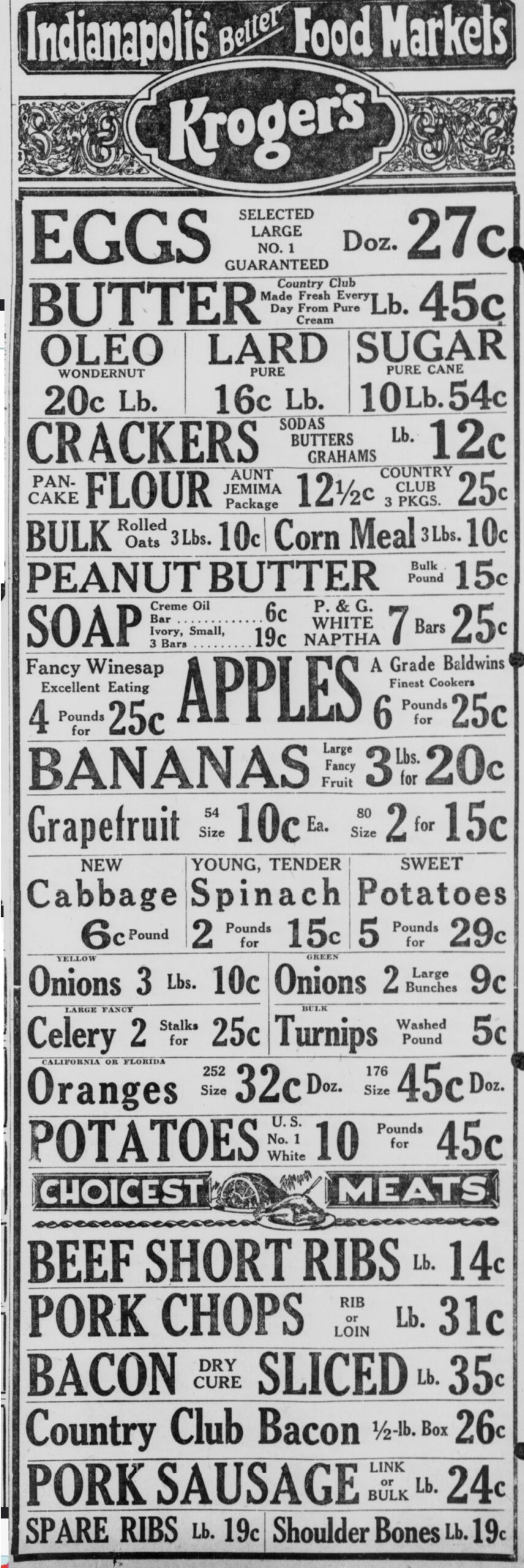
For a look at how much groceries cost in 1926, this ad for Kroger’s appeared in the Indianapolis Times one hundred years ago today, March 9, 1926.

The prices look low, but there’s been a lot of inflation since then. According to this online inflation calculator, one dollar in 1926 was the equivalent of about $18 in today’s money.  So the 27 cent eggs work out to almost $5, which sounds expensive.  But the 19 cent spare ribs are the equivalent of about $3.42 per pound, which doesn’t sound too bad.

What would you make for dinner if you were shopping a hundred years ago?


Tropicalizing Radios, 1946

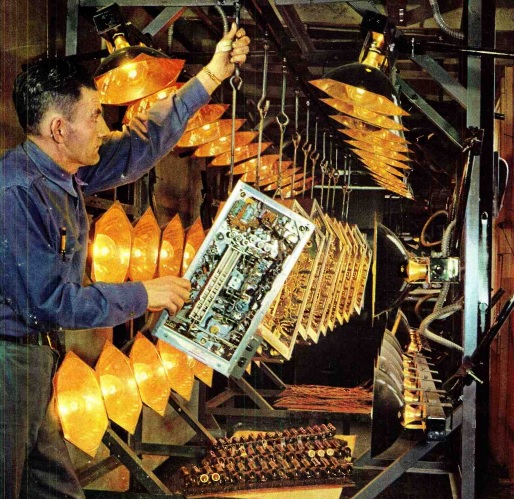
Eighty years ago, this Indiana radio worker is “tropicalizing” radio equipment. The chassis has just had a lacquer applied, and it is now passing through an infrared drying oven. The photo was taken at the Farnsworth Television and Radio Corp. in Marion, Indiana, and appeared on the cover of Radio News, January 1946.


Claypool Trio, Indianapolis, 1925

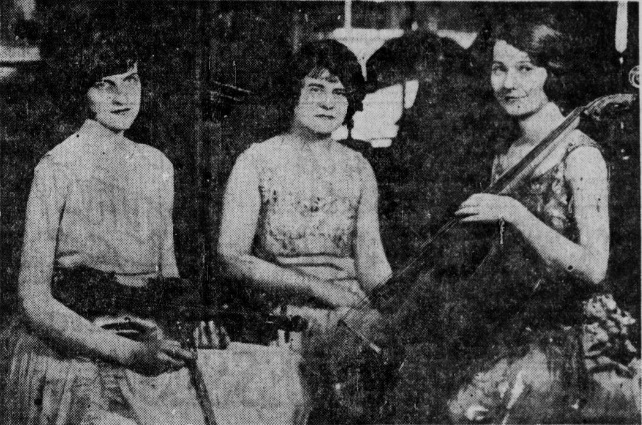
If you were listening to the radio 100 years ago tonight, October 30, 1925, in Indianapolis, you would be able to tune in to the Claypool Trio, composed of Alma Miller Lentz on the violin, Carolyn Turner at the piano, and Consuelo Couchman Rettig on cello. The program was heard on WFBM (now WNDE), and this photo appeared in the Indianapolis Times, October 29, 1925.


Trailer Radio Shop, Elkhart, IN, 1940

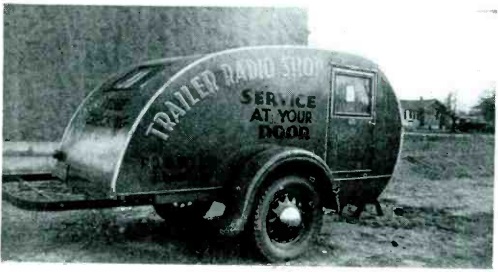
Shown above is the radio service shop of Charles Hurt of Elkhart, Indiana, in 1940, shown here in the August 1940 issue of Service magazine.  He had been in business for a number of years without really making a living, and realized that he had to make some changes. He figured out that to be profitable, he had to make a profit on every single transaction, and he established a bookkeeping system to make sure that happened.

He also realized that there was fierce competition in his area, any one of which were able to press their advantages and force him out of business. The answer was to expand his service area and do it efficiently. Therefore, he purchased the trailer shown here, made it his shop, and adopted the slogan “service at your door.”

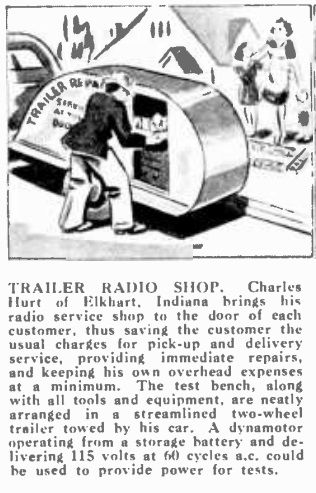
Hurt is also shown in this illustration in the December 1940 issue of National Radio News, which notes that the arrangement was also advantageous to the customer, as they avoided charges for pickup and delivery. This item also reveals that for AC power, the trailer was equipped with a dynamotor and storage battery.


World’s Largest Ball of Paint

366912497_10230975783281863_306859489934306664_nAs John F. Kennedy famously said, we do some things not because they are easy, but because they are hard. We previously documented the hard way to start a library.  And we recently discovered the hard way to decorate a baseball.

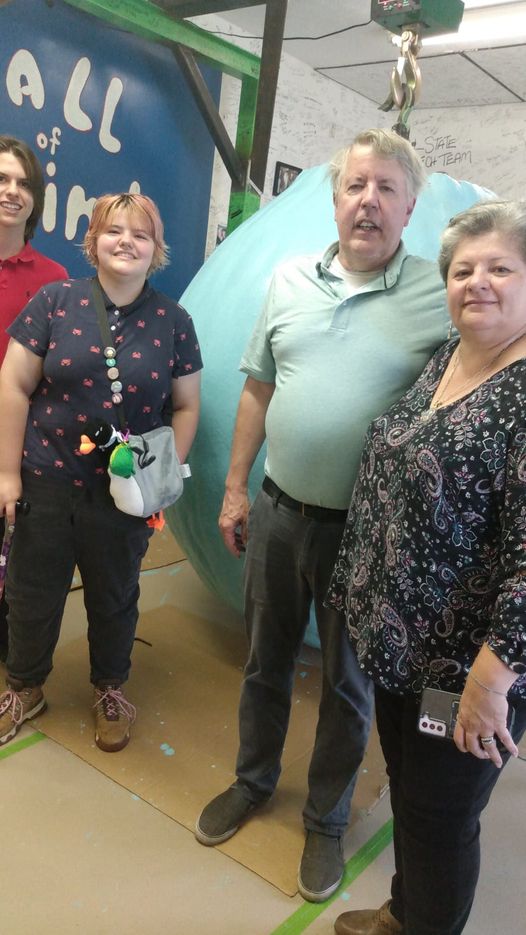
My family recently visited the world’s largest ball of paint, near Anderson, Indiana.  (No, I didn’t coordinate the color of my shirt–that was just a happy coincidence.)  At the core of this massive ball of paint is a baseball, that Mike Carmichael and his family began painting in 1977.  Over the years, over 25,000 layers of paint cover the ball, which now weighs in at over 4,000 pounds, as attested to by the scale from which it now hangs.  As the ball grew, Carmichael constructed a building to house it, and showed us the steel beam frame from which it hangs.

The ball is open to the public, and Carmichael is eager to show it off.  In fact, visitors are often invited to add a coat of paint.  We arrived at a time when the ball was wet from an earlier coat of paint that morning, so we weren’t able to contribute this time.  He suggests that visitors contact him in advance, to ensure an opportunity to paint.  He can be contacted through the ball’s official website.

Carmichael is a veteran and, not surprisingly, a house painter by trade.

Admission is free, although free-will donations are welcome.  It’s open to the public 7 days a week from 9:00 to 5:00.  We became aware of the existence of the ball of paint due to seeing hundreds of smiling sun lawn ornaments on lawns throughout the region.  All of them were created by Carmichael, who explained that he began making them in 2020 during COVID as a way to bring a bit of joy to the community.  They are also for sale.  Of course, we purchased one, which will soon be on display at OneTubeRadio.com world headquarters.


1922 Zenith Ad

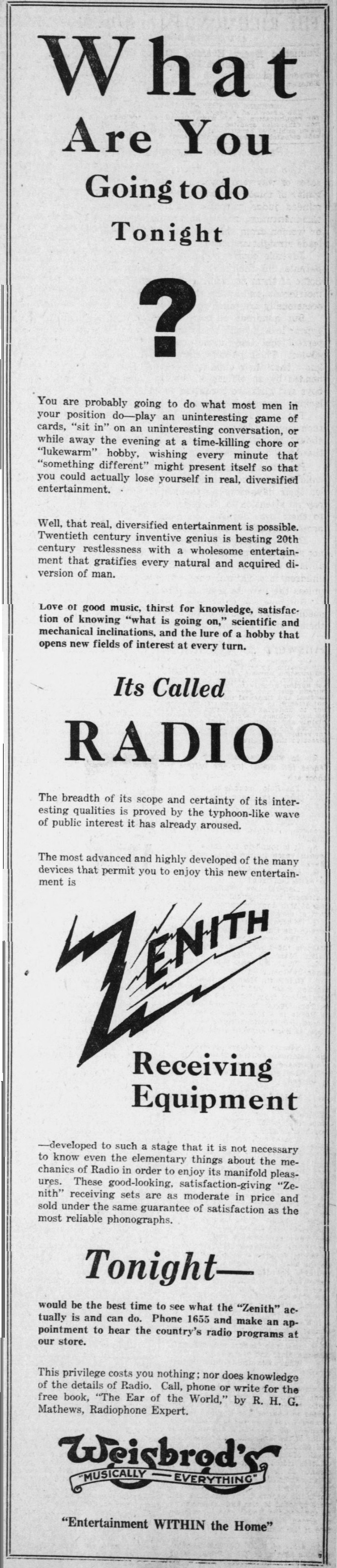
1922Oct26RichmondIndThis Zenith ad ran a hundred years ago today in the October 26, 1922, issue of the Richmond (Ind.) Palladium and Sun-Telegram.  It asks the reader what they’re going to do that night, and speculates that they might play an uninteresting game of cards, sit in an uninteresting conversation, or spend the night in some time-killing chore or lukewarm hobby.

But real, diversified entertainment was at hand, in the form of radio! To find out more, all you had to do was call the Weisbrod’s music store, the town’s Zenith dealer, and set up an appointment to come into the store and see what their sets could pull in.

(Click on the ad to see a full size version.)


Free Radio for Selling Newspapers: 1922

A hundred years ago, if you were a kid in South Bend, Indiana, and you wanted to get in on the excitement of radio, then this deal was for you.

All you had to do was sell twelve new subscriptions to the South Bend News-Times (just 20 cents a week for a minimum of 13 weeks), and you would earn yourself a radio receiving machine, absolutely free. This ad ran in the paper’s June 1, 1922, edition.


Hoosier Radio Company, Indianapolis, 1922

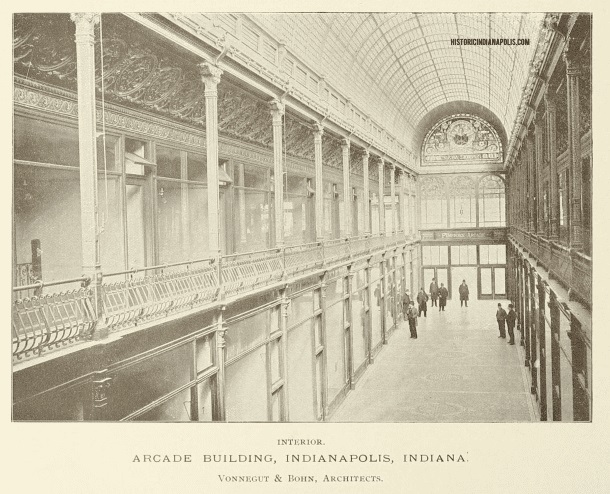
Pembroke Arcade.  Image, historicindianapolis.com.

Pembroke Arcade. Image, historicindianapolis.com.

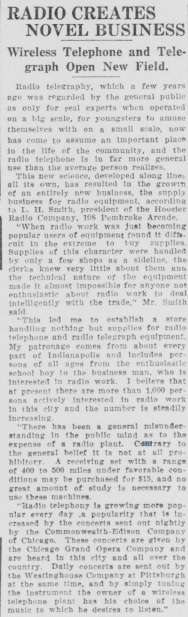
1922Jan9IndianaA hundred years ago today, the January 9, 1922, issue of the Indiana Daily Times carried this feature describing a radio store, Hoosier Radio Company of Indianapolis.
RADIO CREATES NOVEL BUSINESS
Wireless Telephone and Telegraph Open New Field.

Radio telegraphy, which a few years ago was regarded by the general public as only for real experts when operated on a big scale, for youngsters to amuse themselves with on a small scale, now has come to assume an important place in the life of the community, and the radio telephone Is In far more general use than the average person realizes.

This new science, developed along lines all its own, has resulted in the growth of an entirely new business, the supply business for radio equipment, according to L. H. Smith, president of the Hoosier Radio Company, 108 Pembroke Arcade.

“When radio work was Just becoming popular users of equipment found it difficult in the extreme to buy supplies. Supplies of this character were handled by only a few shops as a sideline, the clerks knew very little about them and the technical nature of the equipment made it almost impossible for anyone not enthusiastic about radio work to deal
intelligently with the trade,” Mr. Smith said.

“This led me to establish a store handling nothing but supplies for radio telephone and radio telegraph equipment. My patronage comes from about every part of Indianapolis and Includes persons of all ages from the enthusiastic school boy to the business man, who is interested in radio work. I believe that at present there are more than 1,000 persons actively interested in radio work in this city and the number is steadily Increasing.

“There has been a genera! misunderstanding In the public mind as to the expense of a radio plant. Contrary to the general belief it is not at all prohibitory. A receiving set with a range of 4OO to 500 miles under favorable conditions may be purchased for $15, and no great amount of study is necessary to use these machines.

“Radio telephony is growing more popular every day, a popularity that is increased by the concerts sent out nightly by the Commonwealth-Edison Company of Chicago. These concerts are given by the Chicago Grand Opera Company and are heard in this city and all over the country. Dally concerts are sent out by the Westinghouse Company at Pittsburgh at the same time, and by simply tuning the instrument the owner of a wireless telephone plant has his choice of the music to which he desires to listen.”

The building in which this shop was located, shown above, the Pembroke Arcade, was located in downtown Indianapolis and built in 1895. It was what we would call today a shopping mall–an enclosed building with a large number of stores inside. It was torn down in 1943.


Indiana Schools Get Phonographs: 1921

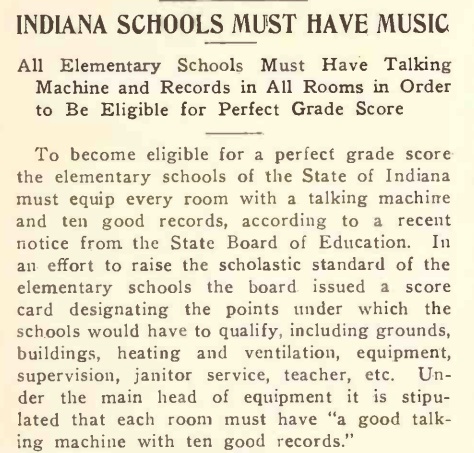
1921DecTalkMachWorldThis item appeared a hundred years ago this month in the December 1921 issue of Talking Machine World.  The Indiana State Board of Education determined that music was an important part of education. Accordingly, in its report card for schools, one criterion for scoring was that each elementary school in the state should equip every room with a talking machine and “ten good records.”

We don’t know for sure, but we’re guessing that this record would qualify as one of those ten good ones. Recorded in 1921, it’s entitled “Popular songs of yesterday” and is a medley of “Hail! Hail! The gang’s all here!” “The bowery,” “Sidewalks of New York,” ” Summertime,” and “Yip! I adde! I aye.”

You can listen by clicking the link below or by visiting the Library of Congress National Jukebox.