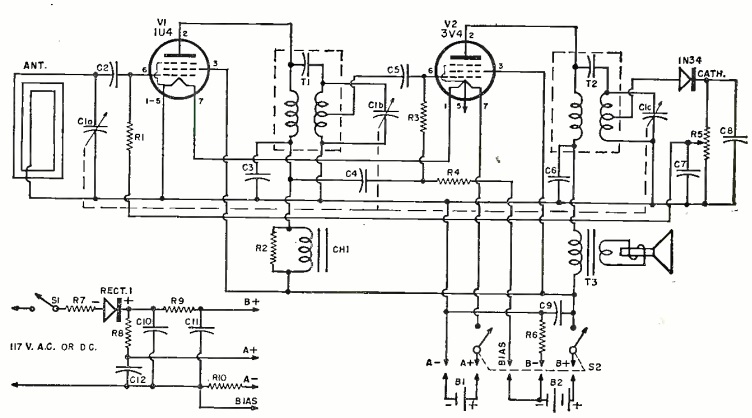
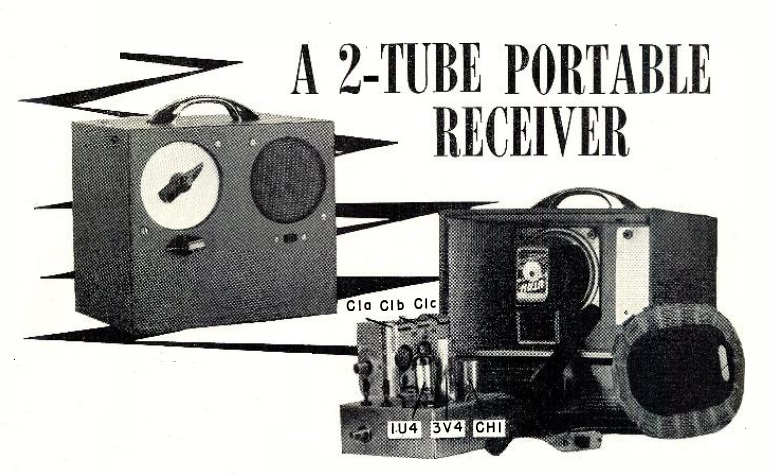
 Seventy-five years ago, the November 1951 issue of Radio News carried the plans for this two-tube portable receiver for the broadcast band. The circuit for an AC power supply is shown (and the author recommends doing the initial alignment with AC power), but the primary design consideration was long battery life. He noted that battery cost could be many dollars per kilowatt hour, and he wanted to limit that cost. Therefore, only two tubes were used, a 1U4 and a 3V4. Despite the spartan nature of the circuit, he was able to pull in Chicago stations a hundred miles away during daylight hours, with only a loop antenna.
Both tubes were reflexed to provide both RF and AF amplification, turning the set into the equivalent of a four-tube model. The detector was a 1N34 diode. Speaker efficiency was deemed to be an utmost concern, and a speaker with a large magnet was used. In fact, the circuit was so efficient that only a single filament in the 3V4 was used.