Category Archives: Radio history

Field Day 1941

19410609MilwSentinel

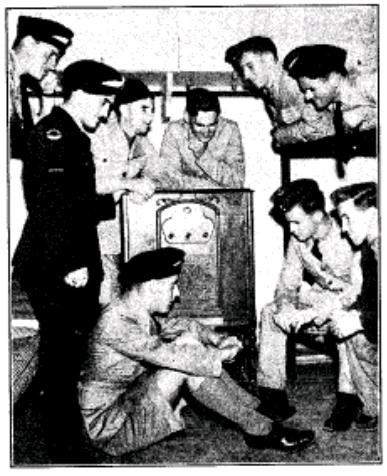
Seventy-five years ago, this day’s issue of the Milwaukee Sentinel, June 9, 1941, carried this report of ARRL Field Day, which had just concluded.

The Milwaukee hams had operated for 26 hours from a location at 43rd Street and West Edgerton Avenue in Milwaukee, a site which “presented a strange mixture of homemade and expensive commercial equipment. Above the tent strewn field a 60 foot all-wave telescopic antenna reached up for messages from the sky.”

The article reported that 291 contacts were made with all nine call areas. The furthest contact was with Puerto Rico. The paper noted that this was a test of emergency communications, and demonstrated how Milwaukee would reach the outside world should catastrophe wipe out power and telephone lines.

This was to be the last pre-war Field Day, with Amateur Radio operation silenced after Pearl Harbor. In 1940, the FCC had severely restricted portable operation, restricting it to weekends, only with self-powered apparatus intended for emergency use. 48 hour advance notice was also required. At the ARRL’s request, the FCC relaxed these requirements in a March 11, 1941 order:

It Is Ordered, That during the period of the American Radio Relay League Field Day test from 4:00 P.M. E.S.T., June 7, 1941, to 6:00 P.M. E.S.T., June 8, 1941, the prohibition contained in Commission Order No. 73 shall not apply to communications transmitted by licensed portable and portable-mobile stations participating in such tests.

The announcement of this order in the May 1941 issue cautioned that the relaxation applied only to stations participating in Field Day.

Results were published in the January 1941 issue of QST, and noted that at least 2180 individuals had participated from 163 club stations and 119 non-club stations.  The Milwaukee group’s showing was overshadowed by the Tri-County Radio Association of Plainfield, NJ, W2GW/2, with 1112 contacts.  That club’s contacts were evenly split between CW and phone.  They had 163 worked on 160 meters, 447 on 80 meters, 245 on 40 meters, 32 on 10 meters, 20 on 5 meters, and 61 on 2-1/2 meters.

Like most Amateur Radio traditions, Field Day resumed after the war.  This year’s running will take place on June 25-26.  The event has continued to grow over the years.  In the 2015 running, the high scorer, Potomic Valley Radio Club and Columbia Amateur Radio Association, W3AO, logged a total of 9700 contacts from 18 transmitters.

Click Here For Today’s Ripley’s Believe It Or Not Cartoon


Loretta Poynton, NBC Radio, 1936

1936LorettaPoynton

Shown here on the cover of Radio Guide, June 6, 1936, is Chicago-based NBC radio actress Loretta Poynton Carroll, who performed under her maiden name. She originally planned for a career in legitimate theater, after her intense activity in school dramatics. However, because her mother was ill, she decided to look for work closer to home, and was hired by NBC. According to Radio Guide, she played the character Ruth Morrow in “Flying Time,” and the daughter in “Don Harding’s Wife.” She was later a regular on “Amos ‘N” Andy.”

She retired from Radio in the 1940’s, and died in 1992 at the age of 77 in Thiensville, Wisconsin, according to her obituary in the Chicago Tribune.

Click Here For Today’s Ripley’s Believe It Or Not Cartoon



1941 “American Ace” (Emerson Model CF-255)

June51941

Seventy-five years ago, this little radio would set you back exactly one dollar (along with an additional $29.95 purchase) at Wadlheim’s furniture store in Milwaukee. This ad appeared in the Milwaukee Journal, June 5, 1941.

It looks like a great bargain, and it probably was being sold below cost, but this radio is about as basic as they get.  While most table radios of the day were four or five tube superhets, this one was actually a two tube TRF receiver.  It would probably pull in the local stations, but even then, an external antenna would probably help it along considerably.  You can see a nice example of this patriotic little set at the Radio Attic, with more discussion at this forum.  As can be seen at those links, the white set has red and blue knobs for the full patriotic effect.

The set is identical to the Emerson model CF-255 “Emersonette” from 1939, and uses a 12B8GT serving as RF amplifier and detector, with a 32L7GT audio amplifier.  The 32L7GT also contains the rectifier.  The filament voltage is courtesy of a curtain burner line cord, in addition to another fixed resistor in series.

Click Here For Today’s Ripley’s Believe It Or Not Cartoon


1916 Portable Transmitter/Receiver

1916JuneElectricalExperimenter

A hundred years ago this month, the June 1916 issue of Electrical Experimenter magazine carried the plans for this portable wireless set. The author noted that now that summer was in sight, the progressive radio amateur was making ready for experiments with portable equipment. However, it noted that too many sets were made of extra or discarded equipment, with disappointing results.

The set shown here promised good results with an antenna of 150-200 feet, 30 feet high on each end. The receiver was a crystal set with no power needed, and the transmitter would provide many hours of service with six internal flashlight batteries of 4.5 volts each, wired in parallel. Provision was made for six external large dry cells in series. With this power source, the set would produce a 1/32 inch spark. A test buzzer for setting the detector was separately powered with a 1.5 volt dry cell.

The author noted that the receiver pulled in NAA in Arlington, Virginia, in New York City, a distance of 275 miles, and that longer distances could be covered. The transmitter was capable of getting out about two miles, or even five or ten if an audion detector was used at the other end.

The total weight of the set, mounted in a suitcase, was about 14 pounds, and the total cost was about $15. The article notes that this cost was low enough to bring it within the reach of every wireless club or Boy Scout troop.

The author of the article was Milton B. Sleeper (1896-1963), who later went on to publish a number of magazines, such as High Fidelity and FM/TV. About the time of this article, Sleeper was working for Lee De Forest, and he later became a close associate of Major Edwin Armstrong.

The full schematic of the set is shown below, although it contains one perplexing omission.

1916JuneElectricalExperimenterSchematic

My first reaction when looking at the schematic of the transmitter was to wonder what made the coil spark, since the primary is connected only to DC, meaning that other than the instant when the key was depressed, there would be no voltage on the secondary.  The article, however, mentions the spark coil’s vibrator, which is not shown in the schematic.  The primary would have an series with it an interrupter, which would rapidly turn the coil on and off, resulting in a square-wave AC current, which would make the transformer work, resulting in a higher voltage on the secondary, sufficient to create a spark.  Since a manufactured spark coil was used, the schematic doesn’t show this detail.

A more complete diagram of a similar transmitter, from a 1920 issue of Electronics World shows the internal wiring of the spark coil:

1920ElectronicsWorld

When the key is pressed, the power from the battery energizes the primary of the spark coil.  In so doing, the magnetic field pulls open the primary vibrator contact, which kills the power to the primary.  With the magnetic field gone, the vibrator contact closes, once again energizing the coil.  The wiring is exactly the same as an electrical bell or buzzer, which operates on the same principle.  This causes the primary of the coil to repeatedly turn on and off, generating a square wave, which induces a larger voltage in the secondary winding, and that voltage is large enough to generate a spark.

Click Here For Today’s Ripley’s Believe It Or Not Cartoon


1956 Vocaline Model JRC-400 CB Transceiver

1956VocalineCover

Sixty years ago, the familiar Class D Citizens Band at 27 MHz was still a couple of years away. Class B Citizens Band on 465 MHz had been authorized for a number of years, but as the June 1956 issue of Popular Electronics  pointed out, the service hadn’t gained traction due to equipment requirements:

Equipment for the Citizens band (radio -telephone) must meet specifications set forth by the Federal Communications Commission. To pass these specifications, the equipment must be examined and ap- proved by the FCC in its laboratories. Because of this cumbersome arrange- ment (although fully justified), the design of Citizens radio equipment has for a number of years taken a back seat. The ice has been broken by the Vocaline Model JRC-400 transceiver, which brings Citizens band communication facilities within the reach of everyone’s pocket. After a manufacturer secures FCC approval, he may then produce identical units on an assembly line basis.

The magazine promised further reviews in upcoming issues, but included some observations about the Vocaline unit, which could operate on either 117 volts AC or 6 volts DC. The magazine’s field test showed 100% reliable ranges of 1.5 miles in a metropolitan area or 3 miles in open areas. Out in the country, weak signals were fully readable up to six miles.

1956VocalineAntennaThe same issue of the magazine carried this ad for the transceiver, showing its retail price of $69.75. The antenna was available separately, and consisted of a quarter-wave ground plane which could be affixed to a vehicle’s roof with large suction cups.

1956VocalineAd

A schematic of the set is available online and reveals that the set used three tubes. A 6AF4 served as superegenerative detector and the oscillator for the transmitter. For audio on both transmit and receive, a 6AV6 and 6AS5 were used. The power supply included a vibrator for DC operation, and included a selenium rectifier.

Click Here For Today’s Ripley’s Believe It Or Not Cartoon


3QF, Merchantville, NJ, 1916

1916MayQST

This drawing of a well equipped amateur station of a century ago appeared in QST, May 1916. It shows the station of J. Donald Haig of Merchantville, N.J.  The sketch, drawn by Mr. Haig, shows the sending set containing Leyden jar condensers, rotary spark gap, and large oscillation transformer.  The receiver is shown to the left.

QST didn’t give Mr. Haig’s call sign, but according to the 1916 call book, the call was 3QF, and the station was located at 118 E. Maple Avenue in Merchantville.


Click Here For Today’s Ripley’s Believe It Or Not Cartoon


1941 Aetna Model 421

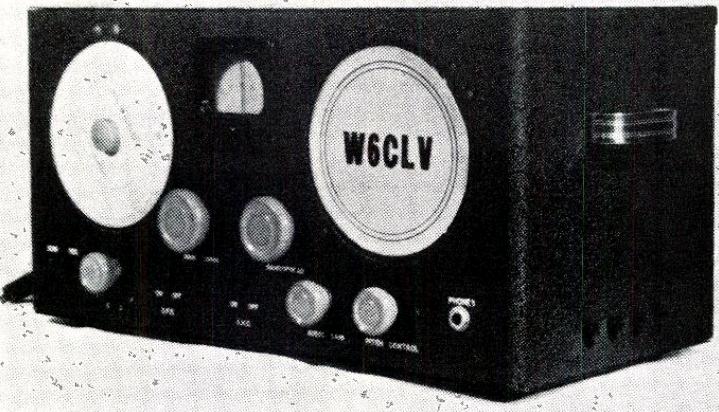
19410528Seventy-five years ago, someone looking for an inexpensive radio could get one of these at Walgreen’s for $5.99. This is a bare-bones four tube superheterodyne sold under the Aetna name, which was Walgreen’s house brand, which could have come from a number of factories in the Chicago area. This ad appeared in the Milwaukee Journal, May 28, 1941.

The set appears to be Aetna model 421.  It tunes up to 1700 kHz, meaning it would tune the newly expanded broadcast band, as well as some police calls.  With the war less than a year away and the end of radio production, this set would probably remain in service for the duration.

Click Here For Today’s Ripley’s Believe It Or Not Cartoon


Lucile Fairbanks and GE Musaphonic Console, 1941

1941LucileFairbanks

In May 1941, the American economy was beginning to boom. Radio Today magazine alerted radio dealers that business indexes were peaking, men were going back to work in increasing numbers, defense jobs were putting money into workers’ pockets. In short, people had money to spend and were earning it.

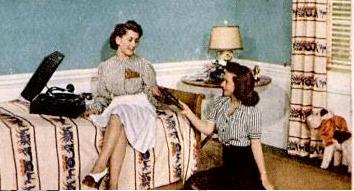
The magazine showed radio dealers how to go after this money. The magazine noted that extra shoppers were coming to town, and one of the radio man’s jobs was to get them next to bigger radios, like actress Lucile Fairbanks with the GE Musaphonic console shown here.

Click Here For Today’s Ripley’s Believe It Or Not Cartoon


1931 Electronic Television

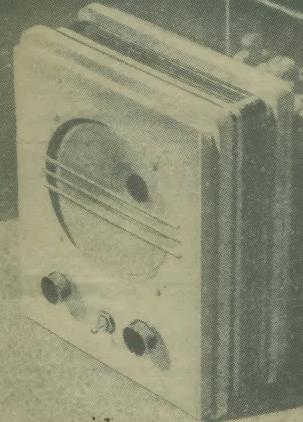
1931ElectronicTVImageShown here is one of the very earliest examples of an image sent by electronic television. It appeared 85 years ago, in the May-June 1931 issue of Television News, in an article by Baron Manfred Von Ardenne, whom the magazine identified as the “famous European televsision expert.”

Von Ardenne noted that the cathode-ray tube had “long been proposed for television reception and has been used in many more or less successful laboratory experiments. In spite of these extremely
advantageous characteristics, television has thus far been obtained only with mechano-optical means.”  He then went on to discuss some of his improvements.

His system involved using a cathode-ray tube as part of the transmitter.  A film was placed between the tube and a photo-electric cell.  Thus, the tube in the camera could be synchronized with the tube in the receiver scanning at the same rate.  Depending on the configuration of the electronics, the resulting image would be either the positive or the negative of the original film.  A diagram of the system used for transmission is shown here:

1931ElectronicTVtransmission

Von Ardenne made the first public demonstration of this system in August 1931 at the Berlin Radio Show. He successfully transmitted pictures in 1933, and his system was used in the German television service starting in 1934. Regular broadcasting began in 1935 and continued throughout the war.

Bundesarchiv Bild 183-K0917-500, Prof. Manfred v. Ardenne.jpg

Von Ardenne in 1930. Wikipedia photo.

After the war, von Ardenne made contacts with the Red Army and found his way to the Soviet Union, where he was made head of Institute A. He was initially asked to participate in the Soviet atomic bomb project, but declines, realizing that his participation would prevent his return to Germany. Instead, he worked on isotope enrichment. His work included development of an electron microscope, for which he was awarded the Stalin Prize. With the prize money of 100,000 rubles, he purchased the land for a private institute in East Germany, where he was allowed to return in 1954. From 1963 to 1989, he served as a member of the Volkskammer, the East German parliament.  At the time of his death in 1997, he held about 600 patents.

Click Here For Today’s Ripley’s Believe It Or Not Cartoon


WOW Omaha Turns 18, 1941

WOW1941Radio station KXSP, Omaha, first came on the air in 1923. The station is probably best known for the WOW call letters that it bore from 1926 to 1999, representing its owner, Woodmen of the World Life Insurance Society. When it first came on the air, those call letters were not available, since they were assigned to the steamer Henry J. Bibble. Instead, the station signed on as WOAW. When that ship was scrapped in 1926, the station took over those call letters.

When the station reached the age of majority eighteen years later, it held a birthday party, and invited six young Omaha women who were born the same day. The six are shown here, and they are, from left to right, Blanche Zaloudek, Roslyn Levy, Jacqueline Giles, Helen Rummelhart, Elaine Kinzli and De Lorse McCarty. They appeared in the May, 1941, issue of the station’s program guide, Radio News Tower.

Seven years later, the young woman on the left had married, and was known as Blanche Howard. Her uncle, J.F. Zaloudek, died in Kansas without a will, and Blanche was one of the heirs. She inherited a portion of some property in Wilson, Kansas. Shortly thereafter, Blanche, along with one of the other heirs, was back in court. It turned out that her uncle had a judgment against his brother, another one of the heirs. She went to court to seek to enforce this judgment, and the case ultimately went to the Kansas Supreme Court. In its opinion in the case, Zaloudek v. Zaloudek, 171 Kan. 72, 229 P.2d 727 (1951), that court held that Blanche and the other heir didn’t have standing to revive the judgment against the brother.

Click Here For Today’s Ripley’s Believe It Or Not Cartoon