Category Archives: Radio history

1936 Battery Merchandising

1936BatteryDisplay

The radio retailer 80 years ago was always looking for a way to add a few more sales, and with summer vacation season underway, one idea was this counter top battery display for the obligatory flashlight.  The display took up only 8-1/2 by 11 inches of counter space, but promised to keep customers shelling out for cells.

The ad, from the Bond Electric Corporation of New Haven, CT, appeared in the July 1936 issue of Radio Retailing magazine.

Click Here For Today’s Ripley’s Believe It Or Not Cartoon

Building an online therapy practice


1936 Tube Data

1936JulyRadioNews

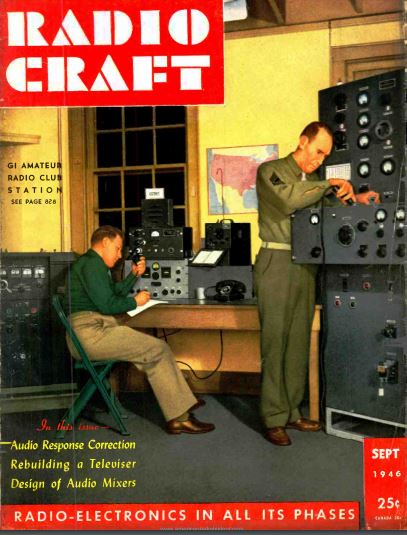
If you’re looking for data on tubes from the mid-1930’s, then the July 1936 issue of Radio News is probably a good place to look, since the issue was devoted to tubes.

However, even if you don’t read it for the articles, you’ll enjoy the cover art, reproduced here.

Click Here For Today’s Ripley’s Believe It Or Not Cartoon



1941 Crystal Sets

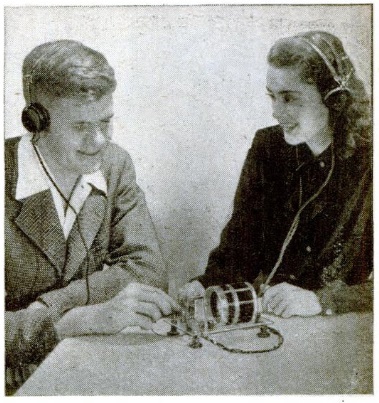
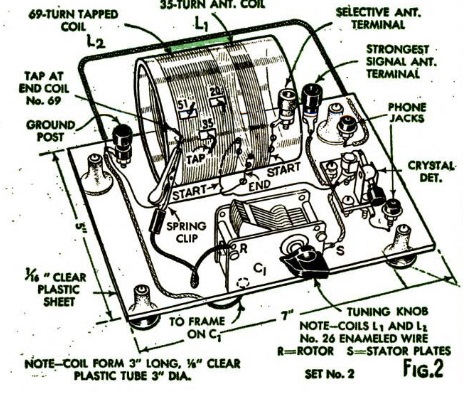
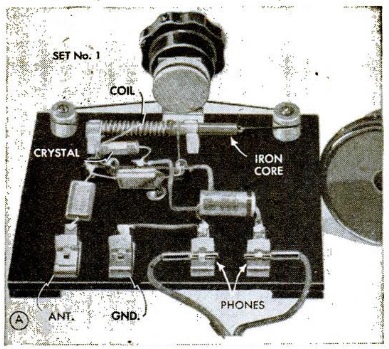
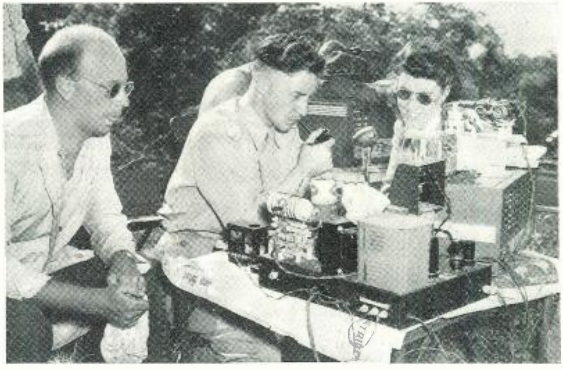
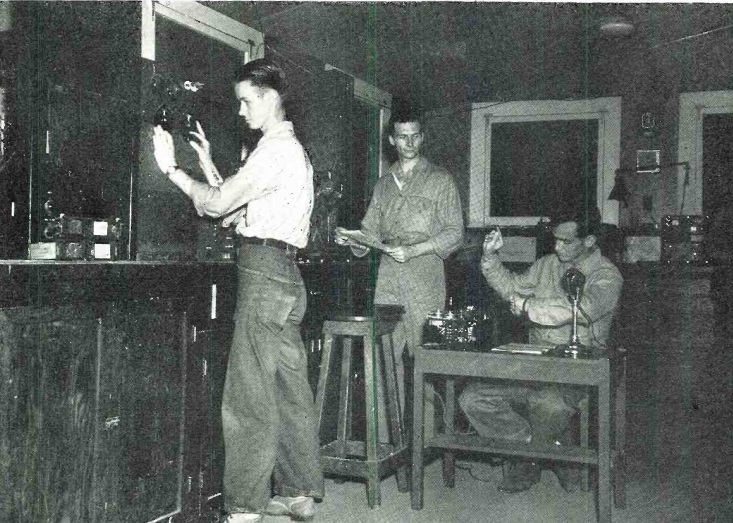
1941JulyPMXtalSetsThe young gentlemen shown here are currently about 85 years old. They are shown in the July 1941 issue of Popular Mechanics demonstrating the operation of two of the seven crystal set circuits in the accompanying article.

The article noted that distant reception was possible under certain favorable and unusual conditions, but a crystal set was normally limited to a range of about ten miles. All of the circuits used a fixed detector. The simplest one was tuned by tapping the coil at various points. More complex circuits used various tricks to coax out as much signal as possible. The article stressed the importance of a long high antenna, and grounding to a cold water pipe.

Click Here For Today’s Ripley’s Believe It Or Not Cartoon


1936 Popular Science Regenerative Receiver

1936JulyPSThe plans for this simple one-tube regenerative shortwave receiver appeared in Popular Science 80 years ago this month, July 1936.

It used a single 6C5 metal triode.  The tube, as well as the other components, are readily available, although the modern components might have a slightly different look.  According to the author, the set’s volume and sensitivity equalled those of more complicated circuits.  From the author’s home in Nebraska, the set pulled in amateur, police, air-mail, and commercial shortwave stations from all around the country with excellent headphone volume.  The author was also able to pull in foreign stations, despite a relatively short antenna and being in the middle of a noisy business district.  The total cost of the parts was about five dollars.

The plans showed coil winding data for plug-in coils for 10 through 160 meters.

1936JulyPSschematic

Click Here For Today’s Ripley’s Believe It Or Not Cartoon


1941 Audio Amp

1941JulyPMAudioAmp

Bill is cheerful about it, but you have to wonder whether he’s questioning his wisdom in building the audio amplifier described 75 years ago this month in the July 1941 issue of Popular Mechanics.

The simple device used a single 117N7GT, a rectifier and beam-power tube, and ran right off AC power. The article described four uses for the little amp. First, it could be used to provide loudspeaker volume from a crystal set or one-tube radio. It could even be used as a B-battery eliminator for a set (although the article cautioned that if used in this way, the radio could not be directly grounded). Third, it could be used as a phonograph amplifier with a crystal pickup.

The fourth proposed use is how Bill wound up using his. With a micropone, “it becomes a serviceable low power public address unit. The speaker unit may be connected to long cabled leads between counter room and kitchen in small cafes and sandwich shops, or (as Bill wound up doing) between the basement and other rooms in the home.”

Bill undoubtedly reasoned that this would be the most convenient use for his amplifier.  But perhaps he’s having second thoughts.  He’s in the basement trying to fix a fan when the summons comes over the horn:  “Hi!  Bill bring up the screwdriver.”

Bill seems like a cheerful sort, and it looks like fixing the fan will have to wait.  But as he brings up the screwdriver, I wonder whether he’s thinking that he should have made himself a phonograph.

1941JulyPMAudioAmpSchematic

Click Here For Today’s Ripley’s Believe It Or Not Cartoon


1926 Frequency Allocations

1926Allocations

Here are what the U.S. frequency allocation chart looked like ninety years ago, as shown in the July 1926 issue of Radio Broadcast magazine.
These allocations had been adopted at the Fourth National Radio Conference, and differed only slighly from those adopted at the earlier conference.

As you can see, some of these allocations are familiar. Marine uses were between 235 and 500 kHz, with the calling and distress frequency set at 500 kHz. The broadcast band was set at 550-1500 kHz, with no allocations yet set for shortwave broadcasting.

Hams had an exclusive allocation on 160 meters, which extended from 1500-2000 kHz (the lower frequency edge of which was 200 meters, reflecting that hams had been relegated to “200 meters and down” after the war).

Hams also had non-exclusive allocations on 80 meters (3500-4000 kHz, the same as today), 40 meters (a generous 7000-8000 kHz), and 20 meters (an even more generous 14000-16000 kHz).

The ten meter band had not yet been allocated to hams, with the entire range of 18.1-56 MHz designated merely as “experimental.” Hams had not yet been assigned an allocation at 2-1/2 meters, but the 5 meter band was set at 56-64 MHz.

The highest allocation was that to amateurs at 400-401 MHz.

Click Here For Today’s Ripley’s Believe It Or Not Cartoon


Benny’s Radio Shop, 1941

1941JuneNRI

Seventy-five years ago, entrepreneur and radio student Benny McGehee had this sign up in front of his shop at 411 Arcadia Avenue, Arcadia, Florida. This photo appeared on the cover of the June-July 1941 issue of National Radio News, the magazine put out for students and alumni of the National Radio Institute (NRI), whose ubiquitous ads for home study in radio appeared in magazines for decades.

1941JuneNRI2McGehee, who billed himself as the “chief keeper-upper of your radio,” was one of NRI’s students. Prior to enrolling in the home study course, he had worked as a traveling salesman and was away from home four days a week. The radio shop was still a part-time enterprise, as he was employed in an office as he built up his radio business.

According to McGehee, his sole regret was that he didn’t enroll with NRI ten or twelve years earlier when he started seeing the ads. “I read those advertisements for ten years before I acted. I could have been really independent now, and I am only thirty-four. Yet, I hope to succeed even though I waited a long time to start.”

The magazine complimented McGehee on the quality of his sign, and noted that McGehee had consulted a professional sign painter, and carried the same design over into his letterhead and other printed matter, “giving his advertising distinction and dignity.”

Click Here For Today’s Ripley’s Believe It Or Not Cartoon


“America Asks, Germany Answers,” 1941

19410628RadioGuide

Seventy-five years ago, while it was clearly gearing up for war, the United States was still neutral, and the Nazis wanted to keep it that way. this date’s issue of Radio Guide, June 28, 1941, carried an interesting look at one of the propaganda programs being broadcast to North America by Berlin stations DJB and DJD on 11.77 and 15.20 MHz. The program was “America Asks, Germany Answers.”

Bundesarchiv Bild 183-1989-0821-502, Joseph Goebbels.jpg

Goebbels. Wikipedia photo.

As early as 1933, Propaganda Minister Paul Josef Goebbels had set up a North American Service of the German Radio, staffed largely by expatriate American “foreign correspondents.” In February 1941, the station requested American listeners to forward reception reports and questions about Germany by means of collect telegrams of up to 25 words. By the end of February, over 10,000 telegrams had been received, despite criticism in the American press and deliberate attempts to clog the German end of the circuit. In March, the “America Asks, Germany Answers” program was on the air to answer these questions.

Among the American reporters was Frederick W. Kaltenbach (1895-1945), who had formerly been an Iowa teacher. In 1935, while teaching in Dubuque, he had started the “Militant Order of Spartan Knights,” a club for boys based on the Hitler Youth. Concerned parents saw to it that his teaching contract was terminated, and he left for Germany. He worked as a freelance writer and translator until landing his radio job in 1940. Many of his broadcasts began with “Greetings to my old friend, Harry in Iowa.” He was indicted for treason in 1943, but was arrested by Soviet troops and died in a detention camp in October 1945.

The “America Asks, Germany Answers” program was read by two announcers, “Democ” and “Nazi.” Democ would pose questions from American listeners, and Nazi would provide the answers.

According to the Radio Guide editor, the cost of these telegrams (about $10,000) amounted to “the cheapest imaginable form of advertising for the station, since the whole proposition was widely publicized in the American press and thousands of listeners who were only dimly aware of even the existence of a German short-wave station found themselves listening to it nightly, at first to see if their cables would be answered over the air, subsequently because, once the habit of listening to a certain program is formed, it is not easily discarded. Thus by a clever artifice the German short-wave station gained thousands of new listeners not only to the comparitively innocent program, “America Asks, Germany Answers,” but to the more deadly blasts from Goebbels’ master propagandists in their nightly bombardments on the democratic way of life.”

The magazine did note that a certain number of questions were sympathetic to the Nazi cause, and “quite likely, the names and addresses of these pro-Nazis were promptly garnered by the secret police, who in turn passed them along to the American Nazi organization for investigation so that eventually the fifth column in this country will receive additional recruits.”

However, as might be expected, most questioners were anything but sympathetic, but Democ and Nazi were still eager to tackle them, often by dismissing them with humor.

For example, one Harry Hoffman of Brooklyn asked in his cable, “how do you like your diet of horse meat and dog meat in Berlin these days?” Nazi answered, “my dear Hoffman, we like our diet just fine. It’s excellent. In fact, it’s good. Since we can no longer get giraffe tails or nightingale tongues, we must now be content with veal cutlets, lamb chops or T-bone steaks.” He then added sarcastically, “I suppose you also believe German tanks are made of paper.”

A more serious reply came in response to the question of one Mr. Fletcher of New York who asked about German plans for expansion in the western hemisphere.” Nazi replied that “Germany has NO plans whatsoever against any part of South, Central, or North America. Our campaign is directed solely against England.”

The only question which provoked some showing of anger was that of one Mr. Lehe of New York who opined that “neither England nor Germany but America will win the war.” To this, Mr. Nazi bitterly replied, “this is England’s war, not yours. It’s absolutely none of your business and America should keep its nose out of the affairs that do not concern it in the least.”

References

Read More at Amazon


Click Here For Today’s Ripley’s Believe It Or Not Cartoon


1941 One-Tube Shortwave “Push-Pull” Receiver

1941JunePSswSeventy-five years ago this month, the June 1941 issue of Popular Science carried the plans for this simple one-tube receiver suitable for long wave, medium wave, or short wave.

The set used a 1E7G dual pentode tube, used as a push-pull detector.  The design called for two plug-in coils for each band.  In fact, as can be seen from the schematic, the entire circuit is basically doubled.

1941JunePSswSchematic


Click Here For Today’s Ripley’s Believe It Or Not Cartoon


TV Pioneer Eleanor Thomas, W9XBY/W9XAL, Kansas City, 1936

1936JuneModernMechanEighty years ago, this month’s issue of Modern Mechanix, June 1936, featured eighteen-year-old Eleanor Thomas, the assistant engineer of stations W9XBY and W9XAL, Kansas City, Missouri. Billed as a “mathematical genius for a girl,” Miss Thomas reportedly found life on a college campus too prosaic, and instead entered an engineering school, namely the training division of First National Television, Inc.

First National Television was the licensee of the two stations. According to its 1934 QSL card, W9XBY was one of four “high fidelity” stations operating in the United States, just above the top end of the standard broadcast band, which then extended to 1500 kHz, at 1530 kHz. The 1000 watt station operated from the 29th floor of the Power and Light Building, and had its transmitter near 86th and Wornall Road.

W9XBY operated as the voice channel for television station W9XAL, one of the first television stations to operate on the VHF band, licensed to operate on 42-56 MHz. While the station was initially a mechanical television station, it had both electronic and mechanical equipment in 1936. By 1939, it was all electronic.

The article noted that Miss Thomas was the “youngest member of her sex ever to pass the difficult examinations for a first class operator’s license from the Federal Communications Commission.

More information about the station can be found in the July 1991 issue of Popular Communications.

Click Here For Today’s Ripley’s Believe It Or Not Cartoon