For the 1920’s radio dealer, an important way to get potential buyers in the door was the window display. And Thanksgiving was a tried and true theme for that display. This 1928 store window featured a cutout turkey listening to the radio.
The photo appeared in the April 1928 issue of Radio Retailing.
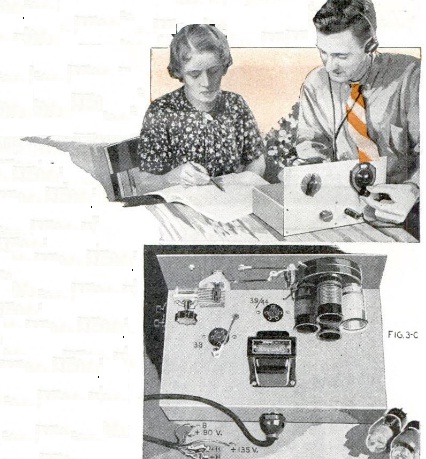
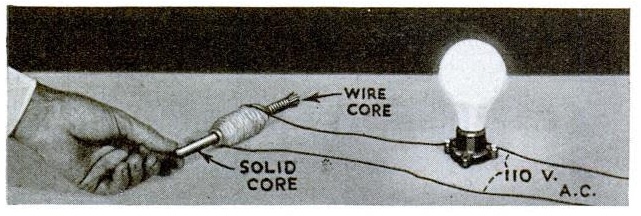
Fifty years ago, the “Beginner’s Corner” of the November 1966 issue of Electronics Illustrated carried three circuits for basic radio receivers. The first was the crystal set, the second added one stage of audio amplification, and the third was this basic regenerative set.
The tuner was a ferrite loopstick coil, which were available in abundance for experimenters to use in similar circuits. It used permeability tuning by moving the ferrite core in and out. The tickler coil was added on as a winding around the outside.
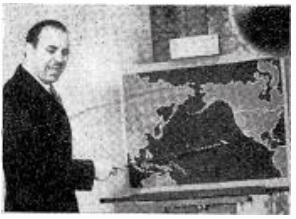
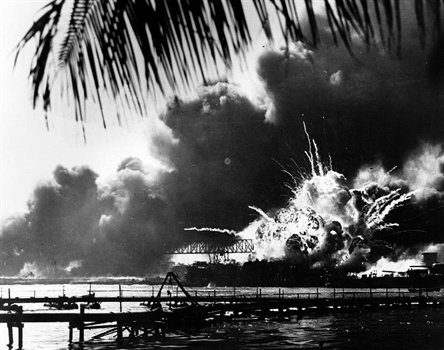
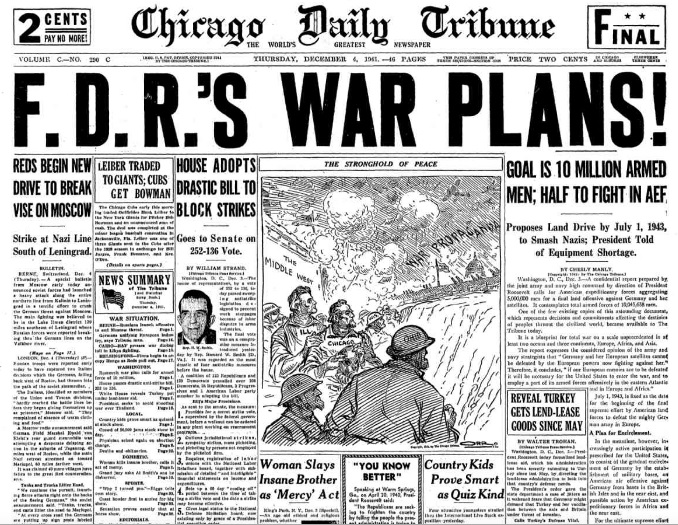
Seventy-five years ago today, only two weeks before Pearl Harbor, the Pittsburgh Post-Gazette for November 22, 1941, posed the question of whether America could be bombed, and included contradictory answers: Yes, an air raid was possible, but a Coventry-style attack on the Continental United States would be impossible, as long as America or a friendly navy controlled the Atlantic.
The article didn’t mention the Hawaiian or Philippine Islands which would be so obviously in the news in a fortnight. However, it did look at the Pacific situation on the continent. From Japan, air raids could possibly be made against Alaska. If Siberia fell into enemy hands, then most Alaskan bases could be raided at will.
The focus of the article was a traveling exhibit put together by the Science Museum of Minnesota. After being displayed in Minnesota, the exhibit was on tour, and was making its first stop in Pittsburgh.
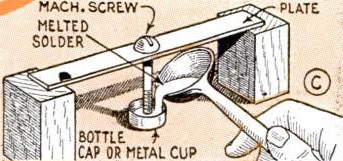
This simple idea for a code practice oscillator appeared in the January 1944 issue of Radio Craft magazine.
No doubt inspired by wartime parts shortages, the audio feedback loop could be created with an old telephone receiver and microphone placed next to each other. The idea was sent in to the magazine by one Mr. Ivan H. Walker of Mt. Horeb, Wisconsin.
Seventy-five years ago this month, the November 1941 issue of Boys’ Life carried this image of a New York television broadcast featuring scouts from Troop 1, Mendham, N.J. While not identified in the magazine, the gentleman in the center appears to be Troop 1’s Scoutmaster, William “Green Bar Bill” Hillcourt, the prolific writer whose works included three editions of the Scout Handbook.
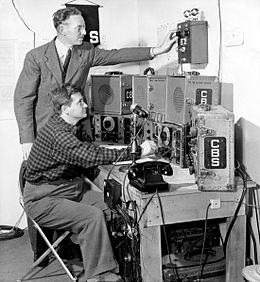
From the CBS logos on the camera, the broadcast was from WCBW, which later became WCBS-TV. It is the nation’s second oldest commercial station, having gone on the air only an hour after rival WNBT, leter WNBC.
Both stations began commercial broadcasting on July 1, 1941, the first day that the stations then operating under experimental licenses were allowed to operate under commercial licenses.
Troop 1 was founded by the Danish-born Hillcourt in 1935, and chartered by the National Council of the BSA. He was asked to develop scouting in America, and he used Troop 1 to test his ideas. The twelve candles shown in the picture undoubtedly represent the twelve points of the Scout Law.
This advertisement for Eveready batteries appeared 75 years ago this month in the November 1936 issue of Popular Science. I had never heard of the Zamzam, but her last voyage is a fascinating but forgotten story of the Second World War.
I haven’t found any independent verification of the claim in the ad, that the Captain used Eveready batteries to avert disaster. But whether or not he did, it’s a compelling story.
The Zamzam set sail from New York in the Spring of 1941 under the Egyptian flag, bound for Egypt by way of South America and South Aftica. Built in 1909, she originally bore the name Leicestershire and flew the British flag. She first served as a passenger ship to India, and during the First World War, she served as a troop carrier, carrying troops to Russia and repatriating Australian troops after the war. After the war, she was modernized to burn oil rather than coal, and resumed passenger service to Rangoon until 1930.
In that year, she was sold to the British National Exhibition Ship Company Ltd., and was renamed the British Exhibitor, where she was to serve as a floating expedition showcasing goods throughout the Empire. When that company went into liquidation, the ship was purchased by the Egyptians, where she transported 600 pilgrims at a time from Suez to Mecca for the next eight years.
With the outbreak of war, the Zamzam was pressed into service carrying passengers between Egypt and New York. The first trip to New York was apparently uneventful, but her last voyage was the return trip.
The ship left Hoboken, New Jersey, on March 20, 1941, with 201 passengers aboard. To avoid war zones, the neutral ship would sail to Trinidad, thence to Recife, Brazil, across the Atlantic to Capetown, South Africa, and then up the east coast of Africa to Mombasa, Kenya, and then to Alexandria, Egypt.
The largest contingent of passengers consisted of 144 missionaries, representing both Catholic and Protestant denominations. Interestingly, the contingent of missionaries from the Augustana Lutheran Church were on their way to Tanzania, where they were to replace German Lutheran missionaries interned by the British.
The passengers also included a group of ambulance drivers from the British-American Ambulance Company, en route to North Africa to serve as ambulance drivers for British forces. There were also a group of American tobacco buyers en route to Rhodesia. Most passengers were American, but there were a large number of Canadians. The missionaries in particular included many women and children among their numbers.
Joining the passengers in Brazil were Life magazine photographer David E. Scherman and Fortune magazine editor Charles J.V. Murphy, who documented the later sinking.
A few days after leaving New York, the passengers were startled when the crew began painting over the portals and announcing that the ship would be travelling in strict blackout conditions. This prompted considerable protest by the passengers, who had believed that they would be traveling openly under the protection of a neutral flag. The captain, a British officer, insisted that he was acting under orders of the Admiralty, to the great consternation of passengers. The ship traveled under strict blackout, and no light, not even a lit cigarette, was permitted on deck.
During the early morning hours of April 17, the German raider Atlantis (also known as the Tamesis), a reflagged Norwegian freighter, attacked. The passengers donned life jackets and boarded lifeboats and the ship sunk. Since some of the lifeboats had been damaged, a number of passengers were forced to float in the water.
Just as the raider hoisted its Nazi flag and its crew were stationed at machine guns, a rainbow appeared in the morning sky. Eventually, the survivors signaled (presumably with the captain’s Eveready flashlight) that the ship was neutral. The German ship took the survivors aboard, and the captain discovered to his dismay that many of the passengers were Americans.
By all accounts, the captain, Bernhard Rogge, treated the prisoners humanely, and they were transferred a few days later to another ship which eventually transported them to occupied France. The Americans were repatriated fairly rapidly through Spain and Portugal, but the Canadians were interned.
The Catholic missionaries were American born, but were traveling under Canadian passports to expedite entry into South Africa. In retrospect, the decision was undoubtedly regretted, since they were interned with the other Canadians. This turned out to be a fortunate circumstance for the Germans, since the Geneva Convention required them to provide chaplains for POW’s, a role which these prisoners took on.
Eventually, seven of the Canadian women were to be exchanged for German women being held in Canada. At some point, they were placed on a train to Berlin. Unfortunately, nobody had bothered to tell Berlin that they were coming, and they were left to their own devices in the enemy capital. They made contact with American journalists and diplomats, and were eventually returned to Canada.
During their stay, however, they were forced to obtain food in the local economy along with the Germans. One butcher, recalling his humane treatment by the allies as a prisoner in the previous war, greeted them in English each time they entered his shop, and allowed them to the front of the line, somewhat to their embarrassment.
This video, prepared by one of the predecessors of the Evangelical Lutheran Church in America, is a fascinating look at the bizarre odyssey of these missionaries.
In this ad from the November 1946 issue of Sponsor magazine, WLS Radio in Chicago reminds its potential advertisers that it is the radio home of tomorrow’s friendly audience.
In July of that year, 2000 boys and girls from every county in Indiana were in the studio audience of the WLS Dinner Bell Time broadcast, “a program familiar in their homes from babyhood.” They were attending the annual 4-H Round-Up being held on the campus of Purdue University.
WLS presented the plaques for outstanding 4-H achievement, all broadcast live over the station’s 50,000 watt Chicago blowtorch. People in Illinois, Indiana, Michigan, and Wisconsin considered the station “one of the family,” and its complete weather, market reports, news, and down-to-earth entertainment expemplified the quiet neighborly way that WLS served both today’s and the future’s friendly audience.
This ad appeared in Life Magazine 75 years ago today, November 17. 1941. Victor Record recording artist Rose Bampton is listening to records on the RCA Victrola Model V-215 radio-phonograph console. The nine-tube set provided 12 watts to the 12 inch speaker. In addition to the standard broadcast band, it tuned two shortwave bands, 2.3-6 MHz and 9.3-15 MHz. You can view a nicely preserved example of the set at this link. The set had an original retail price of $214.95.
As the ad points out, the set features the “Magic Brain” automatic changer, and points out that the Magic Brain does all the work–you just sit back and listen. It also points out that the changer has “no needles,” meaning that it had a sapphire stylus and ceramic cartridge rather than “old-fashioned needles,” and that the total weight of all moving parts on the tone arm was “less than the weight of a postage stamp.”
Mezzo-soprano Rose Bampton performed with the Metropolitan Opera from 1932-1950. She died in 2007 at the age of 99.
This ad for a 5-tube supereheterodyne broadcast radio appeared 75 years ago today in the November 16, 1941, issue of the Pittsburgh Press.
The set sold for $14.95 (complete, no extras), or could be bought on time for a quarter down and fifty cents a week.
The set appears to be model 330, which can be seen at the Radio Attic Archives. It was a standard “All American Five,” with a tube lineup of 12SA7GT, 12SK7GT, 12SQ7GT, 50L6GT, and 35Z5GT. A schematic and more photos are available at the Radio Museum. While the set’s tuning range didn’t extend much above the broadcast band, it was billed as easily receiving police calls, as well as distant stations.
Ninety years ago this month, the November 1926 issue of Popular Science showed how to assemble this crystal set for the radio beginner, and offered a number of possible variations depending on the listener’s location and available stations.
The article noted that millions of Americans lived within five miles of powerful stations, but a surprisingly large number had not yet taken an interest in radio. But this simple receiver was billed as a mighty good way to get started, and predicted that many builders would eventually decide to upgrade and build a vacuum tube set. Parts selection kept in mind that many of the components, such as the variable condenser, could be used in the new set.
The author remarked that he had a friend who had a good five-tube set, but kept the old crystal set around for times when he wanted to listen to the radio alone. The headphones masked outside sounds, and he didn’t have to worry about wear and tear on his tubes.
The article suggested modifications of the antenna coil depending on the location and number of stations. It gave instructions on tuning. While moving the dial, you would adjust the crystal for the first hint of sound. When that was found, you would tune the dial for maximum sound, and then adjust the crystal for maximum volume. The crystal position could usually stay put for weeks. To prevent vibrations, the author suggested placing the set on a piece of cloth.