Author Archives: clem.law@usa.net

Dutch Reagan, WHO 1936

1936nov14radioguide

Eighty years ago today, the November 14, 1936 issue of Radio Guide carried a profile of the man who would, 44 years later, be elected President of the United States, Dutch Reagan.

As recounted by the magazine, Ronald Reagan walked into WOC radio in Davenport, Iowa, in 1932, looking for a job. The station was at the time synchronized with WHO Des Moines. The program director, Peter MacArthur, asked if he knew anything about football. When Reagan answered in the affirmative, MacArthur told him to stand by a microphone and imagine that he was at a game. The program director listened amazed for fifteen minutes before telling Reagan, “you’re broadcasting the Iowa-Minnesota game!”

When WOC and WHO split in 1932, Reagan went with WHO, where he broadcast the Chicago games by telegraphic report.

The article describes the future president:

He is over six feet tall with the pro- verbial Greek -god physique: broad – shouldered, slim-waisted and a face that would make Venus look twice before running to her man Zeus! And then he can talk, too.  Dutch has a smooth -running “gift o’ gab” which never seems to falter, never is at loss for the right word. In short, he has quick wit and a nimble vocabulary, and large, too.

It noted that during his days at Eureka College, where he lettered in several sports, he never allowed anyone to call him Ronald, even though it was his name.  The magazine also seemed to think that the young announcer had a future:

But there are new things beckoning. One is a career with the networks.
Like any ambitious announcer, Dutch, who never uses quotation marks about his name, has high hopes toward becoming the Husing or the McNamee of the airwaves, 1937 style. Watch him; he’s stream-lined. He might do it.


WGEA and WGEO, Schenectady, NY, 1941

1941wgea

Shown here as it appeared 75 years ago is a view of 100 kW shortwave stations WGEA and WGEO, the General Electric station at Schenectady, New York.  The picture appears in the November 1941 of FM Magazine, along with an extensive look at the technical details of the stations, as well as those of GE’s sister station in San Francisco, KGEI (about which we wrote earlier).

The station had its start in 1925 with an experimental license under the call sign W2XAD. When the FCC deemed shortwave broadcasting to be sufficiently developed for commercial service in 1939, the station went on the air commercially.

GE received over 30,000 pieces of mail per year, and prepared its programs based on listener preferences. In addition to English, the stations had regular programs in Spanish, Portuguese, French, Dutch, Czech, and Chinese.

Frequencies used at the time were 6190, 9530, 9550, 9670, 15330, and 21590 kHz. Directional antennas beamed programs from Schenectady to Central America, Brazil, Europe, Argentina, and North Africa, and from San Francisco to South America and Asia.


Philco Model 1013, 1941

1941novradioretailing3

Seventy-five years ago this month, Radio Retailing magazine, November 1941, carried this ad showing the Phiclo model 1013 (42-1013) radio phono console. The set retailed for $230 in mahogany or $225 in walnut. In addition to the automatic phonograph, the set covered the broadcast band, the prewar FM band, and 9-15.5 MHz shortwave.

This ad reminded retailers that there would be considerable advertising support for the set during the Christmas season, including a window display and special rotogravature ads.

3986 were manufactured in walnut, 1755 in mahogany.  You can see a nice example of the set at this site, and a video of a nicely restored model can be seen playing here:


Armistice Day: America’s Obligation and Opportunity To Serve Stricken Humanity

free-vector-poppy-remembrance-day-clip-art_106032_Poppy_Remembrance_Day_clip_art_smallNinety-eight years ago today, the First World War ended with the signing of the Armistice, with hostilities to cease at 11:00 AM, November 11, 1918.

The next day’s newspaper carried the plea of Food Administrator Herbert Hoover with respect to America’s duty: “The nation’s obligation and opportunity to serve stricken humanity in war-torn Europe by helping to provide sustenance until the next harvest will demand further sacrifices of the American people.” He pointed out that North America would need to furnish 60% of the world’s supply of food, and to forestall starvation, would need to export 20 million tons, as compared with the prewar normal of 5 million.

“The group of gamblers in human life who have done this thing are now in cowardly flight, leaving anarchy and famine to millions of helpless people.”


Canada Carries On: 1941

1941nov10bc

Seventy-five years ago, the United States was less than a month away from entering the war, but Canada had been at war with Germany since 1939.  In this ad from this date’s issue of Broadcasting magazine, November 10, 1941, the Canadian Broadcasting Corporation reminded potential American advertisers that Canada was carrying on.  Despite wartime conditions, industry was at capacity, new factories were coming online, employment was at a peak, and most important for advertisers, retail sales were showing gains.

The CBC was serving wartime duties, and it reminded advertisers that it provided complete broadcast services to reach the Canadian market.


1916 Spark Coil

1916novelectexp

One thing that sometimes mystifying when looking at diagrams of early spark transmitters is that the descriptions often lack much detail as to the most important component, the induction coil or spark coil. A good description can be found in Electrical Experimenter magazine, November, 1916, from which this illustration is taken.

The “coil” is really two coils, plus an interrupter, and the operation is described here:

When the primary switch of such a coil is closed, the battery current passes through the first winding on the core and magnetizes it. This attracts the iron armature on the vibrator spring, as shown in Fig. 1, and when this spring breaks contact with the platinum tipped screw in front of it, the circuit is opened. At this juncture there is induced in the secondary winding a very powerful current. The spring-actuated vibrator returns to its former position in the fraction of a second and the process is repeated all over again.

The referenced schematic diagram is shown here:

1916novelectexp2


Battle of Moscow, 1941

7 November 1941 parade in Red Square, 1949 painting by Konstantin Yuon via Wikipedia.

Seventy-five years ago today, the Battle of Moscow was underway, with Nazi troops at the gates of the Soviet capital.

To boost morale and stiffen the Red Army’s resolve, Stalin ordered the traditional Revolution Day parade to take place as it traditionally did in Red Square. But this time, after the troops paraded past the Kremlin, the continued marching directly to the front.

The event is heroically depicted in the 1949 painting by Konstantin Yuon shown above.  Film of the event can be seen here:

As the soldiers paraded to the front, Stalin charged them:

Comrades, men of the Red Army and Red Navy, commanders and political instructors, men and women guerillas, the whole world is looking to you as the force capable of destroying the plundering hordes of German invaders. The enslaved peoples of Europe who have fallen under the yoke of the German invaders look to you as their liberators. A great liberating mission has fallen to your lot. Be worthy of this mission! The war you are waging is a war of liberation, a just war. Let the manly images of our great ancestors inspire you in this war! May the victorious banner of the great Lenin be your lodestar!

For the complete destruction of the German invaders!

Death to the German invaders!

Long live our glorious Motherland, her liberty and her independence!

Under the banner of Lenin, forward to victory!


Radio Bargain House, Birmingham, AL, 1941

1941novradioretailing1

Seventy five years ago this month, Pearl Harbor was still a month away, and the end of civilian radio production was still five months away. But radio retailers were starting to feel shortages, since many parts were in short supply due to wartime material priorities, and in some cases, the numbers of new sets available didn’t meet demand.

This led many retailers to take a closer look at selling used sets. Trade-ins were often viewed as a headache, and little effort was made to realize a profit from them. But the wartime economy made many retailers consider selling used radios. The November 1941 issue of Radio Retailing carried advice from the experience of M.M. Law, the proprietor of Radio Bargain House of Birmingham.  Law got into the radio business by accident when running a hotel.  A hotel guest turned a radio over to him for sale, and he placed a classified ad in the paper.  He received fifteen calls in response to the ad.  When he eventually lost the lease on the hotel, he decided to get into the radio business.

1941novradioretailing2Law typically made a net profit of about $2 on each set.  He often bought in bulk from other dealers looking to unload their trade-ins, sometimes as low as $1 per set.  He typically invested about $3 fixing up each set, and quickly sold many for $6.95.  He estimated that his average sale was between $12 and $15.

He continued advertising in the classified ads, since his experience was that this was where bargain shoppers looked.  He always kept a set outside his shop, marked “today’s special,” and reported that he would often sell this set, with the buyer not bothering to look for others.  In other cases, however, the set outside would entice a buyer to come in the store to buy a better set on the floor.


1936 Two Tube AC-DC Regen

1936novradiocraft

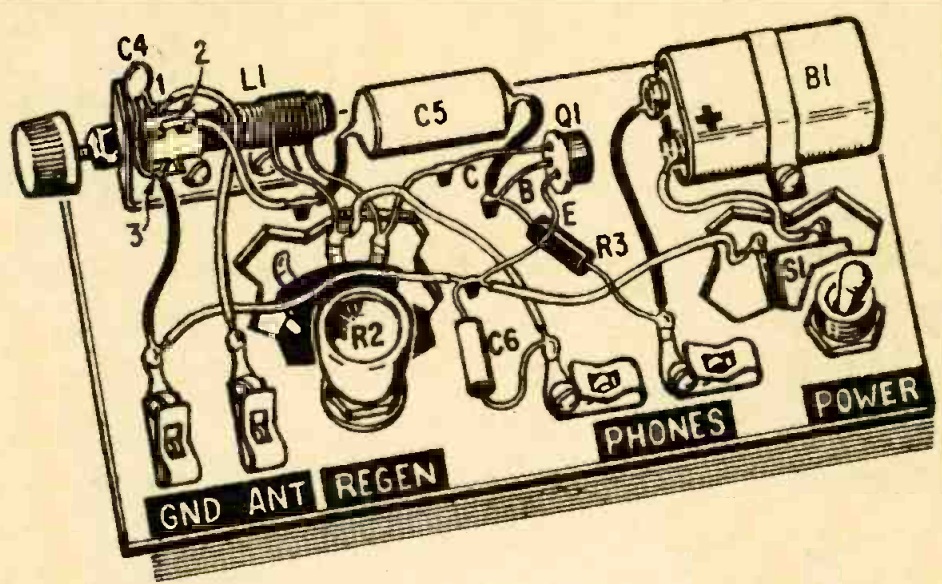
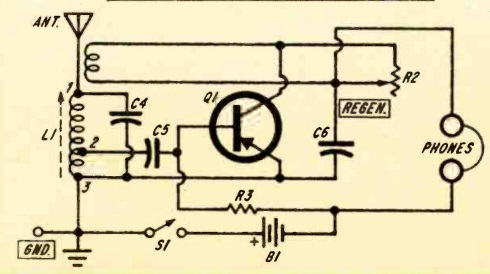
The plans for this simple two-tube set appeared eighty years ago this month in Radio Craft magazine, November, 1936.

With plug-in coils, the set tuned 10 to 600 meters, and the author reported picking up numerous European and other foreign stations in New York City with excellent volume. The set employed two tubes, either type 37 or 76. One served as rectifier, with the grid and plate terminals tied together. The other served as the regenerative detector which was “capable of picking up even the faintest of signals.” An antenna of 30-100 feet was recommended. No ground connection was necessary, since the house current took care of the ground.

1936novradiocraft2


1956 Boys’ Life Radio Contest

1956octbl1

Sixty years ago this month, the Boys’ Life Radio contest was once again underway, and radio made the cover of the November 1956 issue of Boys’ Life, depicting a ham who took a break from his duties in the school Thanksgiving  play to work some DX.

This cover was the work of frequent Boys’ Life artist Harold Eldridge. According to the magazine’s description:

Miles Standish thought he had it touch, having to defend the pilgrims with just a handful of soldiers armed with blunderbusses. But pity the poor dramatics coach who has his Indians better trained than his hams. That friendly Algonkian in the window probably pictures the coach back in the high school auditorium, sweaty hands clutching the curtain ropes, but not John Alden, no Priscilla Mullen, and no Miles Standish yet appearing in the wings.

According to the magazine, the artist never did tell whether the DX’ing ham ever got back in time to cut some turkey on stage.