Caruso’s only Christmas recording was O Holy Night (Cantique de Noel). It was recorded on February 23, 1916, and a hundred years ago, Christmas 1916. would have been the first time it was heard.

Caruso’s only Christmas recording was O Holy Night (Cantique de Noel). It was recorded on February 23, 1916, and a hundred years ago, Christmas 1916. would have been the first time it was heard.
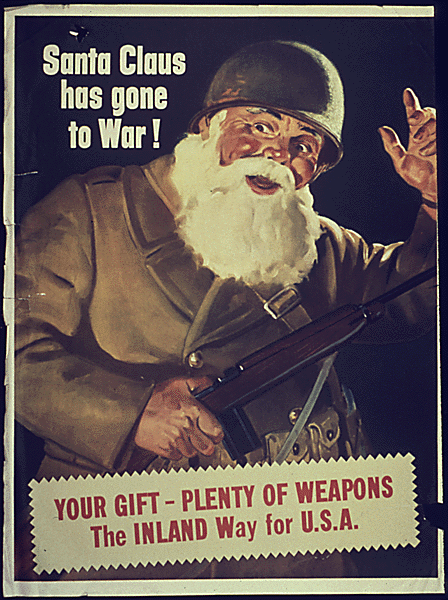
As a public service, we once again remind readers that Santa takes the naughty list very seriously. This 1942 poster was produced by the War Production Board.
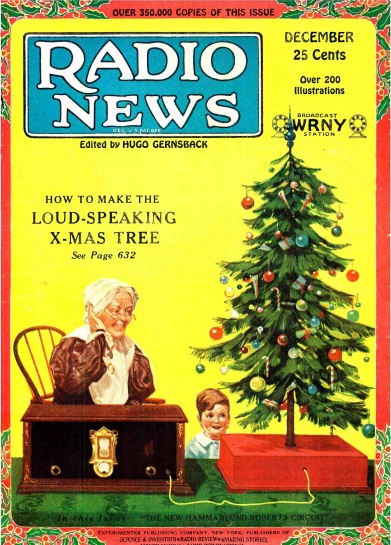
I’m not sure how practical the idea was, either then or now, but the December 1926 issue of Radio News offers this suggestion to turn your Christmas tree into a Loudspeaking Christmas Tree.
According to the accompanying construction article, authored by none other than publisher Hugo Gernsback himself, “a Christmas tree and music are almost synonymous.” For some years, Gernsback had been wondering why the self-evident idea of combining the tree’s scent with a radio has not been more universal.
The idea shown here killed two birds with one stone, by providing not only a base for the tree, but also make the tree musical.
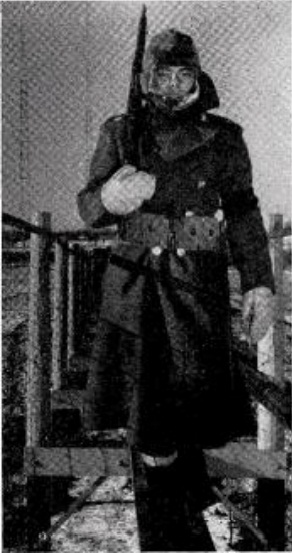 With America’s entry into the war, the nation’s broadcast stations were essential to inform and warn the public, and to maintain morale. As such, they were placed under military protection.
The photo shown here appeared 75 years ago today, in the December 22, 1941, issue of Broadcasting magazine. It shows a military policeman, stationed at Fort Snelling, standing guard over KSTP, St. Paul, MN. The caption notes that the station housed both the 50,000 watt main transmitter as well as an auxiliary 5000 watt transmitter with its own tower. Both transmitters had been equipped for code transmission on Army and Navy frequencies.
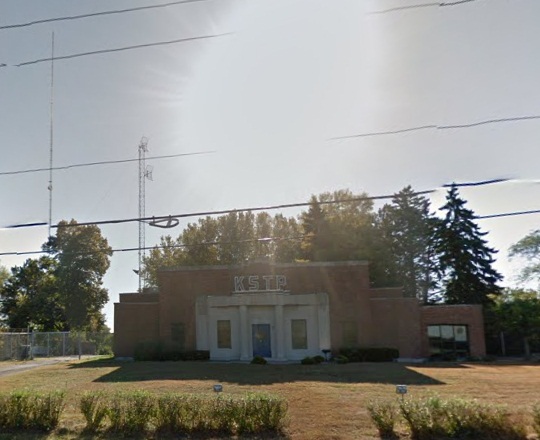 The transmitter site remains at the same location today on the east side of U.S. Highway 61 in Maplewood, MN. The modern image here is the Google street view.
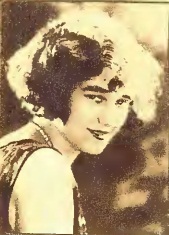 Shown here 90 years ago is Miss Mathilde Harding, pianist at WEAF New York. Miss Harding was a native of Washington, Pennsylvania, and according to the caption of this photo in the December 1926 issue of Citizen’s Radio Call Book magazine, she was 21 years old. According to the Pittsburgh Post-Gazette, February 18, 1935, she was later half of “20 fingers of Harmony,” a program that aired on NBC.
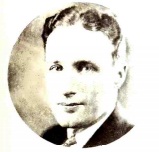
Donald Withycomb in 1935.
According to the January 1, 1935, issue of Broadcasting, she later married Donald Withycomb, a native of Montreal. After serving in the Royal Flying Corps in the First World War, he moved to the United States in 1922, where he was employed by NBC as assistant secretary. In 1934, he became general manager of WFIL, Philadelphia.
According to the Social Security Death Index, Mrs. Withycomb died in August 1967. Her birth date is listed as November 25, 1903. If true, then the Call Book publishers perpetrated a slight fib as to her age, since she would have been 23 years old when the picture was taken.
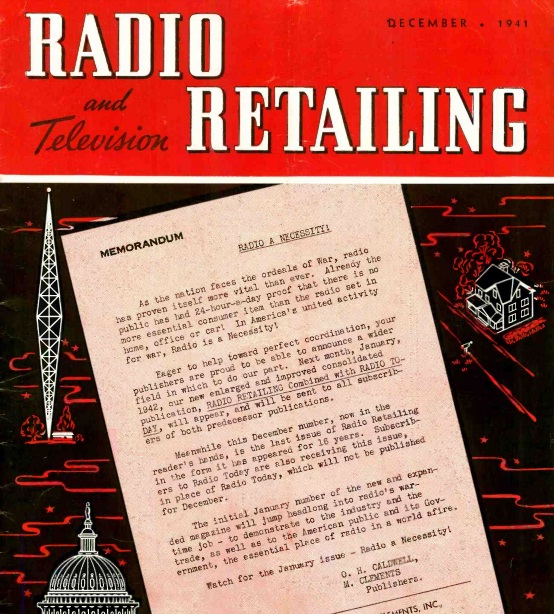
The December 1941 issue of Radio Retailing hit the presses after Pearl Harbor, and much of the issue stressed that for the war effort, radio was a necessity. The cover reminded that there was no more essential consumer item than the radio. It noted that millions of Americans had learned anew that the radio in the home, office, or automobile was of prime importance, and that the nation’s radio retailers and servicemen would need to meet the imperative of keeping sets in operation above everything else.
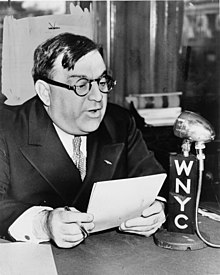
LaGuardia. Wikipedia photo.
The issue provided a quote from Defense Administrator Fiorello LaGuardia for advice during blackouts: “Keep indoors. Lie down. Turn off the lights. Turn on the radio.”
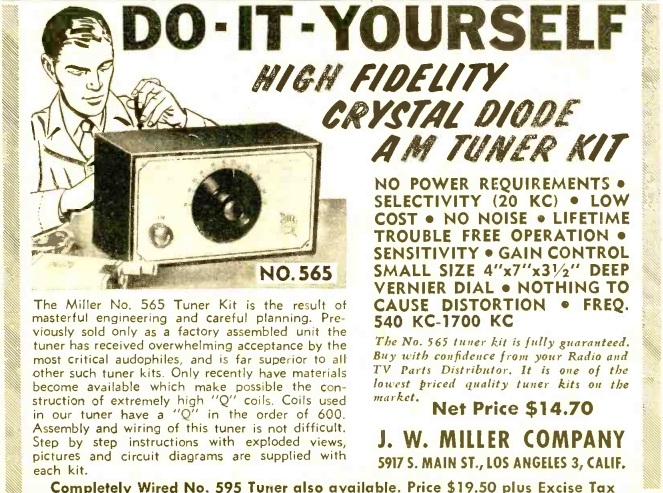
Sixty years ago this month, the December 1956 issue of Popular Electronics carried this ad for what was probably one of the most expensive commercial crystal set ever marketed, the J.W. Miller Company Model 585 High Fidelity Crystal Diode AM Tuner Kit, which was also available assembled as Model 595.
The set was said to have received “overwhelming acceptance by the most critical audiophiles,” since it contained nothing to cause distortion. With a strong AM signal, it probably did provide the best possible fidelity. Its high Q coils gave it very high selectivity. Indeed, it was equipped with a vernier tuning dial.
A complete set of the assembly instructions are available at this link. A nicely preserved specimen can be found near the bottom of this page.
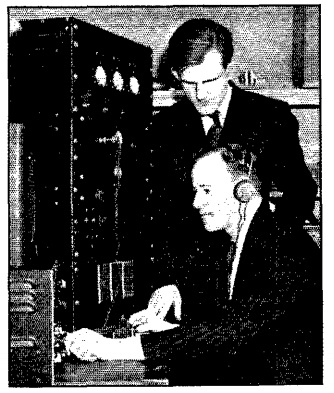
Sadowsky (seated, with headphones) and Gunderson. QST, December 1941.
Seventy-five years ago, the December 1941 issue of QST carried a profile, authored by Clinton DeSoto, of a remarkable amateur radio operator, 21-year-old Leo Sadowsky, W2OFU. then of 482 Ashford Street, Brooklyn, New York. The remarkable fact was that Sadowsky was both deaf and blind, but despite his handicaps, he successfully obtained his license and was active on the air.
He was born deaf, and at the age of two, he lost the sight in one eye in an accident. At the age of sixteen, the “overburdened right eye also failed,” and he became totally blind.
Sadowsky’s instructor, Robert T. Gunderson, W2JIO, was an instructor at the New York Institute for the Education of the Blind. Gunderson was himself also blind. When Sadowsky first approached him to teach radio, Gunderson was at first skeptical whether it would be possible. Gunderson asked how he would hear the signals, and Sadowsky replied that he would take his word for it that the receiver was working correctly.

Sadowsky (left). Boys’ Life magazine, Nov. 1941.
Sadowsky was able to learn code with a low-frequency buzzer, keyed by a relay connected to the receiver’s output. This was later refined to a 60 cycle tone that drove a pair of headphones whose vibrations he could feel. By the time he got his license, Sadowsky was able to build and operate his own equipment, and could copy code at 15-20 words per minute.
The FCC initially took the position that Sadowsky wasn’t eligible to sit for the code test, since the regulations specified that it be taken “aurally.” Gunderson argued that whether he could hear was beside the point, since he was taking the code test with a pair of headphones on his ears.
The exam, which Sadowsky took on July 1, 1941, was described as a “complicated procedure” owing to the fact that he “spoke” in a variety of ways. Before he had become blind, he and his brother had devised a wigwag system. To other blind persons, he talked by touching fingers and simulating the shapes of Braille characters. And the article noted that he was now capable of conversing by Morse code, either by tapping the wrist with a finger, or by “sound” through his headphones. For the code test, he dictated the text word-for-word to his brother, who wrote it down longhand.
Gunderson then transcribed the written test in Braille, Sadowsky wrote them in Braille, and Gunderson rewrote them on a typewriter. The required diagrams were given in word form. The following Saturday, a telegram arrived from Washington informing Sadowsky that he had passed, and was now W2OFU. His station consisted of a 6L6 crystal oscillator running 25 watts and an ACR-136 receiver.
The QST article concluded:
Certainly Leo’s world is now vastly expanded beyond the small circle of family and Braille books and typewriter and a few blind friends; now he is in intimate contact with what must seem like the whole world.
An inspiring concept, that–the prospect of a normal and well-rounded life thus opened by the magic of amateur radio. Even more inspiring, however, is the demonstration of perseverance, ingenuity and indefatigable resolution exhibited by this young amateur and his mentor in the face of their combined handicaps. That’s the kind of spirit America needs.
Surprisingly, I’ve been able to find little subsequent information about Sadowsky. He is listed, at the same address, in the 1947 Call Book. He is not listed, at least in the second call area, in the 1949 Call Book or the 1956 Call Book. The Social Security Death Index does list a Leo Sadowsky of Queens, New York, born on February 24, 1920, who died in July 1992 at the age of 72.
While Sadowsky was apparently the first deaf-blind person to become a licensed radio amateur, he was not the last. Amateur radio has a long tradition of serving as a window to the world for those with disabilities. One of the best sources of support for persons with any kind of disability who are interested in radio is the Courage Kenny Handiham Program, which provides practical support to disabled persons wishing to earn their licenses and get on the air.
References
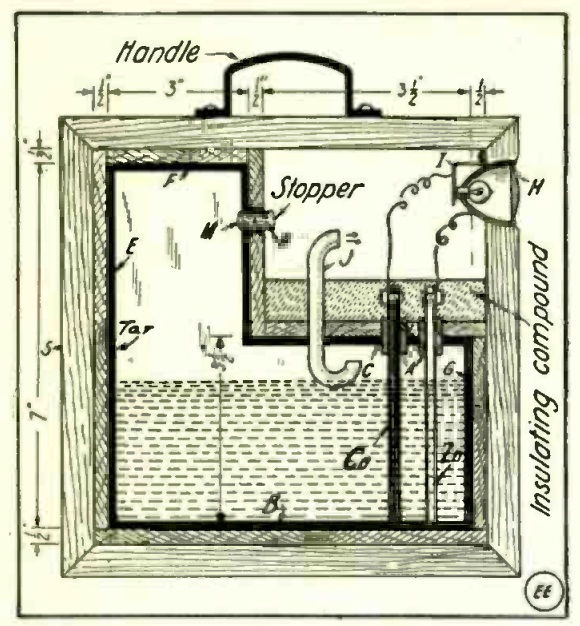

But a hundred years ago, while handheld flashlights were available, they were more expensive and less reliable. So the economy minded handyman might consider the idea of just making his own, battery and all. The self-explanatory diagram shown at the top of the page, taken from the December 1916 issue of Electrical Experimenter, shows exactly how it can be done. The great advantage of this do-it-yourself model was that it didn’t even require a switch. You just set the light on its side, all of the electrolyte would slosh to the compartment on the left, and the light would extinguish.
The lamp is built from nice thick pieces of hardwood, which securely contain the acid sloshing around inside. What could possibly go wrong? Well, what could go wrong is hinted at by this admonition in the instructions:
The next, and perhaps the most important step, to be taken in the construction of the portable battery lamp, is to seal up the battery jar so as to make it absolutely acid-proof. To prevent the acid from leaking out of the jar the cracks can be filled up by applying a thin coat of molten pitch or asphalt around the inside walls of the jar, as indicated by the heavy black line. This can be done very well by melting a few pounds of asphalt in a kettle and pouring a small quantity through the rubber tube holes at A, tilting the whole case so that it will run into all the corners; then permit it to cool. Additional molten tar is added until every crevice and surface of the interior is thoroughly coated with the insulating and acid-proof material.
After this acid-proof container is thus constructed, the interior is filled with a solution of sulfuric acid. When the lamp is set as shown in the diagram, the bulb should glow brightly.
This is presented as inspiration for a science fair project, but even I would recommend that aspiring scientists contemplating a similar project should make a few more concessions to safety. The school janitor probably won’t be very pleased if some sulfuric acid leaks out of your wooden “jar” onto the floor of the school gymnasium. And mom probably won’t appreciate it if you melt a few pounds of asphalt in one of her kettles. But the general concept is sound. It’s quite possible to make your own battery capable of generating honest to goodness electrical current. For more ideas on other homemade batteries, you can visit my earlier post on the subject. You can find other science fair ideas at this link.
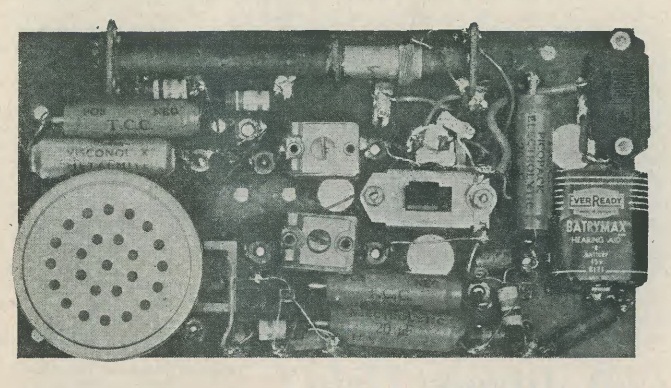
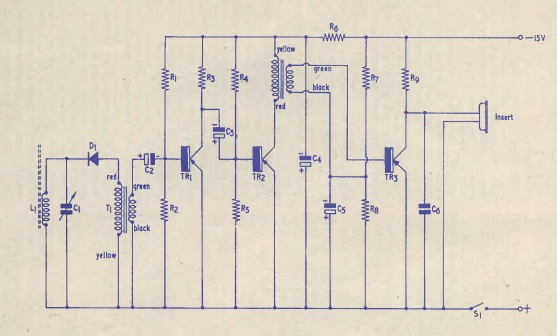
Sixty years ago, the December 1956 issue of the British publication Radio Constructor carried the plans for this three transistor broadcast set. Those who built it were undoubtedly amongst the first in the British Isles to own a transistor radio.
The set was basically a crystal set, using a type 0A71 crystal diode detector, with three PNP transistors serving as audio amplifier. The transistors are identified as “Red Spot” from Henrys Radio, and are undoubtedly CK722‘s.
In place of a speaker, a crystal microphone element is used, with a capacitor in parallel which was said to soften the audio a bit. In London, the set pulled in the two local BBC broadcasts without an external antenna. For more remote areas, an external antenna, perhaps concealed in a carrying strap, could be employed. The set as shown here was pretuned to two stations, with the switch used to go from one to the other. The article noted that a more traditional variable capacitor could also be used, as shown in the schematic below.