Young Ham With Bad Timing, 1941

1944JunePMAmateur radio was off the air for the duration during World War II, but a lot of young men were interested in radio (not unlike the ones shown above in a previous post.)  One of them had a really bad luck with timing, and received his ticket on December 6, 1941.  He wrote the following letter, which appeared with a response 80 years ago this month in the October 1942 issue of Radio Craft.

Dear Editor:

I feel that I have been cheated by the Japanese. or Germans, or the F.C.C. or someone. To explain this I will have to give you some of my past history.

I became interested in radio in the winter of 1939. I listened to amateurs on the short-wave end of my broadcast receiver. I also read radio books here and there for about a year. I got a telegraph set and learned to send up to about 12 w.p.m. on it. Then I got a key and buzzer. In May of 1941 I built a two -tube battery radio and had much trouble with it. I did not get it
to operate until July, 1941. Also in May I bought a license manual and radio amateur’s handbook, and rented a Teleplex instrument. It was two months before the Teleplex came, because of war needs. I studied in all of my spare time until September 22, 1941. That day I went 165 miles to Dallas and took my examination. I passed the code exam swell and I figure that I made about 85 on the questions.

From then until December 6, 1941, the day when my licenses came through the mail, 1 built my station. I bought a Sky Buddy receiver and built a 25 -watt transmitter and a lot of other equipment. The only thing was that my antenna was broken by a high wind and replacement had to wait several days before I could get some more of the right kind of wire. On December 8, ‘I finished it and was ready to go on the air for the first time in my life. I was excited all over. I had been waiting for this hour for two years. Then I heard over the broadcast receiver about the F.C.C. closing all amateur stations. You can imagine how I felt.

Between December and February, 1942, I did not see a R & T. magazine. Without it, I could not read about what was happening in the radio field. Now I have forgotten nearly all I knew; I can’t send or receive over about 10 w.p.m.; I have forgotten most of the ham slang and everything. I am very unhappy. I suppose a lot of other amateurs are, too.

The government claims it uses the amateur bands for aviation and army use. 1 have a good communication receiver and I search all over the amateur bands and I can’t hear anything. Not even a telegraph signal. Why can’t the F.C.C. give us amateurs just a little space to operate. For instance, they could give us back the 160 – meter band and not let us use over 40 watts input and operate only during a certain period of the day.

There are a lot of amateurs in the army and on defense jobs, but there are still some left, like the ones under 17 and over 64, or the blind, deaf, or disabled, who love amateur radio.

I am 14 years old. It will be at least three years before I can go to war. If I could get on the air and Use radio equipment and become experienced enough, I would be able to operate a radio in the army. I have my licenses, but I have never been on the air, and have not studied radio since December of ’41.

Isn’t there some way for us to get on the air, at least to learn?

GILES EASLEY,
Calveat [Sic, Calvert],Texas.

(Your letter stresses the nuisance of war but fails to consider the seriousness of war. If an amateur band were opened it would require constant vigilance to see whether advantage were not taken of this liberty by enemy agents, and the F.C.C. is too busy for that.  Undoubtedly you can find other amateurs in your vicinity who may be able to meet with you for occasional code practice–even if its only on an audio oscillator. You should have more time now to study the technical phases of radio and to do some experimental work which will be valuable to you later on. Perhaps your local Civilian Defense group will find use for your services, either for constructing or operating emergency transceivers. -Editor)

It appears that the author did eventually get on the air. The 1952 call book lists a Giles M. Easley of Silver Spring, MD, being licensed as W3SSG. According to the Social Security Death Index, he died in Texas in 1985 at the age of 58. His gravestone indicates that he did, indeed serve in the U.S. Navy in World War 2.


Quiz Time!

1962OctPE1Can you identify which animal goes with each of these electronic parts? This quiz appeared in Popular Electronics 60 years ago this month, October 1962. We’ll show the answers tomorrow.


1952 Two-Tube Regen

1952OctPM1952OctPM2Seventy years ago, this gentleman is pulling in the short waves, or possibly a station on the standard broadcast band, with this two-tube regenerative receiver. It was ideal for those interested in becoming hams, or just for those who wanted to listen to foreign broadcasts, hams, or just local broadcasts.

A 12SL7 was used as regenerative detector, with the other half of the tube serving as audio amplifier. This was fed to a 50L6 which served as final AF amplifier to drive a loudspeaker. A selenium rectifier rounded out the active devices, allowing operation on household current. The tube filaments were in series with a dropping resistor and could run directly off the household current. For best results, a 75-100 foot outdoor antenna was recommended, but stronger stations could be picked up with 20-40 feet of wire indoors.

Plans for the set were found in the October 1952 issue of Popular Mechanics.

1952OctPM3


Basics for Getting Emergency News and Information

Hurricane Ian serves as a reminder to have something in place to receive news and information in the event of an emergency. According to news reports, at least five TV stations and 21 radio stations were off the air, and internet and cellular service was interrupted in many areas. The good news, however, is that while 26 stations were off the air, over 500 stations in the state remained on the air, along with stations in other states that can be heard in Florida. So with a little bit of preparation, it’s possible to get information in an emergency.

Even if you don’t have any other radio available, as we reported previously, virtually every cell phone sold in America has a built-in FM radio. This tuner picks signals up over the air, and does not depend on the internet. Many phones come with the required software, so check your phone and see if it’s installed. It’s probably an app called “FM Tuner.” But even if the app is not installed, the tuner is built in to the hardware. This CNET article explains how to install the required app.

Your cell phone uses the headphone wire as its antenna. It will work for strong stations without headphones, but to ensure good reception, you should plug in a pair of wired (not cordless) headphones. So it’s a good idea to get a cheap pair of headphones.

It’s important to know that there is a radio built in to your cell phone. After all, most people carry their phone with them all the time, which means that you have a radio with you all the time. But that radio is not ideal, mostly because it probably uses more battery resources than a small portable radio. Also, the cell phone won’t get AM stations, which might be important if you want to listen to out-of-state stations at night. Given the minimal cost, it’s cheap insurance to buy an inexpensive AM-FM radio.  As with everything, inexpensive ones are available on Amazon.

Of course, you’ll need batteries for these radios. In most cases, they take either AA or AAA batteries. The good news is that the batteries will last a long time. For occasional listening, one set of batteries will probably last several days. Even if you’re listening to it constantly (which you might in an emergency), one set should last at least a day. Therefore, it pays to stock up on batteries to have enough to make it through an emergency.

Many TV stations have realized that if there is a widespread power outage, many of their viewers won’t be able to watch. Therefore, many TV stations have made arrangements to have radio stations simulcast their broadcasts.   However, once your basic information needs are taken care of, you might consider getting an inexpensive battery powered TV, in addition to having a radio. Most of these sets are rechargeable, and it’s a good idea to keep them topped off before the storm hits. If you do need to recharge during the storm, one option is to use a car USB adapter and charge them there.

Another option is a TV tuner dongle such as this one, which will turn your Android phone or tablet into a TV set.

While it’s probably a good idea to get a TV or TV tuner in addition to a portable radio, it’s important to have an old-fashioned portable radio as well. This is because the battery life on a portable radio will be considerably longer than a TV, tablet, or phone. A package of alkaline batteries will last you weeks, which is better than constantly trying to figure out how to charge your phone or TV.

For more information, see our earlier post about preparing for power outages.


Some links on this site are affiliate links, meaning that this site earns a small commission if you make a purchase after using the link.

1937 Two Tube Transmitter

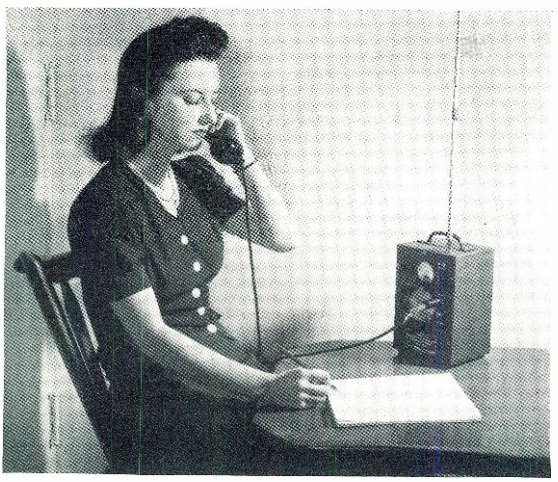
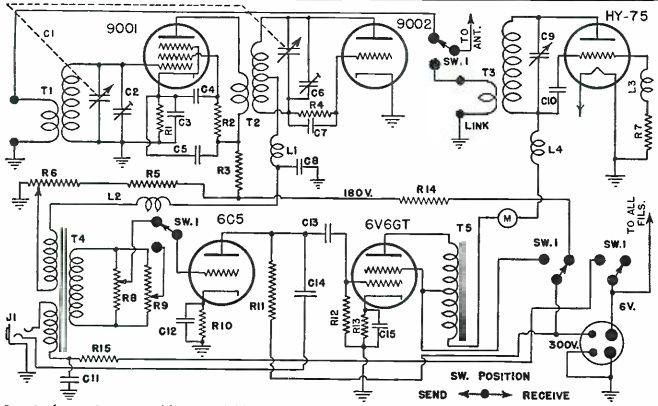
1937OctPS2Eighty-five years ago this month, the October 1937 issue of Popular Science carried the plans for this simple transmitter for 160, 80, 40, or 20 meters. The rig was designed with portable operation in mind, hence the small cabinet. To keep it small, the tube, coil, and crystal were mounted on top, which meant that the interior wiring was very uncluttered. A type 47 tube was used, along with a type 80 rectifier. All parts were said to be easily obtainable.

In tests, the rig was able to get out over 500 miles, and the quality was said to rival many larger and more expensive sets.

Any receiving antenna could be used, but a “single wire designed for the proper wave length” was recommended. The article included an interested method of calculating the length of a (half-wave) antenna: “To calculate the proper antenna length in feet, simply multiply the wave length to be covered (in meters) by 1.56.”  While I’ve never seen it expressed this way, this is the equivalent of the familiar 468/f formula.

The author was Donald Levenson, W8PIN.

1937OctPS3


1947 AM-FM Bendix Facto-Meter

1947SepRadioRetailingSeventy-five years ago this month, the September 1947 issue of Radio Retailing carried this ad for an interesting AM-FM receiver. The set, a mostly normal AM-FM superhet, wasn’t for sale to the public. It was instead billed as an instrument for use by the dealer to stimulate sales. The compact receiver could be taken to the prospect’s home to demonstrate how well FM signals could be received.

It had a signal-strength meter with two adjustable ranges, as well as a means for switching between the built-in telescoping antenna, and an outdoor antenna. Therefore, it was possible to tell whether an antenna would be necessary, and the best spot in the house to mount the set.


Broadcasting for Servicemen Overseas: 1942

1942Sep28BCEighty years ago today, the September 28, 1942, issue of Broadcasting carried this article on the subject of getting American broadcast programs to servicemen overseas. Elsewhere in the magazine, it was reported that the Office of War Information was purchasing time on broadcast stations in Alaska and Hawaii to get programs of interest to military personnel there. But overseas, the problem was more accute.

In Europe, the BBC, of course, carried programs in English. But other than the news, programs were generally regarded as quite dull to the American ear. Shortwave didn’t fill the gap entirely, because of propagation and the lack of receivers on base. One plan under consideration was a string of 50 watt stations near bases, all on the same frequency. Of course, thought had to be given to camouflaging them and shutting them down in case of air raids.

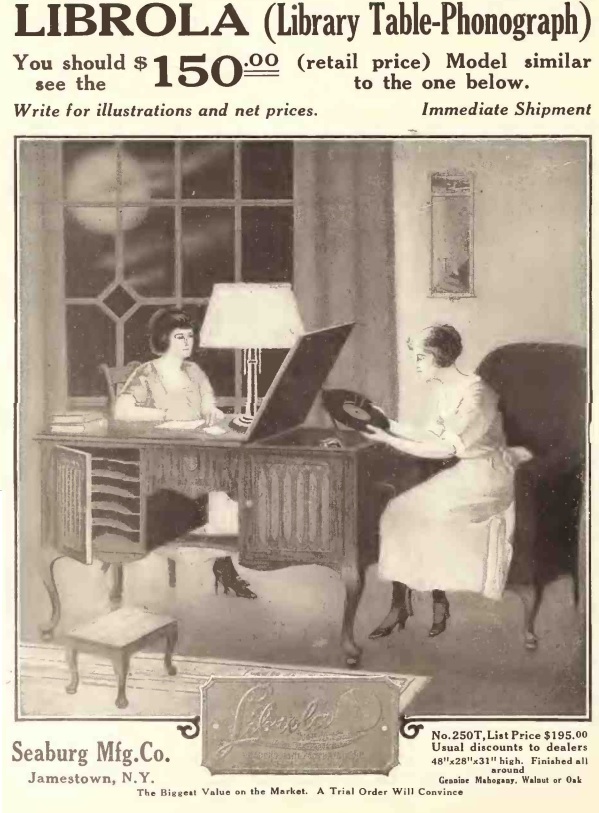
Morale kits were in heavy demand. The goal was to provide one kit for each 116 men. These included a radio for long, medium, and short waves, for either battery or plug-in use, one phonograph, 25 transcriptions of radio shows, and 48 records containing the latest hits. These were dubbed the “B Recreation Kit,” although I haven’t found any references using that terminology.

The soldiers shown at left are listening to a phonograph that was part of one such kit. Interestingly, due to shortages of shellac, the records supplied by Uncle Sam were actually vinyl 78 RPM discs, and were one of the first uses of vinyl for phonograph records.


1955 Grocery Prices

1955Sep27PghPressFor a snapshot of grocery prices in 1955, this ad appeared in the Pittsburgh Press September 27, 1955. The prices look low, but according to this online inflation calculator, one dollar in 1955 was the equivalent of $11.05 in 2022 buying power. So the two loaves of bread for 29 cents works out to $3.20 today, or $1.60 for a one-pound loaf. How does that compare to today’s prices, at the link below?

Of course, the 1955 bread included a coupon for dime off a cake or pastry. Margarine was 33 cents a pound, the equivalent of $3.64 today. And Velveeta cheese was 2 pounds for 89 cents the equivalent of $9.83. How do those compare to current prices?


Some links on this site are affiliate links, meaning this site earns a small commission if you make a purchase after clicking the link.

1947 Homemade Television

1947SepRadioNews2Seventy-five years ago this month, this viewer was undoubtedly the first on her block to have a television, courtesy of a design contained in the September 1947 issue of Radio News.

The magazine contained detailed plans, and suggested that the set could be constructed in one of three ways. The experienced constructor could employ the usual method of following the schematic, aided by photos of the completed set. For larger groups, it could be done with a series of step-by-step instructions prepared by an instructor. Finally, it could be done by a group using typical factory production methods.

Whichever way they decided to make the 18-tube set, the builders would become acquainted with the basic requirements of both video and FM sound reception. The schematic was shown in the magazine, but for those desiring factory-sized blueprints, they were available from the author for $1 per copy.

1947SepRadioNews3