Ten Commandments for Radio Fans: 1922

1922NovPSA hundred years ago, radio was definitely becoming a phenomenon, as evidenced by making the cover of Popular Science, November 1922.

The magazine contained ten commandments for the radio fan, authored by Jack Binns, described by the magazine as America’s most popular writer on radio. Many of the commandments are common sense, such as “learn how to use your tuner properly,” although most are outdated, such as “do not use a loop aerial with a crystal detector.”

The second commandment admonishes the reader not to make the ground connection with a gas pipe, but it’s not for the reason you might think. It turns out that gas pipes are insulated at certain points, so it just wouldn’t work very well.


Some links on this site are affiliate links, meaning that this site earns a small commission if you make a purchase after using the link.

Hitler’s First Mention in the New York Times: Nov. 21, 1922

1922Nov21NYTA hundred years ago today, November 21, 1922, Hitler first made the pages of the New York Times,  page 18 to be specific. The newspaper’s Munich correspondent concluded that the “Nationalistic anit-Semitic movement (the word “Nazi” didn’t appear in the article) has now reached a point where it is consiered potentially dangerous, though not for the immediate future.”

The paper noted that the anti-Semitic propaganda had reached a point where “a number of prominent Jewish citizens have sought asylums in the Bavarian highlands, easily reached by fast motor cars, whence they could hurry their women and children when forewarned for an anti-Semitic St. Bartholomew’s night,” (which happened eleven years later).
https://en.wikipedia.org/wiki/Kristallnacht

But the paper reassured readers that this couldn’t happen: “Several reliable, well-informed sources confirmed the idea that Hitler’s anti-Semitism was not so genuine or violent as it sounded, and that he was merely using anti-Semitic propaganda as a bait to catch masses of followers and keep them aroused.”

Interestingly, the article presupposes that reader’s have some knowledge of Hitler, as the article doesn’t bother to use his full name.

If you have a New York Times account, you can view the full article at the link above. Otherwise, you can find a copy at this link.


Meissner 2-CW Transmitter, 1952

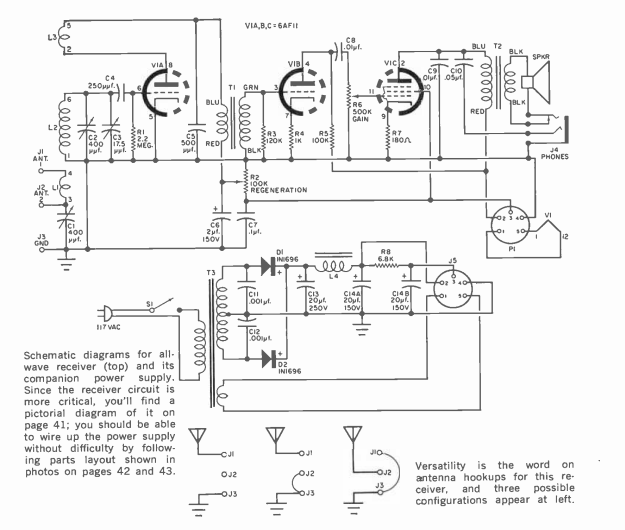
1952NovRadioNews1Seventy years ago this month, the November 1952 issue of Radio News introduced this transmitter for the novice. While the article contained the full details for constructing the set, it was really a kit, the Messner Model 2-CW. According to that company’s 1954 catalog, the kit retailed for $40, plus $5.50 for a plug-in coil for the desired band. Normally, the novice would start out on 80 meters, with the included coil, but as they upgraded, they could buy coils for 40, 20, 15, or 10 meters.

The transmitter used a single 6L6 tube, plus a rectifier, and was self-contained with a built-in power supply. Cathode keying was promised to keep chirp to a minimum.

1952NovRadioNews2


1922 Drone Delivery

Popular-Wireless-1922-11-S-OCR-1Amazon might be starting drone delivery any day now, but as we can see here, it’s not a new idea. A hundred years ago this month, the cover of the November 1922 issue of Popular Wireless showed Major Raymond Phillips’ “famous” method for wireless controlled aerial mail.  The issue included part of a series written by Major Phillips with some of the technical details of his system.


Some links on this site are affiliate links, meaning that this site earns a small commission if you make a purchase after using the link.

1947 Police Radar

1947NovRadioCraftSeventy-five years ago this month, the cover of Radio Craft magazine for November 1947 showed this Connecticut State Police officer studying traffic speeds courtesy of a radar, the Electro-Matic Speed Meter from Eastern Industries Ltd. of Norwalk, CT.

The complete unit consisted of three parts, the transmitter-receiver with built-in antenna, the indicator-amplifier, and a power supply. The radar used the doppler effect, since the reflection from an incoming object shortened the wavelength, and this could be measured and correlated with speed.

A number of the units were being tested, and the magazine noted that those tests would probably result in the adoption of radar speed control throughout the state.

According to the magazine, Connecticut speeders protesting that they were only doing forty would soon find themselves arguing with radar.

The complete apparatus weighed in at only 45 pounds, and could operate on either 120 volts AC or 6 volts DC. The radar signal on 2455 MHz was about 0.1 watt. The magazine noted that the radar required an FCC station license, but since it was so easy to operate, no operator’s license was required.


Electronics Illustrated: 1958-1972

Screenshot 2022-11-16 12.41.28 PMFifty years ago this month, I got some sad news in the mail.

A couple of years earlier, as previously recounted here, I had been perusing the Publishers Clearing House mailing (which contained numerous personal notes written to me by my personal friend, company head honcho Robert H. Treller) and was intrigued by a magazine named Electronics Illustrated.  I subscribed, and I think the magazine was one of the main things that spurred my interest in radio and all things electronic.

In fact, I even got my name in the magazine, as one of the finalists in the magazine’s Screenshot 2022-11-16 1.01.22 PM“Win the World” contest, for submitting QSL card from shortwave and broadcast stations I had heard, as shown here in the March 1972 issue.  I actually hadn’t submitted that many cards, and I was a little bit surprised that I had done as well as I had.  And I was just a little bit proud to be a ten year old with my name in a national magazine.  I figured the next year, I’d be able to easily win a valuable prize by employing a slightly better strategy.

But unfortunately, there would be no next year.  Fifty years ago, the magazine delivered the sad news shown above, in the magazine’s November 1972 issue, which was to be the last.  The magazine put the best spin on it as possible, and announced it as a “merger” with Mechanix Illustrated.  But I knew better.  I predicted that the “Electronics Illustrated” name would soon disappear completely, and it did.  They had to placate us loyal subscribers by sending something, and they did it by continuing the subscription with Mechanix Illustrated.  That was a good magazine, but it wasn’t the same.

The editor seemed to even concede this, in the full announcement buried deep in the last issue, in which he conceded that he would “miss the club-like atmosphere and special insider’s language.”  He hit the nail on the head.  I felt like I was a member of the club and had learned a new insider’s language, but now the club was to be disbanded.  Bad news on the doorstep, indeed.


Fashion Pointers for Winter Fuel Shortages

1942Nov16LifeThe young woman shown here is about to turn 100, and she’s probably thinking about the prospects for fuel shortages this winter. But she’s undaunted and prepared for them, because she’s been through it before.

In 1942, there were also fuel shortages brought on by the war.  The radiator was turned down many places, but according to the November 16 issue of Life Magazine, this girl learned a few tricks for keeping warm from her grandmother. Today, she’s probably teaching her grandchildren and great grandchildren the same pointers. The secret to stay warm was then, and is now, quilted fabrics. This young woman is showing off her quilted rayon taffeta slacks, quilted booties, and a closely knit long-sleeved sweater.

After you have your winter wardrobe picked out, don’t forget to check our earlier post about other preparations for winter power outages.

While we don’t know the name of the model, the photographer was Walter Sanders.  The German-born photographer emigrated to the U.S. after being hounded by the SS for non-Aryan activities.  As an enemy alien, his cameras were initially confiscated shortly after Pearl Harbor, but he was soon back in business.


Radios for Christmas: 1922

1922Nov15WashHeraldChristmas of 1922 was going to be a big one for radio, as evidenced by this ad in the Washington Herald a hundred years ago today, November 15, 1922. As shown here, Santa’s workshop was busy turning out radio sets, many of which would show up under the tree.

We previously profiled this dealer, White & Boyer, 812 13th St. NW, Washington.  In addition to running the retail dealership, they were the licensee of station WJH, thus ensuring their customers had something to tune in.


1962 Distance Learning

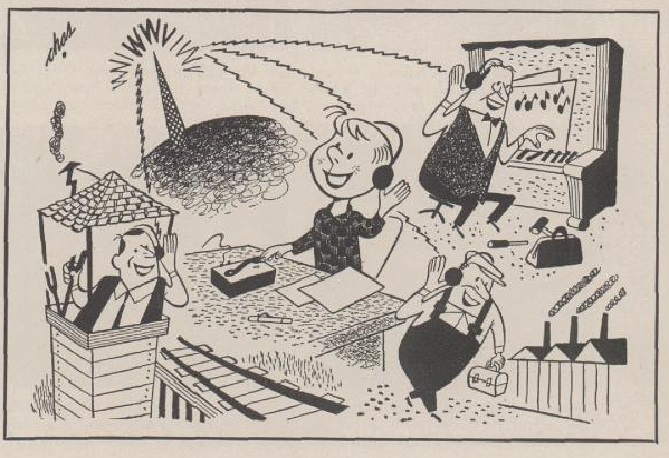
1962NovEI1962NovEI2They didn’t have Zoom classes 60 years ago, but when a polio outbreak struck Nunda, NY, in 1962, the high school tapped the ingenuity of local hams and CB’ers to come up with a method of distance learning.

Several students came down with the disease and were confined to their homes. Initially, they had to discontinue their studies, but the school bought a number of CB radios. Hy-Gain antennas were placed on the school roof, with coaxial cables running to classrooms. The school purchased Johnson transceivers, and volunteer students carried the radios from class to class and plugged the radio into the coax outlet in each room. The teacher was then able to transmit lectures to students at home.

Individual homes had smaller mobile-style whip antennas installed hooked up to transceivers there. When homebound students were called upon, it was a simple matter of pressing the push-to-talk button.

The pictures here appeared in the November 1962 issue of Electronics Illustrated, which pointed out that so far, seven students had received their schooling at home via CB. The teacher shown above was discussing the lesson with a student after class. The magazine confirmed that call letters were always given as required.


Science Fair Idea: Gravity Furnace

1942NovPSIf Junior is looking for a spectacular science fair project, they can’t go wrong with this project from 80 years ago, from the November 1942 issue of Popular Science.

Octopus furnace. Wikipedia image.

Octopus furnace. Wikipedia image.

It demonstrates how an old-fashioned “gravity” furnace works.  These are often affectionately known as an octopus furnace, since they had tentacles going from the furnace to each room. As shown clearly by this experiment, the air in the furnace heats up and rises. Then, when it gets to the room, it cools and returns through the lower set of pipes.

Such furnaces are out of favor, and I doubt if they are still manufactured. But there’s really nothing that can go wrong, so they still exist in some older houses. They are not as efficient as modern furnaces, but they have some advantages. Unless some electronic controls have been retrofitted, they don’t require any electricity to operate. In the event of a winter power outage (see our earlier post for more thoughts), modern furnaces would be useless, even if they burn gas or oil, since they need electric power to run the blower. But the old gravity furnace will keep the house toasty warm, even with no electricity. Back in the day, the homeowner would shovel coal to keep it going, although most were converted to gas or oil.

To put the experiment together, in addition to the items found around the house, Junior might need to purchase the following items. You can find them locally, but as with everything, you can also find them on Amazon, at the links below:

As with many of our science fair projects, don’t forget to give Junior a box of matches!


Some links on this site are affiliate links, meaning that this site earns a small commission if you make a purchase after using the link.