1946 80 Meter Transmitter from Popular Science

1946octps

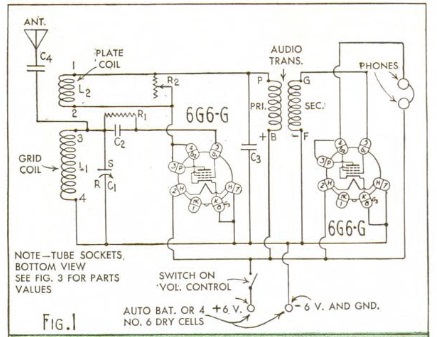
Seventy years ago, the October 1946 issue of Popular Science showed the beginning ham how to put together this compact transmitter for 80 meters (on the left in this photo).

The set employed a single 7N7 dual triode, and was said to be capable of real performance. But the article warned to bear in mind that “the 80-meter band is crowded with high-power outfits, so you’ll have the best chance of getting through during the relatively quiet hours.”

The set was mounted on a 5×7 wooden base, and required a 250-300 volt power supply, as well as filament voltage. The antenna tuning unit was mounted on a separate chassis, with twisted lamp cord connecting the transmitter and tuner.

1946octpsschematic


NBC Shortwave Listening Station, Bellmore, Long Island, 1941

1941oct25radioguide

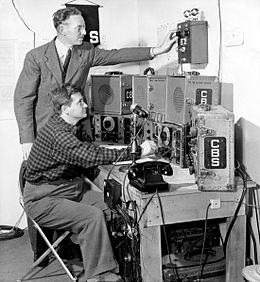
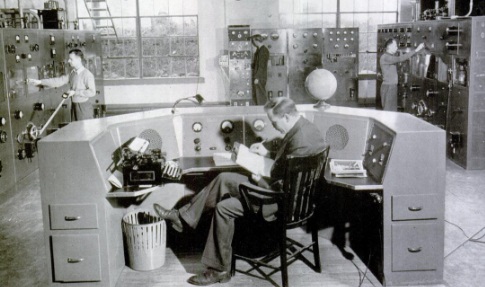
Shown here in the October 25, 1941, issue of Radio Guide is the Shortwave Listening Station which the NBC network had recently installed at Bellmore, Long Island. The station was in operation 24 hours a day, and the staff of 24 foreign language experts and radio engineers kept tab on the war of words coming from Europe.

The issue also reported on a publicity stunt recently conducted by Berlin Radio. For a number of days, the station had announced that Lord Haw Haw had been banned from the air. Then, an announcement followed that Lord Haw Haw would be allowed to come on the air and give his side of the story.

Many American editors fell for it, and the broadcast received plenty of advance publicity. However, Lord Haw Haw hadn’t been banned from the German airwaves. It was a publicity stunt in which he announced merely that the American networks refused to carry his propaganda.


1936 “Wrist Watch” Radio

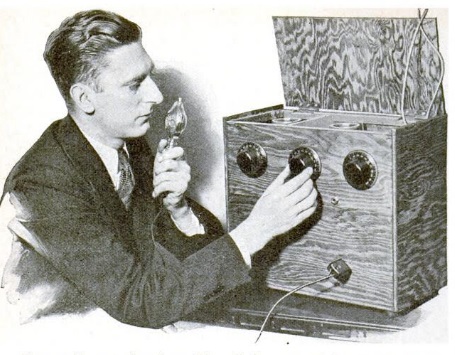
1936octoberpsYou can probably barely see it, but this gentleman is listening to an ultra-compact radio, as described 80 years ago in the October 1936 issue of Popular Science.

This “wrist-watch” radio is crammed into a chassis measuring two and a half inches square.  It’s a two-tube circuit, but uses a dual 6A8 tube, with one half serving as regenerative detector and the other half as audio amplifier to drive the headphones.  The set is powered by batteries around the gentleman’s waist.  If you look very carefully at the photo, you might see them.

The set called for a fifteen foot antenna, which he is presumably dragging along.

So even in 1936, if you wanted an ultra-discrete method to listen to the radio, you could put together one of these, and nobody would even notice that you had a radio with you.


Four Reasons Why You Need Two Radios: 1936

1936octradioretailing

Eighty years ago, consumers buying a new radio had come to expect that they could trade in the old set. This presented a headache for the retailer, since any sale of the used set would probably cut into sales of new sets. The trade press often contained pointers on what to do with these old sets, such as donating them to charitable organizations, or selling them in bulk to other dealers, hopefully in another town, so that they would be another market’s problem.

The October 1936 issue of Radio Retailing included this graphic to help salesman convince buyers that they would be better off having two sets.
The page was designed to be shared with customers, and noted that “many questions asked by the consumer are difficult to answer because of his limited technical knowledge and inability to visualize.” Thus, the graphic was easier to understand, “and most people believe much of what they see in print.” Thus, graphics such as this one were printed to assist the salesman close a deal by “picturing the answer to a specific question which introduces selling resistance.”

This page notes that the old radio is worth more than the maximum trade-in value any dealer could allow, and suggests four uses for the old set. First, it could be moved to the playroom, allowing the parents to “duck the kid’s programs without breaking their hearts.”

Another viable option would be the bedroom. The magazine notes that it could be connected to an automatic time switch for a musical alarm.

In the kitchen, “any good serviceman can remove the chassis and build it in” for a truly modern kitchen.

The final use would be in the “whoopee room,” where we see a group playing ping pong and enjoying cool beverages, listening to the old set which has been “painted, in color, for that modernistic touch.”


1926 Homemade Battery Charger


1926octoberpmOne of the electronic components we take for granted today is the semiconductor diode for use as a rectifier. But even ninety years ago, if you wanted to build your own battery charger, you could do it at home, as shown by these plans from the October 1926 issue of Popular Mechanics.

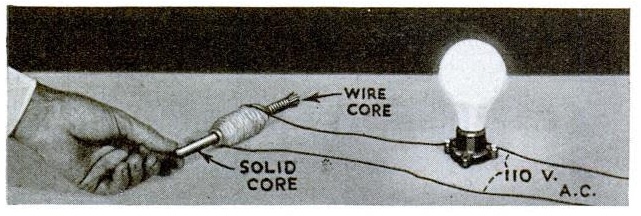
To charge a six volt battery, this charger used a 12 volt doorbell transformer.  The rectifier consisted of a glass jar containing a solution of borax, with electrodes made of lead and aluminum.  The total cost of all of the parts was said to be $2.50.


Women in Radio: 1916

A hundred years ago this month, the October 1916 issue of Electrical Experimenter devoted a large portion of the magazine to “the Wireless Girl,” and featured on the cover this painting by George Wall.  Loyal readers will recognize the painting as being based on a photograph of Kathleen Parkin, 6SO/6BP, of San Rafael, California.  As we related in an earlier post, she built the quarter kilowatt transmitter shown here, along with a vacuum tube receiver, and had one of the more impressive stations on the West Coast.

In the Electrical Experimenter article, Miss Parkin writes of her interest in wireless:

With reference to my ideas about the wireless profession as a vocation or worthwhile hobby for women, I think wireless telegraphy is a most fascinating study, and one which could very easily be taken up by girls, as it is a great deal more interesting than the telephone and telegraph work, in which so many girls are now
employed. I am only fifteen, and I learned the code several years ago, by practising a few minutes each day on a buzzer. I studied a good deal and I found it quite easy to obtain my first grade commercial government license, last April.

It seems to me that every one should at least know the code, as cases might easily arise of a ship in distress, where the operators might be incapacitated, and a knowledge of the code might be the means of saving the ship and the lives of the passengers. But
the interest in wireless does not end in the knowledge of the code.

You can gradually learn to make all your own instruments, as I have done with my 1/4 kilowatt set.

There is always more ahead of you, as wireless telegraphy is still in its infancy.

Graynella Packer operating the wireless aboard the

Graynella Packer operating the wireless aboard the Mohawk.

Miss Parkin was not the only young woman at the forefront of radio, as the article cited a number of others. For example, Graynella Packer of Jacksonville, Florida, was the first woman wireless operator to serve on a commercial vessel, aboard the Mohawk of the Clyde Line, where she was in full charge of the vessel’s wireless.

Numerous other women radio operators were featured in the article, which stressed the role that wireless played in national preparedness.  The photo below shows a group of young women studying wireless at a summer preparedness camp.

1916preparednesscamp


“Vision of Peace,” 1936

1936octpopularmechanics

Eighty years ago, the October 1936 issue of Popular Mechanics featured the familiar “Vision of Peace” sculpture in the Ramsey County Courthouse-St. Paul City Hall. The sculpture had been unveiled earlier that year.

The sculpture was created by Swedish sculptor Carl Miles, and is based on his own vision of Native American spirituality, with no connection to any particular Native American beliefs. It depicts five Native Americans seated around a fire holding their peace pipes. Emerging from the smoke is an unnamed god of peace speaking to all the world.

The statute originally honored the Minnesota soldiers who died in the First World War. Subsequently, names of those who died in other wars have been added. The name “Vision of Peace” was given in 1994, during a ceremony involving the three major Indian tribes of Minnesota.

The 60 ton 38 foot statue sits on a revolving base which turns 132 degrees every 2.5 hours.


1936 Radio Show

1936octradiocraft

This cover spread from the October 1936 issue of Radio Craft showed some of the new sets getting ready to hit the market for 1937, as seen at the September 1936 New York Radio Show. Some of the sets featured here include:

  • RCA Model 10-T
  • General Household Utilities Co. Model 1541 Teledial Console
  • United Motors Service Model 3209, a 32 volt farm set
  • General Electric Model E-155
  • Crosley Model 167 Console
  • Noblitt-Sparks Industries Rhythm King Model 1127
  • Philco Model 116X DeLuxe
  • Zenith Model 7D-148
  • Admiral Model AM 387
  • Stromberg-Carlson Model 145-L
  • Detrola Model 102-C
  • Emerson Model L-143


1941: How Radio Will Defend America

1941oct18radioguide

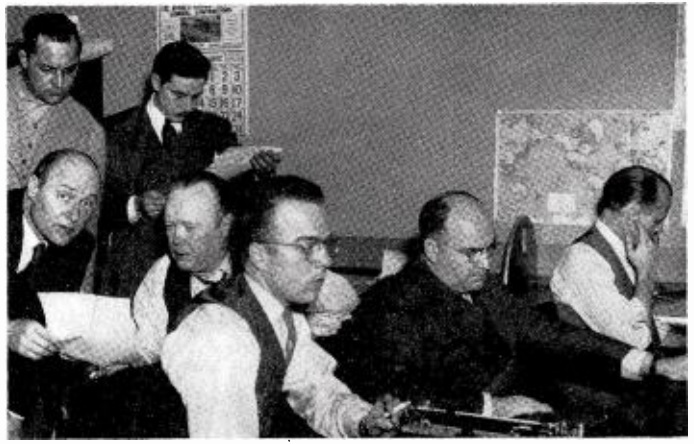
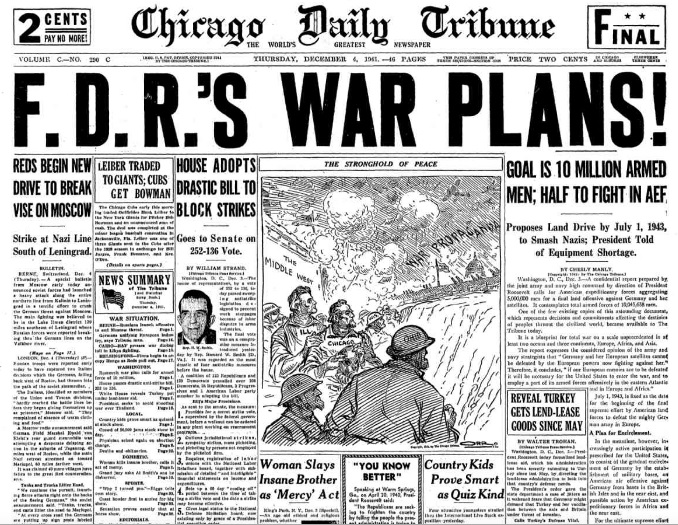
On this date seventy five years ago today, October 18, 1941, less than two months before Pearl Harbor, Radio Guide magazine told all the ways that radio would defend America.  The author, an army officer who had previously served as an editor of the magazine, started by saying that the bombers would come first, make no mistake about it. They would do it, unless radio prevented them, as one of the nation’s first line defenses. He noted that the shores were ringed with listening stations on our territory, on distant islands and ships at sea, and aboard blimps above the ocean. One of those stations would see them coming, and radio would carry the message to commanders whose duty it was to defend our shores.

If enemies did get through, then “radio must do for America what it failed to do for France; it must tell Americans where to go and by what routes. When areas need to be evacuated, radio must instruct automobilists and truck-drivers to use certain roads and highways. The Army has first claim on the others. Indeed, it may be a part of one’s preparedness to keep his radio continuously tuned in. No other means can tell the public so quickly of threatened danger.”

Another aspect of national preparedness was monitoring foreign shortwave broadcasts. “Would you think, for example, that by listening to what Germans are telling Americans, both in North and South America, you could learn what Germany may do next? Well, you can. Even now German short-wave stations are talking to us at all hours. Each twenty-four hours they are sending us thirty thousand words of trickery and deceit. By following it for month after month we have learned that it assumes a pattern that is visible to experts. Our own Federal Communications Commission hires such experts and many others besides to listen to all foreign language broadcasts. Stations in Oregon, Texas, Maryland and Puerto Rico hear all broadcasts directed to this country and to South America. They make recordings of these broadcasts, turn them over to translators, then to analysts, then to psychologists. Result: The American government was warned ahead of time that Japan was going to occupy Indo-China. Germany’s attack on Russia was predicted within a few days.”

Air Corps radio operators.

Air Corps radio operators.  “A few months ago many of them were ‘hams’ you heard on short waves. Today they’re learning everything from signal codes to radio night-fighting technique.”

The article also noted how broadcasting had served the public by providing information and quieting rumors.  It concluded by noting that in peace, Americans had used radio better than any other nation.  “We have more stations, more receivers, more artists, more technicians, more listeners.  In war, if it comes, we shall also use radio best–there can be no doubt of that–and employ its multitude of services in order that a complete and glorious victory may quickly be ours.”


NPOTA: Lewis & Clark National Historic Trail

dsc01378

Preparing to send RF ‘cross the wide Missouri.

During the 2016  ARRL National Parks On The Air (NPOTA) event,  Amateur Radio operators are celebrating the 100th anniversary of the National Park Service (NPS) by setting up their equipment in NPS units  to make contact with other Amateurs around the world.  Since the beginning of the year, the event has been extremely popular, with over 13,000 activations from 450 different different units of the NPS and over 700,000 individual two-way contacts.  As I’ve reported in other posts, I’ve made contact with 281 different parks and operated multiple times from six parks in Minnesota and Wisconsin.

One of the event’s successes has been encouraging visits to the parks.  Until recently, my activations have been confined to the NPS units in Minnesota and Wisconsin.  Last week, I had to be in Sioux City, Iowa, for one of my continuing legal education programs.  The city lies along the path taken by Lewis and Clark as the traveled from St. Louis to the Pacific Ocean, and is therefore part of an NPS unit, the Lewis and Clark National Historic Trail.  Because the trail’s sheer length, and because it passes through so many other notable sites, it is the NPOTA’s most popular activation site, with over 13,000 individual contacts made.  Since my son had recently been studying Lewis and Clark in school, I decided to bring him along.

Sioux City marks the point where the only death during the 1804-06 Corps of Discovery’s expedition took place.  Sgt. Charles Floyd is buried under a prominent obelisk on a bluff overlooking the river.  The Sioux City riverfront contains two museums devoted to Lewis and Clark’s journey.  The first is in a drydocked former riverboat, the M/V Sergeant Floyd.  The ship was an Army Corps of Engineers Inspection Vessel.  Interestingly, the ship contains a ham station, although it’s supposed to be a recreation of the ship’s radio room.  As you can see from the photo below, the radio room is equipped with an E.F. Johnson Viking Valiant and a Hallicrafters S-40.  Even though these amateur rigs appear to be out of place, it was interesting to see this inadvertent ham station set up.

dsc01372

dsc01371The museum also contains the forensic reconstruction of Sgt. Floyd shown here, created from a plaster cast of his skull.

The second museum on the riverfront is the Sioux City Lewis & Clark Interpretive Center, which includes animatronic versions of Lewis, Clark, President Jefferson. and “Seaman,” the expedition’s Newfoundland dog.

Conditions were relatively poor the day I visited the site, and my initial attempt with a mobile antenna was unsuccessful.  Since the day was nice, I returned and set up a dipole at a picnic shelter overlooking the river and made ten contacts on 20 meter CW.

Read More at Amazon