Wartime Lamp Radio

1944octpm

Despite wartime parts shortages, the young man shown here was able to furnish his room with a radio, courtesy of plans found in the October 1944 issue of Popular Mechanics.

The lamp is not merely ornamental; it is part of the circuit. The 40-watt bulb serves to drop the line voltage to light the tube filaments. Two tubes are used, either type 37 or 76. The article noted that these tubes could be found in an old set, or in the radio student’s junk box. One served as a rectifier, with the other one serving as regenerative detector. The cabinet is a wooden file box. The lamp socket comes from the dime store and is mounted on a curtain rod secured to a wooden block on the cabinet with glue. The switch on the lamp socket turned on both the lamp and radio.

The coil was wound on a cardboard tube, and wire from an old transformer or filter choke could be used.

The set was billed as a “Desk Lamp DX’er for Boy’s Room.” For best selectivity on local stations, the article recommended an indoor antenna of 15 feet. For pulling in DX, it recommended a long and high outdoor antenna.

The article notes that no external ground is used, but doesn’t explain why not. Since the set is connected directly to the AC wiring, adding an external ground would run a 50/50 chance of blowing a house fuse (or in a modern home, popping a GFI). And anyone planning to make a modern recreation should be aware that the set isn’t exactly safe. One side of the headphones is connected directly to the AC line, and the antenna connection has only one capacitor between it and a hot wire. So the modern parent, before giving one of these interesting sets to Junior to put in his room, would probably be well advised to include an isolation transformer.

1944octpmschematic

Click Here For Today’s Ripley’s Believe It Or Not Cartoon


National Parks On The Air: Appalachian Trail

1941oct13life

During 2016, the American Radio Relay League (ARRL) is conducting its National Parks On The Air (NPOTA) event, in which  Amateur Radio operators set up their equipment in units of the National Park Service (NPS) to make contact with other Amateurs around the world.  Since the beginning of the year, the event has been extremely popular, with over 13,000 activations from 450 different different units of the NPS and over 700,000 individual two-way contacts.  As I’ve reported in other posts, I’ve made contact with 278 different parks, operated multiple times from six parks in Minnesota and Wisconsin, and plan to activate additional parks in the Midwest before the end of the year.

One of the surprises of this event has been the popularity of the National Scenic Trails.  I’ve operated from two, the North Country National Scenic Trail and the Ice Age National Scenic Trail.  These operations are a bit more challenging, since the event rules require all equipment to be hand carried to the operating location, rather than operating from a vehicle.  I would have expected this restriction to make the scenic trails less popular, but the reality has been quite different.  In fact, two scenic trails are in the top ten of parks activated.  The North Country Trail has seen 249 activations with 9932 individual contacts, and the Appalachian Trail has had 239 activations with a total of 6700 contacts.

The Appalachian Trail is probably the most famous of the nation’s National Scenic Trails.  It runs 2130 miles from Georgia to Maine.  I’ve made a number of contacts with stations on the trail.  Some of them were with small stations carried during long multiple day hikes.  Others were located closer to civilization,

(C) Copyright 2016 Tim Carter All Rights Reserved. Used by permission.

(C) Copyright 2016 Tim Carter All Rights Reserved. Used by permission.

Shown here is one of those in the latter category (as judged by the availability of pizza rather than dehydrated meals)  by Emily, KB3VVE, Keith, KB3FVN, and Tim, W3ATB, operating on a section of the trail in Pennsylvania.

Seventy-five years ago, 1941oct13life1this day’s issue of Life Magazine, October 13, 1941, carried a feature on the Appalachian Trail. The photo at the top of this post, a cabin along the trail at Shenandoah National Park, is from that article.   The photo at the right shows those same hikers approaching the cabin after an October snowstorm.  According to the article, the trail was completed in 1937.  As of 1941, only four persons had hiked the entire trail, but none of them had done so in a single uninterrupted session.  In contrast, thousands of hikers now hike the entire length of the trail each year.


1956 Boys’ Life SWL’ing

1956octbl

Notwithstanding the microphone and bug shown in the photo, the young ham shown here in the October 1956 issue of Boys’ Life is honing his SWL skills in preparation for the magazine’s forthcoming shortwave listening contest which would be announced the following month.

The accompanying article gives scouts pointers on the shortwave listening hobby, and reminds readers that there were a lot of interesting signals to be pulled in by even inexpensive receivers.  It pointed out that aspiring SWL’s should first take a look at the family’s radio in the living room, since there was a good chance that it pulled in the shortwave bands in addition to standard broadcasts.

The article appears to be a reprint of the same article that appeared in the October 1952 issue.  The author was Roger Legge, who penned the “English Broadcasts to North America” feature in Popular Electronics for many years.  The byline of the 1952 article also identified him as the Frequency Assignment Officer of the Voice of America.

Click Here For Today’s Ripley’s Believe It Or Not Cartoon


1941 Two-Tube Superhet

1941octps

Seventy-five years ago this month, the October 1941 issue of Popular Science showed how to put together this two-tube superheterodyne broadcast set. With a 20 foot antenna lying in the floor, the set would provide loudspeaker volume.

The article noted that even a few years earlier, a superhet would consist of at least seven tubes. But with advances in tube technology, this two-tube set was now possible. A 1A7GT pentagrid tube served as first detector and local oscillator. This was fed to the triode section of a 1D8GT which served as detector. The other half of the 1D8GT served as audio amplifier to drive the speaker.

This was a battery set, with a 1.5 volt dry cell running the filaments. The B+ voltage came from a 90 volt battery, with a 7.5 volt C battery also used.

Since batteries were in relatively short supply during the war, it’s likely that any readers who built this set probably left it on the shelf for most of the next four years.

1941octpsschematic

Click Here For Today’s Ripley’s Believe It Or Not Cartoon


1956 British Two Tube Receiver

1956radioconstructor

This simple two-tube broadcast receiver appeared sixty years ago this month in the October 1956 issue of the British Radio Constructor magazine.

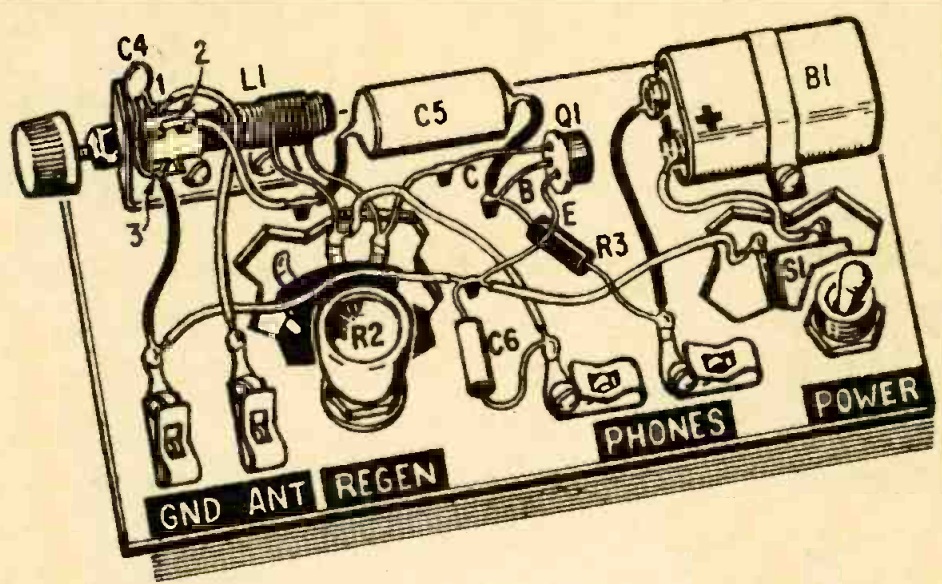
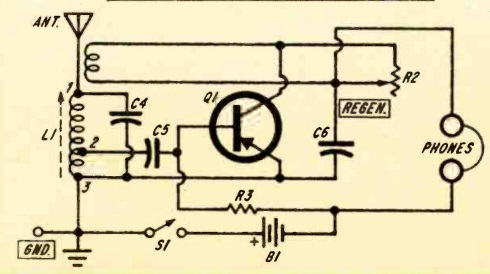
One tube serves as the regenerative detector, with the other tube serving as AF amplifier to drive the speaker.  The set uses what is called a “metal rectifier,” although a modern semiconductor diode would probably be much more reliable.

The set runs directly off the AC mains, and the article notes a number of safety precautions, and the article assures that “if the precautions mentioned are taken, and the receiver fitted in a wooden cabinet, it will be quite safe.”  In particular, in addition to being completely surrounded the an insulating cabinet, the article notes that all metal components must be insulated.  The knob on the tuning capacitor must be covered with a non-conductive knob (with the hole for the setscrew filled in with insulating material), the switch must not come in contact with the chassis. and the bolts holding the chassis to the panel must be covered.  The plans give instructions for wiring the set for either 110 or 250 volts.

1956radioconstructorschematic

Click Here For Today’s Ripley’s Believe It Or Not Cartoon


Knight Kit Star Roamer

1966octpe

Fifty years ago this month, the October 1966 issue of Popular Electronics carried this ad for the venerable Knight Kit Star Roamer receiver.  It used four tubes, a selenium rectifier, and two diodes to cover 200-400 kHz longwave and the broadcast band through 30 MHz.  It was an ideal first receiver for the shortwave listener.  Despite the low price, in contrast to similar sets of the era, it did contain a power transformer to keep the chassis isolated from the AC line.

In another post, I have a link to a review of this set.

Click Here For Today’s Ripley’s Believe It Or Not Cartoon


Editorial Endorsement: Gary Johnson for President

Today, we interrupt our normal programming and announce our endorsement for President of the United States.

I am a lifelong Republican, and have voted for every Republican nominee since Ronald Reagan in 1980. In some cases, I cast my vote enthusiastically. In other cases, I only reluctantly voted for the nominee. But in each case, I believed that the nominee more or less reflected the principles of the party of Abraham Lincoln and Ronald Reagan. I am also a card-carrying Republican, both as a precinct officer and delegate to the Minnesota state Republican convention (although the party would certainly be within its rights to remove me for publishing this endorsement.)

For the first time in 36 years, I will be voting for someone other than a Republican for the nation’s highest office. This year, I will be voting for the Libertarian nominee, Gary Johnson. It is with a certain amount of sadness, but also with hopefulness, that I publicly endorse him.

Obviously, this amounts to a vote against Trump, and I want to explain why I am voting against him. It is not because I subscribe to the conventional wisdom and believe that Trump is Another Hitler, because I don’t think he is. I might be wrong, but it seems to me equally likely that Hillary Clinton would actually turn out to be the Another Hitler. I don’t think she is either, but it’s just about as likely.

The real reason I’m voting against Donald Trump is because he fails to embody the principles for which the Republican Party has stood for over 150 years. First and foremost, the Republican Party is the party of Liberty–and that includes both personal and civil liberties as well as economic liberty. A free people best govern themselves when personal decisions are left to the individual, with an absolute minimum of government coercion.  That’s what Republicans believe, and it’s what I’ve always believed.

In the economic realm, this means that every person should be able to succeed or fail on his or her own merits. And as a conservative, I believe that the Free Market is in the least worst way of determining who should succeed and who should fail. If there’s no market for my product or service, then the public is best served if I fail and abandon that product or service in favor of another. My resources and my talents are wasted if I devote them to something the public neither wants nor needs. And the best way to deliver that message to me is to have consumers stop patronizing me.

If another casino is what we need, then the free market should bear that out for someone who wants to take the risk to open one.  But the full coercive power of government shouldn’t be called upon to decide that a casino is the highest and best use for private property.

I have no doubt that Donald Trump was a successful businessman. But he did not become a success by means of the free market. For the most part, he became successful because of what are euphemistically called “public-private partnerships,” or what we used to call Mercantilism. (Or what we could call Fascism, as the word was originally defined.)  He was successful because the full coercive power of the state sided with him. Perhaps another real estate developer would have been more successful, but we will never know that. The other real estate investor didn’t get the imprimatur of the regulators.

Hillary Clinton is no better. The only difference is that she sat on the other side of the table in many a “public-private partnership.” Her attitude is best exemplified in a 1993 quote in which she said, “I can’t be responsible for every undercapitalized entrepreneur in America.” This was in reference to whether health-care mandates would drive small businesses out of business. It didn’t matter to her, because she dismissed those businesses as “undercapitalized.” But they are undercapitalized only because they are not established players in a given industry. I used to believe the Democrats when they said that they cared for the little person in the fight against big business. But I started to notice that the largest established players in any given industry tend to favor greater government regulation. This is because the established players can bear the costs of overregulation, unlike their “undercapitalized” competitors and startups. It’s merely another way in which the government is able to pick winners and losers. The established competitor is favored by regulation, and innovative newcomers are locked out of the market.

There’s only one logical choice for President, and that is someone who exemplifies those principles that the Republican Party once stood for, and that choice is Gary Johnson. He’s a fiscal conservative, but more importantly, be believes in both personal liberty and economic liberty. He was a successful businessman, not because he received a favored position in a “public-private partnership,” but because he provided goods and services that the public wanted.

I don’t agree with Gary Johnson on every issue. Fortunately, however, he is not running to be the absolute dictator; he is merely running for President of the United States. He cannot act unilaterally on most issues. And critically, he seems to understand the Constitutional limitations of his office and would not act unilaterally.

I won’t catalog every issue on which I disagree, but I will mention the most troubling. Gary Johnson is apparently pro-choice. I am pro-life, and I believe that the state has a legitimate duty to protect innocent human life. To the extent that President Johnson acts in accordance with his stated principles, I will oppose him.

But I’m also aware that the President of the United States does not perform abortions, nor does he order that they be performed. He has no power to permit or outlaw abortion. Donald Trump claims to be pro-life (although he declared himself to be staunchly pro-choice in the past).  But whether or not the president is pro-life has little effect on whether innocent lives will be slaughtered. The nation’s policy on abortion should be, in my opinion, properly vested in the state legislatures, who have legislated criminal codes since before the beginning of the Republic. The policy is currently vested (improperly, in my opinion), in the judiciary. But it’s not currently vested in the federal executive branch, nor should it be. So in a sense, whether or not Gary Johnson is pro-life is irrelevant. More importantly, as a proponent of limited government, Johnson himself should see it as irrelevant to his office.

Donald Trump’s sole redeeming quality is his apparent willingness to appoint conservative justices to the U.S. Supreme Court. For example, one of the names that is allegedly on his short list is that of Minnesota Supreme Court Justice David Stras.  As a committed federalist, Stras, or someone like him, would be an excellent choice for the nation’s high court. Again, Trump’s pledge to nominate someone like Stras is the candidate’s sole redeeming quality.

But frankly, I don’t trust Donald Trump enough to vote for him based upon one single pledge. And given Gary Johnson’s apparent willingness to embrace the U.S. Constitution, I do trust him to appoint constitutionalist judges, even if he has not yet named names.

Roe v. Wade won’t be overruled by the executive branch, no matter how zealously pro-life the president happens to be. And it certainly won’t be overruled just because the candidate says that he’s pro-life, despite a long history of saying that he’s pro-choice. In my opinion, Roe v. Wade is a constitutional aberration that ought to be overruled. I believe that a constitutionalist judge would agree if the issue were squarely presented. And I believe that Gary Johnson is the most likely presidential candidate to appoint constitutionalist judges.

In short, Gary Johnson is not a perfect candidate. But he is the closest to a perfect candidate that I’ve seen in the past 20 years. More than any other candidate in the race, he best exemplifies the values of the Republican Party, whether or not he bears that label.

And no, I don’t believe that I am “wasting” my vote by voting for Gary Johnson. I have never voted for a candidate merely because I though he or she was going to win. In fact, as a Republican in a staunchly Democratic state, I rarely vote for the winning candidate. For example, I don’t believe that I have ever voted for a candidate for the state legislature who actually won. In every single legislative race since 1980, I have voted for the loser every single time.  For 18 straight elections, I have consistently voted for the losing candidate.  I’ve volunteered for losing candidates, knowing full well that they were going to lose.  I’ve even served as the campaign treasurer for a losing candidate, knowing full well that she was going to lose.  But I never considered my vote wasted. The purpose of the whole exercise is to determine who the majority supports.  And for that process to work, the people voting for the minority candidate must see their candidate lose.

This year, it’s quite likelty that I’ll be voting for the losing candidate for President.   But that’s nothing new for me.  Even if I do vote for the loser, I won’t consider my vote wasted.

However, I am not convinced that Donald Trump or Hillary Clinton will be the next President. I’m not the only person who believes that there should be another choice. I’ve seen as many Gary Johnson signs as I have seen signs for Hillary Clinton or Donald Trump. I’ve seen more support for Gary Johnson on social media than I’ve seen for either of the other candidates. If all of those people vote for Gary Johnson, then he might win. It’s a self-fulfilling prophecy to vote against him merely because he will lose.

It seems unlikely that Gary Johnson will be the winner as of election night. But it seems quite plausible to me that he will carry enough states to deprive either of the other candidates a majority in the Electoral College. If that happens, then our Constitution calls for the President to be selected by the House of Representatives, voting by State. In that case, the House will be called upon to select the President from among the top three in the Electoral College. In that scenario, it seems likely that Johnson would be elected, as the only palatable compromise candidate. No Democrat is going to vote for Donald Trump, and very few Republicans are going to vote for Hillary Clinton. Johnson is probably the only candidate who can win. Or to put it another way, members of the House would be wasting their vote by casting it for either Trump or Clinton.

Currently, Gary Johnson has more endorsements by major newspapers than Donald Trump. Most recently, the Chicago Tribune endorsed Johnson. For whatever its worth, OneTubeRadio.com now joins them in endorsing Gary Johnson for President.

Tomorrow, we return to our normally scheduled programming, consisting of pictures of old radios.

This page was prepared and paid for by Richard P. Clem. This page is not endorsed by any candidate or candidate’s committee. Minnesota attorney Richard P. Clem is solely responsible for the content of this page.

Click Here For Today’s Ripley’s Believe It Or Not Cartoon


Science Fair Idea: Homemade Cardboard Box Speaker

1966octradiotvexp

The young scientist or engineer looking for a relatively simple but interesting project for the science fair could construct the homemade permanent-magnet speaker shown here.  It appeared fifty years ago this month in the October-November 1966 issue of Radio-TV Experimenter.

The speaker is constructed inside a cardboard box, which also serves as the sounding board (which the article incorrectly calls a “cone,” which it would be in a normal speaker).

The only other components, aside from a few pieces of cardboard and glue, consist of a permanent magnet and wire. Just as in a commercially manufactured speaker, a coil of is mounted on a form surrounding the magnet. When an audio signal is applied to the coil, it and the top of the box are made to vibrate.

The 1965 plans call for a magnet from a burnt out speaker, and this would still be a possibility.  These days, a more prolific source of powerful magnets would be from the drives of defunct computers, as shown in this video:

Suitable magnets are also available from Amazon or many other sources.  These plans call for a coil of 75 turns of 30-gauge enamel wire, although the exact wire size is not critical. The original plans call for using the speaker with a radio or television. The simplest way to make the connection to a modern radio or MP3 player would be through the headphone jack. Another option would be to use an inexpensive audio amplifier such as the one shown below:

The use of an audio amplifier would also allow the use of a homemade microphone, such as one of those shown in an earlier post.  And for another somewhat more complex homemade speaker (or microphone), see this post.

Click Here For Today’s Ripley’s Believe It Or Not Cartoon


1966 GE Rechargeable Portable

1966sepelecworldFifty years ago, the September 1966 issue of Electronics World showed this General Electric transistor portable with a rechargeable battery.  It came with a detachable base containing a clock, which also served as the charger.  The battery was said to power the set for up to twelve hours after an overnight charge.

As seen from the headline, one notable feature was the fact that the set contained integrated circuits, and GE engineers predicted that all of their products would contain IC’s by 1970.

Citing the set’s reliability, GE offered a three year warranty, including the battery.

Click Here For Today’s Ripley’s Believe It Or Not Cartoon


Babi Yar, 1941

Soviet investigators view opened grave at Babi Yar, 1944.  U.S. Holocaust Memorial Museum photo.

Soviet investigators view opened grave at Babi Yar, 1944. U.S. Holocaust Memorial Museum photo.

Today marks the 75th anniversary of one of the largest acts of mass murder to take place during the Holocaust, the massacre at Babi Yar, on the outskirts of Kiev, Ukraine. On September 29 and 30, 1941, 33,771 Jews were killed at that ravine.

German forces entered the city on September 19, 1941. Prior to the German invasion, about 160,000 Jews had resided in the city, about 20% of the population. About a hundred thousand fled in advance of the Germans, and most of those remaining were women, children, the elderly, and the sick.

On September 29, the German military government issued the order shown here, requiring all Jews in the city to report, along with documents, money, valuable, warm clothing, and blankets.

The Nazis conducted the operation with efficiency. The Jews were ordered to proceed and give up first their luggage, then their coats, then their outer garments and shoes, and finally their underwear. By the time they knew what was happening, it was too late. By the time they heard the machine gun fire, there was no chance of escape.

They were led to a ravine about 150 meters by 30 meters. At the bottom of the ravine, they were made to lie down on top of Jews who had already been shot. A marksman, standing on the layers of corpses, then shot each in the back of the neck.

The corpses were then buried in the ravine, and the money, valuables, clothing, and even underwear was distributed to local ethnic Germans.

Shown here is Dina Pronicheva (1911-77), one of the handful of survivors of the massacre. She initially claimed that she was not Jewish and was only seeing someone off. The Germans decided to kill her anyway so that she would not be a witness. She played dead in a pile of corpses as the Nazis covered the mass grave with earth. She was eventually able to exhume herself. She was the only survivor to testify at the Kiev war crimes trial.

References

Read More at Amazon


Click Here For Today’s Ripley’s Believe It Or Not Cartoon