Author Archives: clem.law@usa.net

September 15 1945 Florida Hurricane

Miami Daily News, Sept. 16, 1945.

Miami Daily News, Sept. 16, 1945.

Seventy years ago today, September 15, 1945, a hurricane made landfall in Key Largo and then swept across Miami and Homestead, Florida. It was a Category 4 storm, and winds of 145 mph were clocked at Homestead Army Air Corps Base. Most of the city of Homestead was destroyed, and at Richmond Naval Air Station, a fire ignited during the storm burned down three hangars. 1632 homes were destroyed in Florida, and there were four deaths.

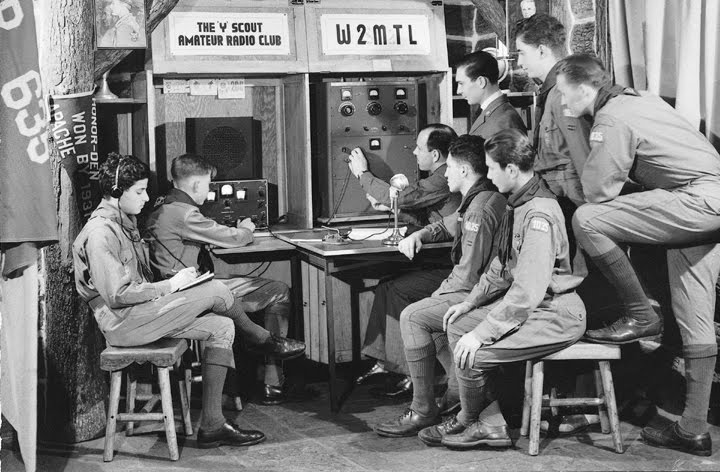
Amateur radio had not yet returned to the air after V-J Day, but hams were still available to help, since they formed the core of the War Emergency Radio Service, which had been formed during the War to allow hams to provide emergency communications for both civil defense and during natural disasters.

The November 1945 issue of QST reported “September Hurricane Finds Miami WERS Ready.” The Dade County civil defense operated under the call sign of WKNW, which used hams to link ten district headquarters stations to the main control station on the roof of the fifteen-story Technical Vocational Building. A Red Cross mobile disaster unit was also equipped with radio, as were a number of privately owned mobile units. Operations began as soon as the wind subsided enough for operators to get to their designated stations.

At the peak of the storm, all lines to the civil defense headquarters were down, and the WERS station, manned by hams and powered by an emergency generator, was the only link. When the phone line to Jackson Memorial Hospital went out, one of the mobiles was dispatched to that location, and contact was re-established in fifteen minutes.

When it was clear that Homestead had suffered damage, a convoy of vehicles set out from civil defense headquartrs. The antenna at headquarters had been repeatedly destroyed, and a temporary antenna was set up inside, with only limited range. Since it couldn’t reach Homestead, one of the mobile hams in the convoy backtracked until reliable communications was established. However, with the 2-1/2 meter equipment in use, it was not possible for that station to reach all the way to Homestead. It wasn’t until the third day that a reliable link was established between Miami and Homestead, after which a considerable amount of traffic flowed.

Singled out for praise were W4NB, W4AFF, W1KVB, W4CFC, w1JMT, and W4ANP, along with two other hams who were licensed after Pearl Harbor and hence had no amateur call sign.  Of those calls, the only one where I could find any later reference was Francis W. Jenard, W1JMT, who died in 1999, according to a QST Silent Key listing.  He was a member of the ARRL A-1 Operators Club, and you can see his 1963 QSL card at this link.


Click Here For Today’s Ripley’s Believe It Or Not Cartoon


Radio Goes to School, 1925

RadioSchool1925a

Ninety years ago, radio went to school, and these Kansas schoolchildren were starting their day by doing their morning calisthenics under the direction of Mike Ahearn, athletic director of the Kansas State Agricultural College. (Ahearn carefully avoided the word “exercise,” since he knew the children had been up for hours and had walked a mile or more to school.)  The same scene could be played out in any of the state’s 9000 country schools, but Ahearn was behind the microphone of the college’s radio station, KSAC in Manhattan.

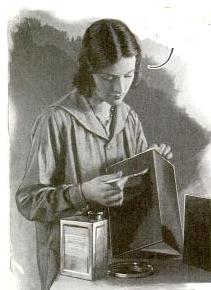
RadioSchool1925bBy September 1925, when these pictures appeared in Radio in the Home magazine, a good percentage of those schools had already been equipped with receivers, and plans were in place to add a radio set to all of them.  In the photo shown here, the antenna is mounted to the school’s belfry, and it is powered by the teacher’s Model T parked outside.

The college’s director of radio extension, Sam Pickard, was doing more with radio than just morning calistenics. The sets would be in place for Kansas farmers to attend statewide radio meetings of farm organizations, and they could be used on Sundays to receive church service broadcasts.  Pickard’s vision for radio saw him appointed two years later by President Coolidge as one of the first five commissioners of the Federal Radio Commission.

KSAC had first come on the air on December 1, 1924, broadcasting with 500 watts on 880 kHz. In 1928, it moved to 580 kHz. In 1929, the Topeka Daily Capital wanted to start a radio station, and asked the college whether it could share the frequency. Since the college couldn’t afford to keep its station on the air 24 hours a day, it quickly came to terms, and was able to boost its power to 5000 watts to match the new station, WIBW.

By the 1980’s, the college had been known as Kansas State University for 30 years, and KSAC got around to requesting call letters that would match the University’s name. However, the call letters KKSU had been assigned to a ship, and even though the ship was mothballed, the owner wasn’t willing to relinquish them. So the station became KEXT (Kansas Extension) for a time until finally getting the KKSU call letters.

Over the years, the commercial station, had tried to buy out the college station, but the college refused. It wasn’t until 2001 that they had relented. WIBW had carried Wildcat football, and the University was planning on moving it to another station. WIBW used the opportunity to point out a clause its 1969 contract with the University. In exchange for allowing WIBW to carry the games, the college had been allowed to extend its operating hours by an additional 15 minutes each weekday. Finally, the University agreed to sell out for $1.5 million. The games would go to the other station, and KKSU would sign off for the last time in November, 2002,

Kansas wasn’t alone in putting radio receivers in the schools. Radio was already installed in schools in Cleveland, Ohio, and the superintendant predicted that within a few years, American schoolchildren would be receiving ten percent of their lessons by radio. Some of the big stations were involved. For example, KGO was broadcasting to the schools in Oakland, California, and WLS in Chicago was broadcasting “Uncle Ben” Darrow’s Little Red Schoolhouse into 150 schools in Cook County, Illinois, and was also popular at schools in Illinois, Michigan, Wisconsin, and Indiana.

Click Here For Today’s Ripley’s Believe It Or Not Cartoon



Allied “Tiny Knight” Model B10509 & B10510, 1941


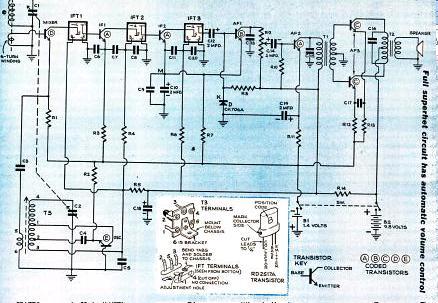
1941Allied4TubeIn an earlier post, we showed an inexpensive 1940 four-tube broadcast radio for $7.95 available at Walgreen’s. A modest radio such as this one would probably stay in service until the end of the War, because on April 22, 1942, the War Production board ended the production of civilian radio receivers. So if you had a radio, that’s the one you would have for the duration.

Shown here is probably one of the least expensive prewar receivers of all. This model, the “Tiny Knight” from Allied Radio is shown here in the 1941 Allied catalog, and had a catalog price starting at $5.30. It measured 6-1/2 by 4-1/4 by 4-1/2 inches and weighed four pounds, and was billed as being something that you could hold in the “palm of your hand.” It was marketed as a second radio, or for travel: “It’s so small you can pack it into any size suit-case or overnight bag and take it along when you travel.” But it was also billed as being “so low-priced that anyone can afford it.” At the tail end of the depression, it’s likely that more than a few households had a set similar to this one as their only radio. And with the ban on the manufacture of new radios, quite a few of these sets were what many families depended upon for war news.

The set’s four tubes consisted of a 12K7GT RF amplifier, 12J7GT detector, and 50L6GT audio amplifier, with a 35Z5GT serving as the rectifier. It tuned as high as 1720 kHz, making it capable of picking up police calls in many areas.

This set was a TRF (tuned radio frequency) receiver. On the same page, Allied showed its least expensive superhet, a five-tube model starting at $8.30.

The four-tube set was Allied model B10509 or B10510, depending on the cabinet.

Click Here For Today’s Ripley’s Believe It Or Not Cartoon


Cave Paintings of Lascaux, 1940

Lascaux_painting

220px-Lascaux_01Seventy-five years ago today,  September 12, 1940, eighteen-year-old apprentice mechanic Marcel Ravidat was exploring the caves near his home in Lascaux, France. The war was over in the “Free Zone” of Vichy France, and young Marcel went exploring a hole he had discovered a few days earlier, opened the prior winter as an oak tree had been uprooted by a storm.

What Marcel saw hadn’t been seen in over 15,000 years. He had 220px-Lascaus,_Megalocerosstumbled upon the entrance of a cave containing some of the most spectacular cave paintings ever found. He and his friends kept the cave a secret until finally revealing its location to a teacher known to be a scholar of the other less spectacular paintings in the area. During the war, the cave was used by resistance fighters to store weapons. In 1948, the cave was opened to the public. But the breath of the constant stream of visitors, along with exposure to the atmosphere, began to take a toll. The cave was finally closed to the public in 1963.

220px-Lascaux_IIAll images here are from Wikipedia.

References


Read More at Amazon


1940: FCC Announces NARBA Rules

BC091540

Saturday, March 29, 1941, was a big day in broadcasting in the North America. At 3:00 AM Eastern Time, most of the broadcast stations in the United States had to change frequency, due to the North American Radio Broadcasting Agreement (NARBA).  The agreement was signed in Havana in 1937 and ratified by the U.S. Senate in 1938. The ratification stipulated that it should take effect a year after the treaty was ratified by four of the participating countries, Canada, Cuba, Mexico, and the United States.

The treaty was necessitated mostly by the powerful Mexican “border blaster” stations which operated on the same frequencies as U.S. stations and caused considerable interference. For example, an earlier post details how Chicago’s WCFL suffered interference from XEAW in Reynosa, Mexico.

Mexico had no incentive to deal with the situation, since it had never been assigned any “clear channel” stations on which these powerful stations could operate. The interference was Uncle Sam’s problem, and Mexico had no reason to fix it. As an incentive, NARBA gave Mexico its own clear channels on 800, 900, 1050, 1220, 1550, and 1570 kilocycles. The rest of North America agreed to keep these channels clear for Mexico. And in return, Mexico would limit its superpower stations to those channels.

The make room for the new channels, the broadcast band was expanded. It had previously run from 550 to 1500 kHz. The new band would extend from 540 to 1600 kHz, where it remained until 1990 when the top of the band was expanded to 1700 kHz.

As a result of the change, 777 of the country’s 862 standard broadcast stations got their orders to move. In most cases, the stations moved up the dial. Near the bottom of the dial, the move was generally up 10 kHz. Toward the top of the dial, most stations moved up 40 kHz. For example, WCCO in Minneapolis moved from 810 kHz to its present spot on the dial at 830.

Over the next few months, there was a great deal of activity. Transmitters would need some tuning during the early morning hours of March 29. But the most pressing matter was new crystals, and the change put a strain on the country’s crystal manufacturers. Since most stations had a spare, stations were encouraged to buy the spare from an existing station on their new frequency and to sell their own spare to a station moving in. For broadcast engineers, the night of March 28, 1941, would be a busy one.

Radio dealers could also take advantage of an opportunity for some business. It was estimated that there were ten million sets in use with pushbutton tuning. The September 15, 1940, issue of Broadcasting
pointed out that a service call to reset the buttons should cost about $2, although any listener “who can read and handle a screw-driver” should be able to do the job. As the months went on, many radio dealers sought to capitalize on the opportunity to visit customers’ homes, and perhaps sell a new set while they were there.

On this day 75 years ago, September 11, 1945, the FCC announced the new channels. The headline shown above is from the September 15, 1940, issue of Broadcasting.  It marked the start of a six-month frenzy to make the necessary changes.

Click Here For Today’s Ripley’s Believe It Or Not Cartoon



Emergency Water Storage in Your Bathtub


Quick Links:


If you have advance warning of a hurricane or other emergency situation, it’s a good preparation to use your bathtub to store emergency water.  Even if you take no steps to sanitize the tub, simply filling it with water is a good idea, since you can use the water for many purposes, such as cleaning. However, unless you clean the tub thoroughly before filling it, you probably don’t want to actually drink the water from the bathtub. Also, the tub is uncovered, so the water can be contaminated. Finally, there’s the possibility that some of the water will leak down the drain. The plug is designed to hold the water long enough to take a bath. If it leaks even a tiny amount, the water could be gone in a few days when you need it.

The products shown here are designed to solve those problems, and they do. For some people, having one of these on hand could be cheap insurance. If you live in hurricane country, you should consider the problem, and having one of these might be part of the solution.

The products shown below are normally available on Amazon.   The first is the AquaPod, and the second is the WaterBob.  However, at the first hint of a hurricane approaching the U.S., they quickly sell out.  If you’re reading this before hurricane season, then it’s a good idea to order now if you think you will need one of these.  If you need a water storage solution and it’s too late to order, continue reading, since this page shows many alternatives.

For a less expensive alternative, see our later post about disposable bathtub liners such as the ones shown here:

Essentially, each of these products is the same: A large plastic bag, made of food-grade plastic, that fits inside your bathtub. The bag itself would burst under the weight of the water, but cradled by the bathtub (which was designed to hold water in the first place), the bag serves simply to keep the water sealed up safely. It also prevents the water from leaking in case the tub’s drain doesn’t have a perfect seal.

Each of these comes with a spout to fill the bag from the tub’s normal faucet. To get the water out, each of them comes with a hand pump to transfer the water to more convenient containers. So overall, each of these products is a good idea, since it gives you a convenient way to store between 65 and 100 gallons of drinking water. For some people, having one of these could be a good solution.

There are a couple of downsides, however, that you should consider. First of all, all of these are really only good for a single use. There’s no way to completely empty it. So once you’ve used it, you need to dispose of it. For that same reason, there’s really no way to test it. I’ve never heard of one of these having a leak. They appear to be well made, and it’s very likely that they will serve the intended purpose. But if it proves to be defective, there’s no way for you to know until the hurricane is bearing down, at which time it’s probably too late to get a replacement.

In addition, there is the matter of cost. While the prices are very reasonable, it’s still something that you hope you never need to use. And it’s possible that you’re reading this hours before a hurricane is expected to strike your area. If you don’t have one of these stored away, it’s probably too late to get one. So it’s important to think about alternatives.


Other Water Storage Alternatives

Obviously, clean water is one of your most critical needs during an emergency. Many emergencies could cut off your supply of tap water.  These could be a local  water line break, a hurricane, a winter storm or blizzaard, or many others.  If one of these is approaching, you should store water in all available containers, whether or not you have one of these. Your kitchen probably contains many pots, pans, and other containers, all of which were designed to hold items for human consumption. Your first order of business should be to fill them with tap water while that water is still safe to drink. Also, if you believe that the water might become unsafe at some point, it’s a good idea to turn off your water heater and turn off the intake valve. Then, you can get safe water from the tap at the bottom. (You’ll probably need to open a hot water tap on a higher floor in order for air to enter the system as you draw out the water.)

In addition, you can probably find additional containers in your recycling bin by making use of soft drink bottles. Simply clean them thoroughly and refill them with water. (Plastic milk bottles probably can’t be cleaned sufficiently to use for drinking water, although they also represent a way to store water for other purposes.)

If you are still expected to have power for a few hours, fill your refrigerator and freezer as completely as possible with water containers.  The ice and cold water will keep the other contents of the refrigerator cold, and it’s another source of clean water.

Even without a special liner, the bathtub can still be used for water storage.  You can clean it thoroughly for use.  Presumably, if you get every last bacteria, then you can simply drink the water.  However, you have no way of knowing whether you cleaned it well enough.  But even if the water is questionable, you could later purify it with bleach.

You’ll also need water for things other than drinking.  So even if you have plenty of drinking water stored elsewhere, filling the tub is cheap insurance.

If you do use the tub without a liner, you’ll want to make sure that the drain is completely closed and makes a good seal.  If you’re not sure, a piece of plastic and caulk can ensure that the tub will remain full.


Emergency Bathtub Water Storage With Garbage Bags

After filling all other containers in the house with water, you can also make your own bathtub liner in one of two ways.  The easiest would be to line the tub with clean plastic sheeting.  Then, simply fill it as usual.  It won’t be covered, but you can take care of that with additional plastic sheeting.

If you don’t have any plastic sheeting, you can also use normal garbage bags.  Of course, such a bag will quickly burst if you just started filling it with water, because it was never designed to hold that much weight.  But it will still keep the water contained.  And the tub will provide the required support.

The process of filling them is not particularly difficult.  Take enough bags to completely cover the surface of the tub.  With a normal household garbage bag, you will probably need four or five.  Place them in the empty tub, and open them up the best you can.  If there is any sharp edge in the tub, such as the drain, it’s best to cover it up with something like a washcloth.

When you have them placed, you’ll need to start filling them.  But you can’t immediately fill one of them all the way, because it won’t hold the weight.  The bag will need to be supported by the tub, and by the other bags.

Therefore, you need to take turns filling them partially, while they’re already in their assigned spot.  You won’t be able to get water from the faucet into the bags at the rear; so you’ll need to come up with another method.  If you have some kind of hose that you can attach to the bathtub faucet (or another nearby faucet), that would be easiest.  Lacking that, you’ll need to use another container.

Fill one bag part way, and then fill the one next to it to the same level.  Once you’ve filled all of the bags to the same level, go back and add more to the first one.  Eventually, all of the bags will be full, and snugly fitting in the tub.


When you pick the bags to use, make sure that you’re using ones that don’t have any kind of insecticide.  This is a case where cheaper is better.

When all of the bags are full, you can tie off the tops to keep them sealed.  Getting the water out will be slightly challenging, but not too difficult.  A pump of some kind would be ideal.  But if you don’t have one, you can simply use another container to remove water as needed.

Just as you filled them evenly, you’ll need to take the water out evenly.  You’ll need to take turns taking water out of different bags so that the water level stays about the same.

If one of the bags springs a leak, that’s not a major emergency.  You won’t be able to use that water for drinking, but it will still be safely contained in the tub for other uses.  And because the other bags are separately sealed, you can still drink that water.

waterstorageIf you need more ideas for storing water in an emergency, a good source of ideas is chapter 8 of Nuclear War Survival Skills.  Despite the title of the book, it is also an excellent source of information for practical ideas for other emergencies.  For example, the illustration here is from that book, and shows a man carrying ten gallons of water in burlap bags lined with a plastic trash bag.  You might not have burlap bags around the house, but you probably have pillowcases, and they will work as well.  You can also use a trash can or heavy cardboard box with a garbage bag as a liner.  (All of these will be heavy once filled, so you’ll want to put them where you need them prior to filling.)

Other Water Containers

Of course, if you know that a storm is coming, rather than relying on expedient solutions, it would be a good idea to have some containers designed for the purpose.  The links below show just a few of the many possibilities:


Other Helpful Links

For more information on emergency preparedness, please visit some of the following pages on my website:

Click Here For Today’s Ripley’s Believe It Or Not Cartoon


Private Anthony J. Theobald, 1894-1919


AnthonyTheobaldDuring the centennial of World War 1, this page periodically remembers American servicemen who gave their lives in that war.

Anthony J. Theobald was born  on January 17, 1894, in Buffalo Grove, Illinois.  He was the son of Mathias J. and Maria (nee Stiff) Theobald.   He served as a Private in the U.S. Army during World War I and survived until after Armistice Day.  However, he died of disease in Germany on March 4, 1919.

According to Martin County in the World War, he was a resident of Jay Township, Martin County, at the time of his induction into the Army as an infantry private at Fairmont, Minnesota, on July 26, 1918. He was assigned to the Headquarters Company, 54th Pioneer Infantry, at Camp Wadsworth, S.C. On August 29, 1918, his unit embarked from Newport News, Virginia, aboard one of the transports Duca d’Aosta or Caserta and arrived at Brest, France, on September 12, 1918, where he was engaged in the Meuse-Argonne Offensive from September 27 until the Armistice on November 11.

Thereafter, his unit was garrisoned in German towns in the vicinity of Wittlich and later Coblenz, and he continued service with the Army of Occupation in Germany, where he contracted pneumonia.

The unit’s history is available online.

Private Theobald died on March 4, 1919, at Neuendorf, Germany.  His death was announced in the War Department’s casualty list of March 21, 1919.  His body was returned to the United States and he was buried in St. Luke’s cemetery, Sherburn, Minnesota, in July 1920.

The photo here is from Soldiers of the Great War, Volume 2, Page 111.


Book Review: The Knowledge by Lewis Dartnell

WikiReader.

My website contains a review of the WikiReader. This little device set me back about $20. It’s apparently no longer available on Amazon, but there do seem to be examples available on eBay and elsewhere. It’s a small battery-operated device that contains in its internal memory (with some limitations) the full contents of the English language Wikipedia.

In other words, it contains what its manufacturer called “the Internet without the Internet.” If you’re transported back in time, if you get stranded on another planet or on Gilligan’s Island, or if the world suffers TEOTWAWKI (The End Of The World As We Know It), you’ll no longer have access to the Internet, but you’ll have a pretty good summary of just about any subject. The batteries of the WikiReader will eventually go dead, but before that happens, all you need to do is find the Wikipedia article on the history of the battery, take some good notes, and you’ll be able to whip yourself up a new one when the time comes. Once you’re settled in in your new era, you find an interesting article such as the one on the electrical telegraph, put together a prototype, and then make arrangements to demonstrate it to Julius Caesar or Louis XIV.

The WikiReader has a number of practical limitations, and I rarely use it. But it’s carefully put away just in case I’m involved in inadvertent time travel. In my pocket, I have the important knowledge of the 21st century. If I accidentally get stuck in a time warp, I’m going to make the best of the situation.

It appears that I’m not the only one who thinks that way. I recently got an e-mail from Amazon stating that customers who bought the WikiReader also bought a book with the intriguing title The Knowledge: How to Rebuild Civilization in the Aftermath of a Cataclysm by Lewis Dartnell. The book is available in the usual places, such as Amazon, amazon.ca in Canada, or your local library.

As the title suggests, the book is written for the benefit of some future inhabitant of Earth who needs to reconstruct (or “reboot” as  author Dartnell calls it) civilization after some sort of cataclysm.  The first chapter suggests some possible sources of the disaster, and the second chapter discusses the “grace period.”  After some types of disasters, such as a pandemic (such as happened in Earth Abides by George Stewart or in my own novel Caretaker), the survivors of the disaster have at their disposal the spoils of the earlier civilization.  It’s a relatively simple matter to eat canned food, set up generators, and take advantage of what was left behind.  In some cases, such as pandemic, that grace period might extend for generations.  In other cases, such as nuclear war, there will be fewer benefits available from the earlier civilization, and survivors will need to get to work right away tending to their immediate needs.

Dartnell doesn’t dwell a great deal on the grace period, since he correctly notes that numerous other survival manuals have been written.  What he spends most of his time talking about is rebuilding a technological civilization after the grace period has ended.  With a few exceptions (such as how to make soap), he doesn’t provide enough detail about any given technology in order to show exactly how they’re done.  But Dartnell does give enough clues in order to point survivors in the right direction.

For example, in the section on radio communication, he describes how to build a crystal radio, and he gives enough detail to allow the future archaeologist to recreate one.  He gives some of the theory, but no unnecessary theory.  In our current timeline, for example, it probably would have been impossible for society to come up with radio without first having an understanding of Maxwell’s Equations.  Instead, Dartnell gives only enough theory to make the thing work.  After building a few radios, the post-apocalyptic society would eventually come up with Maxwell’s Equations on its own.  So future history would follow the same general course, but in the opposite order from ours in some instances.

In addition to the plans for the receiver, Dartnell also gives enough detail so that someone could probably come up with a workable spark-gap transmitter.  I think the stumbling block for the future inventor would be coming up with an earphone sensitive enough to work with the receiver described.  Armed with theory in our own civilization, the telephone was created first, which gave the required prior technology.  Dartnell does qualitatively describe both a magnetic and piezoelectric earphone, but either one would require a great deal of trial and error.  In our own history, a skilled inventor would know enough theory to realize that sound would come out of a telephone receiver if hooked up properly.  If it didn’t work the first time, he would eventually figure out that he needed to make it more sensitive by adding more windings to the coil.  The post-apocalyptic inventor would have more trial and error.  But if he or she had enough faith in the book (perhaps because he knew that the soapmaking description was correct), that might provide the incentive to keep experimenting.  (Dartnell does provide the future inventor with Edison’s admonition that genius is 1% inspiration and 99% perspiration.)

Similarly, Dartnell gives enough clues to invent the triode tube.  There isn’t nearly enough detail to make one, but he tells just enough about the Edison effect so that a gifted future scientist could verify it, and some hints as to how this effect could be harnessed to provide amplification.  Dartnell mentions in passing that oscillation is possible, although I hope the future scientist figures out that feedback is necessary in order to get the thing to produce radio signals.

In order to jump-start science, Dartnell provides a few simple experiments to prove non-intuitive concepts, such as the Earth spinning on its axis (Foucault’s Pendulum) and revolving around the sun (stars rising four minutes earlier each night).   In case the surviving society has lost track of time, he shows how to establish the year, either by the proper motion of Barnard’s Star or changes in the night sky due to the Earth’s axial precession.  The book contains convenient charts showing the reader the year (as well as a map and picture to locate the Svalbard Global Seed Vault).

In short, the future reader will get a lot of useful information from this book.  In most cases, the ideas contained in the book will need additional details, but Dartnell points the future inventor on the right path for either experimentation, or at least a clue as to which ancient texts he or she should try to recover.  (The book contains an extensive bibliography to help the future inventor in that quest.)

Chances are, nobody would read a book entitled, “The History of Science and Technology.”  But when you get to the end, you realize that’s exactly what you read.  In detailing the easiest course for future civilization, he necessarily recreates our own.  There will, of course, be some differences.  For example, most readily accessible deposits of fossil fuels will be gone for the next civilization.  But he offers a number of workarounds.  And since the current nitrate supplies of our early civilization (see The Guano Islands Act for an interesting discussion of a seemingly mundane commodity) are also depleted, he goes into more detail regarding the relatively simple chemistry required to fix nitrogen from the air.  On the other hand, aluminum requires a great deal of industry to refine.  But in the case of a future society, even hundreds of thousands of years in the future, our dumps will provide ample mines of high-grade ore that will need little more than melting down and re-casting.

In short, if you bought a WikiReader after reading my review, then, yes, Amazon was right.  You’ll want a copy of Dardnell’s book as well.

More information, including a discussion forum, is at the book’s website:  the-knowledge.org

   Buy this Book on Amazon:
USA:                              Canada:

Click Here For Today’s Ripley’s Believe It Or Not Cartoon



KGEI, GE’s Shortwave Station

KGEI

Photo courtesy of John Schneider and Bay Area Radio Museum. Used with permission.

Seventy five years ago, this date’s issue of Radio Guide magazine concluded a two-part feature on GE’s short wave station KGEI.  Part 1 appeared in the August 31, 1940 issue, and part two appeared on September 7.

The station was owned and operated by General Electric and went on the air in San Francisco in March 1939. Short wave broadcasting was not new to GE. It first put a short wave signal on the air with station W2XAF in Schenectady, New York. That station later became WGEO. The next year, another transmitter was installed at the same site with call letters W2XAD, later WGEA. By 1940, WGEO was transmitting with 100,000 watts and was the world’s most powerful station. The two stations were popular with listeners in Europe and Latin America.

Golden Gate International Exposition, 1929-40. Wikipedia image.

Golden Gate International Exposition, 1939-40. Wikipedia image.

By 1940, KGEI was running 20,000 watts, but there were plans to increase it to 50,000. The Schenectady stations operated on 9.53, 15.33, and 21.5 MHz. KGEI broadcast on 9.67 and 15.33 MHz, and provided an additional signal to Latin America as well as Asia and Oceania. The station, both studio and transmitter, was part of GE’s exhibit at the Golden Gate International Exposition, and was located on Treasure Island, between San Francisco and Oakland. The Island was also to serve as a terminus for Pan American‘s Clipper ships, and the station was used to promote Pan American as well as GE. According to the article, “one of the most interesting and colorful programs is ‘Clipper Departure.’ This program is a dockside complementary describing the actual departure of the China Clipper for Hawaii, Guam and points westward. The captain and various members of the crew of the Clipper are interviewed, each contributing some bit about the interesting aerial journeys to and fro across the Pacific. Passengers ready to embark give their reactions as they prepare to set forth on their fascinating trip. The program concludes with the roar of the Clipper’s motors as it moves down the ramp and into the bay off to Hawaii on the first leg of its voyage to Manila and Hong Kong.”

THe station had a studio on the Exposition grounds, and it also carried network programming, such as Burns and Allen, Bing Crosby, and the Don Ameche Show.

Photo courtesy of xxxxx. Used with permission.

Photo courtesy of John Schneider and Bay Area Radio Museum. Used with permission.

The picture at the top of the page was taken in late 1939, and bears the KGEI call letters.  The picture of the transmitter and enclosed studio at the left was taken earlier in the year and shows the W6XBE call sign.  The public was allowed to be in the same room as the 50 kW transmitter, separated only by a flimsy guardrail.

After the Exposition, the station continued operation.  During the War, it remained under GE’s control, but at the request of the Government, did carry programming that was recommended.

The station was widely listened to, especially in the Phillipines. Many resistance fighters listened to the station,, which included broadcast in Tagalog. In 1954-55, the station carried broadcasts from Stanford University, billed as “The International University of the Air.” During that period, the University received 12,000 letters from listeners in Latin America.

In 1960, the station was acquired by the Far East Broadcasting Company, a religious broadcaster. Even though FEBC operated other stations in Asia and the Pacific, KGEI was directed mostly to Latin America, billing itself as La Voz de la Amistad (The Voice of Friendship). During the 1962 Cuban Missile Crisis, the station once again put under Government control. In fact, a Cuban listener wrote to the station in 1962, and his letter included the exact positions and descriptions of Russian missile sites. This hadn’t been publicized in the world press yet, but KGEI decided to reproduce this interesting letter in one of its fundraising letters. Unbenknownst to KGEI, that mailing list included the CIA, which hastily arranged a meeting and asked that such letters be made available to them prior to making them public.

A few months later, presidential Press Secretary Pierre Salinger called and informed the station that the President was requesting use of the station to rebroadcast the VOA. The station was reluctant, since it valued its voice as being independent of the U.S. Government. But FEBC was eventually convinced of the need to “volunteer” the station, and it carried VOA programming during the crisis.

KGEI remained on the air until 1994. The original 50 kW GE transmitter was donated to another Christian organization organization for use in Liberia. However, it was destroyed by rebels prior to going on the air. The station’s then main transmitter, capable of 250 kW, was donated to another organization for use in broadcasting to Russia from Alaska.

Acknowledgment

I would like to thank John Schneider and the Bay Area Radio Museum for allowing me to use the photos shown on this page, and for providing much of the information for this post.  More information about KGEI can be found on the Museum’s website.

References 

Read More at Amazon

Click Here For Today’s Ripley’s Believe It Or Not Cartoon


The Tank Turns 100

1915 “Little Willie” prototype. Wikipedia photo.

A hundred years ago today, a new era in warfare began as the first tank rolled off the assembly line.  The prototype, nicknamed Little Willie, weighed 14 tons, had a speed of only two miles per hour, and frequently got stuck in trenches. But as the bugs were worked out, the tank transformed warfare.

The vehicle was the brainchild of British Col. Ernest Swinton and Maurice Hankey, the secretary of the Committee for Imperial Defence. They pitched the idea to Navy Minister Winston Churchill, who organized a committee to beging making a prototype “land boat.”

The project was veiled in secrecy, and workers were told that the vehicles were to be used to carry water to the battlefield. In keeping with the deception, they were shipped in crates marked “tank,” and the name stuck.

British tank in action, Sept. 1916. Wikipedia photo.

British tank in action, Sept. 1916. Wikipedia photo.

Work continued to work out the bugs, and a more refined version was first used on September 15, 1916, at the First Battle of the Somme. It wasn’t an immediate success, but further refinements were made, and at the first Battle of Cambrai in November 1917, the British fielded 400, capturing 8000 enemy troops.


References

Read More at Amazon


Click Here For Today’s Ripley’s Believe It Or Not Cartoon