Author Archives: clem.law@usa.net

1938 Progressive Receiver

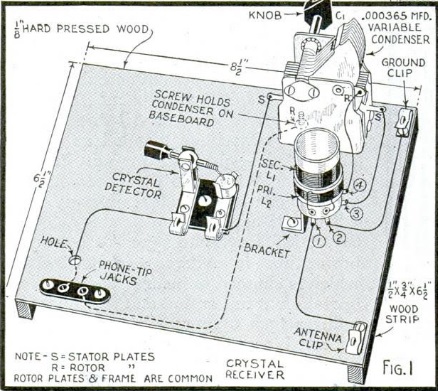
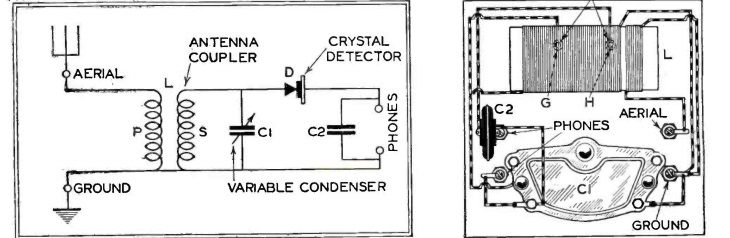
1938AugPMThe young man shown here, now in his early 90’s, is pulling in a strong local broadcast station with the help of a simple crystal set shown in the August 1938 issue of Popular Mechanics.

That, by itself, isn’t particularly remarkable, since a lot of kids constructed a crystal set.  But this young man has the added satisfaction of knowing that within a month, he’ll also be pulling in the weaker stations, and he’ll get loudspeaker volume on those strong stations, when he upgrades the set.  The construction article is actually a two-part article to be continued in the September issue showing two upgrades for the “progressive” receiver.

The first upgrade will replace the crystal detector with a tube.  A few additional parts will be required, but thanks to careful planning, all of the original parts (with the exception of the 12 cent detector) will be re-used.

1938AugPM1And as soon as he gets the one-tube broadcast set going, he’ll be able to get to work on the final upgrade, which will allow him to pull in the short waves by adding a few parts.  The original wooden chassis will be used for all three receivers.

As you can see from the pictorial diagram, the crystal set is a very basic model.  The only interesting angle is that the antenna coil features a primary that can be adjusted by sliding it over the secondary, allowing the set to be peaked for the maximum sensitivity.  When the set is upgraded (using an RK-43 tube), the primary coil becomes the tickler coil of a simple regenerative receiver, with the other half of the tube serving as audio amplifier.  The upgrade to shortwave isn’t shown, but we promise to include it in a later post.


1938 Majestic Charlie McCarthy

1938AugustRadioRetailerEighty years ago this month, the August 1938 issue of Radio Retailing carried this ad for Majestic’s Charlie McCarthy radio. It reminded dealers that the set wasn’t a novelty, but a high-quality six tube radio. The set was to be marketed in theaters, and dealers could reserve their share of the profits by acting fast.

The set is still popular with collectors, and you can see a restoration in progress at this video:


More Planning Advice for Time Travelers

Admittedly it’s unlikely that you’ll need the information, but we occasionally provide useful advice to keep in mind in case you’re ever inadvertently subjected to time travel. If you get caught in a time warp, the experience will be much less unpleasant if you do some minimal preparation.

For example, if you get sent back to the past, your situation would be much improved if you could “invent” some modern technology. Columbus could use some better navigational tools to determine that he had not, in fact, reached India.  Louis XVI would have been more likely to keep his head with a telegraph to better manage the affairs of his kingdom.  Just about wherever and whenever you arrive, you’ll have similar opportunities involving people who would be willing to pay handsomely for bits of technology that you can invent.

We’ve previously written about the importance of having a WikiReader, which holds the contents of the English Wikipedia in a handheld device.  And we’ve written about how to make the most difficult component of a radio receiver, the earphone, from scratch.

We’re confident that most of our readers will do well if they’re ever whisked back into time.

How to Figure Out the Date

In many situations, you’ll be able to determine the date easily.  If you’re in an urban area in the past few centuries, you can simply peek at a newspaper.  You can even  ask people on the street what year it is.  They might give you a funny look, but if more than one person gives you the same answer, it’s a safe bet that they’re telling the truth.  If they’re not clear on the concept of the A.D. scale, then you can determine things such as the name of the king, and use your WikiReader to figure out the year.

But in some cases, this information might not be quite so convenient.  Fortunately, the night sky provides a convenient clock, and with a bit of number crunching, you should be able to figure out the date.

Determining the Day of the Year

The first step is to determine the day of the year, and this is quite easy.  You simply observe the local sunrise and sunset times.  The sunrise and sunset times will be the same from year to year, so you can use a reference for any year.  Just note the time of sunrise and sunset, and see which day they correspond with.  You’ll probably come up with two possible dates, so you might need to check again to see whether the days are getting longer or shorter.  In the Northern Hemisphere, if the days are getting longer, then the date is after December 21 but before June 21.  If the days are getting shorter, then it’s after June 21 but before December 21.  The best source of sunrise and sunset times is probably the Old Farmer’s Almanac, although this information should be available in many places.  You can probably find it somewhere on your WikiReader.  Remember, the year of your source is unimportant, since the data will be about the same from year to year.

Determining the Year

The planets. NASA image.

The planets. NASA image.

Now that you know the month and day, you can move to the next step, namely, figuring out what year it is.  For this, you can use the planets.  The planets Mercury, Venus, Mars, Jupiter, and Saturn are all visible to the naked eye.  On any given date, each one of them is supposed to be in a particular spot in the sky, in one of the twelve constellations of the zodiac.   You start by finding these planets and noting what constellation they are in.

At this point, you can go to a website such as Your Sky, start punching in the various possible dates, and see which one corresponds to the observed data.  When you get a match, you know the exact date, at least within a few days.  For example, currently (1 August 2018), Mercury is in Cancer, Venus is halfway between Leo and Virgo, Mars is right between Capricorn and Sagittarius, Jupiter is in Libra, and Saturn is between Scorpio and Sagittarius.

So if I knew it was August 1, I would simply use that date, and repeat the process with different years until I found that the planets matched up with what I was seeing in the sky.  In this case, as soon as I plugged in 2018, I would see that it matched, and know that I guessed the year correctly.

How To Do This Without the Internet

Of course, I’m sure that by now you’ve spotted a big flaw in this strategy.  If you have the internet available, then you can just ask the internet what date it is.  But that website, and others like it, merely employ a relatively simple computer program.  You can find all of the information you need to calculate the same positions by using a book such as Practical Astronomy With Your Calculator or Spreadsheet.  It will contain all of the information you need to do the calculations, either with a calculator or computer, or if all else fails, with pencil and paper.  You can buy the book now, before the time warp.

On the other hand, you’re probably thinking that the likelihood of needing such a book is quite small.  If you don’t get stuck in a time warp, then it’s money wasted, and I would have a hard time arguing with you.  In fact, if you get sent back along with a public library, you’ll probably be able to find a similar book there.
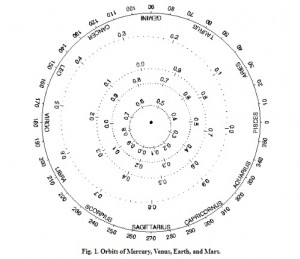
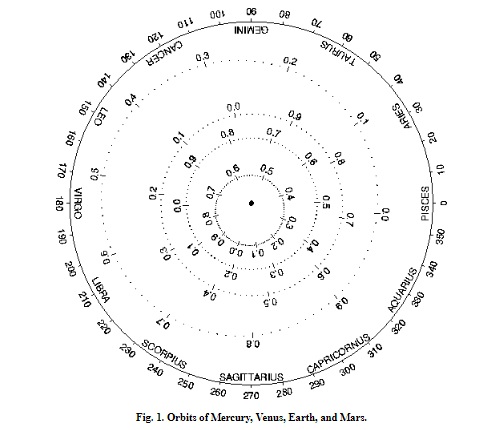
You'll want to use the full size version of this chart, which is available, along with complete instructions, at this link.

You’ll want to use the full size version of this chart, which is available, along with complete instructions, at this link.

But there’s still a minimal level of preparation with practically zero cost!  I found this homework assignment from a college astronomy course.  If you print this out before getting sent back in time, it actually includes all the information you will need to calculate the positions of the five visible planets!  It uses a graphical method:  Right there on the worksheet it gives the position of the planets as of a certain date.  You simply calculate how many times each planet will need to go around to reach that date.  After you do the division, the remainder is the portion of one orbit the planet is away from that spot.  You plot the position of both that planet and the Earth on the provided graph, and you can then see where in the sky the planet is located on a given date.

This method is not as precise as the computer programs, but those computer programs are designed to show you exactly where to point your telescope.  You don’t need that level of precision.  By graphing the general location of several planets, you will be able to confirm what year it is.

You should download (or better yet, print) that worksheet now, before the time warp.

Checking Your Work
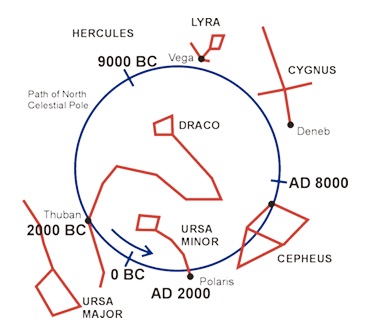
PrecessionOfEquinoxesTo confirm that you’ve picked the correct year, you might want to use another method.  It’s possible, for example, that all of the planets were in the same position in the sky on today’s date millions of years ago.  The best way to check your work is to use the precession of the equinoxes.  Simply put, the star Polaris is currently located at the North Celestial Pole.  In other words, all of the stars in the sky seem to revolve around this point.  But the celestial pole moves over time, following a 26,000 year cycle.   You’ll want to print the handy chart shown here.  Match up the pole star with the chart, and you’ll know where you are in the cycle.  For example, if you discover that Vega is the pole star, that means the year is approximately 11,000 BC (or maybe 12,000 AD).



1938 Knapsack Portable

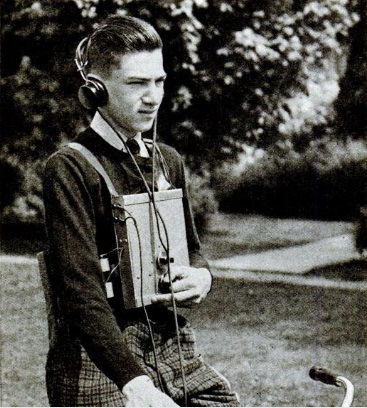
1938AugPS1938AugPS2The young man shown here is enjoying radio on the go thanks to the four tube portable knapsack set shown in the August 1938 issue of Popular Science.

Worn like a life jacket, the set allowed the wearer to tune in broadcast stations while biking or hiking. The radio itself is worn in front, with the loop antenna on the back, and with the batteries at the side. Featherweight headphones were recommended for listening long periods without fatigue.

1938AugPS3


Wartime Tube Shortages

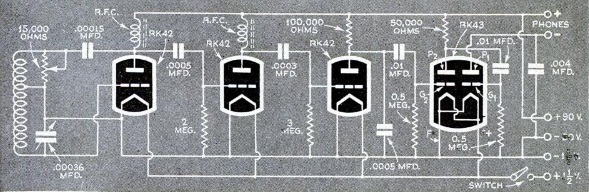
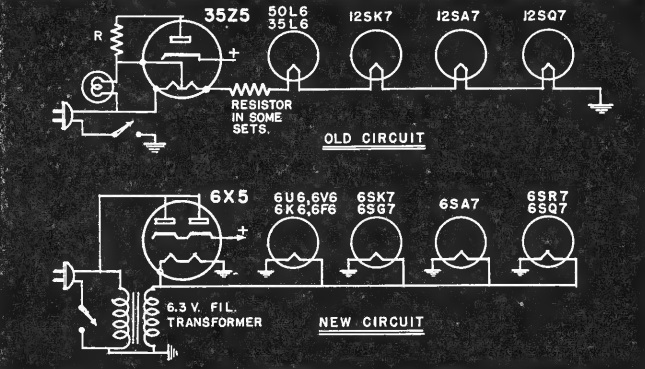
1943JulyRadioRetailingToday2Wartime parts shortages in 1943 meant that radio repairmen had to improvise to make do with what was available, and magazines were full of tips to allow substitutions.

The diagram shown here was sent in to the July 1943 issue of Radio Retailing Today by radio serviceman M.G. Goldberg of 142 E. 4th St., St. Paul, Minn.

Goldberg noted that tubes for the standard “All American Five” circuit were hard to find, but equivalent six volt tubes were still available, and that 6 volt filament transformers were also fairly easy to come by in most areas. So one solution to the problem was to replace the series-string tubes with 6 volt equivalents, as shown here. This particular version meant that the tube sockets could be kept as-is, other than rewiring the filaments. The article also suggested other possible substitute tubes, although other substitutions would require rewiring the sockets.

The Floating Library

FloatingLibrary1At OneTubeRadio.com, we rarely discuss matters of practical importance. Yes, we do have one emphasis on emergency preparedness, but even there, we hope it’s never of practical value.

Most of the other information we share is of no practical value. We’ll show you how to build a crystal set or a one-tube radio, but we both know that a modern commercially built radio will probably work better at a lower cost. Setting up an amateur radio station at a remote location rarely has much practical value, especially since cellular service is usually (but not always) available. Our science fair ideas are sometimes spectacular, but they probably have no useful value. And even having our URL transmitted from the moon and received in Argentina was hardly a useful undertaking. We even occasionally offer advice for coping with inadvertent time travel, although we have to admit that there’s probably no real need for such preparations.

So this afternoon, it’s not surprising that the kids and I brought the OneTubeRadio.com official corporate vehicle, a 1998 Old Town canoe, to Lake Phalen to visit The Floating Library.

Kennedy, in a blue suit and tie, speaks at a wooden podium bearing the seal of the President of the United States. Vice President Lyndon Johnson and other dignitaries stand behind him.

Kennedy’s “We Chose To Go To The Moon” speech. Wikipedia photo.

On September 12, 1962, President Kennedy said:

We choose to go to the Moon in this decade and do the other things, not because they are easy, but because they are hard; because that goal will serve to organize and measure the best of our energies and skills, because that challenge is one that we are willing to accept, one we are unwilling to postpone, and one we intend to win, and the others, too.

No, there’s no good reason to set up a floating library, and there’s no good reason to go visit one. There are plenty of books in libraries located on terra firma. (And unlike most land-based libraries, The Floating Library didn’t even have WiFi.)  No, there’s no good reason to build a crystal set. No, there’s no good reason to build a flame speaker. But we don’t do these things because they are easy. We do them because they are hard.

FloatingLibrary2Weather permitting, The Floating Library will be back at Lake Phalen next weekend, August 4-5, 2018. If you own a small boat, canoe, or kayak, you can launch it from the shore. If you don’t own one, you can rent one there. I can’t tell you any good reason to go, other than that it’s hard. But that’s a good enough reason to go.


1928 Beginner’s Crystal Set

1928JulyRadioNews2Ninety years ago this month, the July 1928 issue of Radio News carried the plans for this simple crystal set. The magazine noted that the multi-tube sets could pull in distant signals, but there was something to be said for the thrill of receiving a local station on a simple receiver built at very low cost. It noted that the majority of receivers in Europe and other parts of the world were still crystal sets, and that the crystal set was actually superior when it came to the quality of the signal received, since there was no distortion caused by the tubes. And added bonus was the lack of operating cost, since not battery was required.

The magazine especially reminded parents that if a boy was interested in radio, then a good way to keep him out of mishcief was to get him started building his own. The simple set would pull in the local stations, and also give him insight into doing things for himself.

1928JulyRadioNews3


What’s Old Is New Again: ARRL Governance

ARRL W1AW building. Wikipedia photo.

There’s a theory that history generally follows 80 year cycles.   The reason seems to be that when the last people to remember the past die, then their descendants repeat the same mistakes.  The American Revolution, the U.S. Civil War, and the Second World War were American historical landmarks separated by approximately 80 years.

A letter published 80 years ago seems to confirm this theory.   The August 1938 issue of Radio News (page 36) contains a letter by newly elected ARRL director Fred Young, W9MZN.  Young recounts showing up at his first board meeting under the impression that he was sent there to represent the members who elected him.

But when he presented those ideas, they were dismissed as “ill-advised,” owing to a supposedly uninformed membership.  To that, Young suggested that the members ought to be informed, and suggested doing that by having the issues be fully argued in the pages of QST.  But this idea was quashed.  Young also noted that the ARRL was “very largely a publishing concern.”

The ARRL has done a reasonably good job in representing the interests of members over the past 80 years, so I suspect that Young had some measure of success.  But history repeats itself, and today, practically the same issues are once again at the forefront of ARRL politics.  Many members (myself included) believe that the League is dangerously close to no longer being a member service organization and turning completely into what Young called a mere “publishing concern.”

I encourage all ARRL members to inform themselves on how the ARRL governs itself.  You’ll find a background on the issues at the myARRLvoice website  and Facebook group.  I encourage you to contact your director and let your voice be heard.  And if you live in the Hudson (parts of New York and New Jersey) or Northwest (Alaska, Washington, Oregon, Idaho, Montana) Divisions, I encourage you to consider supporting Ria Jairam, N2RJ and Mike Ritz, W7VO in their bids for election to the board.

Like Fred Young 80 years ago, they seem to get it that the League is “of, by, and for” the Radio Amateur.

Here’s what Fred Young had to say 80 years ago.  But most of it could be written today:

Impressions of the 1938 ARRL Board Meeting by FRED W. YOUNG, W9MZN, ARRL Dakota Div. Director

A NUMBER of things impress the newcomer to the ARRL Board Meeting. I may have been a bit self-conscious and conspicuous as the only Director who had not attended at least one previous meeting. In any event, it can be said that my notions as to what constitutes representing a division differed widely from those held by most of the other members of the Board.

Prior to attending the meeting, I had sent a letter to every ARRL member in the Dakota Division advising what important issues faced the League. A brief questionnaire was included covering the major issues likely to come up as well as the proposed changes in the Constitution and By-Laws. It seems now that the meeting is over, that I certainly misunderstood section 14 of the Revised June 1937 Constitution and By-Laws which reads “… They (Directors) shall keep themselves informed on conditions and activities in their respective divisions, and on the needs and desires of the League members therein, that they may faithfully and intelligently represent them in the Board of Directors.” It is my understanding of this passage that the director is to present and attempt to carry out the wishes of the members when they are known. In each case, I voted as a majority of my constituents wished as shown by the questionnaires returned, and if their wishes did not come up as a motion by another Director, I presented such a motion.

For attempting to carry out such a policy, I was placed at some discomfort a number of times, and roundly criticized by officials and Board members at others. A number of remarks were made concerning the questionnaire results which I took occasion to mention several times. Such results could not mean anything, some felt, because members were not properly informed on issues. Others dogmatically said that the membership took no interest in amateur affairs except concerning frequency allocations. Still others felt that a Director is not bound to follow the wishes of the majority in his division. Speaking of some of the desires of the majority of the Dakota Division membership reporting, one member of the Board said that they were “half-baked” which he later changed to “ill-advised” when I pressed him to justify his statement.

The Secretary took occasion to say that it was too bad that I was so poorly informed on League affairs (all I know is what I get from him), seeming to take the officious attitude that anyone who would criticize any of the League policies or practices must be uninformed.

As many of you know, I attempted to keep members informed and interested concerning the Board meeting by arranging with W9PZU to broadcast late developments, and during the meeting, brief summaries of its action. A member of the Board took occasion to say to me that such action was ill-advised because it tended to agitate the members concerning the Board meeting.

I was much impressed by the rather arbitrary presumption on the part of most Board members that the membership as a whole was not interested in League policies and affairs. Most of the Directors admitted that they had not made any attempt to canvass their divisions. Many took the attitude that even though the membership is canvassed or seemed interested, results would necessarily be based on misinformation or insufficient information, and therefore, in any case, not worth serious consideration. Thusly do members of the Board excuse themselves from any systematic effort to find out and carry out the wishes of their constituents. The results of my questionnaire canvass showed that members were interested in League affairs. To accuse the membership of being uninformed seems, in my opinion, very unfair because I think that the Director, QST, and the officials should see to it that it is informed.

Further, the Board seemed to take the position that the Director should wait to make up his mind on issues until he had heard the ideas of the other Directors, seeming to place much value in pro and con discussion. However, when I introduced a motion to permit pro and con correspondence to be published in QST over the Director’s signature, the Board voted it down. Then they have the audacity to take the position that the Member is both uninterested and uninformed, and therefore unable to state a wish or opinion that can be counted to be worth anything. I feel that if anyone is at fault in this situation, it is the Board with this attitude.

I still have the conviction that the Directors should keep faith with the majority in their Divisions, that the ARRL is very largely a publishing concern that as such can expect very little government or legislative support; and that the HQ officials are very anxious to keep important issues from members and to keep membership unrest well isolated. To this end they are opposed to conventions on the ground that they are badly managed and often indecent (admittedly some are). I feel that the real reason for this opposition, however, is because conventions permit amateurs to get together, find out what other amateurs are thinking, which might result in criticism becoming too articulate. They are also opposed to opening QST to any critical articles or differences of opinion for the same reason.

It is further my conviction, even after the Board meeting and the majority notwithstanding, that there should be a bigger part for the membership in League affairs, that there should he a budget of expenditures, that the League should be made much more than just a publishing concern, that the HQ station and HQ should be near the center of the US, and that a verbatim report of the Board meeting would be most interesting to the membership, presumably in their behalf.

Previously I felt that the HQ staff was at fault in the conduct of League affairs. Now I am definitely of the opinion that the fault lies with the Board itself. Some Directors demonstrate outright apathy, others a presumptuous tendency to speak for member whom they have never consulted. Most of them seem perfectly willing to take at their fact value the statements and attitudes of the HQ staff. Too many are on the Board without actuallv having been elected by members of their divisions through indifference to technicalities in qualifications.

I maintain that Directors should try to stir up interest and  participation even if it results in competition in elections. In my way of thinking, the HQ staff feel they have a good thing of it, and therefore, want no change. With things as they are, one can hardly blame them for that position, but I do feel that the Board should be more critical in its action.

If the membership is not taken into confidence, coming events are likely to weaken or destroy the effectiveness of the League. The Secretary mentioned at the meeting that it was his opinion that at the next international conference at Rome four years hence, the amateurs will lose both the forty and twenty meter bands. It is likely that no official QST mention will be made to amateurs at large of this condition. Should this loss happen as is predicted, the League will be severely criticised unless members are prepared for it by being acquainted with European conditions which will foreshadow this loss.

Again I must say that positive action awaits an alert, vigorous, and militant membership which must be solicited from the rank and file of those amateurs presently outside as well as inside the League.

1968 Junior High Radio Club

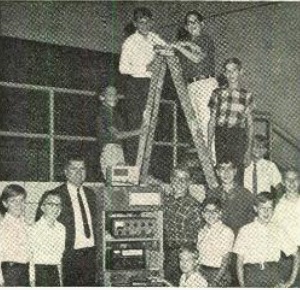
1968JulyPE4This grainy picture appeared fifty years ago this month in the July 1968 issue of Popular Electronics. It shows the members of the Howland Junior High School Radio Club of Warren, Ohio. The adviser is George Watson, WA8HDQ, and the club held the club callsign WA8ODB. According to the camtion, four of the club members had their novice license, with six more well on their way.

THe station consisted of an EICO 720 transmitter shown above the Drake 2B receiver. On top is a Heathkit Twoer two meter AM transceiver, affectionaely known as the Benton Harbor Lunchbox.

WFAA Dallas, 1938

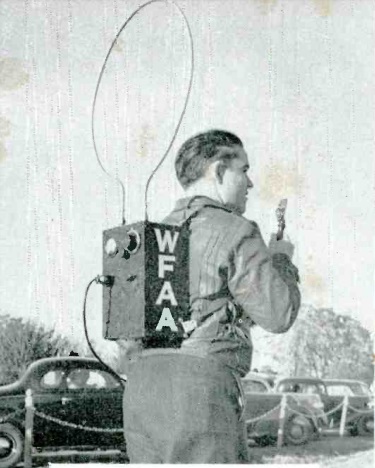
1938JulyRuralRadioDoing remote broadcasts eighty years ago wasn’t a problem for WFAA Dallas, as shown by this photo from the July 1938 issue of Rural Radio magazine.  Newsman Earl Kalusche is shown wearing the station’s pack transmitter, which allowed him to “wander about to describe interesting events.”