Author Archives: clem.law@usa.net

1968 Soviet 10 Meter AM QRP Transmitter & Receiver

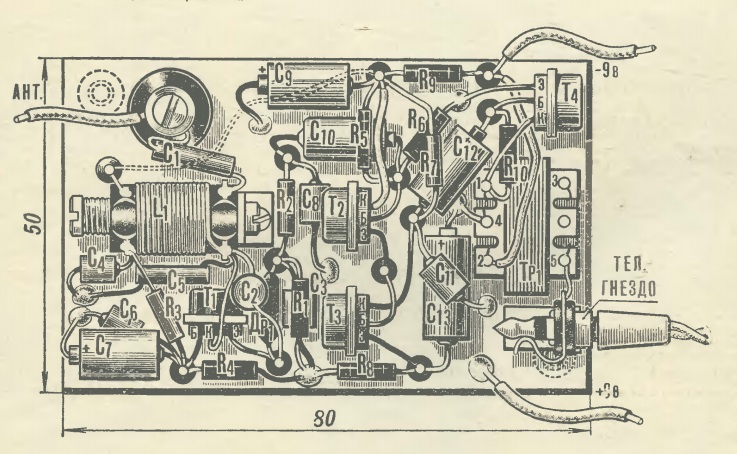
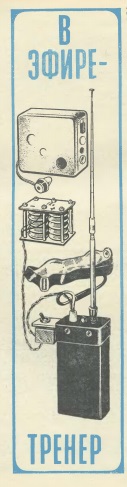
1968-07Model1I’m not quite sure what the function of this Soviet electronic project was. It appeared in the magazine Моделист конструктор (Model Designer) issue number 7 of 1968, with the cryptic title “In the air – the coach.” The magazine covers model building, so at first I assumed that it was a radio control transmitter and receiver. But the transmitter appears to be connected to a microphone, and the receiver is connected to an earphone. So it appears to be intended for voice communication, and it appears to be for the 10 meter amateur band. The text mentions “300 – 500 meters,” so I assume that’s the intended range of the set. Elsewhere in the magazine is a discussion of “what is the procedure for registration and operation of amateur receiving and transmitting radio stations.”

In any event, the illustrations speak for themselves, and presumably some young comrades put together this QRP 10 meter AM station. Here’s the schematic and pictorial diagrams of the transmitter:
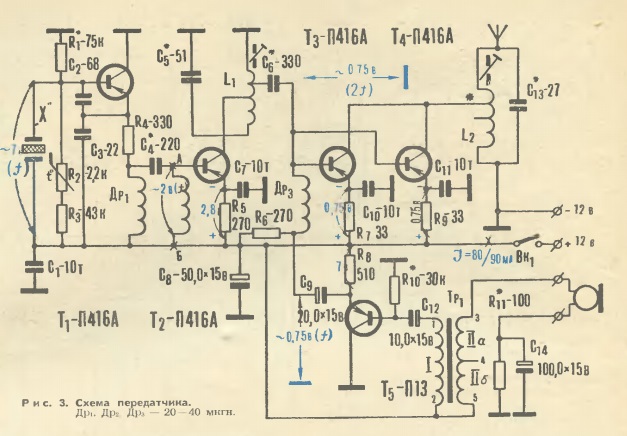
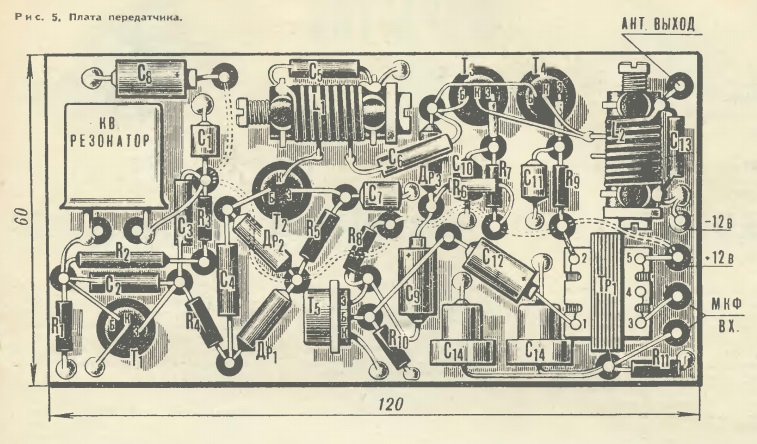
1968-07ModelTransmitterSchematic

1968-07ModelTransmitterPictorial

And here are the schematic and pictorial diagrams of the receiver:
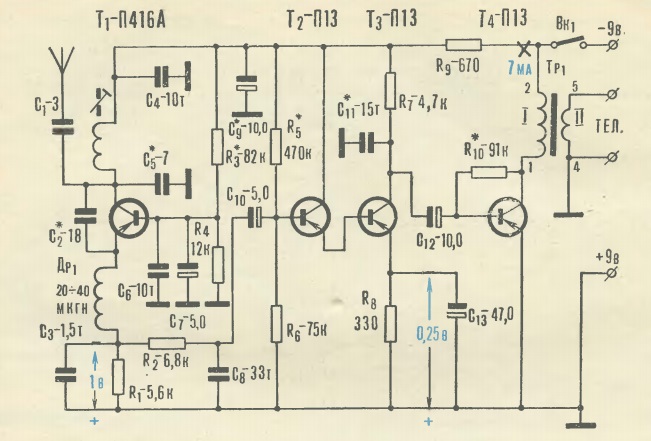
1968-07ModelReceiverSchematic

1968-07ModelReceiverPictorial


Happy Birthday OneTubeRadio.com

kids_image_movies_114868045

We pause from our normal programming today to celebrate the fifth anniversary of OneTubeRadio.com.  Our very first post appeared on October 16, 2013.

We thank all of our loyal readers, and look forward to continuing to provide a unique perspective on the history of radio, as well as other related (sometimes surprisingly) and unrelated content.


Uncle Sam & Kaiser Bill Novelty, 1918

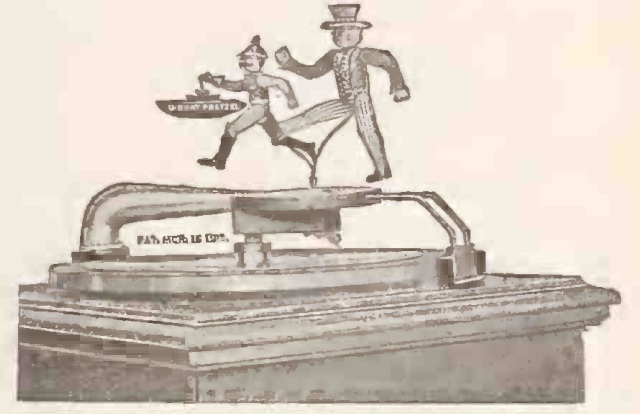
1918OctTalkingMachineWorldA hundred years ago this month, the October 1918 issue of Talking Machine World showed this amusing yet patriotic accessory suitable for use on the phonograph when patriotic records were being played.

The figures of Uncle Same and the Kaiser were mounted on the tone arm, and when the music started, Uncle Sam would commence kicking the Kaiser, who was busy playing with his U-boat.

The magazine included the following quote, taken from the New York Sun:

UNCLE SAM KICKS KAISER TO MUSIC

Canned Chastisement Amusing to Sidewalk Crowds.

Uncle Sam, in front of a large and enthusiastic audience, spent most of yesterday kicking Kaiser Bill where such kicks belong. The kicking kept time with martial airs played on a phonograph. The little “Kaiser kicking toy” is for attaching to phonographs so that when songs which have as their theme the “canning” of the Kaiser are play.

Alas, the Armistice came the next month, so it’s difficult to know how many were ultimately sold for $1.50.  But they were available from the National Company, “mechanical specialty manufacturers,” of 281 Congress Street, Boston.


1948 Periscope

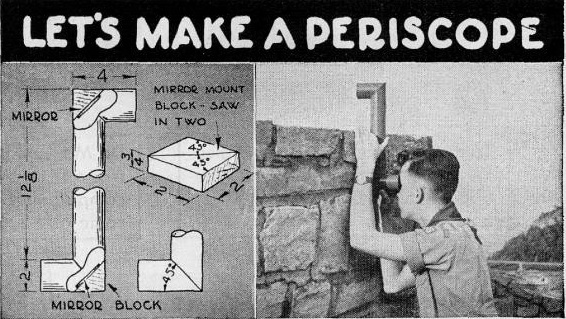
1948OctBLFor anyone desiring to see around corners, the periscope is the ideal solution to the problem. 70 years ago this month, the October 1948 issue of Boys’ Life showed how to make this simple but effective model.

In addition to a small wood block, only two parts were necessary.  And if you can’t find them locally, you can order them on Amazon:  Two two-inch mirrors and an 18 inch, 2 inch diameter mailing tube.  For making the precise 45 degree cuts, a miter saw was recommended.  Rounding out the bill of materials was some glue, and black shoe polish to paint the interior angles to reduce glare.

For older scouts, the completed periscope could be a useful tool for any number of purposes.  And for younger students, the project could serve as the basis for an interesting science fair project.

And for the more impatient modern youth, another option is to simply buy the genuine plastic periscope shown here.
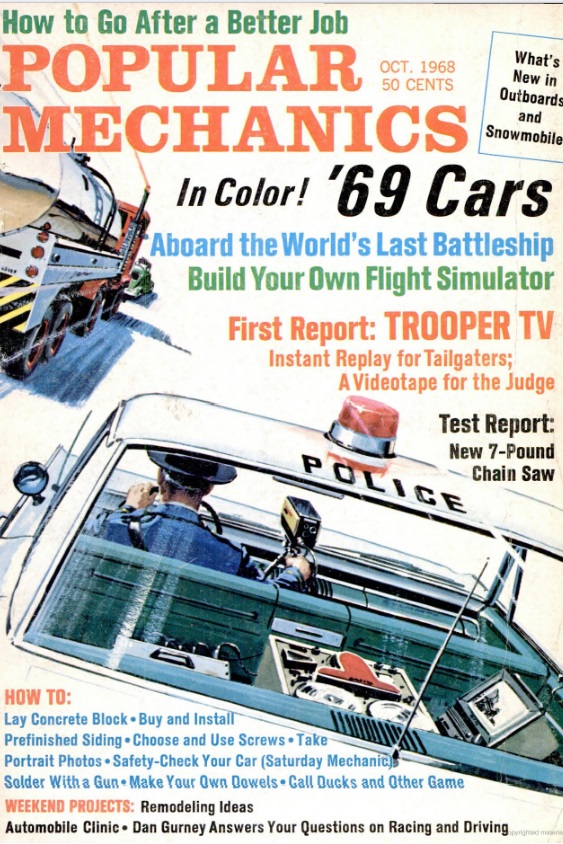


1968 Police Dash Cam

1968OctPMFifty years ago this month, the October 1968 issue of Popular Mechanics shows this early rendition of a police dash cam.  According to the magazine, the Connecticut State Police had just started using the system shown here. The Sony camera was mounted on the dash, with a small microphone hanging around the officer’s neck. The back seat was taken up by the video recorder and monitor. The system ran entirely on 12 volts, at a cost of “less than $2000.”

The article quoted Sgt. Nelson Hurlburt, who reported that he simply let the tape keep running while on patrol. The tape had 30 minutes of recording time, so if he didn’t catch anything at the end of that time, he rewound the tape and started over. The lens was adjusted three times, at the beginning of his shift, again at 10:00 AM, and then again at dusk. The camera could automatically adjust to changing light levels during the day.

The magazine noted that the videotape evidence made a compelling case to the driver who was pulled over or, if necessary, in court.


Hurricane Michael Links

Hurricane Michael. NOAA image.

Hurricane Michael. NOAA image.

With Hurricane Michael bearing down on the Gulf coast, here are links to earlier posts on hurricane preparedness:


KIRO 1968 CB Traffic Reports

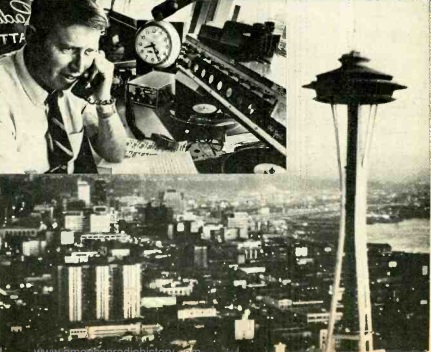
1968OctRadioElecThis photo from the October 1968 issue of Radio Electronics shows KIRO Seattle disc jockey Jim French taking a traffic report via CB radio. The article noted that instead of depending on helicopter reports, the station had a network of 40 CB-equipped motorists sending in live reports. The studio and CB antenna were located atop the 600 foot Space Needle. The location ensured a coverage radius of 20 miles, but the QRM was described as unbelievable at times.


1928: Buy or Build?

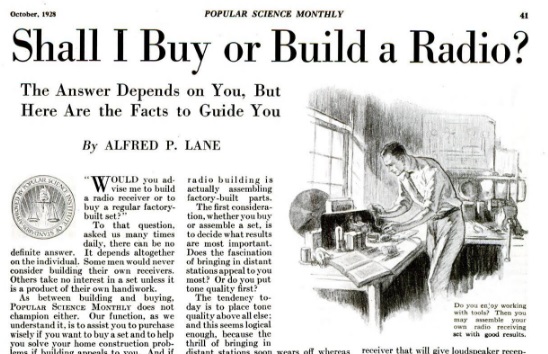
1928OctPSNinety years ago this month, the October 1928 issue of Popular Science tackled the vexing question of whether you should buy or build your radio receiver. The magazine noted that as between building and buying, the magazine championed neither option. It viewed its function as assisting with a wise purchase for those who so desired, or to help solve home construction problems for those who decided to build.

The gentleman shown in the illustration opted to build, and the magazine noted that if you enjoyed working with tools, then assembling your own set would yield good results.

It noted, however, that building a radio was really a misnomer. It was really a matter of assembling factory-built parts.

Either way, the magazine stressed that it was important to identify your needs. Was bringing in distant stations the main appeal, or did you put tone quality first?  By first answering these kinds of questions, the radio consumer would wind up with a suitable set, whether they decided to buy or build.


Canadian Red Cross Packing Plant, 1943

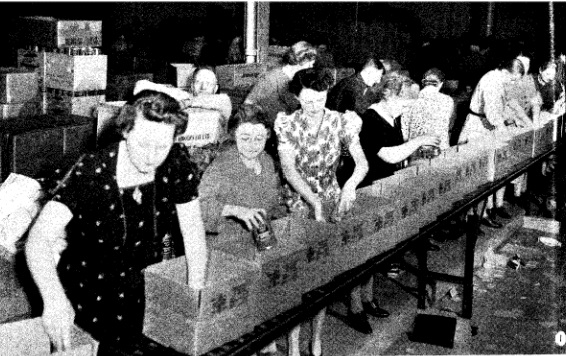
1943OctManitobaCallingThe Canadian women shown here are volunteers packing prisoner of war Red Cross food parcels on their way to Canadian POWs, primarily in Germany and Italy.

The photo appeared in the October 1943 issue of Manitoba Calling, the magazine and program guide of CKY Winnipeg.  It shows the Red Cross packing plant in Winnipeg, the largest of five in Canada. The plant was staffed five days a week by volunteers and turned out food parcels at a rate of 4400 per day. The plant was described as businesslike, with two long conveyor belts. As the parcels moved down the line, a woman placed a food product in the same spot in each box. Items were picked for their nutritive values, and included chocolate, raisins, tinned butter, and corned beef. An acknowledgement card was included in each parcel, which were signed by prisoners and returned by mail to the Canadian Red Cross as proof of delivery.

From Canada, the parcels went by sea to Lisbon. From there, they were taken by Red Cross ships to Marseilles and then by train to Geneva to the warehouses of the International Red Cross. From there, they were distributed within the enemy countries.

The magazine noted that many of the volunteers were related to prisoners, 900 of whom were Manitoba boys.


1943 Toothbrush Twins

1943OctPM2

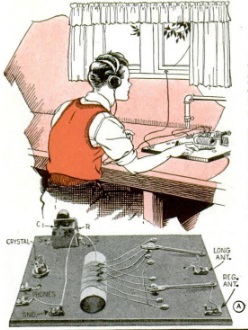
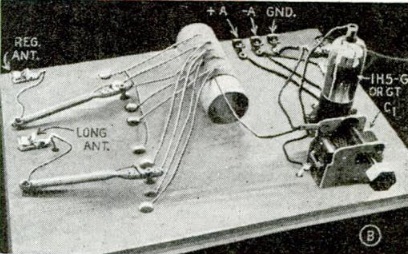
1943OctPM3If you look closely at this picture from the October 1943 issue of Popular Mechanics, you’ll see a 1H5 tube lying on the table. This means that the trio shown here decided to build the one-tube version of the receiver described in the issue. Included were the plans for two almost identical receivers, the difference being that the one shown at left used a crystal detector, while this group decided to tackle the only slightly more complicated,tube version, shown below.

1943OctPMTubeFor either set, as long as the builder had a good set of headphones, a quick look at the junk box, or a trip to the dime store, would produce the necessary parts.

Either set was mounted on a 10 x 13-1/2 inch breadboard, with the coil wound on a toilet paper tube. The coils were tapped and hooked to the switch that gave the sets, the Toothbrush Twins, their name. The switch was made with the handle of a toothbrush from which the bristles were removed with a pair of pliers. This was used as the slider, which contacted thumb tacks layed out on the board with the help of a compass.

If a shorter antenna was used, this was fed to the coil. A longer antenna had its own Fahnestock clip, and bypassed the coil.  Either set was said to provide excellent results with local stations, with the tube version showing a bit more selectivity.

1943OctPMSchematics