I endorse P. Paul Yang for Seat 20, Ramsey County District Court.
As a lawyer, people occasionally ask me about the judicial races on the November ballot. This year in Ramsey County, there is one important judicial race on the ballot. Like most voters, I normally vote for the incumbents, unless there’s a compelling reason to do otherwise.
In this year’s election for Ramsey County District Court, I believe that there is a compelling reason to vote against one of the incumbents. Therefore, I endorse P. Paul Yang in his challenge to incumbent Judge G. Tony Atwal.
Mr. Yang graduated from my alma mater, Hamline University School of Law, in 2002. A Hmong-American, Mr. Yang came to the United States as a child refugee and was the first in his family to go to college. He is in private practice in St. Paul and also serves as a part-time public defender. Mr. Yang is qualified, and I have no doubt that he will serve honorably if elected.
The incumbent, G. Tony Atwal, was appointed to the bench by Governor Dayton in 2016. On January 1, 2018, Judge Atwal was arrested for Driving While Impaired. He subsequently pleaded guilty and was convicted. This was his second offense.
According to findings of the Minnesota Board of Judicial Standards:
Prior to his arrest, Judge Atwal stated to the officer: “So, I live right there. I’m Judge Atwal from Ramsey County.” At least three times Judge Atwal asked to be let go and to walk home. In fact, he was arrested near his residence.
That board concluded that Judge Atwal had violated the Code of Judicial Conduct, including Rules 1.2 (promoting confidence in the judiciary) and 1.3 (avoiding abuse of the prestige of judicial office). Specifically, the board found that Judge Atwal “abused the prestige of judicial office by creating the perception that he was using his position in an attempt to get the police officer to release him instead of arrest him.”
On May 23, 2018, the Board publicly reprimanded Judge Atwal. The board’s order can be seen at this link.
With the seat being up for election within a few months, I believe the Board acted correctly by merely issuing a reprimand and leaving to the voters the ultimate decision of whether Judge Atwal should be removed. And I believe the voters should take that action.
I wish no ill will toward Judge Atwal, and I wish him the best in his legal career. As far as I know, he has served his official duties diligently. But I also believe that the Rule of Law demands that there should be no doubt that judges are acting for the public good, and not in their own self interest. In my opinion, Judge Atwal’s actions when he was stopped called this into question. Mr. Yang is in a stronger position to demonstrate the integrity of the judiciary, and he should be elected for that reason.
It takes a great deal of courage for a practicing attorney to place his name on the ballot to challenge a judge before whom he might appear. Mr. Yang (and Elliott Nickell, another attorney who was defeated in the primary) took that courageous action. I’ll be voting for Mr. Yang for Seat 20.
Incidentally, there are actually two Yangs on the judicial ballot. The other candidate, Adam Yang is running for the open seat, Seat 11, against Scott Michael Flaherty. Both of those candidates appear well qualified, and I am not making an endorsement of either.
When confronted with the ballot, please remember to vote for Paul Yang. If you forget the first names, remember that he is the only Yang who is running against an incumbent. Or, you really can’t go wrong if you simply vote for both of the candidates named Yang.
This page was prepared and paid for by attorney Richard Clem, who is solely responsible for its content. Not authorized or paid for by any candidate or candidate’s committee. Photo credit: PaulYangForJudge.com.

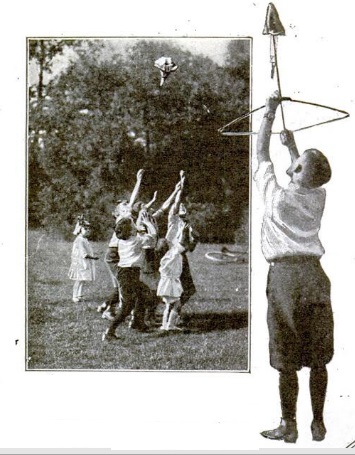 At first glance, this toy idea from a hundred years ago looks like a really bad idea. This adult is shooting an arrow straight up into the air right next to this group of children. And, of course, what goes up must come down. Since it’s going straight up, it will come straight down.