Author Archives: clem.law@usa.net

Checking for High Voltage Without a Meter

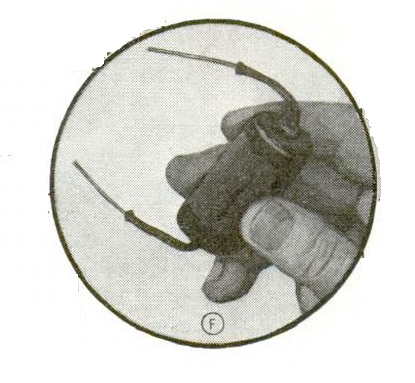
1943NovPM75 years ago, wartime shortages meant that meters were not readily available. The November 1943 issue of Popular Mechanics offers this tip for checking whether high voltage is present. A small capacitor (.25 to 2 uF, 400 volt) has spaghetti tubing placed over the leads, which are connected where the high voltage is being tested for. The capacitor is then removed and the ends shorted. A spark indicates the presence of high voltage.


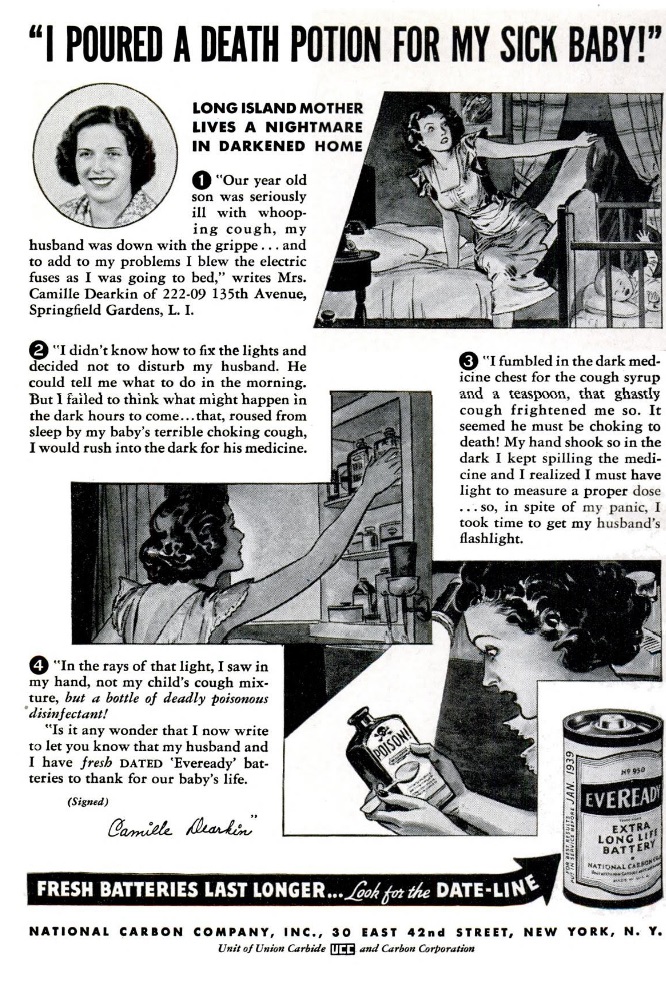
“I Poured A Death Potion For My Sick Baby!” 1938

1938NovPMEighty years ago, an Eveready flashlight and Eveready batteries saved another life, as recounted in this ad from the November 1938 issue of Popular Mechanics.

The story was sent in by Mrs. Camille Dearkin of 222-09 135th Avenue, Springfield Gardens, Long Island. It was one of those nights. Her one year old son was seriously ill with whooping cough, and her husband was also “down with the grippe.” And while she was going to bed, she managed to blow a fuse.

Since she didn’t know how to replace the fuse, she decided to wait until the morning. But she was awakened by her son’s terrible coughing, and rushed in the dark to the medicine cabinet to find the medicine.

Her hand was shaking in the dark as she fumbled in the medicine cabinet until she encountered what she believed was the bottle. But her shaking was such that she spilled the medicine, and she realized that she needed light to properly measure it. So in spite of her panic, she took the time to get her husband’s trusty Eveready flashlight.

When she got it, to her horror, she realized that she had taken the wrong bottle! In her hand, she was holding not the cough syrup, but a bottle of deadly poisonous disinfectant! The Eveready batteries had saved her baby’s life.

Of course, it’s probably best not to store deadly poison right next to the medicine. But if you do, make sure you keep your Eveready flashlight handy.

People frequently Google their own names and names of family members, and I always enjoy hearing from them to follow up on these old stories.  So if you are the 81 year old Mr. Dearkin mentioned in this story, I would love to hear from you.  Please feel free to contact me at clem.law@usa.net, as I would enjoy sharing your recollections of this event.



Happy Halloween!

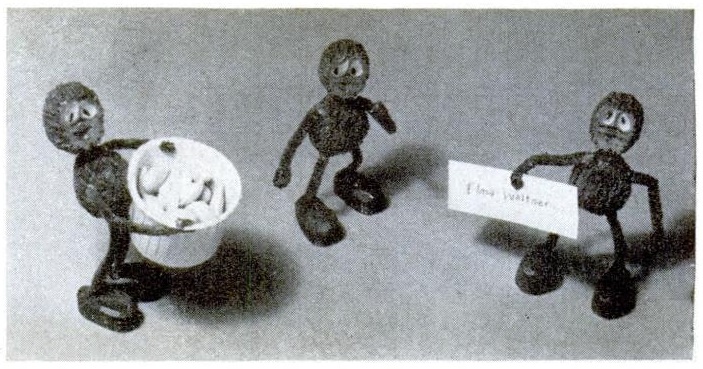
1943NovPSFor Halloween this year, we offer this Halloween craft project from 75 years ago, courtesy of the November 1943 issue of Popular Science. Wartime shortages of Halloween decorations needn’t have put a damper on things, since you could just make these. They could be placed around the room for decorations, or serve as nut holders or place tag holders at the Halloween dinner table.

All that was needed were some walnuts, pipe cleaners, and a few miscellaneous bits that could be found around the shop. The main cuts were done with a coping saw, with the nut held in a vice. The magazine provided instructions on how to finish up the tiny goblins.


1938 Mobile Generator

IMG_20180929_231546_690

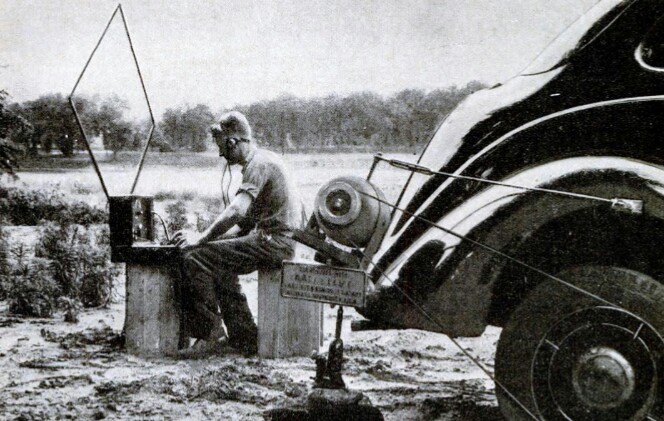
From the October 1938 issue of Popular Science, this photo is self-explanatory: For a convenient source of electric power, all you need is a generator on the rear bumper, hooked to the drive wheel with a belt and pulley. It can be used in motion, or when stopped, simply by jacking up the rear wheel.


Ramsey County War Dead, World War I

free-vector-poppy-remembrance-day-clip-art_106032_Poppy_Remembrance_Day_clip_art_smallThe following residents of the City of St. Paul and Ramsey County, Minnesota, gave their lives in the First World War. These names are taken from Volume 2 of Soldiers of the Great War, published in 1920.

If I’ve been able to locate the serviceman’s grave or other information, it is linked below.  Please let me know if you have any additions or corrections to clem.law@usa.net.

  • Pvt. George Abdalla
  • Pvt. Louis Ackerman
  • Pvt. Alfred W. Anderson
  • Pvt. Clarence J. Anderson
  • Pvt. John G. Anderson
  • Pvt. Oscar Nels Anderson
  • Pvt. Charles Aussant
  • Pvt. Frank J. Bannick
  • Pvt. John Belland
  • Pvt. Leonard Bergren
  • Pvt. John Binder
  • Pvt. Tomas L. Blacik
  • Pvt. Albert J. Blaschka
  • Pvt. Alfred H. Bornemann
  • Pvt. Arthur Lindsay Broderick
  • Cpl. A.L. Brown
  • Pvt. Fred T. Carlson
  • Pvt. John Chartter
  • Sgt. Charles H. Chatterton
  • Pvt. Arnold F. Christenson
  • Sgt. John S. Christie
  • Cpl. Dean C. Clark
  • Pvt. Frank W. Cochrane
  • Pvt. John M. Connelly
  • Pvt. William F. Connelly
  • Lt. William Cowper
  • Pvt. Wilbert W. Crocker
  • Pvt. Claude Curry
  • Pvt. John Daley
  • PVt. Henry De Loy
  • Pvt. Adolph Demel
  • Pvt. Richard W. Dingle
  • Pvt. Bernard Dittman
  • Lt. John Nealls Donohue
  • Pvt. John Dordan
  • Pvt. Frederick C. Duberge
  • Pvt. John Eischens
  • Pvt. Joseph A. Erwin
  • Pvt. Chrles J. Eue
  • Pvt. Hubert Fallon
  • Pvt. Humbert Fallon
  • Pvt. Patrick J. Feeney
  • Pvt. Edward Flaherty
  • Pvt. Michael J. Ford
  • Pvt. Joseph C. Francois
  • Sgt. Eugene Frankel
  • Pvt. Clarence R. Gatrell
  • Pvt. Thomas Gaughn
  • Pvt. Alfred Edward Gieson
  • Pvt. Raymond A. Goeke
  • Pvt. Nathan Goldstein
  • Sgt. Jacob J. Gorgoschilitz
  • Pvt. Louis F. Graff
  • Sgt. Alfred C. Hainlin
  • Pvt. Harry J. Haessly
  • Pvt. James G. Hewins
  • Pvt. Glenn L. Howard
  • Pvt. John Hanson
  • Cpl. Robert B. Hess
  • Pvt. George Jackson
  • Pvt. John Arnold Jelm
  • Pvt. Conrad G. Jensen
  • Pvt. Carl E. Johnson
  • Pvt. Ferdie Mild Johnson
  • Pvt. George H. Johnson
  • Pvt. Herman Johnson
  • Lt. Scott M. Johnson
  • Pvt. James Allen King
  • Pvt. Maurice Kerr
  • Pvt. Lewis N. Kiesel
  • Pvt. Joseph H. Kipp
  • Pvt. Frederick Klanska
  • Pvt. Ward L Knoder
  • Pvt. George C. Koernig
  • Pvt. Edward J. Kunz
  • Pvt. William Laidlaw
  • Pvt. Charles W. Langerdorf
  • Pvt. Axel Larson
  • Pvt. Leslie Lawrence
  • Pvt. Edward F. Lundholm
  • Pvt. James F. McCann
  • Pvt. Len R. Machovec
  • Pvt. Clarence S. Manthe
  • Cpl. Alphonse J. Meidinger
  • Pvt. Clarence M. Merrill
  • Pvt. Walter Metz
  • Pvt. Lorenz Milli
  • Pvt. Oscar M Moline
  • Pvt. Eco H. Mullier
  • Cpl. David W. Neary
  • Pvt. Carl E. Neilson
  • Pvt. William A. Nelson
  • Pvt. Emil F. Neuman
  • Pvt. Gustaf A. Newman
  • Pvt. Peter Niemczyk
  • Pvt. Johan Nilsson
  • Pvt. Thomas Collins O’Leary
  • Pvt. Bernard J. Paddock
  • Pvt. George J. Panuska
  • Pvt. Albert E. Peterson
  • Pvt. Axil Jullus Peterson
  • Pvt. Nick M. Phillips
  • Pvt. Frank Podgerski
  • Pvt. John W. Richardson
  • Sgt. Paul W. Robinson
  • Cpl. Arthur W. Rock
  • Pvt. John Roddewig
  • Cpl. Elmer A. Roessler
  • Pvt. John Romocky
  • Pvt. George E. Root
  • Pvt. Frank Sager
  • Pvt. Frank J. Scharfbillig
  • Pvt. John R. Schillo
  • Pvt. Lawrence O. Schmidt
  • Cpl. Rudolph R. Shockey
  • Pvt. Charles T. Smith
  • Pvt. Charles S. Skweres
  • Pvt. Frank L. Steiner
  • Pvt. Isidore J. Stameshkin
  • Pvt. Louis F Steber
  • Pvt. George Stewart
  • Pvt. George W. Stocking
  • Pvt. Paul E. Swanson
  • Pvt. Oscar M.L. Thorson
  • Pvt. Ruben O. Tibbling
  • Cpl. Thomas J. Tierney
  • Pvt. Luke Toner
  • Pvt. Emil Truhler
  • Pvt. Benjamin H. Warner
  • Sgt. Fred H. Warwick
  • Pvt. Louis Weiner
  • Pvt. Tomas J. Wilkins
  • Pvt. Stanley B. Zabroki


1948 Homemade Transistor

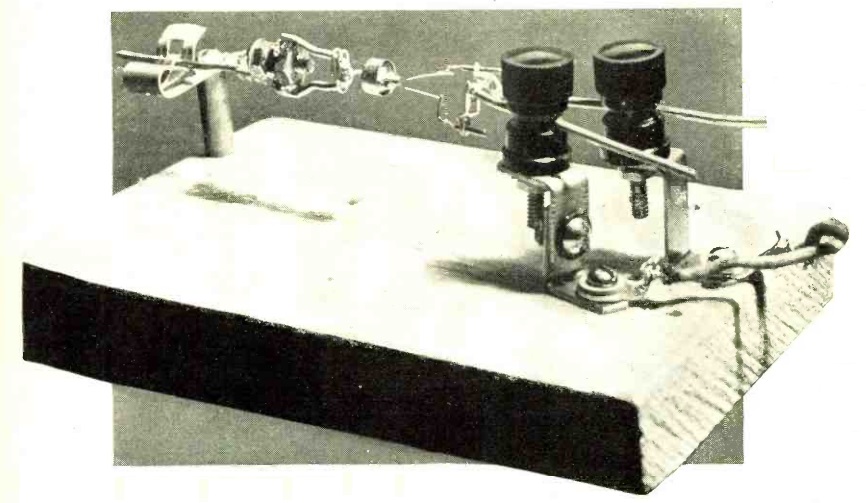
1948OctRadioNewsShown here is a crude but functional homemade transistor from 1948, from the October 1948 issue of Radio News.  While the author had not yet used the fragile device in a working circuit, he did note that he achieved amplification by a factor of up to 50.  The transistor was very unstable at that high amplification, but it did work reliably amplifying by a factor of 15.

The transistor was made of a 1N34 germanium diode carefully broken open.  One lead was kept intact, and the other two contacts were made by making cat whiskers out of filaments of old tubes.

The article cites some 1920s articles where the authors made “amplifying crystals” by a similar means.  By applying the techniques in this article, the advanced student could prepare a science fair project that his or her teacher would probably declare impossible–making a homemade transistor.


Science Fair Idea: Trajectory of Moving Object

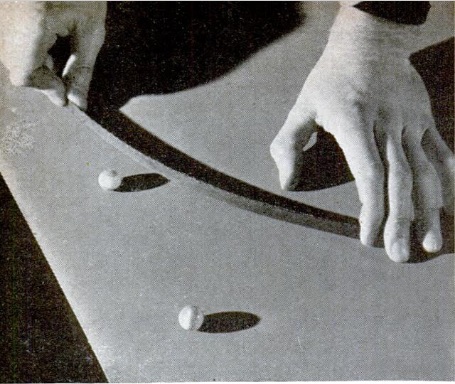
1943OctPS2If Junior needs to quickly put together a science fair project, this idea from the October 1943 issue of Popular Science will demonstrate some meaningful science with minimal preparation.  It makes use of two marbles and an old hacksaw blade, although with a bit of ingenuity, substitutions can be made to take advantage of available materials.

The two marbles are placed at the edge of a table and whacked as shown in the illustration.  Obviously, one of them flies off the table much faster and further than the other one.  But by listening to the sound of them hitting the floor simultaneously, it is clear that they are traveling downward at an identical rate.

If the teacher requires a question to be answered by the experiment, it can be something along the lines of:  “Does horizontal velocity of a projectile affect the rate of descent due to gravity?”

Junior will walk away with the blue ribbon, and the teacher will be none the wiser that he waited until the last minute.


Distilling Water

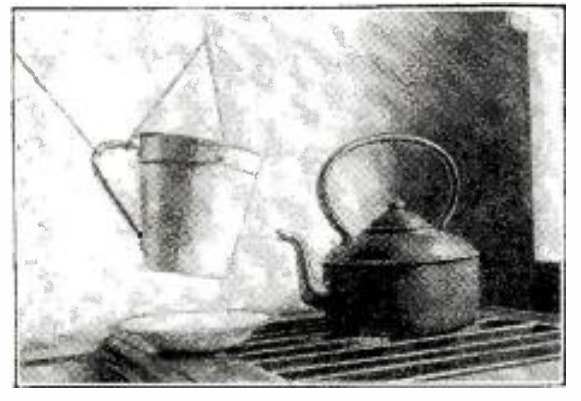
1928OctRadioNewsIf you need some distilled water, it’s usually a pretty easy matter to go to the local supermarket and buy a convenient gallon jug. Or, if you’re willing to pay for the convenience, you can even order it on Amazon.

But it’s also easy to whip up a small batch at home, as shown in this self-explanatory photo from Radio News, October 1928.  The hanging container is filled with cold water, preferably ice water.  It should be as thin as possible.  The spout of the kettle is directed at this container, and the distilled water drips onto a plate below.

The idea was sent in to the magazine by  one C.A. Oldroyd.

If the aspiring young scientist needs distilled water for a science fair project, adding this method to the project will almost guarantee the elusive blue ribbon.