1941 Illinois State Police Radio

1941ILStatePoliceRadio

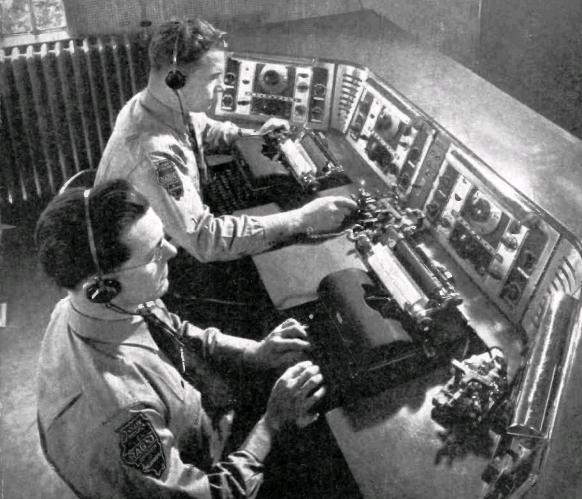
Shown here on the cover of the July-August 1941 issue of National Radio News is one of the operating consoles of the radio system of the Illinois State Police.

Shown are senior operator E. Swaringen and supervisor C.I. Hopper. They are at the zone and interzone console at the Springfield station.

The magazine reported that in its three years of radio operation, the apprehension of criminals had rocketed to record-breaking heights. For example, the percentage of stolen cars recovered had jumped from 13% to a new high of 83%.

Click Here For Today’s Ripley’s Believe It Or Not Cartoon


TV in New York Taverns: 1941

1941AugRadioRetailing1

Seventy-five years ago, television was making its appearance in New York taverns, as reported in the August 1941 issue of Radio Retailing magazine.

In the photo above, the set is placed at a spot in the bar “where it keeps feet on rails longer,” while some other highbrow establishments had built the set into the wall.

1941AugRadioRetailing2The article noted that hundreds of Du Mont sets had been installed in public places around New York. The public intitially flocked to them out of curiosity, but when commercial broadcasting was authorized on July 1, 1941, having a set in a tavern or cafe became a practical trade benefit.

The biggest draw was sports, with boxing, wrestling, baseball, basketball and football being the most popular, in that order. However, other programs proved popular, such as news events. “Some taven and cafe owners even advise that fashion programs have brought in some ladies!”

Sets were typically placed in the bars on a trial rental basis for a month or two.  Almost invariably, after the initial term, owners discovered that the sets were paying for themselves in increased trade.  They then had the option of continuing the rental, or applying rental payments to purchase of the set.

Click Here For Today’s Ripley’s Believe It Or Not Cartoon


1936 Stealth Radio

1936AugPS

If you wanted a radio in your living room 80 years ago and wanted to be stealthy, you could construct this five-tube TRF set concealed behind a tapestry, as shown in the August 1936 issue of Popular Science.

The set, in addition to the rectifier, contained one stage of RF amplification, a detector, and two stages of audio amplification.  The antenna was concealed in the silk cord that supported the picture, a power outlet could be installed behind the picture, and the tuning and volume knobs were at the bottom of the frame.

1936AugPS2

Click Here For Today’s Ripley’s Believe It Or Not Cartoon


1941 Popular Science Midget Regen BC Receiver

1941AugPS

Seventy-five years ago this month, the August 1941 issue of Popular Science carried the plans for this midget one-tube broadcast receiver geared to the needs of the outdoor enthusiast.

1941AugPS3According to the magazine, the set was small enough to be carried in a knapsack on hiking trips, but would pull in stations up to 400 miles away at night. It used a single 1T4 miniature pentode and got power from a standard flashlight cell running the filament, with a midget 45 volt battery supplying the B+.

When used in the great outdoors, a long nail could be driven into the earth for the ground connection, with a 40 foot wire tossed over a tree.

1941AugPSschematic

Click Here For Today’s Ripley’s Believe It Or Not Cartoon


1936 “Porcupine” Antenna

1936JulyPS3

Eighty years ago this month, the July 1936 issue of Popular Science included this novel “porcupine” antenna.

for either shortwave or broadcast reception. The magazine noted that where space was at a premium, it could be fastened to the outside frame of a window, since it required no mast, insulators, or dangling wires. The “antenna” consisted of a “clump of short wires that resembles a procupine or bristle brush.”

It seems to me that the outdoor clump of wires would add little or nothing to the reception. In reality, if the antenna worked, it was only because the lead-in wire was functioning as an antenna.  At least it wasn’t advertised as containing oxygen-free wire.
Click Here For Today’s Ripley’s Believe It Or Not Cartoon


1956 Four Transistor Superhet

1956JulyRadioElect

Sixty years ago this month, the July 1956 issue of Radio Electronics magazine announced, “This is it!” When the transistor had come out a few years earlier, it was predicted that it would eventually replace all of the tubes in broadcast radios. Other plans had been published for “transistor radios,” but they were merely crystal sets with a transistor used for audio amplification. All-transistor superheterodynes were just coming on the market, and the magazine announced that “at last, experimenters and hobbyists may construct their personal all transistor radio–one that can fit into a shirt pocket!

The set, constructed in a 29 cent clear plastic box, was powered by three penlight cells that were said to last up to 600 hours. Unlike earlier “self-contained” sets, this one required no external antenna, and had been tested in many different locations, such as walking along the street, in a steel building, or even in a cellar.

The set used four 2N112 transistors. The author reported picking up 20 stations in the New York area, and extolled readers to build one. “You will find plenty of use for it since you can keep in touch with the ball games, news flashes, your favorite concerts, etc. When carried in a shirt pocket, everything remains hidden except for the hearing-aid earpiece.”

Click Here For Today’s Ripley’s Believe It Or Not Cartoon


WLS Radio In The Barn Club, 1941

1941WLS

WLS Chicago billed itself as the Prairie Farmer Station, as shown in this ad that appeared in Broadcasting magazine 75 years ago today, July 28, 1941.

The ad reported that the station’s Bulletin Board program at 6:30 AM included weather, livestock estimates, crop news, and other items of interest to farmers. Many farmers wrote to the station to report that they had radios in their barns and listened as they did their chores. In response, the station formed a “Radio in the Barn Club” with certificates of membership.

Certificates were issued to almost 2000 farmers in 14 states: Pennsylvania, Tennessee, Ohio, California, Minnesota, Mississippi, Missouri, Texas, Iowa, Illinois, Indiana, Michigan, and Wisconsin.

The WLS call letters were first used in 1924.  At the time, the station was owned by Sears, and the station’s call letters boasted the World’s Largest Store.  The station was sold to Prairie Farmer magazine in 1928, which owned it until the station was sold to ABC in 1960.

Click Here For Today’s Ripley’s Believe It Or Not Cartoon


NPOTA: Touro Synagogue, Rhode Island

Touro Synagogue. National Park Service photo.

Touro Synagogue. National Park Service photo.

During the ARRL National Parks On The Air (NPOTA) event, Amateur Radio operators are setting up their stations in various units of the National Park Service (NPS) and making contact with other Amateurs around the world. Since the beginning of the year, there have been over 9000 activations from 444 different different units of the NPS (with only 44 not yet activated), with over a half million individual contacts.

One interesting aspect of this event is learning about the different parks, some of which I did not even know existed.   For example, in an earlier post, I wrote about the fascinating history of Kalaupapa National Historical Park in Hawaii, a remote settlement originally set aside for persons suffering from leprosy.

Synagogue interior. Wikipedia photo.

This week, I learned, by talking to someone there, of another important site in American history, Touro Synagogue National Historic Site in Newport, Rhode Island.  In addition to being the oldest synagogue in the United States, the site is important as a symbol of religious liberty for all Americans.  The synagogue still houses an active congregation, Congregation Jeshuat Israel, as it has since 1763.  It was designated a National Historic Site in 1946, and is an affiliated area of the National Park Service.

The congregation itself was founded in 1658.  The ancestors of the founders had fled Europe for the Caribbean in search of religious freedom, and the founders of the synagogue ultimately fled to Rhode Island for even greater liberty.  It was well established by 1790, when President George Washington wrote his letter to the “Hebrew congregation at Newport,” in which he vowed that the new nation would give “to bigotry no sanction and to persecution no assistance.”

The congregation does an annual reading of President Washington’s letter, the next scheduled for August 21, 2016.

This week, the park was put on the air by students from Rogers High School Ham Radio Club, W1VRC.  Most national parks can be easily “activated” by individual hams simply pulling in and operating from a parking lot or picnic table.  But many culturally sensitive sites, such as this synagogue, require more advance planning, and W1VRC worked with the site to do an activation that was both sensitive to the site, and also well planned from a radio point of view.  With their advance planning, they were able to put up a 132 foot long Windom antenna, that put out an effective signal but was unobtrusive.

In sanctioning the activation, the Synagogue found especially compelling the youth involvement as the students made contacts.  The young operators all did an excellent job, and there were many compliments as to their professionalism as they  made 185 contacts, including one with me.  This operation was actually a trial run for a larger activation, which will take place on August 7, 2016.  If you’re a ham, I encourage you to try to work them.  The best place for up-to-date information on frequencies is the NPOTA Facebook group. More information about W1VRC’s activation is also available at the school’s website.

Read More At Amazon


Click Here For Today’s Ripley’s Believe It Or Not Cartoon


Execution of Capt. Charles Fryatt, 1916

Charles Fryatt IWM Q 066269.jpg

Capt. Fryatt. Wikipedia photo.

Today marks the 100th anniversary of the execution of Captain Charles Fryatt, a British mariner. He was executed by the Germans for attempting to ram a U-boat which was attacking his ship, the SS Brussels, in 1915.

Fryatt’s first encounter with a U-boat came in March 1915 when his command, the SS Wrexham, was under attack. Even though the ship’s normal top speed was 14 knots, with deckhands assisting the stokers, he managed to make 16 knots and arrive safely at port.

On March 28, he was in command of the Brussels, and was ordered to stop by U-boat U-33. When the U-boat surfaced to torpedo the ship, he ordered full steam ahead in an attempt to ram the U-boat. The incident received some notariety in England, and Fryatt was awarded a gold watch by the admiralty.

On June 25, 1916, the Brussels left Holland for England. A passenger on deck reportedly signaled to shore, and the ship was soon surrounded by five German destroyers. The ship was seized, its radio destroyed, and the crew was arrested.

Fryatt was tried by a German court martial on charges of sinking a submarine as a non-combatant (even though the submarine had not really been sunk). He was tried on July 27, 1916, the inscription on the watch serving as evidence of the charges. He was found guilty and executed by firing squad that same evening at Bruges, Belgium.

Whatever warning the execution might have given mariners was overshadowed by the reaction in neutral America. The New York Times called the execution “a deliberate murder,” and the New York Herald called it “the crowning German atrocity.”

The Swiss Journal de Genève opined, “it is monstrous to maintain that armed forces have a right to murder civilians but that civilians are guilty of a crime in defending themselves”.

The November, 1916, issue of Wireless World carried the following note which underscores Capt. Fryatt’s bravery:

A very touching little posthumous incident connected with Captain Fryatt, the gallant Commander of the Brussels, so infamously done to death by the Germans, was recently chronicled by the daily Press. The English stewardesses who, after a great deal of diplomatic pourparlers, were at length released in the beginning of October, narrated that Captain Fryatt was warned by the Germans that if he employed his wireless equipment his vessel and all on board would be sent to the bottom.

Therefore when the wireless operator asked, as the Germans clambered on board, whether be should summon aid the chivalrous seaman answered,” No, I don’t care “what they do with me, but I must think of the lives of the women I carry.” In view of the recent haul of German and Dutch spies made by the Netherlands Government, the further statement of the stewardesses that movements of the Brussels were signalled by flashlight to a German submarine lurking in Dutch waters, and retransmitted by wireless to the German torpedo boat, assumes an air of verisimilitude.

Mount Fryatt, Alberta. By chensiyuan (chensiyuan) [GFDL (http://www.gnu.org/copyleft/fdl.html) or CC BY-SA 4.0-3.0-2.5-2.0-1.0 (http://creativecommons.org/licenses/by-sa/4.0-3.0-2.5-2.0-1.0)], via Wikimedia Commons

Mount Fryatt, Alberta. By chensiyuan (chensiyuan) [GFDL  or CC BY-SA 4.0-3.0-2.5-2.0-1.0], via Wikimedia Commons

The 11,027 foot Mount Fryatt, in Jasper National Park, Alberta, Canada, was named in honor of Captain Fryatt in 1922. The nearby Brussels Peak is named in honor of his ship.

Read More at Amazon


free-vector-poppy-remembrance-day-clip-art_106032_Poppy_Remembrance_Day_clip_art_smallClick Here For Today’s Ripley’s Believe It Or Not Cartoon


1976 Temporary CB License

1976CBtemporarypermit

Forty years ago, the United States was in the midst of the CB craze. The eleven meter band had been set aside for the Class D Citizens Radio Service in 1958, and it was initially a relatively useful service for short-range communications. But during the 1970’s, it became so wildly popular that every channel was almost continually filled with signals of varying strengths, so that only the closest and most powerful could break through. Back in those days, tuning through the 27 MHz band revealed a cacophony of heterodynes every 10 kHz along the dial, night and day.

CB’s also required a license, and at some point, the FCC was hopelessly overwhelmed. A few years later, they gave up, and licensed everyone in the United States under a “licensed by rule” arrangement. Many people ignored the license requirement, but those who went by the rules faced delays of months before the license arrived in the mail.

As a stopgap measure, the FCC in 1976 allowed for interim licenses. After you mailed in the license application, you filled out a second form, which you retained for your records. You even assigned yourself a call sign. The call started with K, followed by your initials, followed by your ZIP code. So in my case, I would have been KRC-55418.

Both the license application and the interim license were contained in the box when you bought a CB. But if you didn’t have a copy, the July-August 1976 issue of Elementary Electronics contained a copy.  Apparently, the size of the form had to be right, so the magazine instructed you to carefully cut the page to exactly 8 x 10 inches, and follow the instructions.

After you certified, under penalty of imprisonment, that you had mailed the form and the $4, that you were over 18 and not the representative of a foreign government, and weren’t in any prior trouble with the FCC, you assigned yourself the call sign, and you were on the air.  The back of the page contained a summary of the rules that you were to scrupulously obey.

Click Here For Today’s Ripley’s Believe It Or Not Cartoon