Direction Finding With An AM Radio

Portable radio mounted on base for direction finding.

Portable radio mounted on base for direction finding.

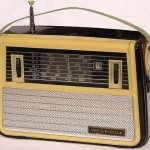
Sixty years ago this month, the July 1956 issue of Popular Electronics carried an excellent tutorial on how to use a portable AM radio for direction finding.

Most AM radios, both then and now, are very directional in that there is a “null,” or spot where the signal fades out, on each side of the built-in antenna.  You can demonstrate this by tuning to a relatively weak AM station and then slowly rotating the radio.  You will find that there are two spots, 180 degrees apart, where the station disappears or becomes very weak.  If the radio, like most portables, has an internal loopstick antenna, these are the points where the long narrow antenna is pointing directly at (or away from) the station.

You can use this principle to determine your location.  Even with a very cheap radio, you can usually establish your location with astonishing accuracy.

Detail of direction finding mount for portable radio.

Detail of direction finding mount for portable radio.

The Popular Electronics article shows how to construct a rotating mount for your radio.  You strap the radio in place, turn it for the minimum signal, and the pointer on the mount shows the bearing to or from the station in degrees.  For example, if the station’s null is at 45 degrees, then you can draw a line on a map over the station with that same angle from north.  In other words, in this example, running NE-SW.  Your current location is somewhere along that line.

By repeating this process with a second radio station, you will have two lines drawn on the map.  The point at which the two lines intersect is your current location, sometimes to astounding accuracy.

The mount shown in Popular Electronics is for a more or less permanent installation in a boat.  But this is not necessary.  In most portable radios, the antenna is mounted parallel with the outside case, usually with the longest side.  Therefore, it is possible simply to use the radio itself as a straightedge:  Align the map with the Earth, in other words, place the top of the map toward the north.  Then, rotate the radio so that the signal disappears.  With the radio at the same angle, place one edge over the station’s location and draw a straight line on the map.  Your location is somewhere along this line.

Then, repeat the process with a second station.  The point where the two lines come together is your location.  To confirm your location, you can repeat the process with a third station.  If the three lines come together very close to the same point, then you can be quite certain that the location was accurate.  If one of the lines doesn’t seem to agree, then you can repeat the process with a fourth station, and ignore the reading that doesn’t seem to match the others.

With a bit of practice, you can find your location very accurately.  In an urban area, by using 3 or 4 local stations, I have identified my location within a hundred yards or so.  In a rural area, where the stations might be further away, the accuracy will not be quite as great, but you should be able to locate yourself within a fraction of a mile.

The Popular Electronics article contains instructions on disabling the receiver’s automatic volume control (AVC), because in the case of a strong station, the radio might keep playing at full volume even with the station nulled out.  However, it is not necessary to modify the radio.  Most stations, unless they are very strong, will show a null even with the AVC functioning.  And for those stronger stations, you can compensate by tuning the radio slightly off frequency.  For example, if the station you are trying to locate is at 800 and you can’t get a null, you can reduce the signal strength simply by tuning to 810.  You’ll still hear the station with the radio properly oriented, but the signal will be weak enough that you will be able to detect the null.

Of course, for this method to work, you need to know the exact transmitter location of the radio stations you plan to use.  These often differ from the location of the station’s studio and office.  In some cases, they are many miles from the station’s city of license.

Fortunately, in the United States, this information is easy to obtain from the FCC website.  You can search for a particular station, for all stations within a state, or all stations within a certain radius of a given location.  When you click on the station’s call letters, you will be given the exact latitude and longitude of the transmitter.  (Transmitter locations of most AM stations are also shown on aeronautical charts, since pilots still use this method of direction finding.)

Direction finding, even with a very cheap AM radio, can give amazingly accurate results.  It is certainly not as convenient as other methods, such as GPS.  But in an emergency, it should not be overlooked as a backup method to determine your location.  It requires very little equipment (just a radio, map, and pencil).  It also requires a bit of practice beforehand, since you need to learn the characteristics of the radio you will use.  And it requires knowledge of the location of some local transmitters.  But if you can locate those transmitters on your map, you can also locate yourself.

As I mentioned, I’ve been able to determine my own location within a hundred yards by knowing the exact locations of local radio stations.  But even without an exact knowledge of their location, I was able to locate myself, at night, within about 30 miles, simply by using the approximate location of strong distant stations.  For example, I know that WBBM’s transmitter is in or near Chicago.  I know that WSM’s transmitter is in or near Nashville.  I know that CFZM’s transmitter is in or near Toronto.  Even though I did not know the exact locations of these transmitters, when I used this method at night, I was able to locate myself within about 30 miles.  There’s probably little practical application for doing it this way, since it’s unlikely that someone would find themselves not knowing what state they are in.  (However, it should be noted that before the invention of accurate chronometers, most mariners wouldn’t know their location that accurately.)  But it is still rewarding to know that you can determine your location on Earth with such primitive equipment.

Click Here For Today’s Ripley’s Believe It Or Not Cartoon


Product Review: Wise Food Storage “Savory Stroganoff”

One of this site’s advertisers is Wise Food Storage, who recently sent me a free sample to review.  The company supplies dehydrated food for emergency food storage, camping, and backpacking.  On their website, they sell mostly packages consisting of assortments of food, such as the package shown below, which is billed as providing enough food for two people for 72 hours:

72 Hour Kit for 2 PeopleTHe sample I was sent was a single meal, namely their “Savory Stoganoff.”

I was initially a bit skeptical, since my experience has been that most suppliers of “survival” food seem to charge a considerably higher price than one would pay for comparable items at the supermarket.  In many cases, they hide the higher price by making inflated claims as to how long the product will last.  For example, some companies offer a “30 day supply” of food, but if you look carefully, you realize that you would be eating starvation rations for those thirty days.

It was refreshing to see that Wise doesn’t follow this same practice, and the claims on their website are reasonable.  A normal diet consists of about 2000 calories per day.  You can certainly survive on less, but if you want to replicate a normal diet as much as possible during an emergency, you should plan on having about that many calories per day per person.  And Wise seems to use honest figures on their website.   For example, the 72 Hour Kit for 2 People shown above supplies over 13,000 calories, which is indeed enough to feed two people for three days, with their normal caloric intake.  In fact, with a bit of scrimping, it would probably last even longer than advertised.  It is refreshing to see a company that didn’t fall into the trap of making exaggerated claims.  As you shop around, you might see lower prices.  But before you buy, make sure you’re really getting the number of days’ supply that the company is claiming.  In Wise’s case, you are.  In the case of some other suppliers, you are not.

I’m not normally a fan of “kits” for food storage.  From a price point of view, you’re probably better off buying normal food from the supermarket.  You’ll know that they are items you like to eat, the cost will be lower, and the supermarket has many items that can be stored for a long period of time, especially if you rotate them into your family’s normal diet.  On my food storage basics page, I have ideas for emergency food storage using items available at any supermarket.

On the other hand, there is something to be said for buying a well thought out “kit.”  You know that everything is optimized for long-term storage and minimal preparation.  And there’s something reassuring about looking at a single container and knowing that it will give you enough food to eat for X days.  I wouldn’t recommend a kit as your family’s sole source of emergency food, but they do have their place.  In addition to Wise’s 72 Hour Kit, they have a variety of other similar assortments. such as a 1 Month Emergency Food Supply for 1 Person – 56 Servings and a 2 Week supply geared for backpackers.  Again, you can probably put similar kits together yourself at a somewhat lower price, but for some people, the convenience is worth it.

Package of Savory Stroganoff being reviewed.

Package of Savory Stroganoff being reviewed.

Wise’s website doesn’t seem to sell individual meals, but they are available from WalMart.  For example, you can purchase a single package of the “Savory Stroganoff” reviewed here.  The price is quite reasonable, and you can order online and have it delivered to a local WalMart, so there is no shipping cost.

The Savory Stroganoff I reviewed exceeded my expectations.  I wouldn’t describe it as a gourmet meal, but it was reasonably good tasting, easy to prepare, and would be quite adequate during an emergency or while camping.  The nine-ounce package was billed as having a storage life of 25 years.  It was packaged in a heavy plastic pouch with an oxygen absorber inside (and I’ll say more about the oxygen absorber in a moment).  According to the nutrition facts, the package supplies four servings of 250 calories each.  In other words, the one package contains a thousand calories, or about half of one person’s caloric needs for the day.  We did feed four people lunch using the one pouch, and the meal was filling.  Each serving contains 45 grams of carbohydrates, 4.5 grams of fat, and 7 grams of protein, so it’s a reasonably well balanced meal by itself.  The vitamin content is relatively low, supplying 0% of the daily requirement of vitamin A, 2% of the daily requirement of vitamin C, 8% of the calcium, and 8% of the iron.  During a short-term emergency, vitamin deficiency isn’t an issue, but those planning for a longer-term emergency would be well advised to include some multivitamin tablets if relying on this kind of storage food.

The main ingredient is the pasta, along with nondairy creamer and textured vegetable protein.  You can view the full list of ingredients and nutrition facts at the WalMart website.

Preparation was very straightforward, and we followed the instructions on the package exactly.  You start by boiling four cups of water, turning off the heat, and then adding the contents of the package to the boiling water.  We used the stove, but the water could be boiled by any emergency heat source.  Since the only actual cooking is the boiling of the water, there’s really nothing that can go wrong.  You simply cover the pot and wait 12-15 minutes.

The glitch in the instructions was that it didn’t mention the oxygen absorber inside, so we wound up pouring it into the boiling water, where we had to fish it out.  But other than this oversight, the instructions were self-explanatory.

After 15 minutes, you remove the cover, and let it stand for another 2-3 minutes.  We used a normal kitchen pan, but any container with a lid could be used.  In an emergency, to minimize the amount of cleanup, I would boil the water in one container, and then “cook” the food in some kind of disposable container.

The completed Stroganoff.

The completed Stroganoff.

The finished product didn’t look particularly appealing.  Perhaps it would have looked better if we had let it sit a while longer, but it was rather watery.  It looked more like a thick soup than Stroganoff.  It was best served in a cup or bowl and eaten with a spoon.

However, it tasted quite good, and neither my wife and I nor our kids had any complaints.  It did not have the “dehydrated” taste that I feared it would have.  It tasted like noodles and sauce.  There was a bit of seasoning–I noticed that the ingredients included dried onions.  However, it was rather bland, and adding a little bit of salt and pepper improved it considerably.  My daughter added a little bit of Knorr chicken bouillon, and she reported that this made it taste quite good.  So my main advice if you’re going to rely on prepackaged items like this, it would be a good idea to also include familiar seasonings.

In summary, the stroganoff tasted better than I expected without a “freeze dried” taste, and was more reasonably priced than I expected.  It’s more expensive than comparable supermarket items, but much less expensive than comparable items billed as “survival” or “backpacking” food.  I probably won’t order one of Wise’s food “kits,” but I’ll probably purchase a few packages of the stroganoff and other meals to keep in the camper, or just to keep in the house for times when a relatively quick meal is needed.

Full Disclosure:  The product reviewed was supplied to me free of charge by Wise Compnay, one of this website’s advertisers, in exchange for an honest review.  All product links on this page are affiliate links, meaning that if you click on the links and purchase the product, I will receive an advertising fee.

Click Here For Today’s Ripley’s Believe It Or Not Cartoon



Free Shipping on all Wise Food Storage Products!


1916 Preparedness Day Bombing

Newspaper images of the injured and dead. Wikipedia image.

Today marks the 100th anniversary of the Preparedness Day Bombing of July 22 1916.

During San Francisco’s Preparedness Day parade, a suitcase bomb exploded, killing ten and wounding 40. Two labor leaders, Thomas Mooney and Warren K. Billings were convicted and sentenced to death, their sentences later commuted to life. Later investigations found that the convictions had been obtained by false testimony, and the men were released in 1939 and later pardoned. The identity of the bombers has never been determined.

The parade followed the Washington preparedness parade of June 14, and had been targeted by radicals. One unsigned pamphlet had been circulated which read, “we are going to use a little direct action on the 22nd to show that militarism can’t be forced on us and our children without a violent protest.”

The three and a half hour parade had over 50,000 marchers and 52 bands. At 2:06 PM, the cast steel pipe bomb exploded on the west side of Steuart Street, just south of Market Street.

Read More At Amazon


Click Here For Today’s Ripley’s Believe It Or Not Cartoon



July 20, 1956 CONELRAD Test

Milwaukee Civil Defense Director Don E. Carleton and Col. Anthony F. Levno assess damage after simulated attack on Milwaukee. Milwaukee Journal, Jul. 20, 1956.

Milwaukee Civil Defense Director Don E. Carleton and Col. Anthony F. Levno assess damage after simulated attack on Milwaukee. Milwaukee Journal, Jul. 20, 1956.

Today marks the 60th anniversary of what was, as far as I’ve been able to determine, the only nationwide test of CONELRAD, the system designed to give Americans emergency information about a nuclear attack.

As I wrote in a previous post, all radio and TV broadcast stations in the U.S. left the air at 3:10 PM Eastern Time.  Designated stations came on the air on 640 or 1240 kHz, alternating between transmitters to confuse enemy bombers.  In some cities, such as Milwaukee, local exercises were conducted in conjunction with the CONELRAD test.  In the photo shown here, civil defense planners are examining the hypothetical ruins of Milwaukee.

Click Here For Today’s Ripley’s Believe It Or Not Cartoon


Battle of Fromelles, 1916

Australian soldiers at Fromelles. Of the men shown here, only three survived, all of whom were wounded. Wikipedia photo.

Today marks the 100th anniversary of the Battle of Fromelles, fought July 19-20, 1916, in northern France.  British and Australian forces began the battle to prevent the Germans from moving troops to the Battle of the Somme, which was being fought fifty miles away.  5533 Australians–90% of those fighting–were casualties, as were 1547 British (half of those fighting).

Niela Goodelle, 1936

1936JulyRadioGuide

Eighty years ago, this day’s issue of Radio Guide magazine, July 18, 1936, featured Niela Goodelle.

Born Helen Goodell, a friend remarked that her name “reeked of the kitchen,” and suggested she change it.  She turned her first name around and spelled it the way it sounded, and added an “e” to her last name.  The magazine described her as a welcome addition to any broadcast who had carried herself to the topmost pinnacles of radio fame.

According to the Internet Movie Database, she died in New York in 1988.

Here, she performs “Ten Pretty Girls.”

Click Here For Today’s Ripley’s Believe It Or Not Cartoon


First Televised Wedding, 1931

1931JulyTVNews

The first ever televised wedding took place 85 years ago, as shown here from the July-August 1931 issue of Television News.

The bride and groom, Grace Jones and Frank Du Vall were wed by Dr. A. Edwin Keigwin of the West End Presbyterian Church over the airwaves of W2XCR-WGBS. The video was transmitted over W2XCR, with the synchronized audio being transmitted over WGBS. The magazine reported that thousands of visualists were trilled by this marvel of modern science.  Du Vall was apparently a station engineer

The television studio and 500 watt transmitter were located at 655 Fifth Avenue, New York City. The station used a mechanical system employing a strong arc light with a rotating disc with a “flying spot” to do the scanning. The visual pickup consisted of fixed photocells. The more conventional system at the time placed the spinning disc in front of the photocell. The system used by W2XCR essentially consisted of a beam of light that scanned the subject, synchronized with the spinning disc on the receiver. The system used 60 lines and scanned 20 pictures per second.  The general idea is shown in the illustration here:

1931JulyTVNews2

The sound was sent by wire to WGBS at Astoria, Long Island.  According to the Spring-Summer 1931 issue of White’s Radio Log, WGBS operated on 600 kHz with 250 watts of power.  The station’s call sign represented its owner, Gimbel’s Department Store, and the station is the predecessor of WINS.

 W2XCR, licensed to Jenkins Television Corporation, operated on 2000-2100 kHz or 2750-2850 kHz.

According to the 1940 census, the couple was happily married and living in Essex, New Jersey, on their ninth anniversary.  The clergyman, Dr. Keigwin, appears to be the author of the 1899 hymn, The Someday By and By.

Click Here For Today’s Ripley’s Believe It Or Not Cartoon


Vive La France!

https://www.youtube.com/watch?v=pHOkECIg1AA

Allons enfants de la Patrie,
Le jour de gloire est arrivé!
Contre nous de la tyrannie
L’étendard sanglant est levé,
Entendez-vous dans les campagnes
Mugir ces féroces soldats ?
Ils viennent jusque dans vos bras
Égorger vos fils, vos compagnes!

Aux armes, citoyens,
Formez vos bataillons,
Marchons, marchons!
Qu’un sang impur
Abreuve nos sillons!

Arise, children of the Fatherland,
The day of glory has arrived!
Against us tyranny’s
Bloody banner is raised
Do you hear, in the countryside,
The roar of those ferocious soldiers?
They’re coming right into our arms
To cut the throats of our sons, our women!

To arms, citizens,
Form your battalions,
Let’s march, let’s march!
Let an impure blood
Water our furrows!

La Marseillaise. Translation, Wikipedia.

Lunar Eclipse of July 15, 1916

A partial lunar eclipse took place on this date one hundred years ago, f July 15 1916.  The eclipse was notable for the effect it had on Sir Ernest Shackleton’s Imperial Trans-Antarctic Expedition, an attempted crossing of the Antarctic continent.  The expedition consisted of two parties.  One party, led by Shackleton aboard the Endurance, was to make the crossing from the Weddell Sea.  This party was the most famous, since after the loss of the ship, the party had to travel to Elephant Island, then to South Georgia island, and finally make a dangerous land crossing to a whaling station on the other side of that island.

 A man, fresh-faced with dark, brushed-back hair, seated among a group. He is wearing a naval officer's uniform with a high, stiff collar

Aeneas Mackintosh, Ross Sea party commander. Wikipedia image.

The other party was to enter the continent from the Ross Sea, and was led by Aeneas Mackintosh.  This party would head inland and establish depots for the party making the crossing.  In 1916, five of this party were stranded, and needed to reach the relatively safety of a hut at Cape Evans.  An attempt was made in May, but the ice was too thin.  They had to wait for colder weather, which also meant darkness.  The weather was bad during the full moon of June, but on July 15, conditions seemed good.  But when the moon rose, the men were surprised to find that it was about to be eclipsed.  Fortunately, even though the eclipse continued for two hours, it was only partial, and enough light remained to make the journey.

Read More At Amazon


Click Here For Today’s Ripley’s Believe It Or Not Cartoon



1936 Code Oscillator

1936JulyPS11936JulyPS2Eighty years ago this month, the July 1936 issue of Popular Science contained the plans for this code practice oscillator.  The main feature was that it required neither headphones nor a battery, since it had sufficient volume to drive a speaker, and ran off household power.

As shown in the schematic, it used a single dual tube, a 12A7, with one half serving as rectifier and the other half as oscillator.  The 12 volts for the filament was supplied with a curtain burner line cord.

Click Here For Today’s Ripley’s Believe It Or Not Cartoon