Wartime Sliced Bread Ban

SlicedBread

This ad for sliced Wonder Bread appeared in the Milwaukee Sentinel, March 9, 1943. It heralded the end of one of the most unusual aspects of wartime economic controls, namely, the ban on sliced bread.

On January 18, 1943, the War Foods Administration handed down its edict that, as a wartime measure, the sale of sliced bread would be banned. Thereafter, only unsliced loaves would be for sale, and the hapless housewife would need to cut it herself. As the Wonder Bread ad above notes, one effect was that children couldn’t get a slice of bread by themselves.

The exact rationale for the ban was never made entirely clear, but the ostensible reason was that it would save on waxed paper, since the unsliced loaf would stay fresh longer by itself, and wouldn’t need to be wrapped as well. But there was no shortage of wax paper, and most bakeries had sufficient stocks on hand.

As might be epxected, this edict didn’t go over well with the general public. Some bakeries simply ignored the ban and condtinued to slice the bread for customers on request. One housewife wrote the following letter to the editor of the New York Times:

I should like to let you know how important sliced bread is to the morale and saneness of a household. My husband and four children are all in a rush during and after breakfast. Without ready-sliced bread I must do the slicing for toast—two pieces for each one—that’s ten. For their lunches I must cut by hand at least twenty slices, for two sandwiches apiece. Afterward I make my own toast. Twenty-two slices of bread to be cut in a hurry!

The ban was quickly lifted, sliced bread went back on sale in March, and as the Wonder Bread ad notes, children could once again get a slice of bread all by themselves.


References


Click Here For Today’s Ripley’s Believe It Or Not Cartoon


1966 International Crystal Model MO-23 CB

1966JulyPEIntlMO23

When I first saw this ad from the Popular Electronics issue from 50 years ago this month, July 1966, I was amazed that they had achieved such a level of miniaturization, until I looked closer.  This is an ad for the Model MO-23 CB radio from International Crystal, which was so compact that it could hide under the dash, in the console, or in the glove compartment. As you can see, the radio isn’t much larger than the microphone.

Closer examination reveals that only the control head is inside the car. As with most two-way radio equipment of the 40’s through 60’s, the guts of the radio was in the trunk. The ad notes that “technically speaking, the MO-23 combines the best advantages of tubes and silicon transistors,” since the control head and power supply were transistorized, but the actual transmitter and receiver used tubes.

At least one example of this radio made it to market, since I did find this e-bay listing for one.  It shows the trunk unit, with at least nine tubes. Three transistors mounted at the back are probably part of the power supply to convert the car’s voltage to the B+ required by the tubes.

Click Here For Today’s Ripley’s Believe It Or Not Cartoon


1970 Broadcast Preamp

1970JulyEE

The listener shown here, on the cover of the July-August 1970 issue of Elementary Electronics, is listening to her Hallicrafters S-120A “Star Quest” receiver, which had just come out. It was a transistorized version of the S-120, and according to a sidebar in the magazine, it incorporated features found only on more complex and expensive receivers. It tuned the broadcast band, as well as 2-30 MHz shortwave, and included a BFO for tuning in CW and SSB.

But she wasn’t tuning the shortwave bands. She is actually listening to the broadcast band, and making use of the TennaBoost, the device sitting on top of the receiver, the plans for which were included in the magazine. The Tenna Boost was an external preamplifier. It was made from a commercial kit from International Crystal, but modified with the external ferrite loop. The amp was said to provide 30 dB gain, with the loopstick providing an additional 10 to 20 dB. The result was that you would hear a station every 10 kHz along the broadcast band. The article stressed the importance of making sure the case was completely shielded, since without the cabinet being securely screwed together, the amp and loopstick would break into oscillation.

Click Here For Today’s Ripley’s Believe It Or Not Cartoon


1936 Battery Merchandising

1936BatteryDisplay

The radio retailer 80 years ago was always looking for a way to add a few more sales, and with summer vacation season underway, one idea was this counter top battery display for the obligatory flashlight.  The display took up only 8-1/2 by 11 inches of counter space, but promised to keep customers shelling out for cells.

The ad, from the Bond Electric Corporation of New Haven, CT, appeared in the July 1936 issue of Radio Retailing magazine.

Click Here For Today’s Ripley’s Believe It Or Not Cartoon
Building an online therapy practice


1936 Tube Data

1936JulyRadioNews

If you’re looking for data on tubes from the mid-1930’s, then the July 1936 issue of Radio News is probably a good place to look, since the issue was devoted to tubes.

However, even if you don’t read it for the articles, you’ll enjoy the cover art, reproduced here.

Click Here For Today’s Ripley’s Believe It Or Not Cartoon


1941 Crystal Sets

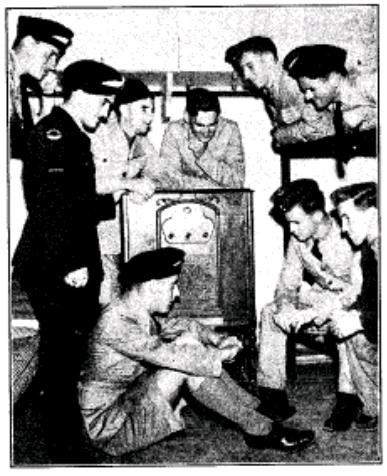
1941JulyPMXtalSetsThe young gentlemen shown here are currently about 85 years old. They are shown in the July 1941 issue of Popular Mechanics demonstrating the operation of two of the seven crystal set circuits in the accompanying article.

The article noted that distant reception was possible under certain favorable and unusual conditions, but a crystal set was normally limited to a range of about ten miles. All of the circuits used a fixed detector. The simplest one was tuned by tapping the coil at various points. More complex circuits used various tricks to coax out as much signal as possible. The article stressed the importance of a long high antenna, and grounding to a cold water pipe.

Click Here For Today’s Ripley’s Believe It Or Not Cartoon



1936 Popular Science Regenerative Receiver

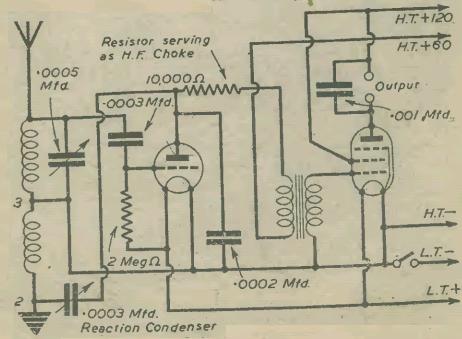
1936JulyPSThe plans for this simple one-tube regenerative shortwave receiver appeared in Popular Science 80 years ago this month, July 1936.

It used a single 6C5 metal triode.  The tube, as well as the other components, are readily available, although the modern components might have a slightly different look.  According to the author, the set’s volume and sensitivity equalled those of more complicated circuits.  From the author’s home in Nebraska, the set pulled in amateur, police, air-mail, and commercial shortwave stations from all around the country with excellent headphone volume.  The author was also able to pull in foreign stations, despite a relatively short antenna and being in the middle of a noisy business district.  The total cost of the parts was about five dollars.

The plans showed coil winding data for plug-in coils for 10 through 160 meters.

1936JulyPSschematic

Click Here For Today’s Ripley’s Believe It Or Not Cartoon


NPOTA: Interstate State Park, Wisconsin

Taking down my station after operating.

Taking down my station after operating.

Pothole

Glacial pothole at Interstate State Park. National Park Service photo.

On the Fourth of July, I did another activation for National Parks On The Air (NPOTA), an event in which amateur radio operators set up portable stations at National Park units and make contact with other amateurs at home.  The event has been very popular, and there have been hundreds of thousands of contacts made from the parks.  Even though I don’t live near an actual National Park, there are hundreds of National Park units around the country, many of which are close to home.  Three of them are located in Wisconsin very close to the Twin Cities area.  Those are the St. Croix Wild and Scenic River, the Ice Age National Scenic Trail, and the Ice Age National Scientific Reserve.  The trail covers 1200 miles as it loops through Wisconsin, the river is the state’s western boundary, and the Scientific Reserve is made up on nine Wisconsin State Parks, one of which is  Interstate State Park, located less than an hour from Minneapolis and St. Paul, MN.  The trail and scientific reserve get their name from the geological features, since the landscape was carved out by the glaciers.  The spot from which I operated was called the Pothole Trail, since it contains massive potholes carved into the rock by the action of rushing water as the glaciers receded.

InterstateSP070416B

Myself and my assistants at the trailhead before starting the arduous quarter mile hike to the operating location.

In my earlier trip to scout out the area, I confirmed that there was a small area where the three National Park units came together.  The park’s western boundary is the river, so any operation within 100 feet of the water qualifies as being from the river.  Operation from the scenic trail must be within 50 yards of the trail, and the operating location must be reached using human power.  For most of my river and park activations, I’ve operated from my vehicle.  But in order to activate all three units simultaneously, I needed to reach the site on foot.  In my earlier trip, I did confirm that there were spots within 100 feet of the water and 50 yards of the trail.  I forwarded this information to ARRL, which made the spot a “threefer” for NPOTA purposes.  This week, together with my wife and daughter, I set out to operate from that small area.  (My son is at scout camp this week at Tomahawk Scout Reservation, which coincidentally also lies along the Ice Age Trail near Rice Lake, Wisconsin.)

At the marker showing the western terminus of the trail. My station is contained in the blue bag over my left shoulder. The golf ball retriever served as walking stick and antenna support.

At the marker showing the western terminus of the trail. My station is contained in the blue bag over my left shoulder. The golf ball retriever served as walking stick and antenna support.

My station consisted of my  Yaesu FT-817, powered by a 12 volt sealed lead acid fish finder battery,  The antenna consisted of a 20 meter inverted vee supported by my trusty golf ball retriever  in the center and tied to some convenient trees with string.  I carried a folding chair, and my operating table consisted of a boulder conveniently left behind by the last glacier.

As I was setting up, I ran into another ham, KD0IYR, who happened to be climbing in the area.  To help ensure I made my required ten contacts, I handed him my $30 Baofeng UV-5R and worked him twice, on 2 meters and 70 cm.  I then worked my wife, KC0OIA, on both of those bands.  With four contacts out of the way, I only needed an additional six to make the activation official.

After setting up my antenna, I started calling CQ, and had my wife spot me on DXSummit.fi.  Within seconds of her posting the spot, I had callers.  I made ten contacts in the next fifteen minutes.  Unfortunately, after fifteen minutes, the spot disappeared off the DX cluster page, and I didn’t get any more replies.  I made my ten contacts, even without counting the four orchestrated ones, but it’s still somewhat disappointing how many chasers depend on the cluster, when there are easy units to be worked simply by tuning around and listening.  My best DX was S58AL in Slovenia.

After things quieted down, I tuned around and worked K2M, one of the stations in the Thirteen Colonies operating event.  Band conditions were not the best, but I did tune the phone band.  I heard one other park on the air, but was unable to raise him before he had to QRT.  I called CQ for a few minutes on SSB, but with no takers.


Click Here For Today’s Ripley’s Believe It Or Not Cartoon


Hurricane of July 5 1916


One hundred years ago today, July 5, 1916, the U.S. Gulf coast was hit by a hurricane.  Mobile and Pennsacola were cut off from the outside world, and New Orleans suffered major effects.  The storm was initially reported on July 3 near Swan Island.  Weather along the coast was ordinary on the 4th of July, but the barometer kept dropping.  Winds at Mobile eventually peaked on the 5th at 106 MPH, and the barometer fell to 28.92 inches.

Warnings were surprisingly effective.  In addition, the fact that the storm made its presence known on a holiday meant that the number of ships in peril were minimal.

The weather bureau at New Orleans reported that the “warning was given an extraordinary distribution. It was send by telephone to the docks with instructions to send it to Grand Isle by motorboat. The boat traveled 18 miles, warning points along the way. The warning was also sent to all telephone exchanges with instructions to disseminate the warning widely. It was also sent to all telegraph stations with similar instructions.

Those warnings were heeded, and most craft remained in port. At New Orleans, a number of vessels stopped in the Mississippi until advised that it was safe to proceed. In addition, all trains crossing Lake Pontchartrain were suspended.  Similar warnings were distributed at Pensacola and other points.


Cotton bale debris in Mobile.

Cotton bale debris in Mobile.

References


Independence Day 1916 and 1941

1916July4

July 4 a century ago and again 75 years ago both had the distinction of being the last Independence Days prior to war. In this cartoon from the Bismarck Daily Tribune, July 4, 1916, Uncle Sam is clearly pondering war on his 140th birthday.

Just a quarter century later, the July 4, 1941, issue of the Chicago Tribune carried the pro-neutrality cartoon below.

1941July4

Click Here For Today’s Ripley’s Believe It Or Not Cartoon