Custom TV Installation, 1951

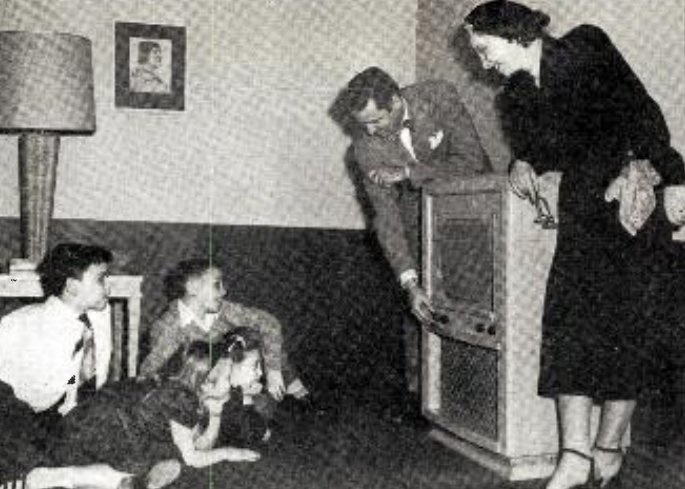
Seventy-five years ago, it was a red letter day for this housewife when the man in the white lab coat showed up at her door to do the custome installation of what would later be called a home theater. This particular installation included a Radio Craftsman Model RC 101 16″ television and model R-10 AM-FM radio. The record player came from Milwaukee Stamping Co., and the speakers were from Jensen. Atop the extra cabinet unit was a Talk-A-Phone “Chief” intercom, and there was a storage compartment that could later be used for a tape recorder.

The picture appeared on the cover of Radio News, January 1951. The accompanying article noted that custom installation was once considered a novelty, but was rapidly becoming an important factor in the trade.

This unit was a free-standing cabinet, but the article noted the many options for built-in equipment. Architects, interior decorators, and home designers were said to be having a field day with the new options. The magazine traced the evolution of home heating. It began with open fireplaces, then stoves, then fancy baseburners, and finally a furnace hiddn away in the basement or utility room. It predicted a similar progression for home electronics.


Iran Protests: The Importance of a Shortwave Radio

I know that this site has at least one follower in Iran.  But I’m certain that they are not following us at the moment, because the government of Iran shut down the internet.  International telephone service has also been cut.  When things settle down, they’ll be back, and they can know that they were in our prayers.  But since they obviously have an interest in radio, we hope that they are getting news from the outside world via radio.

If they have Starlink, they can use that.  But it’s unlikely that most people have the hardware just sitting around, since it’s expensive.  And it’s probably illegal.   Satellite TV is apparently popular, but it’s also illegal.  And if the revolutionary guards are running around shooting people, you probably don’t want to have an illegal satellite dish visible on your balcony.

Once again, we are reminded the importance of having even a very inexpensive shortwave or even mediumwave (AM) receiver.  With it, even if due to circumstances outside of your control cause you to lose contact with the outside world, you can still keep yourself informed.

To get some idea of what you would be able to hear on a radio in Iran, I went to one of the closest WebSDR’s I could find, a remote receiver in Kuwait.  The medium wave stations would be different from the ones I would hear in Iran, but the shortwave band would sound about the same.  There were dozens of signals available.  Most were in local languages, but I did hear French, and at least one English station, Radio China International on 9600 kHz.

Undoubtedly, many of the signals I was hearing were in Farsi or Arabic, meaning that local listeners would be able to get news from the outside world, such as from the BBC Persian service from transmitters in Cyprus, Rwanda, and Oman.  During normal times, having an FM receiver is also a good thing.  But in this case, unless you were close enough to a border to hear foreign stations, it wouldn’t provide much useful information.

You needn’t spend a lot of money on a shortwave radio.  And even during normal times, a portable AM/FM radio (since the inexpensive shortwave sets also get AM and FM) can come in handy.

This link will take you to the Amazon search results for inexpensive shortwave radios.  The list is sorted by price, and also includes only products with free shipping available.  So if you have Prime, you pay no shipping.  If you don’t have Prime, then add some items to your order to bring it up to $35.  (My favorites in this category are toilet paper, coffee, or canned goods.)  As you can see, prices start for under $10.  I don’t have experience with these particular models, since they come and go.  But my experience is that most of these cheap receivers perform very well on FM, serve the purpose on AM, and will pull in at least a few strong shortwave stations.

Looking at the reviews, it appears that this one performs adequately, and would get at least some shortwave stations, although the small dial makes it tricky to tune.  It requires AA batteries, so be sure to stock up on them as well.    This one is slightly larger, meaning that it’s easier to tune.  It has a built-in rechargeable battery which charges from a USB.  (See our earlier post on preparing for power outages to make sure you’re prepared to recharge it in an emergency.)

For most of our readers, it’s very unlikely that your government will intentionally put you in the dark.  But even in circumstances as mundane as a power outage, it’s good to know that you can find out what’s going on in the world.  And the price for making this preparation is close to zero.

آزادی، آزادی، آزادی


Some links on this site are affiliate links, meaning that this site earns a small commission if you make a purchase after using the link.

Big Beam Jr. Flashlight, 1951

If you were in the market for a flashlight 75 years ago, you couldn’t go wrong with the Big Beam Jr. from the U-C Lite Mfg. Co. of Chicago.  It could be focused to provide a sharp beam, or as a floodlight.  It retailed for $6.75, less battery.

It is featured here in the January 1951 issue of Popular Mechanics.


Tropicalizing Radios, 1946

Eighty years ago, this Indiana radio worker is “tropicalizing” radio equipment. The chassis has just had a lacquer applied, and it is now passing through an infrared drying oven. The photo was taken at the Farnsworth Television and Radio Corp. in Marion, Indiana, and appeared on the cover of Radio News, January 1946.


Grant’s Department Store Radio Department, 1926

A hundred years ago, if you were in need of radio parts in San Antonio, then you couldn’t go wrong by heading to the Radio Department of Grant’s Department Store, 305-311 East Houston Street, where you could find tubes, B batteries, or even tuning condensers for just a dollar a piece. This ad appeared in the San Antonio (TX) Sun, January 8, 1926.


1926 British “Ultra” Crystal Set

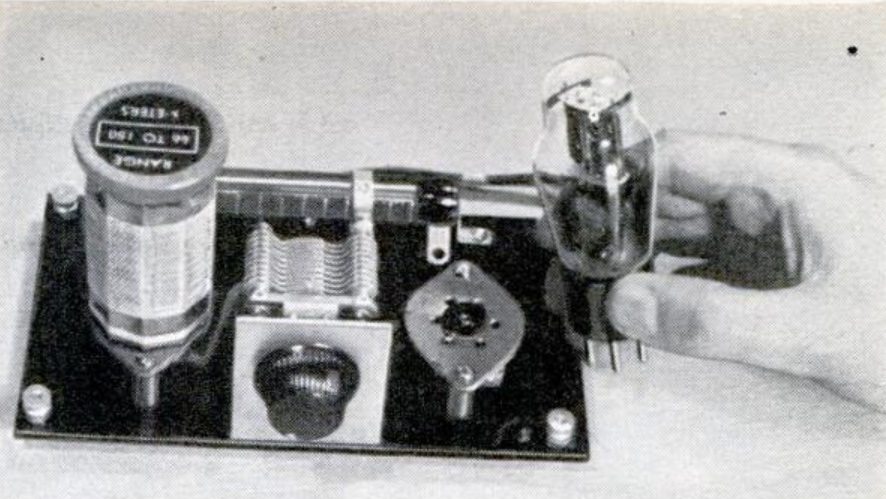
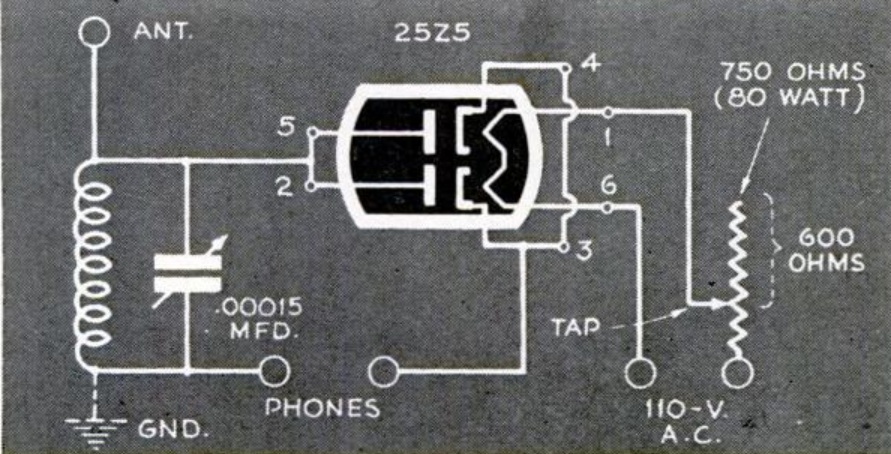
A hundred years ago, the January 1926 issue of theBritish publication Popular Wireless showed how to put together this “ultra” crystal set.  It was designed to  pull in the main BBC broadcast, as well as the then-new transmissions of station  5XX on 187.5 kHz.  That station broadcast from Daventry with high power (then 25 kW), with the idea of blanketing Britain with its signal.

The set was named “ultra” due to the fact that the honeycomb coils were designed such that the primary and secondary would always have their main portions directly next to one another, for maximum signal transfer.


1926 Guarantee Portable Phonograph

If you were a retailer a hundred years ago and wanted to sell portable phonographs, you couldn’t go wrong with this model from the Guarantee Talking Machine Co., 109 North Tenth Street, Philadelphia. Your cost was $11.50, and it retailed for $25. This ad appeared in the January 1926 issue of Talking Machine World.


George Washington Carver National Monument

Replica of the Jessup Wagon used by Carver as a mobile agricultural classroom.

We recently had the pleasure of visiting the George Washington Carver National Monument in Diamond, MO, Carver’s birthplace.  For the Route 66 fans, that’s not far from Joplin, MO.  Since Carver lived until 1943, we had no doubt that radio would play an important part of the exhibits.  And we were not disappointed, as one of the galleries contained the stylized antique radio shown above, which allowed visitors to listen to several radio broadcasts made by the scientist and inventor.  In addition, there were microphones and headphones which visiting students could use to create a similar radio interview.

You can find a sampling of broadcasts by Carver at the Iowa Public Radio website.  At this link, you can listen to the 1939 broadcast of “Strange As It Seems” about Carver, including an interview.

The monument also includes a classroom and laboratory.  The classroom is a non-specific period room, while the lab is modeled after Carver’s laboratory at the Tuskegee Institute.  The Monument is geared up for school field trips.  I noted that there were a number of rules written on the board in the lab, such as “four on the floor.”  One of the rules was the mortar and pestle must stay together, as I’m sure the mortar and pestle would otherwise make interesting toys for the students.

Carver died 83 years ago today, on January 5, 1943.


Inventions Needed: 1956

Seventy years ago, the January 1956 issue of Popular Electronics gave some suggestions on the kinds of things that electronics hobbyists could think about inventing.  The ideas came from the National Inventors Council, a governmental agency tasked with encouraging independent inventors to come up with ideas useful to the government and military.

Shown above is a 3D radar display.  The magazine noted that a “truly three- dimensional display would not only have wide application in military work, but might have wide commercial application in the development of a three -dimensional television system for home use.”  (We should note that Mr. Whoopee didn’t come up with his version until 1963.)

Some of the inventions described in the magazine did come to fruition.  For example, it mentions that the military is in need of a recording method which would cover a huge spectrum, up to 1000 MHz, but that current tape and wire recorders weren’t up to the task.  Today, it’s pretty commonplace for a software-defined receiver (SDR) to have recording capabilities, so that you can play back a huge chunk of spectrum.  Today, your computer has enough capability to do just that.

Similarly, the portable power sources that the military was looking for 70 years ago are probably in your pocket right now, as the battery in your phone meets most of those specifications.

The magazine mentioned that hams could probably come up with a “microwave oscillator, suitable for both continuous – wave and pulsed operation, with an output of 1 kw. or more.”  The idea shown at left did, indeed, come to fruition, and you probably have it installed on both your computer and phone, in the form of some kind of voice-recognition software.  So someone must have come up with that new approach mentioned in the caption.


Keeping Your Store Before Her Eyes: 1946

Eighty years ago, with the War in the rear view mirror, this woman needed a radio, or perhaps a home appliance, and she was calling her friendly local radio dealer, who had the foresight to make sure that she had his number handy.

She is shown on the cover of Radio Retailing, January 1946. The magazine reminds dealers that soon there would be a flood of products onto their sales floors: “Let’s forget the past. Forget the days of famine and the days of “in-the-bag” sales. Let us remember what happened in other fields. -There are plenty of cigarettes now; there are beefsteaks, metal razors, face tissues and nylons.” And soon, there would be plenty of radios.