Category Archives: World War 2

Rock Radio, American Samoa, 1944

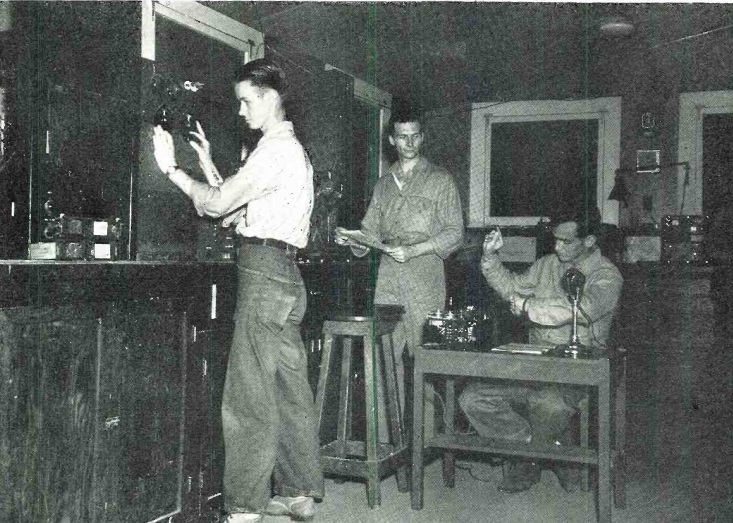
1943rockradio

Shown here are Radio Technician First Class Kenneth D. McCoy of Salem, Oregon; Radioman First Class Stanley T. Dixon of San Francisco; and Radioman Third Class Charles H. Wilson of Steubenville, Ohio, the operators of 2-1/2 watt “Rock Radio,” located in 1944 in American Samoa. The picture and accompanying article appeared in the June 1944 issue of Radio News.

The station was cobbled together with scavenged parts including “tired tubes, broken bed springs, and stripped Jeep gears.” The station’s microphone consisted of the receiver of a Marine field telephone. The record player was an antiquated Victrola purchased for $3 from one of the natives.

Each night, the station came on the air, manned by whichever of the three was not on duty that night. It signed on with an almost worn out recording of the Star Spangled Banner, followed by a variety program of recordings chosen at random by the announcer. After a fifteen minute newscast, requests were taken. On Christmas Eve, the station recorded and rebroadcast the President’s message to the armed forces.

The station’s signal covered the entire island, and proved popular with the sailors and marines stationed on the island.


1946 NPOTA Activation

1946septradionews

During the 2016 centennial of the National Park Service, the American Radio Relay League (ARRL) is conducting its National Parks On The Air (NPOTA) event.  Amateur Radio operators are setting up their stations in various units of the National Park Service (NPS) and making contact with other Amateurs around the world. Since the beginning of the year, the event has been extremely popular, with over 11,000 activations from 450 different different units of the NPS (with only 39 not yet activated), with over 640,000 individual two-way contacts.  As I’ve reported in other posts, I’ve made contact with 251 different parks, operated multiple times from six parks in Minnesota and Wisconsin, and plan to activate additional parks in the Midwest before the end of the year.

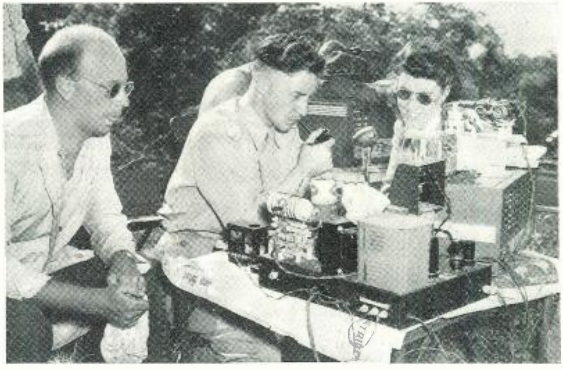
Even though this event is recent, operating portable from the National Parks is nothing new, as shown from the photograph above, which appeared seventy years ago this month in the September 1946 issue of Radio News.

Shown here are members of the Washington Radio Club operating Field Day 1946 from Shenandoah National Park in Virginia. Shown here are Dick Houston, W4QPW (apparently at the mike), along with Major Eric Ilott, G2JK, of the British Army (later VE3XE), and club secretary Barbara Houston. They are operating a 25 watt phone rig on 10 meters, with a Hallicrafters Sky Champion serving as the receiver. Power was supplied by a 300 watt gasoline generator.

Ilott, apparently at the left in the photo, served in the British and Canadian military until his retirement as a Lieutenant Colonel in 1974. He immigrated to Canada in 1947. During the war, he served as a listener for the British War Office, sending reports to Bletchley Park. Among his accomplishments after the war was bringing the first ever television signal to Kingston, Ontario, from an antenna atop a water tower. He died in 2015 at the age of 95.  (For another look at the early days of bringing distant TV signals to town, please see my earlier post on the first TV in Marathon, Ontario.)

1946 was the tenth running of the ARRL Field Day, an event in which hams set up stations at portable locations to make as many contacts as possible.

I previously wrote about the 1941 Field Day, in which the high scoring station had made 1112 contacts. That would be the last Field Day before the war, and the one shown here was the first postwar Field Day. According to the results in the February 1947 issue of QST, the top 1946 scorer made 809 contacts.

But the results article noted that it would be pointless to compare the 1946 results with those of prewar Field Days, since operating conditions as of June 1946 were quite different. In particular, hams had not yet regained access to the 160, 40, and 20 meter bands, which had been the workhorses for the prewar events. The 1946 Field Day was limited to 80 and 10 meters on HF, along with the 50, 144, and 420 MHz bands.

Shenandoah was not the only national park being activated in 1946. In addition, according to the results article, there were operations from Rocky Mountain National Park in Colorado and a battlefield national park in Virginia, as well as numerous other venues.

n3knshenandoah

Photo courtesy of N3KN.

While the Washington Radio Club took the honors of activating Shenandoah National Park in 1946, my own 2016 contact took place on February 8 on 20 meter phone.  Fortunately, the 20 meter band was returned to hams shortly after the war, as the contact on 10 or 80 meters in 1946 would have been considerably more challenging.  My contact was with Kay Craigie, N3KN, shown here.  In addition to being an avid NPOTA chaser, activator, and member of the NPOTA Facebook group, Kay is the immediate past president of the ARRL (a select group which included Herbert Hoover, Jr.).  She was at the helm of the ARRL when the NPOTA event was proposed and adopted.

Click Here For Today’s Ripley’s Believe It Or Not Cartoon


W2OEC, Ft. Monmouth, NJ, 1946

1946septradiocraft

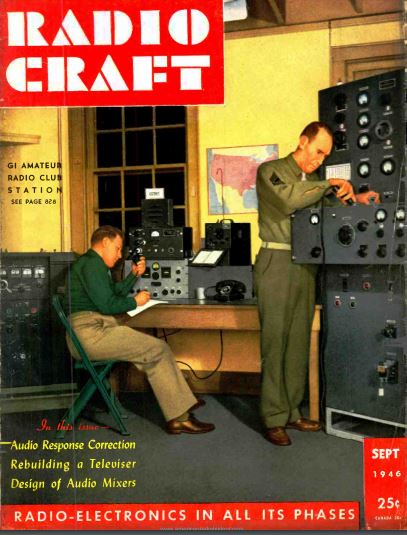
Seventy years ago, the cover of the September 1946 issue of Radio Craft shows the well equipped station at W2OEC, the military recreation club station at Fort Monmouth, New Jersey. Since the base was the home of the Signal Corps, it understandably had a large population of hams. Indeed, since there were hams from throughout the country, there was talk of adding an award for working all ten call areas within Momnouth County, New Jersey.

There were plans to equip the station with a kilowatt on all bands below 30 MHz. Transmitters consisted of military models BC-610 and BC-339.

The accompanying article described the station’s antennas, which included a rotatable beam for 10 meters. The 80 meter antenna’s main lobe was aimed for Missouri, allowing good coverage of the entire country.

Click Here For Today’s Ripley’s Believe It Or Not Cartoon



Siege of Leningrad: 1941-43

Today marks the 75th anniversary of the start of the Siege of Leningrad. On September 8, 1941, German and Finnish troops cut off the last land access to Leningrad, in a move deliberately designed to starve the residents. The city was cut off almost completely until January 18, 1943. For most of that time, the only lifeline was a route over Lake Ladoga known as both the “Road of Life” and the “Road of Death.”

RIAN archive 324 In besieged Leningrad.jpg

Nevetsky Prospekt, Leningrad, 1942. Wikipedia photo.

During the siege, approximately 1.5 million Soviets died, mostly of starvation. Most residents subsisted on 125 grams (about a quarter pound) of bread per day, and the bread consisted of half sawdust.

One propaganda coup scored by the Soviets was the premiere of Symphony No. 7 by Dmitri Shostakovich. It was composed by Shostakovich partially while in the sieged city, and partly after being evacuated. But it had its premiere on the Leningrad radio on August 9, 1942. The date was highly symbolic, since it had been scheduled by Hitler as the date for a celebration within the city of the completion of the invasion. Supposedly, Hitler even had invitations printed up for the event to be held at the Leningrad Astoria Hotel.

The first rehearsal lasted but 15 minutes, since the musicians (especially the brass players) were physical unable to perform due to malnutrition. But with heroic efforts, the concert took place as scheduled, and was broadcast.

For full propaganda effect, loudspeakers outside the city were directed toward the German lines, and the German soldiers were treated to the concert. One German soldier later recalled, “who are we bombing? We will never be able to take Leningrad because the people here are selfless.”

Civilians constructing anti-tank fortifications. Library of Congress photo.

While the concert was broadcast over “radio,” the actual broadcast almost certainly took place not over the airwaves, but through the extensive Soviet wired broadcasting network. The vast majority of “radio” receivers in the Soviet Union were not actual radio sets, but a speaker, transformer, switch, and volume control, which may or may not have been mounted in a radio cabinet. The receiver was commonly called a “rekord.” These simple receivers were connected to a wired network, similar to a telephone network, which would carry the program continuously.  Indeed, according to this source, private radio receivers were confiscated at the very beginning of hostilities with Germany.

Immediately prior to the war, the Soviet Union boasted over 5.5 million wired speakers. In contrast, as of 1936, the country had only 650,000 radio receivers, 270,000 of which were crystal sets.  A nice collection of such speakers (mostly postwar) can be found at this link.

The use of wired radio during the siege of Leningrad is stated here:

The wire net of the radio diffusion exchange may carry programs which originate at the exchange, and this makes possible utilization of the radio for mass communication of a purely local nature. This ability to broadcast without actually going “on the air” proved itself invaluable during the war, since the local radio could continue to function and maintain contact between the authorities and the population without the risk of having enemy aviators make use of the signals to guide them to their objective.

An outstanding example of such use of the wired net is to be found in the siege of Leningrad. During the siege the Leningrad wired net operated around the clock. During hours when no programs were on and throughout the night the Leningraders kept their speakers tuned in.  The slow beat of a metronome kept the wire alive. Whenever it was necessary to make an important announcement the beat of the met – ronome was rapidly increased. Thus, at all times the authorities were able to maintain constant contact with the population, to transmit orders, warn of danger, or make special announcements .

Communications Research 1948-1949, page 245.

The Seventh Symphony was first broadcast in the United States on July 9, 1942, over the NBC network. As explained in an article in the April 1945 issue of Radio Age, the musical score was sent from Moscow to the United States via facsimile, or what the article called radiophoto.

https://www.youtube.com/watch?v=jd8iAe4WhMM

At Amazon

Click Here For Today’s Ripley’s Believe It Or Not Cartoon


Anzac News Letter, 1941

1941AugManitobaCalling

This 1941 photo shows servicemen stationed in Canada from Australia and New Zealand gathered around the radio at 9:00 on a Sunday morning to listen to “The Anzac News Letter,” a weekly program provided by the CBC and the Australian Broadcasting Commission.

The Australian and New Zealand airmen shown here were attending wireless chool in Canada. The program originated in Australia and was sent by cable to Ottawa where it was recorded. The program was well received by the Anzacs. One wrote, “personally, I consider it the most interesting session on the radio, and I feel sure that the majority of Australians in this camp hold similar views. In the normal course of events it takes four to five weeks for the home newspapers to reach camp, so you can imagine how much we appreciate receiving news within twenty-four hours of the events taking place.”

The photo appeared in the August 1941 issue of Manitoba Calling, the magazine and program guide of CKY in Winnipeg, which carried the program.

Click Here For Today’s Ripley’s Believe It Or Not Cartoon


FDR and Churchill Meet, 1941

On this date 75 years ago, Franklin Roosevelt and Winston Churchill had their first in-person meeting of the war, aboard the U.S.S. Augusta, in Newfoundland.  While it was their first meeting as world leaders, the two men had actually met once earlier, in 1918, although Churchill didn’t recall the meeting.

The Lend-Lease Act had passed in March of that year, and it was clear that America would be involved in the war.  At their meeting, the two men drafted the Atlantic Charter, which included eight common principles to which the two countries were committed.  They agreed to a postwar world in which neither country would seek territorial expansion, and with liberalized trade, freedom of the seas, and international labor, economic, and welfare standards.  Both men agreed to the need for restoration of self-government for the occupied countries.

Churchill announced the Charter in this speech given a few days later:

Click Here For Today’ Ripley’s Believe It Or Not Cartoon


A Radio For Every Recruit, 1941

1941AugustRadioNews

With the United States having its first peacetime draft, there were a lot of inductees away from home needing a way to stay connected and entertained.  The August 1941 issue of Radio News pointed out the opportunity this afforded radio dealers in the form of a “radio for every recruit.”

The article noted that most–but not all–draftees had an income of $21 per month, hardly enough to splurge on a radio.  Instead, the article noted that most sales were made to the families of the soldier.  In fact, one dealer had the fortunate circumstance of having his ad for portable radios happen to appear on the same page of the newspaper listing the names of draftees.  He did record business as the families of those servicemen hurried to his store to buy one of those portables.

Army officials cautioned that it was best for soldiers to wait until after their permanent placement before buying one more belonging to drag around.  But battery portables and compact sets were proving popular, and some men were using radio-recorders to make records to send home instead of letters.

Click Here For Today’ Ripley’s Believe It Or Not Cartoon


Wartime Sliced Bread Ban

SlicedBread

This ad for sliced Wonder Bread appeared in the Milwaukee Sentinel, March 9, 1943. It heralded the end of one of the most unusual aspects of wartime economic controls, namely, the ban on sliced bread.

On January 18, 1943, the War Foods Administration handed down its edict that, as a wartime measure, the sale of sliced bread would be banned. Thereafter, only unsliced loaves would be for sale, and the hapless housewife would need to cut it herself. As the Wonder Bread ad above notes, one effect was that children couldn’t get a slice of bread by themselves.

The exact rationale for the ban was never made entirely clear, but the ostensible reason was that it would save on waxed paper, since the unsliced loaf would stay fresh longer by itself, and wouldn’t need to be wrapped as well. But there was no shortage of wax paper, and most bakeries had sufficient stocks on hand.

As might be epxected, this edict didn’t go over well with the general public. Some bakeries simply ignored the ban and condtinued to slice the bread for customers on request. One housewife wrote the following letter to the editor of the New York Times:

I should like to let you know how important sliced bread is to the morale and saneness of a household. My husband and four children are all in a rush during and after breakfast. Without ready-sliced bread I must do the slicing for toast—two pieces for each one—that’s ten. For their lunches I must cut by hand at least twenty slices, for two sandwiches apiece. Afterward I make my own toast. Twenty-two slices of bread to be cut in a hurry!

The ban was quickly lifted, sliced bread went back on sale in March, and as the Wonder Bread ad notes, children could once again get a slice of bread all by themselves.


References


Click Here For Today’s Ripley’s Believe It Or Not Cartoon


Independence Day 1916 and 1941

1916July4

July 4 a century ago and again 75 years ago both had the distinction of being the last Independence Days prior to war. In this cartoon from the Bismarck Daily Tribune, July 4, 1916, Uncle Sam is clearly pondering war on his 140th birthday.

Just a quarter century later, the July 4, 1941, issue of the Chicago Tribune carried the pro-neutrality cartoon below.

1941July4

Click Here For Today’s Ripley’s Believe It Or Not Cartoon


June 29, 1946

19460729

The newspapers 70 years ago gave a glimpse at how the postwar world was going to be different.  This is the Milwaukee Journal of June 29, 1946.  The pictures are taken a Bikini Atoll, where Operation Crossroads
was underway, with the world’s fourth atomic blast scheduled for the next day.

The headline at the top of the page reports Herbert Hoover’s statement that mass starvation in the world had been averted, except in China, where there was still a pressing need.  Just over a year earlier, President Truman had enlisted Hoover to deal with the food situation, and Hoover’s final report was noted here.

In other news, President Truman had signed a bill extending the draft, which had been set to expire in March 1947.

Click Here For Today’s Ripley’s Believe It Or Not Cartoon