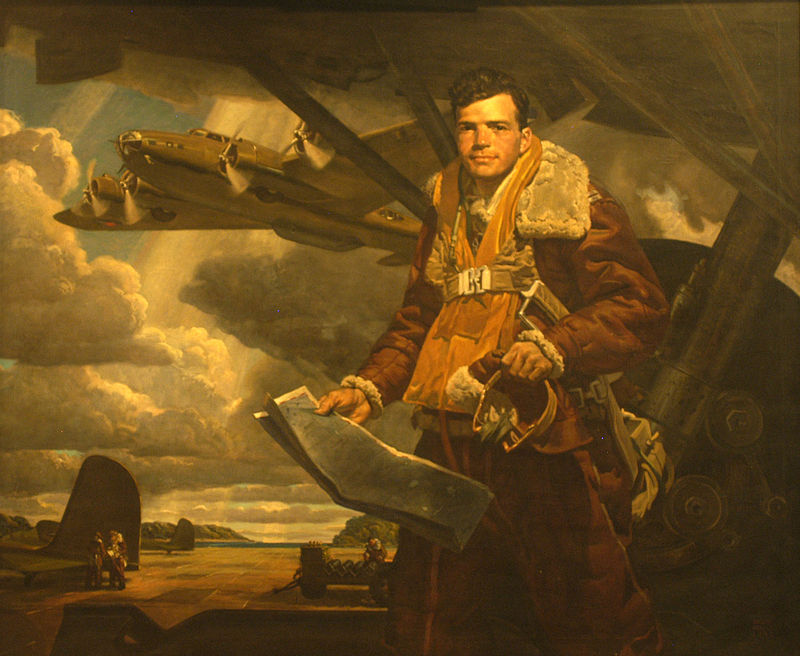
written in 1942 by Paul Roberts and Shelby Darnell. The song refers to a version of heaven reserved for a pantheon of American heroes, including “Lincoln, Custer, Washington and Perry, Nathan Hale and Collin Kelly too.”
The last named American hero, Collin Kelly, died this day 75 years ago, December 10, 1941. He was one of the first heroes of the Second World War. His was the first American B-17 to be shot down in the war.
On December 10, he took off on a bombing run from Clark Field in the Phillipine Islands. On the return flight, the plane was attacked. Kelly ordered his men to bail out. Moments later, the plane exploded, killing him.
Kelly was posthumously awarded the Distinguished Service Cross, and President Roosevelt wrote a letter to the President of the United States in 1956, asking for an appointment for Kelly’s infant son. President Eisenhower honored this request by appointing Colin P. Kelly III to West Point.
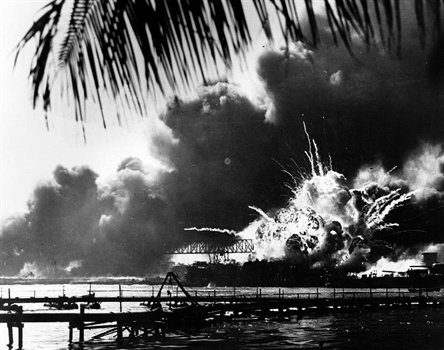
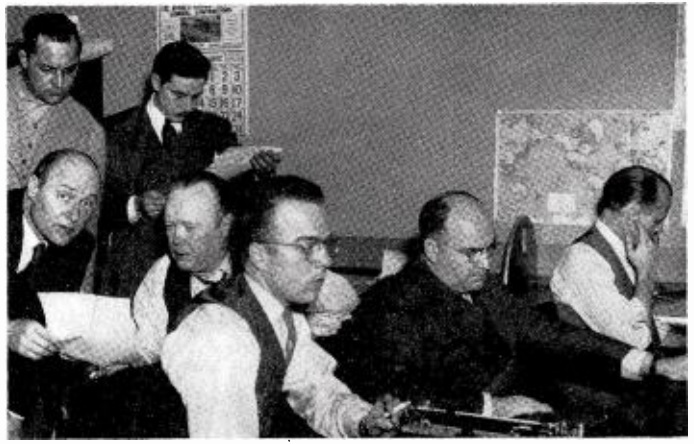
Today marks the 75th Anniversary of the Japanese attack on Pearl Harbor, December 7, 1941. Most Americans learned of the attack by radio, and the story of that coverage featured prominently in the December 15 issue of Broadcasting magazine, the first to go to press after the attack. The photo at the left shows the news staff of stations WLW and WSAI, Cincinnati, huddled shortly after the first news of the attack broke.
According to the magazine, the first broadcast of the attack came at 2:26 Eastern Time, when WOR New York broke into a Dodger-Giant football game to read the United Press flash. Two minutes later, the news was broadcast nationwide over the NBC Red and Blue Networks.
CBS carried the announcement during its 2:30 station break. The afternoon news program was quickly reorganized. CBS newsman John Daly had spoken by telephone with KGMB Honolulu, and news of the attack on Manila, Philipine Islands, was carried live by a telephone hookup with KGMB, that signal being cut mid-broadcast.
Newsrooms came to life as staff were summoned in on an otherwise slow Sunday afternoon. At 2:45, the NBC network rang four chimes, instead of the customary three, to alert staff to report to work.
One NBC executive phoned KGU Honolulu for an immediate report. The voice from Honolulu reported that he was a station executive and did not have a microphone available. The NBC executive told him to keep talking to keep the line open as he raced to the network control room, and the call was eventually patched through live over the air. He was on the air by 4:06 PM with the live report, until a long distance operator broke in to report that the line was needed by the military. A recording of that broadcast is available at this link. Another six minute call was aired later that hour.
Starting on Monday, December 8, West Coast stations were on a wartime basis. In compliance with an army order, stations in California, Washington, Oregon, and Idaho went off the air. In Washington, KIRO‘s 50 kilowatt signal remained on the air for Army and Navy use only.
During the blackout, which lasted until the next morning, only five minute news flashes were permitted every half hour. More organization was apparent by Thursday and Friday, when staggered schedules were followed.
The nation’s shortwave stations went on a 24 hour schedule, with broadcasts in multiple languages. CBS carried reports in ten languages to Europe, and three to Latin America. It noted that both networks were following a policy of objectivity in news, following FDR’s pronouncement that more than ever, there was a need for truth in the news.
The East Coast shortwave stations were assigned staff from the Office of Coordinator of Information to review material for any that might give aid or comfort to the enemy. In San Francisco, the Navy served a similar function for GE shortwave station KGEI.
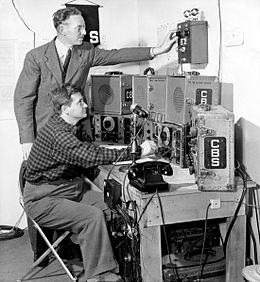
CBS Short Wave Listening Station, Long Island. Wikipedia photo.
The CBS and NBC shortwave listening stations were operating on a 24-hour schedule, making material available for the networks, press, and Government.
More information on radio broadcasting in the aftermath of the attack can be found at this post and this post.
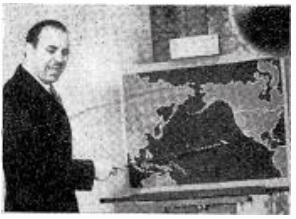
Television had newly come on the air commercially in New York, and the magazine reported that the new medium developed a new presentation as the events swiftly unfolded. WCBW came on the air at 8:45 PM until 10:00, the first time the station had been on the air on Sunday. Throughout the week, it presented several news programs daily. It covered President Roosevelt’s Monday speech, with a waving flag transmitted over the visual channel.
NBC commentator Sam Cuff uses map to show WNBT viewers strategic location of Hawaii.
WNBT moved an AP teletype into the studios, with the camera focused on the incoming wire. In the weeks preceeding the attack, WNBT had devoted much of its programming to civilian defense training, a role which continued during the war.
Sales of battery operated radios were said to have skyrocketed on December 8.
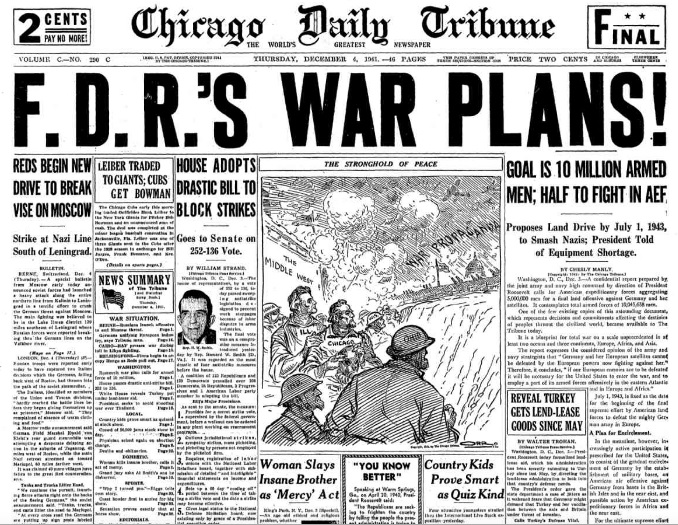
Seventy-five years ago today, America’s entry into the war was three days away, but the signs were clear that it was coming soon. The Chicago Tribune, December 4, 1941, carried this headline of FDR’s plans for war.
The front-page cartoon makes clear that the paper was decidedly in favor of neutrality and opposed to intervention. It shows a Midwestern bastion of peace, looking with alarm at what it viewed as pro-war propaganda from Washington.
The war plans, consisting of documents from the War Department and letters from the administration, had been obtained by the paper and the contents were disclosed. It showed the likely enemies as Germany, Italy, Spain, and Japan, and anticipated theaters of war in both Europe and the Pacific. It also stressed the importance of maintaining solid relations with the republics of the Americas, since trade with both Asia and Europe would probably be cut off for the duration. It called for ten million American men to take up arms, with half of those to serve in an Expeditionary Force to Europe, with a ground offensive slated to begin in 1943.
Another cartoon in the same issue of the paper restated what the paper viewed as Midwestern pro-peace values, insisting that we raised our cattle, and not our sons, for slaughter.
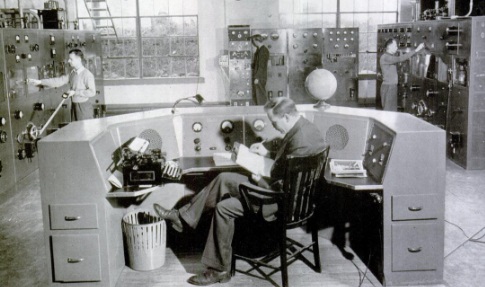
Shown here as it appeared at the time of America’s entry into the War is the control room of Boston shortwave station WRUL. The image appeared in the December 15, 1941, issue of Life Magazine.
The magazine was obviously put together immediately after the attack of December 7, since most of the articles refer to an America that was preparing for war, but still at peace. Only a middle section of the magazine includes images of the attack.
This image is from an article profiling the shortwave station which, according to the magazine, the Nazis hated and feared.
It was billed as the nation’s most powerful shortwave transmitter, and was “waging a mighty war of propaganda against Adolf Hitler and his allies.” The station’s transmitters were 50,000 and 20,000 watts, with plans to increase. Programs went out day and night in 24 languages.
The station had come on the air in 1927 under experimental license W1XAL. With the outbreak of war in Europe, unbeknownst to the staff, the station came largely under the control of British Intelligence. With America’s involvement in the war, the station was leased to the U.S. Government. In 1962, under new ownership, the call letters were changed to WNYW for “Radio New York Worldwide,” with studios in New York and the transmitter reamining in Scituate, Mass. In 1973, the station was acquired by religious broadcaster Family Stations, Inc., and operated as WYFR until that station moved its transmitters to Okeechobee, Florida, in 1979.
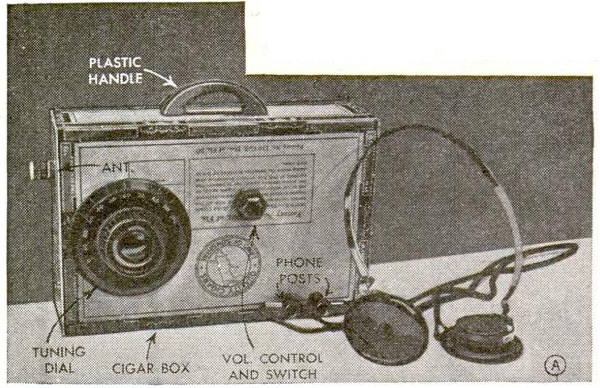
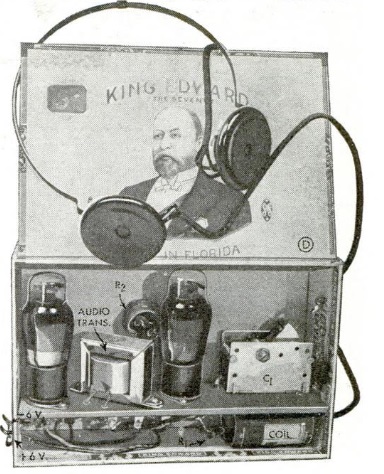
The November 1943 issue of Popular Mechanics carried the plans for this wartime emergency receiver. Built in a cigar box, the set was an updated version of the “Hurricane Receiver” previously published by the magazine and featured here earlier.
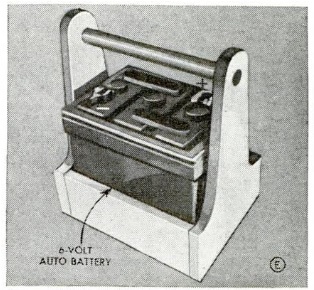
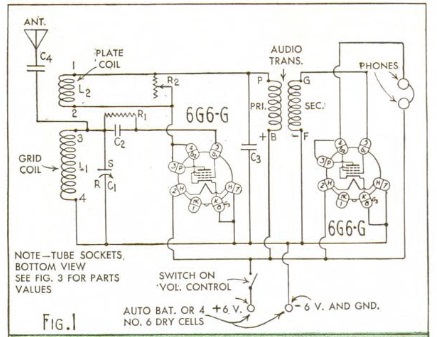
The article noted that the set could be used under blackout conditions in areas where a power line would be unavailable. Both the filaments and B+ were provided by six volts, which could come either from dry cells, or obtained from the nearest automobile. For portable use in shelter conditions, the article suggested a wood carrying case such as shown here for transporting the battery.
The set was said to be of considerably more volume and greater range than the original model. It employed two 6G6-G tubes, and the article noted that these tubes were commonly found in the junk boxes of radio students, experimenters, and servicemen. The set employed one tube as the regenerative detector, with the second one serving as audio amplifier.
The coil was wound on a cardboard tube, and the wire could be salvaged from a burned out choke or audio transformer. A ground connection was recommended for maximum results, and a 20 foot indoor antenna could be used for local stations, although a longer outdoor antenna would pull in stronger signals.
With this set and a 6 volt battery, the owner would be able to listen to local stations for emergency safety and blackout instructions.
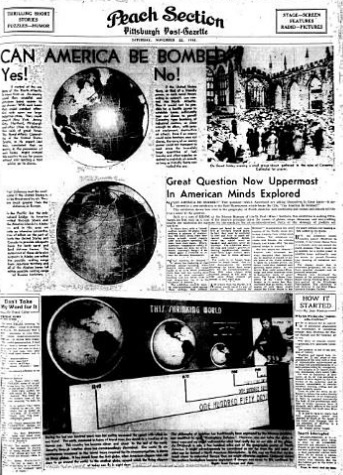
Seventy-five years ago today, only two weeks before Pearl Harbor, the Pittsburgh Post-Gazette for November 22, 1941, posed the question of whether America could be bombed, and included contradictory answers: Yes, an air raid was possible, but a Coventry-style attack on the Continental United States would be impossible, as long as America or a friendly navy controlled the Atlantic.
The article didn’t mention the Hawaiian or Philippine Islands which would be so obviously in the news in a fortnight. However, it did look at the Pacific situation on the continent. From Japan, air raids could possibly be made against Alaska. If Siberia fell into enemy hands, then most Alaskan bases could be raided at will.
The focus of the article was a traveling exhibit put together by the Science Museum of Minnesota. After being displayed in Minnesota, the exhibit was on tour, and was making its first stop in Pittsburgh.
This simple idea for a code practice oscillator appeared in the January 1944 issue of Radio Craft magazine.
No doubt inspired by wartime parts shortages, the audio feedback loop could be created with an old telephone receiver and microphone placed next to each other. The idea was sent in to the magazine by one Mr. Ivan H. Walker of Mt. Horeb, Wisconsin.
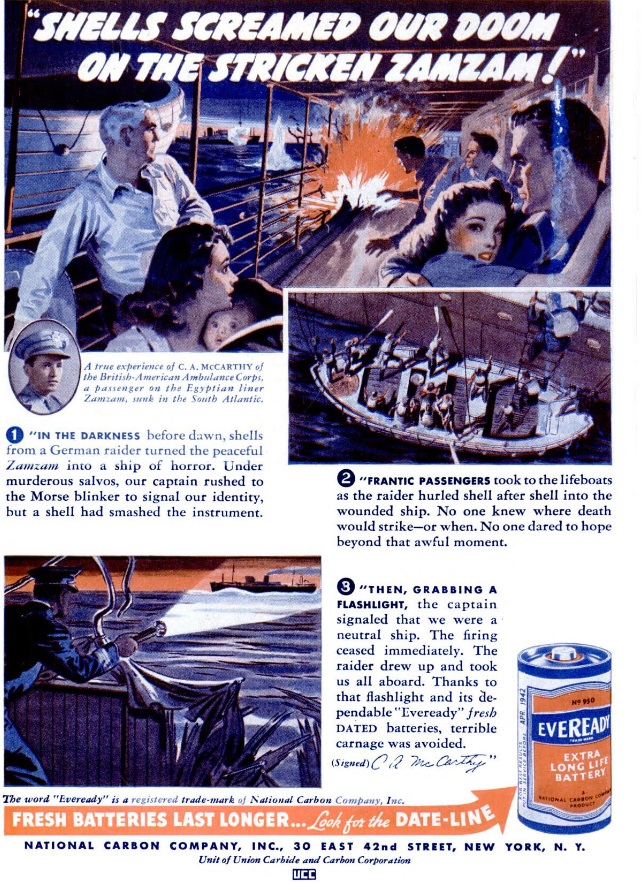
This advertisement for Eveready batteries appeared 75 years ago this month in the November 1936 issue of Popular Science. I had never heard of the Zamzam, but her last voyage is a fascinating but forgotten story of the Second World War.
I haven’t found any independent verification of the claim in the ad, that the Captain used Eveready batteries to avert disaster. But whether or not he did, it’s a compelling story.
The Zamzam set sail from New York in the Spring of 1941 under the Egyptian flag, bound for Egypt by way of South America and South Aftica. Built in 1909, she originally bore the name Leicestershire and flew the British flag. She first served as a passenger ship to India, and during the First World War, she served as a troop carrier, carrying troops to Russia and repatriating Australian troops after the war. After the war, she was modernized to burn oil rather than coal, and resumed passenger service to Rangoon until 1930.
In that year, she was sold to the British National Exhibition Ship Company Ltd., and was renamed the British Exhibitor, where she was to serve as a floating expedition showcasing goods throughout the Empire. When that company went into liquidation, the ship was purchased by the Egyptians, where she transported 600 pilgrims at a time from Suez to Mecca for the next eight years.
With the outbreak of war, the Zamzam was pressed into service carrying passengers between Egypt and New York. The first trip to New York was apparently uneventful, but her last voyage was the return trip.
The ship left Hoboken, New Jersey, on March 20, 1941, with 201 passengers aboard. To avoid war zones, the neutral ship would sail to Trinidad, thence to Recife, Brazil, across the Atlantic to Capetown, South Africa, and then up the east coast of Africa to Mombasa, Kenya, and then to Alexandria, Egypt.
The largest contingent of passengers consisted of 144 missionaries, representing both Catholic and Protestant denominations. Interestingly, the contingent of missionaries from the Augustana Lutheran Church were on their way to Tanzania, where they were to replace German Lutheran missionaries interned by the British.
The passengers also included a group of ambulance drivers from the British-American Ambulance Company, en route to North Africa to serve as ambulance drivers for British forces. There were also a group of American tobacco buyers en route to Rhodesia. Most passengers were American, but there were a large number of Canadians. The missionaries in particular included many women and children among their numbers.
Joining the passengers in Brazil were Life magazine photographer David E. Scherman and Fortune magazine editor Charles J.V. Murphy, who documented the later sinking.
A few days after leaving New York, the passengers were startled when the crew began painting over the portals and announcing that the ship would be travelling in strict blackout conditions. This prompted considerable protest by the passengers, who had believed that they would be traveling openly under the protection of a neutral flag. The captain, a British officer, insisted that he was acting under orders of the Admiralty, to the great consternation of passengers. The ship traveled under strict blackout, and no light, not even a lit cigarette, was permitted on deck.
During the early morning hours of April 17, the German raider Atlantis (also known as the Tamesis), a reflagged Norwegian freighter, attacked. The passengers donned life jackets and boarded lifeboats and the ship sunk. Since some of the lifeboats had been damaged, a number of passengers were forced to float in the water.
Just as the raider hoisted its Nazi flag and its crew were stationed at machine guns, a rainbow appeared in the morning sky. Eventually, the survivors signaled (presumably with the captain’s Eveready flashlight) that the ship was neutral. The German ship took the survivors aboard, and the captain discovered to his dismay that many of the passengers were Americans.
By all accounts, the captain, Bernhard Rogge, treated the prisoners humanely, and they were transferred a few days later to another ship which eventually transported them to occupied France. The Americans were repatriated fairly rapidly through Spain and Portugal, but the Canadians were interned.
The Catholic missionaries were American born, but were traveling under Canadian passports to expedite entry into South Africa. In retrospect, the decision was undoubtedly regretted, since they were interned with the other Canadians. This turned out to be a fortunate circumstance for the Germans, since the Geneva Convention required them to provide chaplains for POW’s, a role which these prisoners took on.
Eventually, seven of the Canadian women were to be exchanged for German women being held in Canada. At some point, they were placed on a train to Berlin. Unfortunately, nobody had bothered to tell Berlin that they were coming, and they were left to their own devices in the enemy capital. They made contact with American journalists and diplomats, and were eventually returned to Canada.
During their stay, however, they were forced to obtain food in the local economy along with the Germans. One butcher, recalling his humane treatment by the allies as a prisoner in the previous war, greeted them in English each time they entered his shop, and allowed them to the front of the line, somewhat to their embarrassment.
This video, prepared by one of the predecessors of the Evangelical Lutheran Church in America, is a fascinating look at the bizarre odyssey of these missionaries.
Seventy-five years ago, the United States was less than a month away from entering the war, but Canada had been at war with Germany since 1939. In this ad from this date’s issue of Broadcasting magazine, November 10, 1941, the Canadian Broadcasting Corporation reminded potential American advertisers that Canada was carrying on. Despite wartime conditions, industry was at capacity, new factories were coming online, employment was at a peak, and most important for advertisers, retail sales were showing gains.
The CBC was serving wartime duties, and it reminded advertisers that it provided complete broadcast services to reach the Canadian market.
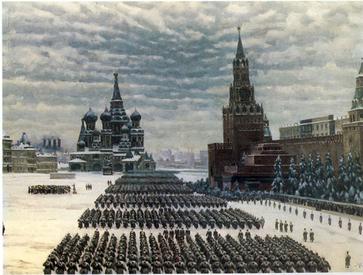
7 November 1941 parade in Red Square, 1949 painting by Konstantin Yuon via Wikipedia.
Seventy-five years ago today, the Battle of Moscow was underway, with Nazi troops at the gates of the Soviet capital.
To boost morale and stiffen the Red Army’s resolve, Stalin ordered the traditional Revolution Day parade to take place as it traditionally did in Red Square. But this time, after the troops paraded past the Kremlin, the continued marching directly to the front.
The event is heroically depicted in the 1949 painting by Konstantin Yuon shown above. Film of the event can be seen here:
As the soldiers paraded to the front, Stalin charged them:
Comrades, men of the Red Army and Red Navy, commanders and political instructors, men and women guerillas, the whole world is looking to you as the force capable of destroying the plundering hordes of German invaders. The enslaved peoples of Europe who have fallen under the yoke of the German invaders look to you as their liberators. A great liberating mission has fallen to your lot. Be worthy of this mission! The war you are waging is a war of liberation, a just war. Let the manly images of our great ancestors inspire you in this war! May the victorious banner of the great Lenin be your lodestar!
For the complete destruction of the German invaders!
Death to the German invaders!
Long live our glorious Motherland, her liberty and her independence!