Category Archives: World War 2

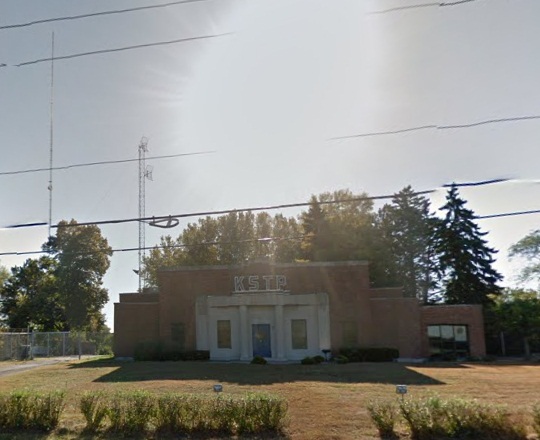
KSTP St. Paul, MN, 1941

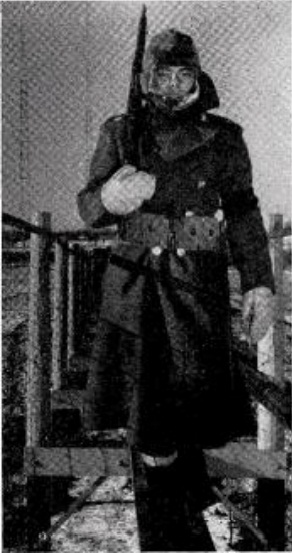
1941dec22bcWith America’s entry into the war, the nation’s broadcast stations were essential to inform and warn the public, and to maintain morale. As such, they were placed under military protection.

The photo shown here appeared 75 years ago today, in the December 22, 1941, issue of Broadcasting magazine.  It shows a military policeman, stationed at Fort Snelling, standing guard over KSTP, St. Paul, MN.  The caption notes that the station housed both the 50,000 watt main transmitter as well as an auxiliary 5000 watt transmitter with its own tower.  Both transmitters had been equipped for code transmission on Army and Navy frequencies.

kstptransmittersiteThe transmitter site remains at the same location today on the east side of U.S. Highway 61 in Maplewood, MN.  The modern image here is the Google street view.


Keep indoors. Lie down. Turn off the lights. Turn on the radio.

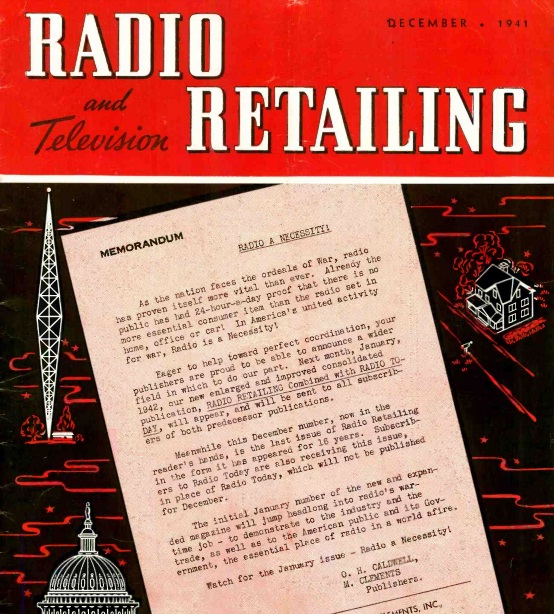
1941decradioretailing

The December 1941 issue of Radio Retailing hit the presses after Pearl Harbor, and much of the issue stressed that for the war effort, radio was a necessity. The cover reminded that there was no more essential consumer item than the radio. It noted that millions of Americans had learned anew that the radio in the home, office, or automobile was of prime importance, and that the nation’s radio retailers and servicemen would need to meet the imperative of keeping sets in operation above everything else.

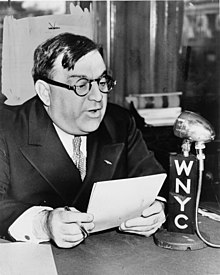
Fiorello LaGuardia.jpg

LaGuardia. Wikipedia photo.

The issue provided a quote from Defense Administrator Fiorello LaGuardia for advice during blackouts: “Keep indoors. Lie down. Turn off the lights. Turn on the radio.”


Capt. Colin Kelly, 1915-1945

Colin Kelly.jpg

Capt. Colin P. Kelly, Jr. Painting by Deane Keller, via Wikipedia.

Here, Hang Snow sings “There’s a Star Spangled Banner Waving Somewhere,”

written in 1942 by Paul Roberts and Shelby Darnell. The song refers to a version of heaven reserved for a pantheon of American heroes, including “Lincoln, Custer, Washington and Perry, Nathan Hale and Collin Kelly too.”

The last named American hero, Collin Kelly, died this day 75 years ago, December 10, 1941. He was one of the first heroes of the Second World War. His was the first American B-17 to be shot down in the war.

On December 10, he took off on a bombing run from Clark Field in the Phillipine Islands. On the return flight, the plane was attacked. Kelly ordered his men to bail out. Moments later, the plane exploded, killing him.

Kelly was posthumously awarded the Distinguished Service Cross, and President Roosevelt wrote a letter to the President of the United States in 1956, asking for an appointment for Kelly’s infant son. President Eisenhower honored this request by appointing Colin P. Kelly III to West Point.


Pearl Harbor, December 7, 1941

imgHandler

USS Shaw at Pearl Harbor. Defense Department Photo.

1941dec15bcToday marks the 75th Anniversary of the Japanese attack on Pearl Harbor, December 7, 1941.  Most Americans learned of the attack by radio, and the story of that coverage featured prominently in the December 15 issue of Broadcasting magazine, the first to go to press after the attack.   The photo at the left shows the news staff of stations WLW and WSAI, Cincinnati, huddled shortly after the first news of the attack broke.

According to the magazine, the first broadcast of the attack came at 2:26 Eastern Time, when WOR New York broke into a Dodger-Giant football game to read the United Press flash. Two minutes later, the news was broadcast nationwide over the NBC Red and Blue Networks.

CBS carried the announcement during its 2:30 station break. The afternoon news program was quickly reorganized. CBS newsman John Daly had spoken by telephone with KGMB Honolulu, and news of the attack on Manila, Philipine Islands, was carried live by a telephone hookup with KGMB, that signal being cut mid-broadcast.

Newsrooms came to life as staff were summoned in on an otherwise slow Sunday afternoon. At 2:45, the NBC network rang four chimes, instead of the customary three, to alert staff to report to work.

One NBC executive phoned KGU Honolulu for an immediate report. The voice from Honolulu reported that he was a station executive and did not have a microphone available. The NBC executive told him to keep talking to keep the line open as he raced to the network control room, and the call was eventually patched through live over the air. He was on the air by 4:06 PM with the live report, until a long distance operator broke in to report that the line was needed by the military. A recording of that broadcast is available at this link.  Another six minute call was aired later that hour.

Starting on Monday, December 8, West Coast stations were on a wartime basis. In compliance with an army order, stations in California, Washington, Oregon, and Idaho went off the air. In Washington, KIRO‘s 50 kilowatt signal remained on the air for Army and Navy use only.

During the blackout, which lasted until the next morning, only five minute news flashes were permitted every half hour. More organization was apparent by Thursday and Friday, when staggered schedules were followed.

The nation’s shortwave stations went on a 24 hour schedule, with broadcasts in multiple languages. CBS carried reports in ten languages to Europe, and three to Latin America. It noted that both networks were following a policy of objectivity in news, following FDR’s pronouncement that more than ever, there was a need for truth in the news.

The East Coast shortwave stations were assigned staff from the Office of Coordinator of Information to review material for any that might give aid or comfort to the enemy. In San Francisco, the Navy served a similar function for GE shortwave station KGEI.

CBS Short Wave Listening Station, Long Island. Wikipedia photo.

CBS Short Wave Listening Station, Long Island. Wikipedia photo.

The CBS and NBC shortwave listening stations were operating on a 24-hour schedule, making material available for the networks, press, and Government.

More information on radio broadcasting in the aftermath of the attack can be found at this post and this post.

Television had newly come on the air commercially in New York, and the magazine reported that the new medium developed a new presentation as the events swiftly unfolded. WCBW came on the air at 8:45 PM until 10:00, the first time the station had been on the air on Sunday. Throughout the week, it presented several news programs daily. It covered President Roosevelt’s Monday speech, with a waving flag transmitted over the visual channel.

1941dec15bc2

NBC commentator Sam Cuff uses map to show WNBT viewers strategic location of Hawaii.

WNBT moved an AP teletype into the studios, with the camera focused on the incoming wire. In the weeks preceeding the attack, WNBT had devoted much of its programming to civilian defense training, a role which continued during the war.

Sales of battery operated radios were said to have skyrocketed on December 8.


December 4, 1941: Three Days to War

1941dec4chicagotribune

Seventy-five years ago today, America’s entry into the war was three days away, but the signs were clear that it was coming soon. The Chicago Tribune, December 4, 1941, carried this headline of FDR’s plans for war.

The front-page cartoon makes clear that the paper was decidedly in favor of neutrality and opposed to intervention. It shows a Midwestern bastion of peace, looking with alarm at what it viewed as pro-war propaganda from Washington.

The war plans, consisting of documents from the War Department and letters from the administration, had been obtained by the paper and the contents were disclosed. It showed the likely enemies as Germany, Italy, Spain, and Japan, and anticipated theaters of war in both Europe and the Pacific. It also stressed the importance of maintaining solid relations with the republics of the Americas, since trade with both Asia and Europe would probably be cut off for the duration. It called for ten million American men to take up arms, with half of those to serve in an Expeditionary Force to Europe, with a ground offensive slated to begin in 1943.

Another cartoon in the same issue of the paper restated what the paper viewed as Midwestern pro-peace values, insisting that we raised our cattle, and not our sons, for slaughter.


WRUL Boston, 1941

wrul1941

Shown here as it appeared at the time of America’s entry into the War is the control room of Boston shortwave station WRUL. The image appeared in the December 15, 1941, issue of Life Magazine.

The magazine was obviously put together immediately after the attack of December 7, since most of the articles refer to an America that was preparing for war, but still at peace. Only a middle section of the magazine includes images of the attack.

This image is from an article profiling the shortwave station which, according to the magazine, the Nazis hated and feared.

It was billed as the nation’s most powerful shortwave transmitter, and was “waging a mighty war of propaganda against Adolf Hitler and his allies.” The station’s transmitters were 50,000 and 20,000 watts, with plans to increase. Programs went out day and night in 24 languages.

The station had come on the air in 1927 under experimental license W1XAL. With the outbreak of war in Europe, unbeknownst to the staff, the station came largely under the control of British Intelligence. With America’s involvement in the war, the station was leased to the U.S. Government. In 1962, under new ownership, the call letters were changed to WNYW for “Radio New York Worldwide,” with studios in New York and the transmitter reamining in Scituate, Mass. In 1973, the station was acquired by religious broadcaster Family Stations, Inc., and operated as WYFR until that station moved its transmitters to Okeechobee, Florida, in 1979.


1943 Emergency Blackout Receiver

1943novpm

The November 1943 issue of Popular Mechanics carried the plans for this wartime emergency receiver. Built in a cigar box, the set was an updated version of the “Hurricane Receiver” previously published by the magazine and featured here earlier.

1943novpm3The article noted that the set could be used under blackout conditions in areas where a power line would be unavailable. Both the filaments and B+ were provided by six volts, which could come either from dry cells, or obtained from the nearest automobile. For portable use in shelter conditions, the article suggested a wood carrying case such as shown here for transporting the battery.

1943novpm2The set was said to be of considerably more volume and greater range than the original model. It employed two 6G6-G tubes, and the article noted that these tubes were commonly found in the junk boxes of radio students, experimenters, and servicemen. The set employed one tube as the regenerative detector, with the second one serving as audio amplifier.

The coil was wound on a cardboard tube, and the wire could be salvaged from a burned out choke or audio transformer. A ground connection was recommended for maximum results, and a 20 foot indoor antenna could be used for local stations, although a longer outdoor antenna would pull in stronger signals.

With this set and a 6 volt battery, the owner would be able to listen to local stations for emergency safety and blackout instructions.

1943novpm4


Can America Be Bombed? November 1941


1941nov22pghpostgazSeventy-five years ago today, only two weeks before Pearl Harbor, the Pittsburgh Post-Gazette for November 22, 1941, posed the question of whether America could be bombed, and included contradictory answers:  Yes, an air raid was possible, but a Coventry-style attack on the Continental United States would be impossible, as long as America or a friendly navy controlled the Atlantic.

The article didn’t mention the Hawaiian or Philippine Islands which would be so obviously in the news in a fortnight.  However, it did look at the Pacific situation on the continent.  From Japan, air raids could possibly be made against Alaska.  If Siberia fell into enemy hands, then most Alaskan bases could be raided at will.

The focus of the article was a traveling exhibit put together by the Science Museum of Minnesota.  After being displayed in Minnesota, the exhibit was on tour, and was making its first stop in Pittsburgh.


1944 Code Practice Oscillator

1944janradiocraftThis simple idea for a code practice oscillator appeared in the January 1944 issue of Radio Craft magazine.

No doubt inspired by wartime parts shortages, the audio feedback loop could be created with an old telephone receiver and microphone placed next to each other. The idea was sent in to the magazine by one Mr. Ivan H. Walker of Mt. Horeb, Wisconsin.