Category Archives: World War 2

1942 Farm Sets for Emergency Use

1942JanService

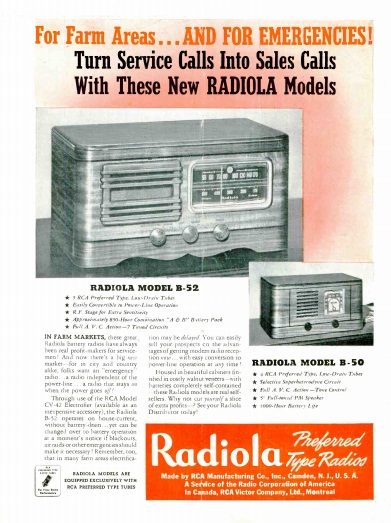
A month after Pearl Harbor, civilian radios were still being produced. The War Production Board was created on January 16, 1942, and issued its order  on March 7, for consumer radio production to cease on April 22.  During those intervening months, there was uncertainty as to the availability of both radios and parts, but both production and advertising continued, but with the War clearly in mind.

Later in the War, the availability of B batteries became an issue. In fact, numerous construction articles, such as this one from 1943, focused on how to make a battery set work on household current. But in the early days of the war, there was a demand for battery operated sets, since it was believed that there might be blackouts and the AC power wouldn’t be available.

This is apparent from the Radiola ad shown above from the January 1942 issue of Service magazine.  Directed at dealers, the ad shows two “farm set” models, suitable for use with batteries on farms that had not been electrified. This ad suggested a new market for such sets, as an emergency set “that stays on when the power goes off.” It also suggested that electrification might be delayed in some areas due to the war.

The ad noted that one of these sets could be the best of both worlds. An optional accessory was the RCA model CV-42 “Electrofier” which would allow either of these sets to operate on household current. So there was a market for these sets even in town: The owner could run it off household current, but quickly switch over to batteries during a blackout.


NM Public Health Nurse’s Radio, 1943

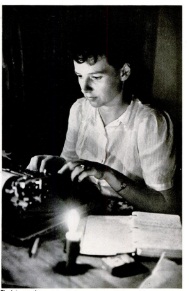
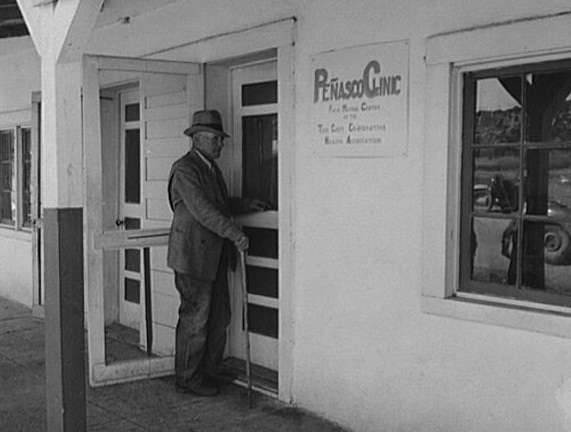
Taken in January 1943, this photograph shows a Peñasco, New Mexico NMclinic2public health nurse relaxing with the radio in her quarters after dinner.  According to the photo’s caption,  “the radio is the only contact with the outside world. Papers come rarely to the town, and the nurse (identified in other photos as Marjorie Muller) at the clinic operated by the Taos County cooperative health association must depend on the news broadcasts to follow daily events.”  She served at the clinic shown at right.

The radio is Zenith model 6G-601-M, as revealed by the distinctive sailboat design on the speaker grill. You can see a well preserved example at this link.  The set was similar in circuitry and styling to the Transoceanic, but covered the broadcast band only.  You can see and hear a nicely preserved specimen of the radio at this video:

The six tube portable (3Q5GT, 117ZG, 1LH4, 1LF, 1LN5, 1LA6) could run off 110 volt household current or batteries. It’s almost certain that the set was being run off batteries, since it seems very unlikely that the clinic had electric power. This and other photos show a kerosene lamp, and there’s no evidence of electric wires in any of the photos. The clinic did have a telephone, as shown in another photo in the collection.

NMclinic3The radio’s dial is tuned to just below 900 kHz. An antenna is visible coming out the window in the picture here of Nurse Muller outside her residence. According to the 1943 White’s Radio Log, there don’t appear to be any powerful West Coast stations near that frequency. But it was night, she had a powerful receiver and an outdoor antenna, and it’s likely that she was listening to WLS in Chicago on 890 kHz. If that’s the case, it’s possible she was listening to NBC Blue Network news with Earl Goodwin at  7:00 Central War Time, which would be 6:00 P.M. in New Mexico.

The photographer for all of the photos shown here was Farm Security Administration/Office of War Information photographer John Collier, Jr.  More of his photos of the clinic are available at the Library of Congress website.


High School Victory Corps: 1942

VictoryCorpsRadio

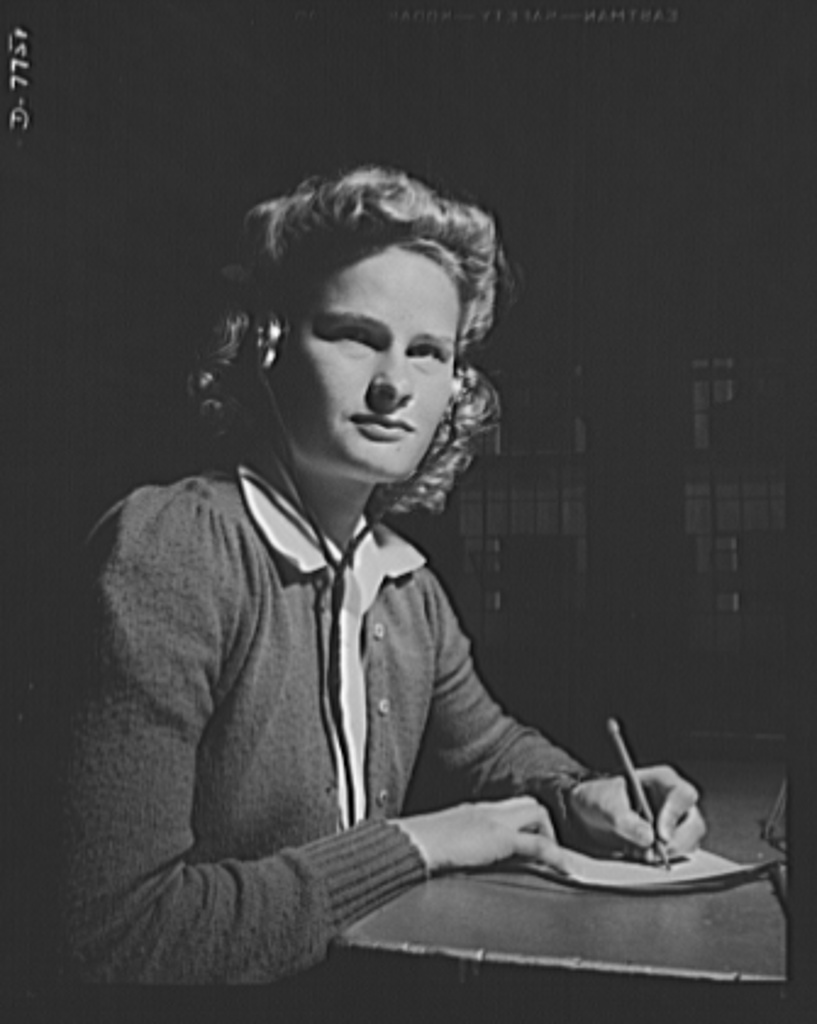
According to the caption of this 1942 Office of War Information photo, this Los Angeles high school student took her radio and code instruction seriously. She was a member of the high school Victory Corps of Polytechnic High School.

Elsewhere in the city, the student shown below was similarly taking her defense training seriously as part of the Victory Corps. She was the sharpshooter of the girls’ rifle team at Roosevelt High School. The caption of this photo notes that rifle practice was one of the phases of the Corps’ activities.

VictoryCorpsRifle


Pres. Trump’s Mad Scientist Uncle

John G. Trump, Wikipedia photo.

John G. Trump, Wikipedia photo.


One of our loyal readers posted a link to a conspiracy buff website pointing out a connection between President Donald Trump and, of all people, Nikola Tesla.  Since most internet mentions of Nikola Tesla turn out to be unfounded (or at least unprovable) conspiracy theories, I approached with a bit of skepticism.

I express no opinion as to the conspiracy in question (that the Trump family is involved in a long standing conspiracy to suppress certain Tesla inventions).  But I was shocked to learn that there was indeed a connection!  President Trump’s uncle, John G. Trump, was a noted professor of Electrical Engineering at MIT, and appears to have spent his career working on the same kinds of high-voltage mad scientist devices that Tesla was famous for.  At the time of Tesla’s death in 1943, the U.S. Government had to go through all of Tesla’s possessions and papers, in order to see whether there was anything worthwhile to the war effort.  Among those they called in to sift through them was none other than Professor Trump.

After his father’s death, John Trump initially went into the real estate business with his brother, Fred Trump, the father of the future president.  Fixing up old houses wasn’t to his liking, so he instead pursued a degree in electrical engineering. He he received his bachelor’s degree from the Polytechnic Institute of Brooklyn in 1929. He followed up with a master’s degree in Physics from Columbia, and in 1933 he received a Ph.D. in electrical engineering from the Massachussets Institute of Technology (MIT). He was on the MIT faculty from 1936 until his retirement in 1973.

Before the war, much of Prof. Trump’s work focused on hospital X-ray machines. Together with Robert J. Van de Graaff (of Van de Graaff generator fame), he developed one of the first million-volt X-ray generators.

As might be expected of the kind of scientist who played around with a million volts, Professor Trump made the pages of Popular Science on three occasions.

1937AprPSFor example, the April 1937 issue discusses the X-ray machine shown here.  It was designed by Prof. Trump along with Dr. Richard Dresser.  It employs a Van de Graaff generator to produce the required million volts.

And in keeping with his apparent status as a mad scientist, Prof. Trump needed a subject on which he could perform his experiments.  The lucky subject is described in the magazine’s July 1949 issue.  In the photo below, Professor Trump (left, operating the controls) is shown conducting experiments on “Mr. Cruikshank” (shown resting comfortably on the machine), a carefully constructed mannequin.

1949JulPS

Professor Trump preparing to send three million volts through Mr. Cruikshank.

Unlike human subjects, Mr. Cruikshank could have film inserted directly in his body to examine the effects of powerful X-rays. Prof. Trump had tested him with three million volts, and he was on the way to Massachussets General Hospital for comparison with the effects of a more modest 250,000 volt machine.

Finally, the magazine’s May 1947 issue mentions Prof. Trump’s work with the Van de Graaff generator as a possible method to directly and conveniently harvest nuclear energy.


References


ND Bond Drive, 1942

For many Americans on the home front, a major contribution to the war effort was participation in bond drives.  North Dakota was a long way from Pearl Harbor, but in 1942, these students in Epping, ND, were doing their part by performing “Remember Pearl Harbor” at a meeting of the town’s women to promote bond sales.

The song was likely the same one performed by Sammy Kaye, which was recorded just 10 days after the attack and rose to number 3 on the charts:


Boy Scouts Distribute Air Raid Posters: 1942


1942jan12chitrib
In hindsight, the likelihood of air raids against Chicago during the Second World War seems small. But the Windy City, as well as the entire region, was a bit safer thanks to the efforts of the Boy Scouts, as reported by the Chicago Tribune75 years ago today, January 12, 1942. According to this article, the 110,000 Boy Scouts in Illinois, Wisconsin, and Michigan were making plans to distribute air raid instruction posters throughout the region.

According to the article, Chief Scout Executive James E. West had wired civil defense officials that the Scouts “would keep on the job until the nation is blanketed with air raid posters and all communities can join the Boy Scouts in being prepared for the emergencies that war may bring us.”

For more information about Boy Scouts during World War II, see my earlier post.


Wabash Blackout Lamp, 1942

1941janservice

Shown here from 75 years ago is a blackout light bulb, manufactured by the Wabash Appliance Corp., 335 Carroll St., Brooklyn, NY. The bulb provided a beam of blue light that was projected downward, for use indoors during wartime blackouts. The inside of the 25 watt bulb had a silver reflector to hide filament glare and direct the beam downward.

It is shown here mounted in a socket, from the January 1942 issue of Service magazine.


USS Arizona, 1917

1917janpmShown here in Popular Mechanics, January 1917, is the recently launched USS Arizona passing down the East River from the New York Navy Yard on her first voyage into the Atlantic. The ship had been launched in June 1915 and christened with a bottle of water taken from the first to flow through the spillway of the Roosevelt Dam.

The 608 foot long ship remained stateside during the First World War. She was sent to Turkey in 1919 at the beginning of the Greco-Turkish war, and transferred to the Pacific Fleet for the rest of her career.

It was regularly used for training between the wars, and after the 1933 Long Beach earthquake, the ship’s crew provided aid to the survivors. In April 1940, she was transferred to Pearl Harbor with the rest of the Pacific Fleet.

Arizona sunk and burning, December 7, 1941. Wikipedia photo.

During the attack of December 7, 1941, a bomb detonated in a powder magazine, causing the ship to explode violently and sink, with the loss of 1177 lives.

The ship remains a permanent memorial to “be maintained in honor and commemoration of the members of the Armed Forces of the United States who gave their lives to their country during the attack on Pearl Harbor, Hawaii, on December 7, 1941.”


Alien Surrender of Shortwave Radios, Cameras, Guns, 1942

1942janradioretailing


Shown here, in the January 1942 issue of Radio Retailing magazine, are resident aliens in Los Angeles lining up at a police station to turn in their cameras, guns, and radios capable of receiving short wave.

The magazine noted that Attorney General Francis Biddle had issued an order that enemy aliens, that is, citizens of Japan, Germany, and Italy, turn these items in to the nearest police station.  An alternative would be to have receiver rendered incapable of receiving signals other than those in the standard broadcast band.  Therefore, the order “seems to open the way for radio servicemen to render a useful service of eliminating shortwave reception from aliens’ sets–and get paid for it.  In this way, the alien may keep his set for regular broadcast listening to U.S. stations, while the police authorities are spared the storage of hundereds of radio sets which they are poorly equipped to handle.  And the radio man collects $1 to $2 per radio set altered.

Typically, the modification consisted of removing the shortwave coils, and providing the set’s owner with an affidavit documenting the modification.

75 years ago today, the Chicago Tribune, January 6, 1942, carried an article regarding the status of the order.  It reported that local officials found the response so far to be unsatisfactory, since fewer than 2550 cameras, guns, and radios had been surrendered as of the previous night, despite an alien enemy population of more than 50,000 (28,000 Germans, 21,000 Italians, and 250 Japanese).

The Chicago police reported that the items surrendered included several antiques, including an 1878 breach loader. One man was reported to have “embarrassedly handing over a sawed off shotgun, possession of which had been taboo in Chicago ever since the prohibition gang war era. He said that he inherited the weapon from his father.”

One man, not bothering to wait for a receipt, simply drove up to the police station, hurried a radio from his car, and drove away. Another motorist tossed a $100 radio from his car and drove off.

The paper also reported a supplemental order from the Attorney General listing the following prohibited items:

Weapons or implements of war or component parts thereof; ammunition of all kinds; bombs; explosives or material used in the manufacture of explosives; signal devices; codes or ciphers: papers, documents, or books In which there may be invisible writing; photographs, sketches, pictures, drawings, maps, or graphical representation of any military or naval installations or equipment of any army, ammunitions, implements of. device or thing used or intended to be used in the combat equipment of the land or naval forces of the United States or of any military or naval post, camp, or station.


Happy New Year!

1942jan12life

Happy New Year from OneTubeRadio.com!

As we enter 2017, we look back 75 years to January 1, 1942, the first New Year’s Day of the War. The nation’s industry was already largely on a wartime footing, as shown by these night shift workers at the Northern Pump Company in Minneapolis. They took a half hour break to don paper caps and give 1942 a short defiant cheer. Then, they went back to work making anti-aircraft guns for the Navy.

The company was founded in 1929 by the merger of Northern Fire Apparatus Company and the Pagel Pipe Company. It moved to the Fridley plant shown here in January 1941. In 1942, it created subsidiary Northern Ordinance Incorporated. Northern Ordinance continued naval production until 1964 when it was purchased by Food Machinery Corporation (FMC), which operated the site until 1994. BAE Systems currently owns and operates the Fridley site.

Northern Pump currently operates in Grantsburg, Wisconsin.

This photo appeared in the January 12, 1942, issue of Life Magazine.