The Kindle edition is currently being offered at a sale price, and it’s well worth downloading this interesting book. You can do so at the link below.

The Kindle edition is currently being offered at a sale price, and it’s well worth downloading this interesting book. You can do so at the link below.
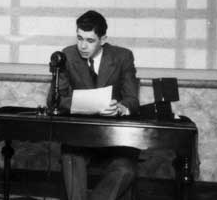
Then 16 year old Hodgkinson at the CKY microphone, circa 1930. Manitoba Historical Society photo.
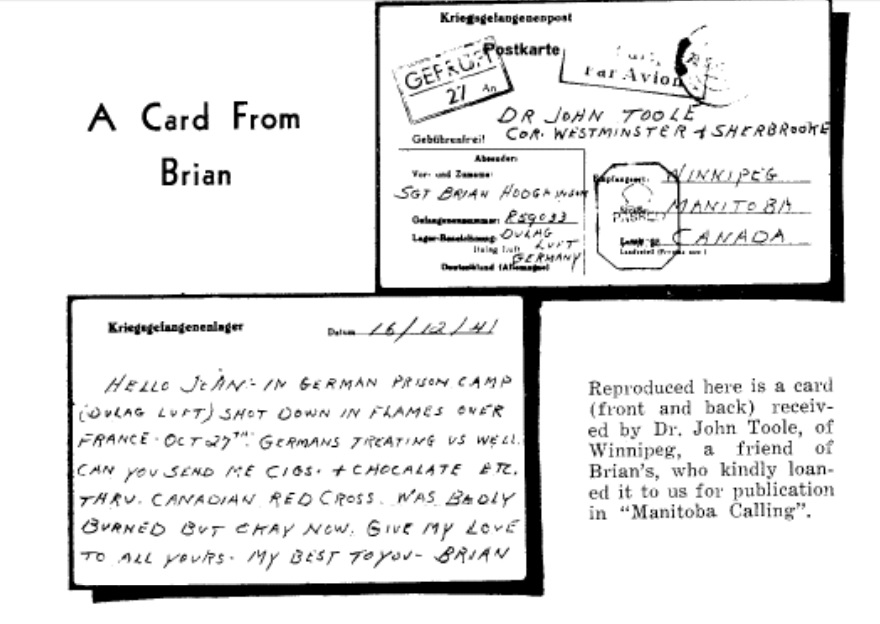
This postcard from RCAF prisoner of war Sgt. Brian Hodkinson appeared 75 years ago this month in the March 1942 issue of CKY’s program guide, Manitoba Calling. Prior to the war, Hodkinson was an announcer at the Winnipeg station. With the outbreak of war, he enlisted in the air force, and on one of his first missions over France, he was shot down and held prisoner for the duration of the war.
This card was sent to a friend in WInnipeg, Dr. John Toole, and reports that the Germans were treating him well. He requested “cigs. & chocolate, etc.” via the Canadian Red Cross. Dr. Toole shared the card with the radio station.
Hodgkinson spoke little of the war years, but after much prodding by friends, he did put his memoirs on paper. After the war, Hodgkinson moved to the United States and was for many years a newscaster and commentator at WHK, WERE, and WDOK in Cleveland.

The book is a fascinating look not only at Hodgkinson’s time as a POW, but also at his training. The RCAF had to get pilots in the air as fast as possible, and the training was intense. Hodgkinson recounts that he got lost on his first solo cross country flight, which was supposed to be from Ottawa to Kingston. He got lost, and finally spotted an airport, which turned out to be Montreal. Low on fuel and daylight, he landed and called his base for instructions. After some discussion, he was told to return to Ottawa the next day. He got lost again, and once again he landed at an unfamiliar airport. When a friendly airport worker came out to meet the plane, he asked where he was, and was told that he had landed in Ogdenburg, New York.
Since the United States was still neutral, Hodgkinson realized that his navigation blunder would result in his spending the duration of the war in an American internment camp. So he asked which way it was to Ottawa, and promptly flew north.
Despite these false starts, Hodgkinson was quickly sent to England, and on one of his first missions over France, he was shot down. Most of the book recounts his experiences in a hospital in France, and then in prison camps in Germany.
One feature that stood out was the fluent English speakers that Hodgkinson encountered. While he and his other prisoners in the hospital in France noted that before long they would be speaking a mixture of three languages, there were English speakers among his captors. The first that he encountered was the doctor who oversaw the treatment of his injuries, Dr. Rudy Meinhoff. Hodgkinson was surprised to hear the doctor address him with a clearly American accent. It had turned out that the German doctor had practiced in Milwaukee before the war, and had even attended a medical conference in Winnipeg.
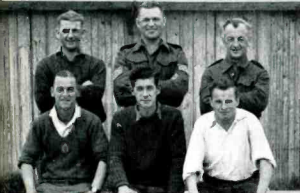
Hodgkinson (front row, center) along with fellow prisoners, 4 New Zealander and 1 English. Manitoba Calling, Apr. 1944.
And upon his transfer to the German prison camp, Hodgkinson’s interrogator was Wehrmacht intelligence officer Col. Gustave Metterling, who also surprised Hodgkinson with an American accented English. Before the war, Metterling had lived in New York, where he made a career of selling forged oil paintings, often made to order by wealthy buyers.
The book is not available in the United States, but used copies are available at a reasonable price on Amazon. In Canada, it’s also available at Amazon.ca.
The book is a fascinating look at the war by one who had to sit most of it out. According to Worldcat, relatively few libraries, American or Canadian, have a copy. But it is apparently still in print from its Canadian publisher, and reasonably priced copies are available on Amazon. It’s definitely worth seeking out.
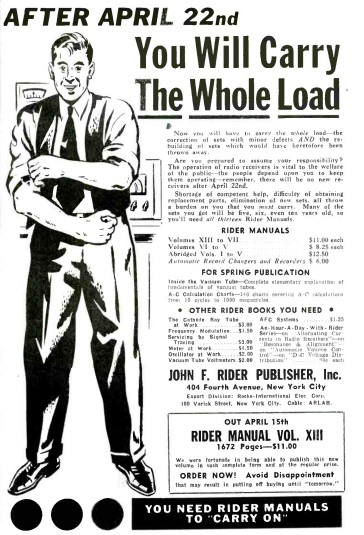
By orders of the War Production Board, manufacturing of civilian radio receivers ended on April 22, 1942, for the duration of the war. Even before this was announced on March 7, radio servicemen knew that at the very least, there would be shortages. When the ban was announced, they knew it was up to them to keep America’s radios in operation for their vital war information and for morale.
When the ban was announced, servicemen knew that it was time to double down, and they were reminded by advertisements such as this one, which appeared in the March 1942 issue of Service magazine. The ad was from the John F. Rider company, publisher of service manuals. These manuals contained diagrams and service information of virtually every set ever manufactured, and this data would prove invaluable for the radio servicemen tasked with keeping the nation’s radios in operation for the duration.
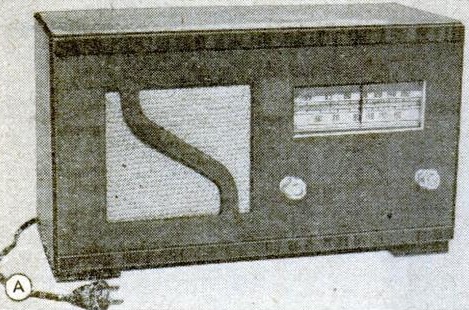
For many years, the March issue of Popular Mechanics had the tradition of carrying the plans for a radio receiver billed the “Little Giant.” A few weeks ago, we featured the 1942 version, and today we offer the version shown 70 years ago in the March 1947 issue.
 The circuit diagram for the 1947 version will look very familiar with those who’ve dug into postwar AM radios, since it’s the classic “All American Five” circuit employed for many years by most radio manufacturers. This one has the familiar complement of octal tubes: 12SA7GT, 12SK7GT, 12SQ7GT, 50L6GT, and 35Z5GT. This is also known as an “AC/DC” set, since it could run off either AC or DC 115 volt household current. It’s transformerless, since it rectifies the line cord for the B+ voltage, and wires all of the filaments in series to run directly off the line current.
This circuit does have one interesting postwar twist. Variable condensers were still in short supply, so it uses permeability tuning. Instead of a variable condenser and fixed coil, it uses a fixed condenser and variable coil. The inductance is varied by moving a plastic molded iron core in and out of the coils.
Today marks the 75th anniversary of the escape from the Philippines by General Douglas MacArthur, which began on March 11, 1942. He and his forces were surrounded on the Island of Corregidor.
The Japanese invasion had commenced at the same time as the attack on Pearl Harbor. In accordance with American doctrine, Manila was declared an open city. By March, American and Filipino forces had withdrawn to Bataan, with the General’s staff on Corregidor. In February, MacArther had announced that he and his family intended to share the fate of the garrison, but fearing that the General would become a high value prisoner, President Roosevelt ordered him to go to Australia.
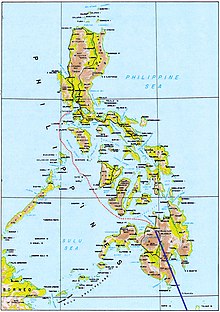
MacArthur’s route. Wikipedia image.
MacArthur, his family and staff, travelled through waters patrolled by Japanese warships in PT boats to Mindanao, from which they flew to Australia. President Roosevelt issued a statement on March 17:
I know that every man and woman in the United States admires with me General MacArthur’s determination to fight to the finish with his men in the Philippines. But I also know that every man and woman is in agreement that all important decisions must be made with a view toward the successful termination of the war. Knowing this, I am sure that every American, if faced individually with the question as to where General MacArthur could best serve his country, could come to only one answer
Over the coming weeks, Bataan fell, leading to the Bataan Death March, which began on April 9, in which thousands of Filipino and American POW’s perished.
MacArthur arrived in Melbourne on March 21, where he gave his famous “I shall return” speech:
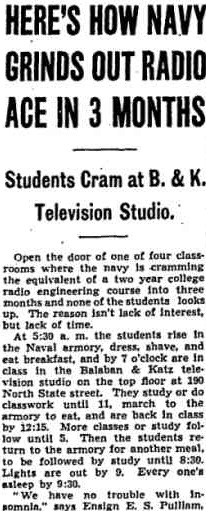 On this day 75 years ago, March 8, 1942, the Chicago Tribune carried this description of the fever pitch at which it was training its radio experts.
It explained how the Navy was cramming a two-year college radio engineering curriculum into three months. Students were housed at the Naval armory where they woke at 5:30, and were in class by 7:00 at the Balaban & Katz television studio at 190 North State Street. The theater company was the licensee of WBKB-TV, located at 190 North State Street, the present location of WLS-TV.
The men were in class until 11:00, at which time they marched back to the armory to eat, and were back in class at 12:15 until classes ended at 5:00. Lights were out at 9:00, and the Ensign in charge of the program reported that there were no problems with insomnia.
In a few months, the men’s duties would include RADAR, so the UHF expertise of the television engineers running the program were ideal for instruction.
The men’s former occupations were diverse, and included electricians, refrigerator servicemen, farmers, and locomotive firemen. Each was given a preliminary scholastic examination by mail, followed by the regular navy physical examination. Even though the scholastic test was tough, the Navy didn’t care whether the students had any formal education.
Many of the men were married, and many had turned down commissions as officers in the Army , instead opting for the rank of naval radioman, second class. They recognized that the training would be invaluable when they returned to civilian life, especially with the prospect of a future in television.
The men were paid $72 per month, with an additional allowance of $34.50 for dependents. It was noted that the men could live on “nothing a week,” with the exception of cigarettes or extras.
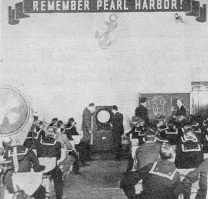 A typical classroom at the school is shown here, courtesy of an article describing this and other Navy radio schools in the November 1942 issue of QST.
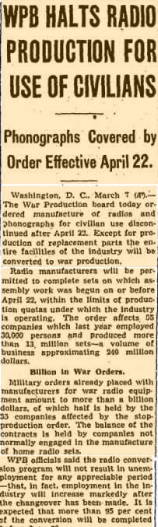 On this day 75 years ago, March 7, 1942, the War Production Board (WPB) ordered that civilian radio production would cease on April 22, as reported in this clipping from the March 8 Chicago Tribune.
As of that date, the entire industry would be on a wartime footing, and the entire industry, with the exception of replacement parts production, would be converted to war production.
A billion dollars worth of war orders were already in the pipeline, and half of that business was to companies making home radio sets. The WPB acknowledged that some unemployment would result as companies switched over to war production, but it was estimated that 95 percent of the conversion would be complete by the end of June.
The board estimated that when the last civilian set rolled off the assembly lines, there would be 60 million sets in operation, with a set in 87% of American homes.
More details of the order can be found at our earlier post.
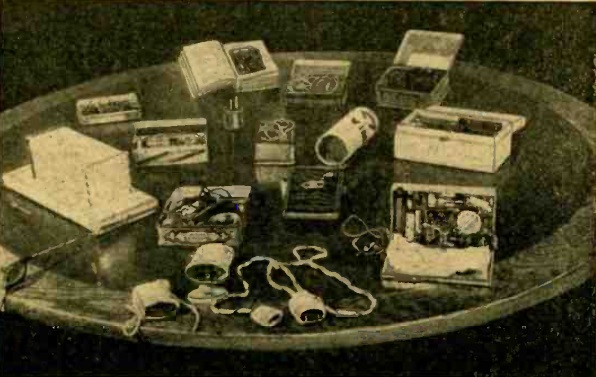
Another collection of clandestine Dutch radios.
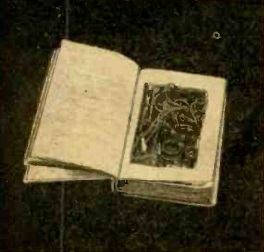
Clandestine radio concealed in book.
When the Nazis invaded the Netherlands, they didn’t want to deal with the possibility of the Dutch tuning in foreign radio broadcasts. So in the spring of 1942, they simply confiscated all radio receivers.
Undaunted, Dutch radio enthusiasts simply went underground and constructed sets to listen to the BBC and Radio Boston to learn how the war was going. A number of interesting radios were described in the March 1947 issue of Radio Craft, in an article by one Mr. J. Maquerinck, who described sets built by himself and others.
The simplest, or course, was the venerable crystal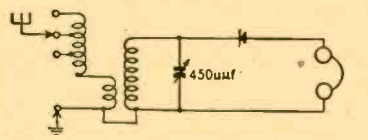 set, such as the one shown here, constructed by one of the author’s friends. This set pulled in England quite well and was constructed in a wooden box. When the friend wanted to listen, he opened the box, hooked up an antenna and ground, and tuned in the BBC.
Another friend, who had in his possession a vacuum tube, constructed the simple one-tube set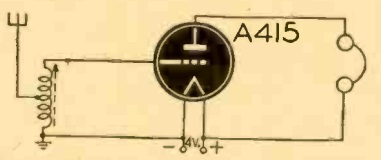 shown here. This friend had no variable capacitor, but the coil wound on an iron core provided adequate selectivity, and was sensitive enough to pull in England.
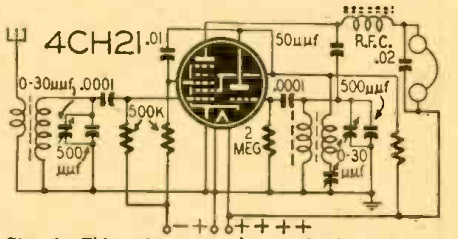
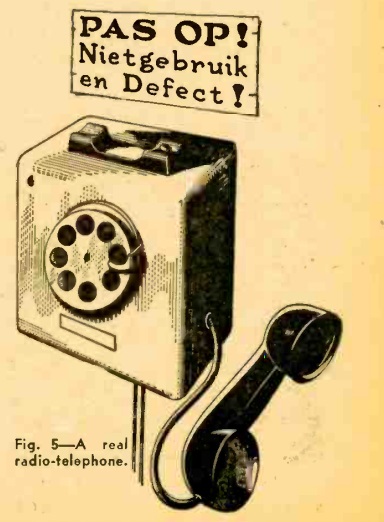 The author himself wanted to avoid the complication of an external antenna, which could be seen. He was fortunate enough to own a dual tube, which he was able to use in the circuit shown here as RF amplfier, grid-leak detector, and audio amplifier. To conceal the set, he hollowed out his telephone and built it inside the phone cabinet. His finger served as enough of an antenna to pull in the BBC on 200 kHz. The telephone’s ground connection served as the radio’s ground.
To avoid detection, he had the phone set up so that the dial had to be turned to 7 to power up the radio. As an added precaution, he placed above the radio the sign shown here, meaning “Take care, don’t use. Defective!” He noted that the loss of the telephone wasn’t much of a loss, since it had been out of order most of the time anyway.
This “real radio-telephone” was never discovered. In September 1944, the civilian population of the author’s town was evacuated. When he returned, everything else in the house had been stolen, but the receiver remained. I guess even Nazis were afraid of messing with the telephone company’s equipment.
The author was evacuated to the town of Aalten, population 10,000. The owner of the home in which the author resided had not previously owned a radio, but the town’s serviceman constructed a regenerative which used plug-in coils, one for 200 kHz and the other for 1000 kHz. The 200 kHz frequency was used to tune in the BBC, and 1000 kHz was the frequency of a station in a part of Holland that had already been liberated.
For another look at clandestine radio receivers used during the war, see our prior post on radios in occupied Guernsey.
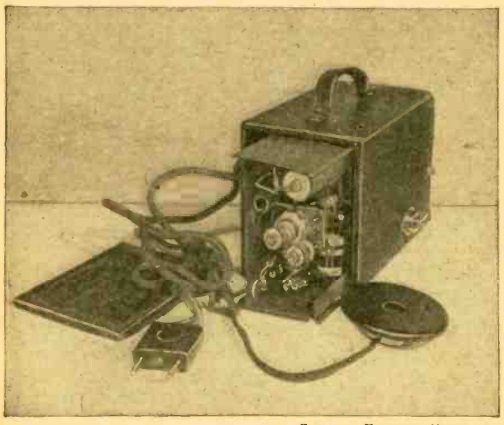
Radio concealed in camera, constructed by F.M. Leopold of Eindhoven , Holland.
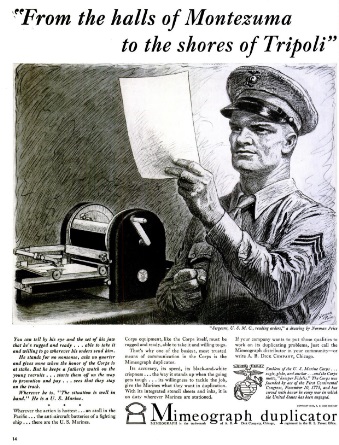
75 years ago today, this ad in the March 2, 1942, issue of Life magazine reminded readers that there was a war to be won, and the United States Marines were busy doing just that. And you can’t win a war without making sure your duplicating needs were taken care of.
The Marine shown here “stands for no nonsense, asks no quarter and gives none when the honor of the Corps is at stake. But he keeps a fatherly watch on the young recruits, start them off on the was to promotion and pay, sees that they stay on the track.”
Corps equipment, like the Corps itself, had to be rugged and ready. And that’s why the busiest, most trusted means of communications in the Corps was the Mimeograph duplicator. It had accuracy and speed, and its black-and-white crispness stodd up when the going got tough. “With its integrated stencil sheets and inks, it is on duty wherever Marines are stationed.”
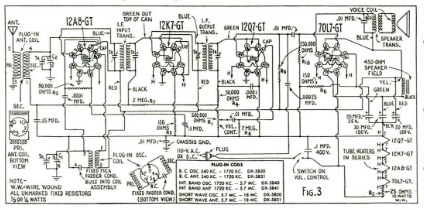
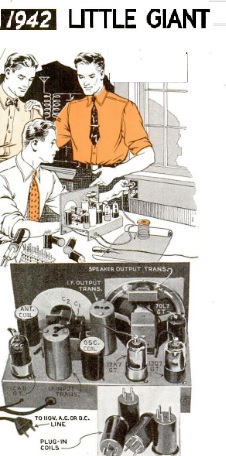 Each March, Popular Mechanics carried plans for a receiver dubbed the “Little Giant,” and the 1942 version is shown here.
With a war going on, this one differed in that it had been stripped of all unnecessary frills and designed for economy. But the little four tube AC-DC set still offered high grade performance with its superheterodyne circuit, featuring automatic volume control, an electro-dynamic speaker, and vernier tuning. The set’s open chassis construction also made it easier to build than earlier models. It tuned from the bottom of the broadcast band to 18 MHz, with three plug-in coils used to change bands.