Category Archives: World War 2

American Radio 1942: WGAC, Augusta, GA

Life1942April27

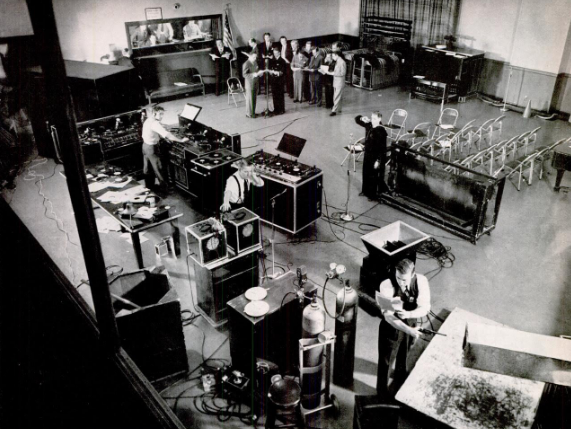
Seventy-five years ago, this day’s issue of Life Magazine, April 27, 1942, carried a photo essay about American radio as it went to war.  The article claimed that war marked the end of a “rich era” which brought fresh problems to the medium. It predicted, with little supporting evidence, that declining advertising revenues were on the way. It asserted that “war has thrown new problems at radio–of presenting fact and propaganda, of keeping commercialism and patriotism decently separated, of informing and stimulating the public.” It acknowledged a few bright points, such as the program “This Is War,” whose production is shown above.

It carried summaries of the current offerings, such as comedy, soap operas, and music, and asserted that programming often catered to the lowest common denominator.

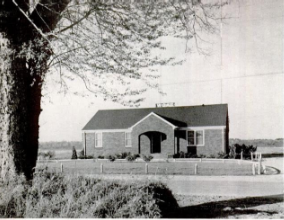
WGAC studio and transmitter.

WGAC studio and transmitter.

The most enlightening part of the feature was the magazine’s look at what it viewed as a typical small station, WGAC, Augusta, Georgia, which then ran 250 watts from 6:30 AM to Midnight.  It carried the NBC Blue network, and had a range of about 60 miles day, 15 miles night.

The station is currently licensed to  Beasley Broadcast Group, Inc. and broadcasts on 580 kHz, 5000 watts daytime, 840 watts nighttime.

Life1942April27B

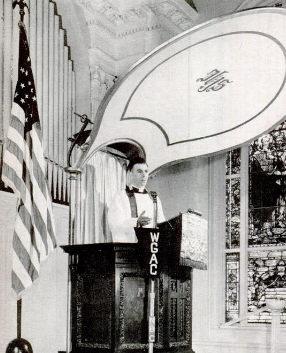
WGAC broadcast of service of St. Paul’s Church.

WGAC commentator and Augusta Herald editor Sam Moss.

WGAC commentator and Augusta Herald editor Sam Moss.

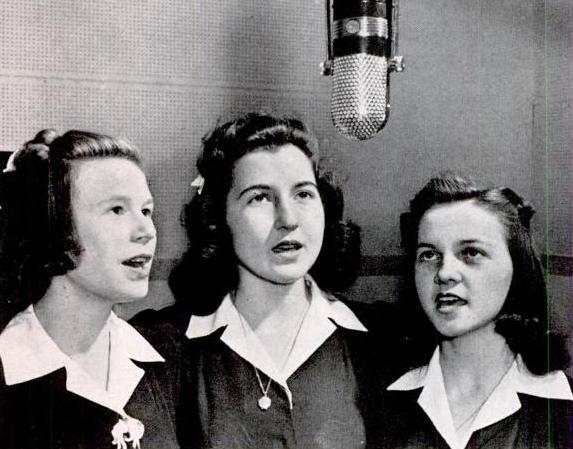
Thomson, GA, high school girls Barbara Burch, Lucy Lockett, and Winona Colton, WGAC's star trio.  "They sing in close harmony just like the big-time girl trios."

Thomson, GA, high school girls Barbara Burch, Lucy Lockett, and Winona Colton, WGAC’s star trio. “They sing in close harmony just like the big-time girl trios.”


KSTP Morse Code Lessons, 1942

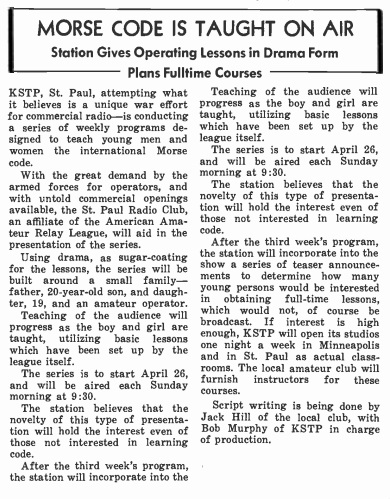
1942April27BCOn this day 75 years ago, April 26, 1942, KSTP radio in St. Paul, MN, began an innovative program, as described in the article shown here from the April 27, 1942, issue of Broadcasting.

According to the report, the station was doing its part to help satisfy the great demand by the armed forces for radio operators, by conducting weekly programs designed to teach young men and women the international Morse code.

The weekly program aired Sundays at 9:30 AM, and “used drama, as sugar-coating for the lessons.” It was built around a small family, one of whom was an amateur operator. Script writing was done by Jack Hill of the St. Paul Radio Club, using lessons from the American Radio Relay League.

After the third week’s episode, the station planned to incorporate “teaser announcements” into the program in an effort to determine how many would be interested in lessons one night a week in classrooms in Minneapolis and St. Paul. The St. Paul Radio Club would furnish instructors for those courses.

The program seems to have been a great success, as reported in the September 1942 issue of QST (pp. 80-81). The fifteen minute weekly programs resulted in a total of 325 Twin City residents signing up for the classes, initially held at KSTP’s Minneapolis and St. Paul studios, with advanced students moving on to classes at the YMCA.

According to QST, transcripts of the radio broadcasts, featuring the “Strong” family, were available by mail by writing to Hill at 1138 Fauquier Avenue (now known as Bush Avenue) in St. Paul.


75th Anniversary of End of Civilian Radio Production

1942MayRadioRetail

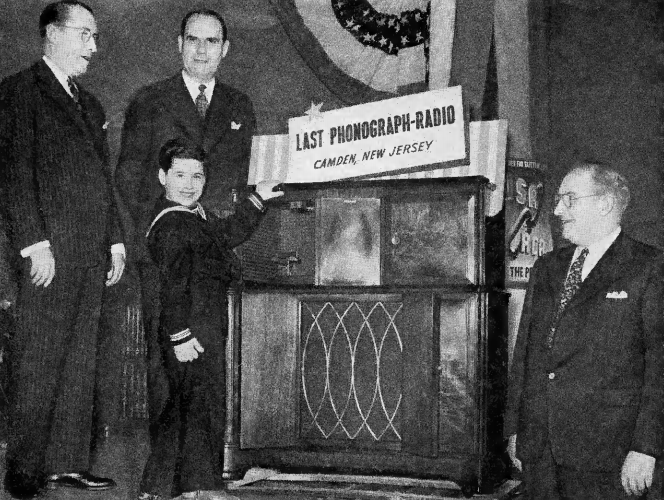
As we previously reported, on this date 75 years ago, April 22, 1942, the last civilian radio receivers rolled off the assembly lines.  For the duration of the war, no more radios or phonographs would be produced, the nation’s industrial output instead being devoted to the war effort.

The photo here shows one of the last RCA radios to be produced before the deadline.  This ad, which appeared in the May 1942 issue of Radio Retailing, shows RCA Victrola No. 17,199,547, which was the last set to be produced at RCA’s Camden plant, on April 7, 1942.

With no more new sets available, the nation’s radio servicemen were acutely aware that they would bear the full responsibility of keeping the nation informed and entertained by keeping existing sets running.


1942 Aircraft Detector

1942AprRadiocraftCover

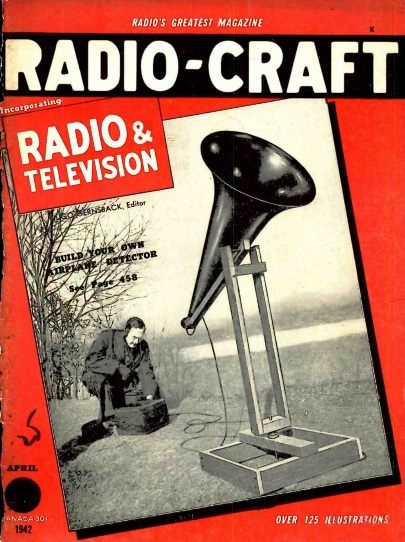
Seventy-five years ago this month, the April 1942 issue of Radio Craft showed the defense-minded electronics hobbyist or serviceman how to put together this aircraft detector. According to the magazine, the detector would be of particular interest to civilian defense units around the country. Cost of parts was set at $50, and the detector used readily available parts. In tests, it was able to pick up conversations at three blocks, and the sound of a bomber ten miles away.

Detail of horn-microphone assembly.

Detail of horn-microphone assembly.

The “ear” consisted of an old phonograph horn with a sensitive microphone mounted at the base. The four-tube battery operated amplifier employed three 1H5GT and one 1G4G tubes and allowed the operator to scan the skies for approaching planes with headphones.


1942 Ground Current Communication

1942AprQST

During World War II, Amateur Radio was off the air for the duration. However, unlike the situation in the First World War, hams were allowed to keep their equipment, and there were no restrictions on listening. Hams were eager to communicate, and with radio unavailable, they were eager to explore other possibilities. Starting with the March 1942 issue of QST, each issue included an experimenters’ section, which discussed many of the possibilities. Among the possibilities were carrier-current radio over power lines, and modulated light beams.

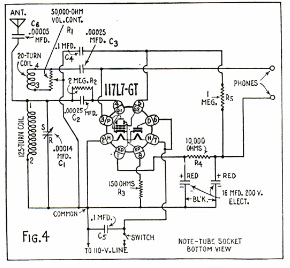
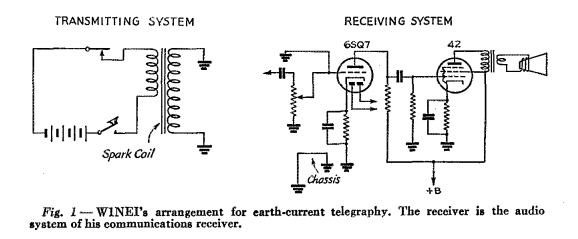
The first ideas started to trickle in 75 years ago this month in the April 1942 issue, and some of the first experiments focused on ground current communications. Leslie C. Merrill, W1NEI reported his preliminary results with the schematic shown above. The receiver consisted of the audio section of his receiver, and the transmitter consisted of the venerable spark coil from a Model T.

From the transmitter, the signal was fed to ground rods three feet apart. At the receiving end, the ground rods were only two feet apart. Despite the close spacing, he was able to copy the signal fifty feet away.

Merrill reported that he lived out in the country, and had the possibility to space ground rods 3/8 mile apart. By extrapolating his initial results, he speculated that a range of 30 miles might be possible with a similarly equipped station at the other end.

We’ve previously covered similar ideas.  In 1940, Popular Mechanics carried plans for a similar setup with a range of about 75 feet.  And in the First World War, the Signal Corps had a field buzzer that could be configured with a similar setup.  And a 1957 “Quist Quiz” showed a similar setup using a telephone, and even noted that old timers would be familiar with such a hookup.


Escape of Gen. Giraud, 1942

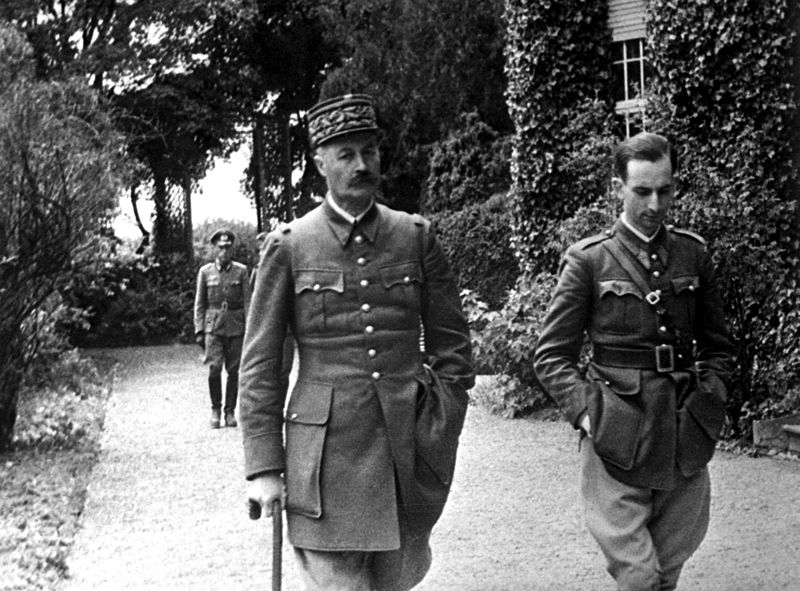
Gen. Giraud during his daily walk during imprisonment, 1940 or 41. Wikipedia photo.

On this day 75 years ago, April 17, 1942, French General Henri Giraud escaped from prison in the Nazi Königstein Fortress near Dresden, one of the largest mountain fortresses in Europe.

In 1940, Giraud was commanding in the Netherlands where his men were trying to block a German attack through the Ardennes.  He was at the front with a reconnaissance patrol when he was captured by German troops.

Giraud spent the next two years planning the escape. He spent the time learning German, memorizing a map of the area, and making ropes out of smuggled-in pieces of twine, copper wire, and bedsheets.

Just before the escape, the 63-year-old General shaved his mustache, climbed the wall, and descended the steep rock on which the fortress lay. He jumped aboard a moving train, and eventually made his way to Switzerland, from which he transferred to Vichy France.

When word of the escape spread in France, the Nazis were beside themselves, and an order to assassinate Giraud was issued, along with orders to arrest his family members.

He tried to talk Marshal Pétain out of continued collaboration, to no avail. He was then secretly contacted by the Allies, and eventually took a submarine to Gibraltar, where he met with General Eisenhower. He was flown to Algiers in November, but Vichy French forces there initially refused his command and his plea to join the Allies.

Giraud’s 1942 escape was actually his second escape from the Germans. In the First World War, he was wounded and left for dead on the battlefield before being taken prisoner and placed in a prison camp in Belgium. He escaped after two months by pretending to be a roustabout with a traveling circus, eventually returning to France via the Netherlands.


Station D-E-B-U-N-K, 1942

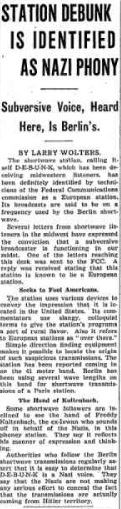
1942Apr12ChiTribSeventy-five years ago, the April 12, 1942, issue of the Chicago Tribune carried this story about a wartime curiosity on the shortwave bands, Station DEBUNK.

After the United State entered the war, the station sprung up on 7.2 MHz, and tried to pass itself off as a clandestine station operating from inside the United States.

But according to the newspaper, the FCC had confirmed what most SWL’s had already figured out, namely, that the station was broadcasting from Europe. The newspaper noted that the station was on the same frequency as the Berlin shortwave station.

The newspaper also noted that many listeners saw the hand of Freddy Kaltenbach in the station’s appearance, noting that it expressed his manner of expression and thinking. We previously wrote  (here and here) about propagandist Kaltenbach, a former Iowan of German birth.

The station was also profiled in the April 18, 1942, issue of Radio Guide, which noted that the station normally signed on to its 41 meter frequency between 7:30 and 8:00 PM Central War Time. The transmission began with an interval signal consisting of a piano playing part of the melody from the Star Spangled Banner, repeatedly playing the music for the words “by the dawn’s early light.”

The announcer then asked listeners to phone their neighbors to tune in and then played some jitterbug records. After about ten minutes, the announcer, one “Joe Scanlon” unleashed propaganda that was “anti-British, anti-American, anti-Communist, anti-Jewish, in fact, anti everything but National Socialism.”

After the diatribe, the station would sign off with the Star Spangled Banner. The Radio Guide profile noted that the station was amateurish in nature, with “the modulation as rotten as the talks.”

Announcer “Scanlon” was actually Herbert John Burgman, originally of Hokah, Minnesota.  Burgman served in the U.S. Army from 1918 to 1920, posted in Germany. In 1921, he was employed as a clerk at the U.S. Embassy in Berlin and married a German national. By 1941, he was a committed Nazi sympathizer, and declined repatriation to the U.S. along with the rest of the embassy staff, and he signed on as a propagandist for Radio DEBUNK.

After the war, he was arrested a tried for treason. The prosecution relied not only eyewitness testimony, but the recordings of the broadcasts from the FCC’s Silver Hill, Maryland, monitoring station. Despite a plea of insanity, Burgman was convicted of 13 acts of treason and sentenced to 6-20 years in prison. In 1951, the Court of Appeals affirmed his conviction. Burgman v. United States, 188 F.2d 637 (D.C. Cir. 1951).
He died in prison in 1953 at the age of 59.  He then found his way home to Minnesota and is buried in Austin, MN.

You can listen to a sound clip of Station DEBUNK at this link.



Bataan Death March, 1942

Today marks the 75th anniversary of the start of the Bataan Death March,
which began on April 9, 1942. After the fall of the Philippines, the Imperial Japanese Army forcibly transferred between 60,000 and 80,000 American and Filipino prisoners of war. The prisoners were marched about 60 miles and then placed on trains.

During the march, between 5000 and 18,000 Filipino solders died, as did between 500 and 650 Americans. The march was later judged to be a Japanese war crime.


Clandestine English Receiver in Norway

1945RadioMissionaryLog

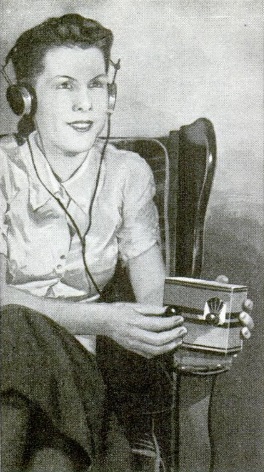
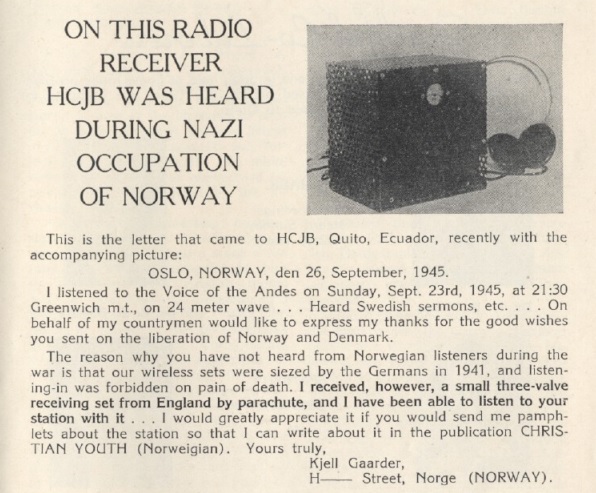
The 1945 issue of Radio Missionary Log, the program guide for HCJB, Quito, Ecuador, carried this letter and photo which the station had received after the war. The writer, Kjell Gaarder of Norway, wrote that he had received HCJB on the receiver shown.

HCJB did not carry a Norwegian broadcast, but Mr. Gaarder listened to the station’s Swedish broadcast. He noted that there probably hadn’t been many reports from Norwegian listeners during the war, since the Nazis had seized all radio receivers in 1941, and prohibited listening on pain of death. But Mr. Gaarder reported that he “received, however, a small three-valve receiving set from England by parachute,” and had listened to HCJB with it.

According to the program guide, HCJB was broadcasting in Swedish ninety minutes per week, from 4:30-5:00 PM U.S. Eastern Standard Time (the same as local time in Quito) on Sunday, Tuesday, and Thursday. The broadcasts were on 12.5 MHz, the station’s main frequency, with 10,000 Watts. The Swedish broadcast would have also gone out with 1000 watts on 9.9 and 6.2 MHz.

Curiously, the book The Portable Radio in American Life mentions an RCA engineer named Kjell Gaarder, who made some adjustments to a small radio in 1940 to make it smaller.  It seems inconceivable that two small radios in different parts of the world just happened to have a connection to someone with the same unusual name.  It seems almost certain that the RCA engineer in America in 1940 was one and the same as the person who just happened to receive a radio delivered by parachute a few years later.

I suspect that Mr. Gaarder returned to Norway during the Nazi occupation, and probably participated in the resistance, as evidenced by his British radio.  There must be an interesting story here, and I hope some reader can give me some clues as to that story.


World War II Radio Heroes: Letters of Compassion, by Lisa L. Spahr

We previously reviewed the book World War II Radio Heroes: Letters of Compassion by Lisa L. Spahr.  The book collects numerous letters from shortwave listeners to families of World War II POW’s held by the Germans and Japanese.  Names of prisoners were broadcast by Berlin and Tokyo radio, and these listeners contacted their families to reassure them that their loved ones were alive and well.

The Kindle edition is currently being offered at a sale price, and it’s well worth downloading this interesting book.  You can do so at the link below.