Category Archives: World War 2

Fall of Corregidor, 1942

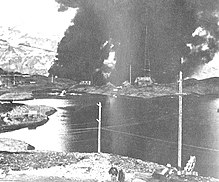
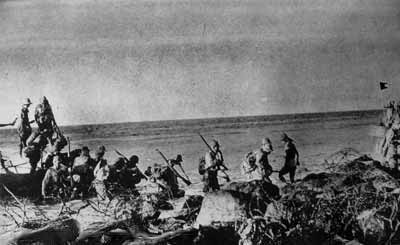
Japanese landing on Corregidor. Wikipedia image.

On this day 75 years ago, May 6, 1942, the island of Corregidor fell to the Japanese, not to be recaptured until 1945.

After the fall of Bataan on April 9, only the heavily defended island of Corregidor stood between the Japanese and control of Manila harbor.  In the first months of the war, the island was under aerial attack, and on May 5, Japanese landing craft began their assault. On May 6, General Johnathan M Wainwright sent a message to President Roosevelt, “There is a limit of human endurance, and that point has long been passed.”


WW2 Japanese-American Internment

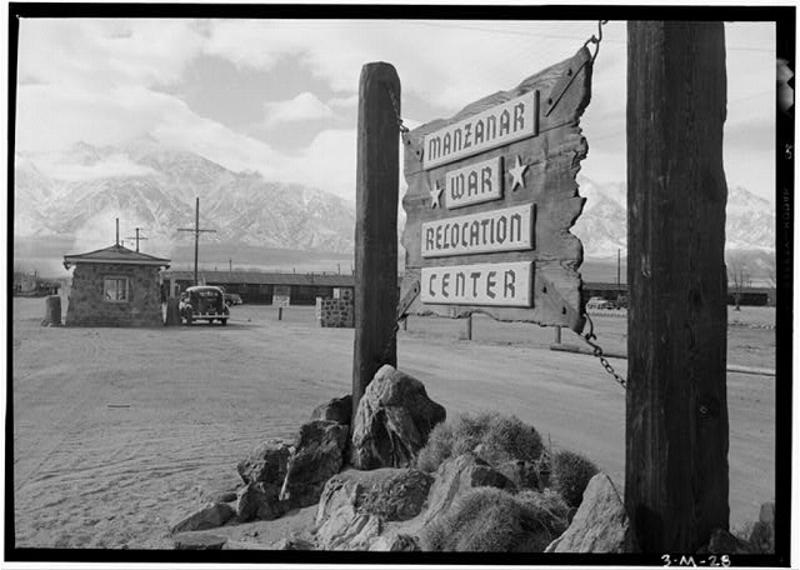
Manzanar Internment Camp. WPA/NPS image.

Manzanar Internment Camp. NPS image.

The following order was issued 75 years ago today.

Western Defense Command and Fourth Army Wartime Civil Control Administration, Presidio of San Francisco, California

May 3, 1942

Instructions to All Persons of Japanese Ancestry Living in the Following Area:

All of that portion of the County of Alameda, State of California, within the boundary beginning at the point where the southerly limits of the City of Oakland meet San Francisco Bay; thence easterly and following the southerly limits of said city to U.S. Highway No. 50; thence southerly and easterly on said Highway No. 50 to its intersection with California State Highway No. 21; thence southerly on said Highway No. 21 to its intersection, at or near Warm Springs, with California State Highway No. 17; thence southerly on said Highway No. 17 to the Alameda-Santa Clara County line; thence westerly and following said county line to San Francisco Bay; thence northerly, and following the shoreline of San Francisco Bay to the point of Beginning.

Pursuant to the provisions of Civilian Exclusion Order No. 34, this Headquarters, dated May 3, 1942, all persons of Japanese ancestry, both alien and non-alien, will be evacuated from the above area by 12 o’clock noon, P. W. T., Sunday, May 9, 1942.

No Japanese person living in the above area will be permitted to change residence after 12 o’clock noon, P. W. T., Sunday, May 3, 1942, without obtaining special permission from the representative of the Commanding General, Northern California Sector, at the Civil Control Station located at:
920 “C” Street,
Hayward, California.

Such permits will only be granted for the purpose of uniting members of a family, or in cases of grave emergency.

The Civil Control Station is equipped to assist the Japanese population affected by this evacuation in the following ways:

  1.  Give advice and instructions on the evacuation.
  2.  Provide services with respect to the management, leasing, sale, storage or other disposition of most kinds of property, such as real estate, business and professional equipment, household goods, boats, automobiles and livestock.
  3.  Provide temporary residence elsewhere for all Japanese in family groups.
  4.  Transport persons and a limited amount of clothing and equipment to their new residence.

The Following Instructions Must Be Observed:

  1. A responsible member of each family, preferably the head of the family, or the person in whose name most of the property is held, and each individual living alone, will report to the Civil Control Station to receive further instructions. This must be done between 8:00 A. M. and 5:00 P. M. on Monday, May 4, 1942, or between 9:00 A. M. and 5:00 P. M. on Tuesday, May 5, 1942.
  2. Evacuees must carry with them on departure for the Assembly Center, the following property:
    (a) Bedding and linens (no mattress) for each member of the family;
    (b) Toilet articles for each member of the family;
    (c) Extra clothing for each member of the family;
    (d) Sufficient knives, forks, spoons, plates, bowls and cups for each member of the family;
    (e) Essential personal effects for each member of the family.
    All items carried will be securely packaged, tied and plainly marked with the name of the owner and numbered in accordance with instructions obtained at the Civil Control Station. The size and number of packages is limited to that which can be carried by the individual or family group.
  3. No pets of any kind will be permitted.
  4. No personal items and no household goods will be shipped to the Assembly Center.
  5. The United States Government through its agencies will provide for the storage, at the sole risk of the owner, of the more substantial household items, such as iceboxes, washing machines, pianos and other heavy furniture. Cooking utensils and other small items will be accepted for storage if crated, packed and plainly marked with the name and address of the owner. Only one name and address will be used by a given family.
  6. Each family, and individual living alone, will be furnished transportation to the Assembly Center or will be authorized to travel by private automobile in a supervised group. All instructions pertaining to the movement will be obtained at the Civil Control Station.

Go to the Civil Control Station between the hours of 8:00 A. M. and 5:00 P. M., Monday, May 4, 1942, or between the hours of 8:00 A.M. and 5:00 P. M., Tuesday, May 5, 1942, to receive further instructions.
J. L. DeWITT
Lieutenant General, U.S. Army
Commanding


Ice Cream Goes to War: 20 Flavors

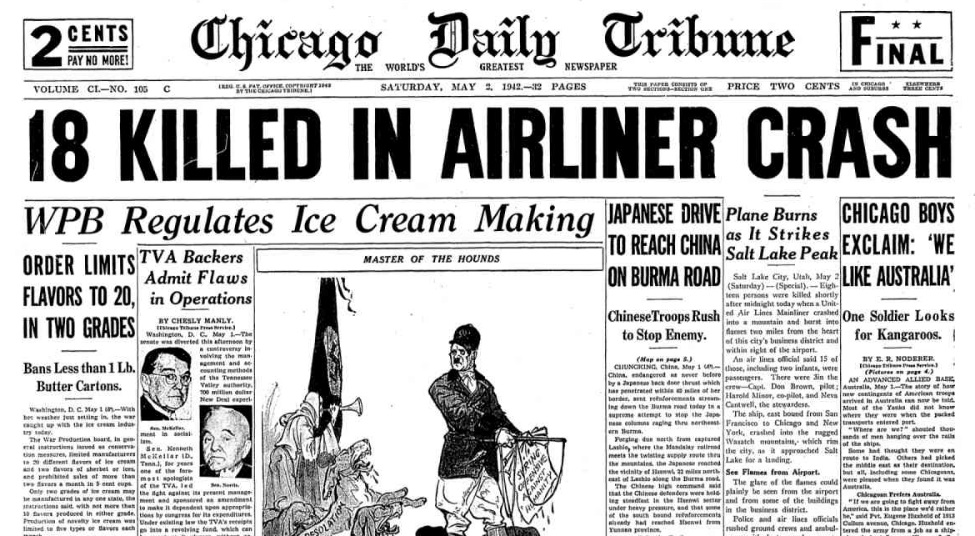
1942May2ChiTrib

During World War II, the War Production Board (WPB) had sweeping powers to control the U.S. economy. The idea was to make sure that U.S. industry was geared up as completely as possible for war production, and no industry was exempt.

In many cases, such as in the radio industry, the restrictions, while draconian, at least made a certain amount of sense. For example, the production of civilian radio receivers was banned during the war, so that the entire output of U.S. electronics factories could be devoted to the war effort.

But it also appears clear that there was a desire to regulate simply for the sake of regulating. As we previously reported, the sale of sliced bread was banned for a time, until consumer objections caused the WPB to relent.

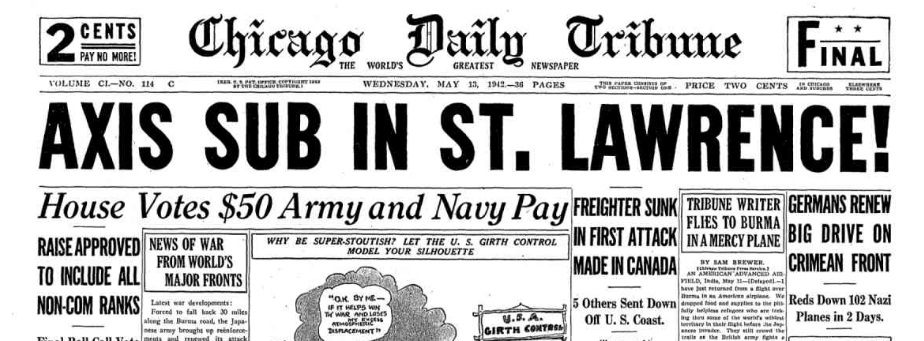
And just like bread, ice cream went to war.  75 years ago today, the May 2, 1942, issue of the Chicago Tribune shown here shows how the dairy industry was affected. Cardboard packaging was not allowed for butter packages of less than a pound. But as the headline notes, the most noticeable regulation related to ice cream.

For the duration of the war, ice cream manufacturers were limited to twenty (20) flavors. Similar restrictions were imposed on ice cream novelty items.

Probably more significant for the manufacturers was the requirement that distribution could be made only by common carriers. In other words, the manufacturer was prohibited from running its own fleet of trucks.


1942 One Tube Emergency Broadcast Receiver

1942MayPMSeventy-five years ago this month, the May 1942 issue of Popular Mechanics carried the plans for the “Veep” one-tube AC-DC broadcast receiver. The set was built on a simple galvanized chassis, and mounted in a cigar box, the “Veep” name coming from the brand of cigars.

The sew was designed to be rugged and compact, and the part count was kept to an absolute minimum to keep costs down. The set ran off standard household current, eliminating the worry of batteries running down. It was designed for instant emergency use. The set could be kept in a pocket, and in case of need for the latest news, air-raid warnings, or other programs, it ccould be put into action at the plant, office, or home at odd times.

The set used a single 117L7-GT serving as rectifier and detector. Since the set ran right off the line cord, the article warned not to use an external ground connection.

1942MayPM2The set would pull in local stations with a 3-4 foot antenna. For greater range, the antenna could be connected to an ungrounded metal object such as a hand rail or bed springs. While the set was designed for headphone operation, it could drive a speaker for strong local stations.1942MayPMSchematic


American Radio 1942: WGAC, Augusta, GA

Life1942April27

Seventy-five years ago, this day’s issue of Life Magazine, April 27, 1942, carried a photo essay about American radio as it went to war.  The article claimed that war marked the end of a “rich era” which brought fresh problems to the medium. It predicted, with little supporting evidence, that declining advertising revenues were on the way. It asserted that “war has thrown new problems at radio–of presenting fact and propaganda, of keeping commercialism and patriotism decently separated, of informing and stimulating the public.” It acknowledged a few bright points, such as the program “This Is War,” whose production is shown above.

It carried summaries of the current offerings, such as comedy, soap operas, and music, and asserted that programming often catered to the lowest common denominator.

WGAC studio and transmitter.

WGAC studio and transmitter.

The most enlightening part of the feature was the magazine’s look at what it viewed as a typical small station, WGAC, Augusta, Georgia, which then ran 250 watts from 6:30 AM to Midnight.  It carried the NBC Blue network, and had a range of about 60 miles day, 15 miles night.

The station is currently licensed to  Beasley Broadcast Group, Inc. and broadcasts on 580 kHz, 5000 watts daytime, 840 watts nighttime.

Life1942April27B

WGAC broadcast of service of St. Paul’s Church.

WGAC commentator and Augusta Herald editor Sam Moss.

WGAC commentator and Augusta Herald editor Sam Moss.

Thomson, GA, high school girls Barbara Burch, Lucy Lockett, and Winona Colton, WGAC's star trio.  "They sing in close harmony just like the big-time girl trios."

Thomson, GA, high school girls Barbara Burch, Lucy Lockett, and Winona Colton, WGAC’s star trio. “They sing in close harmony just like the big-time girl trios.”


KSTP Morse Code Lessons, 1942

1942April27BCOn this day 75 years ago, April 26, 1942, KSTP radio in St. Paul, MN, began an innovative program, as described in the article shown here from the April 27, 1942, issue of Broadcasting.

According to the report, the station was doing its part to help satisfy the great demand by the armed forces for radio operators, by conducting weekly programs designed to teach young men and women the international Morse code.

The weekly program aired Sundays at 9:30 AM, and “used drama, as sugar-coating for the lessons.” It was built around a small family, one of whom was an amateur operator. Script writing was done by Jack Hill of the St. Paul Radio Club, using lessons from the American Radio Relay League.

After the third week’s episode, the station planned to incorporate “teaser announcements” into the program in an effort to determine how many would be interested in lessons one night a week in classrooms in Minneapolis and St. Paul. The St. Paul Radio Club would furnish instructors for those courses.

The program seems to have been a great success, as reported in the September 1942 issue of QST (pp. 80-81). The fifteen minute weekly programs resulted in a total of 325 Twin City residents signing up for the classes, initially held at KSTP’s Minneapolis and St. Paul studios, with advanced students moving on to classes at the YMCA.

According to QST, transcripts of the radio broadcasts, featuring the “Strong” family, were available by mail by writing to Hill at 1138 Fauquier Avenue (now known as Bush Avenue) in St. Paul.


75th Anniversary of End of Civilian Radio Production

1942MayRadioRetail

As we previously reported, on this date 75 years ago, April 22, 1942, the last civilian radio receivers rolled off the assembly lines.  For the duration of the war, no more radios or phonographs would be produced, the nation’s industrial output instead being devoted to the war effort.

The photo here shows one of the last RCA radios to be produced before the deadline.  This ad, which appeared in the May 1942 issue of Radio Retailing, shows RCA Victrola No. 17,199,547, which was the last set to be produced at RCA’s Camden plant, on April 7, 1942.

With no more new sets available, the nation’s radio servicemen were acutely aware that they would bear the full responsibility of keeping the nation informed and entertained by keeping existing sets running.


1942 Aircraft Detector

1942AprRadiocraftCover

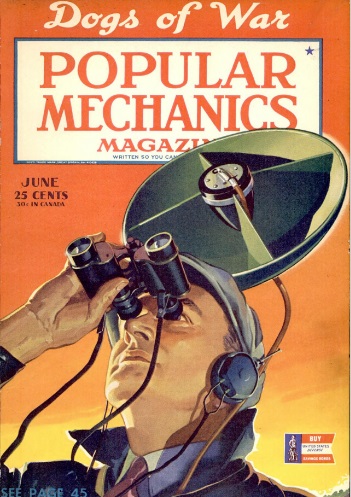
Seventy-five years ago this month, the April 1942 issue of Radio Craft showed the defense-minded electronics hobbyist or serviceman how to put together this aircraft detector. According to the magazine, the detector would be of particular interest to civilian defense units around the country. Cost of parts was set at $50, and the detector used readily available parts. In tests, it was able to pick up conversations at three blocks, and the sound of a bomber ten miles away.

Detail of horn-microphone assembly.

Detail of horn-microphone assembly.

The “ear” consisted of an old phonograph horn with a sensitive microphone mounted at the base. The four-tube battery operated amplifier employed three 1H5GT and one 1G4G tubes and allowed the operator to scan the skies for approaching planes with headphones.


1942 Ground Current Communication

1942AprQST

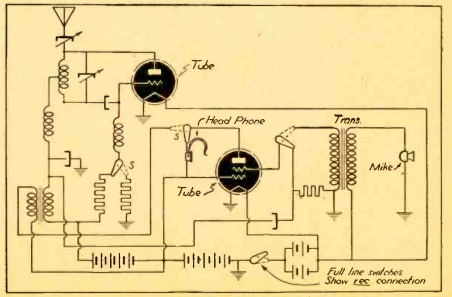
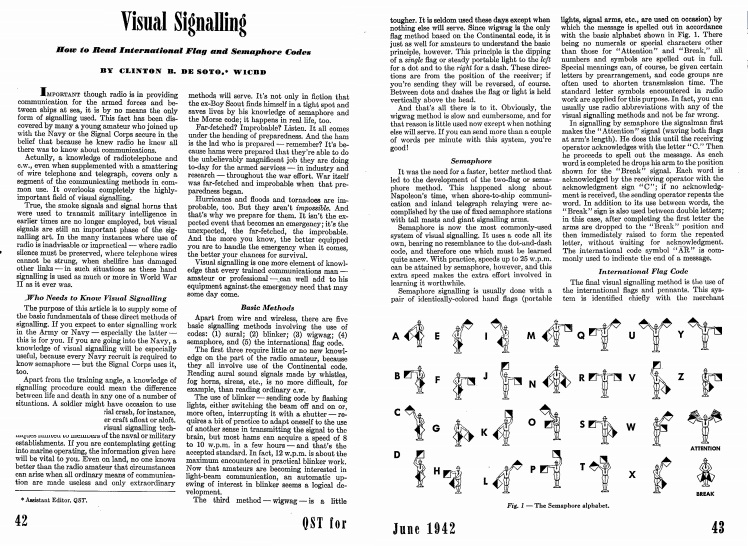
During World War II, Amateur Radio was off the air for the duration. However, unlike the situation in the First World War, hams were allowed to keep their equipment, and there were no restrictions on listening. Hams were eager to communicate, and with radio unavailable, they were eager to explore other possibilities. Starting with the March 1942 issue of QST, each issue included an experimenters’ section, which discussed many of the possibilities. Among the possibilities were carrier-current radio over power lines, and modulated light beams.

The first ideas started to trickle in 75 years ago this month in the April 1942 issue, and some of the first experiments focused on ground current communications. Leslie C. Merrill, W1NEI reported his preliminary results with the schematic shown above. The receiver consisted of the audio section of his receiver, and the transmitter consisted of the venerable spark coil from a Model T.

From the transmitter, the signal was fed to ground rods three feet apart. At the receiving end, the ground rods were only two feet apart. Despite the close spacing, he was able to copy the signal fifty feet away.

Merrill reported that he lived out in the country, and had the possibility to space ground rods 3/8 mile apart. By extrapolating his initial results, he speculated that a range of 30 miles might be possible with a similarly equipped station at the other end.

We’ve previously covered similar ideas.  In 1940, Popular Mechanics carried plans for a similar setup with a range of about 75 feet.  And in the First World War, the Signal Corps had a field buzzer that could be configured with a similar setup.  And a 1957 “Quist Quiz” showed a similar setup using a telephone, and even noted that old timers would be familiar with such a hookup.


Escape of Gen. Giraud, 1942

Gen. Giraud during his daily walk during imprisonment, 1940 or 41. Wikipedia photo.

On this day 75 years ago, April 17, 1942, French General Henri Giraud escaped from prison in the Nazi Königstein Fortress near Dresden, one of the largest mountain fortresses in Europe.

In 1940, Giraud was commanding in the Netherlands where his men were trying to block a German attack through the Ardennes.  He was at the front with a reconnaissance patrol when he was captured by German troops.

Giraud spent the next two years planning the escape. He spent the time learning German, memorizing a map of the area, and making ropes out of smuggled-in pieces of twine, copper wire, and bedsheets.

Just before the escape, the 63-year-old General shaved his mustache, climbed the wall, and descended the steep rock on which the fortress lay. He jumped aboard a moving train, and eventually made his way to Switzerland, from which he transferred to Vichy France.

When word of the escape spread in France, the Nazis were beside themselves, and an order to assassinate Giraud was issued, along with orders to arrest his family members.

He tried to talk Marshal Pétain out of continued collaboration, to no avail. He was then secretly contacted by the Allies, and eventually took a submarine to Gibraltar, where he met with General Eisenhower. He was flown to Algiers in November, but Vichy French forces there initially refused his command and his plea to join the Allies.

Giraud’s 1942 escape was actually his second escape from the Germans. In the First World War, he was wounded and left for dead on the battlefield before being taken prisoner and placed in a prison camp in Belgium. He escaped after two months by pretending to be a roustabout with a traveling circus, eventually returning to France via the Netherlands.