Category Archives: World War 2

“America Asks, Germany Answers,” 1941

19410628RadioGuide

Seventy-five years ago, while it was clearly gearing up for war, the United States was still neutral, and the Nazis wanted to keep it that way. this date’s issue of Radio Guide, June 28, 1941, carried an interesting look at one of the propaganda programs being broadcast to North America by Berlin stations DJB and DJD on 11.77 and 15.20 MHz. The program was “America Asks, Germany Answers.”

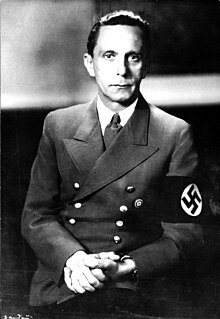
Bundesarchiv Bild 183-1989-0821-502, Joseph Goebbels.jpg

Goebbels. Wikipedia photo.

As early as 1933, Propaganda Minister Paul Josef Goebbels had set up a North American Service of the German Radio, staffed largely by expatriate American “foreign correspondents.” In February 1941, the station requested American listeners to forward reception reports and questions about Germany by means of collect telegrams of up to 25 words. By the end of February, over 10,000 telegrams had been received, despite criticism in the American press and deliberate attempts to clog the German end of the circuit. In March, the “America Asks, Germany Answers” program was on the air to answer these questions.

Among the American reporters was Frederick W. Kaltenbach (1895-1945), who had formerly been an Iowa teacher. In 1935, while teaching in Dubuque, he had started the “Militant Order of Spartan Knights,” a club for boys based on the Hitler Youth. Concerned parents saw to it that his teaching contract was terminated, and he left for Germany. He worked as a freelance writer and translator until landing his radio job in 1940. Many of his broadcasts began with “Greetings to my old friend, Harry in Iowa.” He was indicted for treason in 1943, but was arrested by Soviet troops and died in a detention camp in October 1945.

The “America Asks, Germany Answers” program was read by two announcers, “Democ” and “Nazi.” Democ would pose questions from American listeners, and Nazi would provide the answers.

According to the Radio Guide editor, the cost of these telegrams (about $10,000) amounted to “the cheapest imaginable form of advertising for the station, since the whole proposition was widely publicized in the American press and thousands of listeners who were only dimly aware of even the existence of a German short-wave station found themselves listening to it nightly, at first to see if their cables would be answered over the air, subsequently because, once the habit of listening to a certain program is formed, it is not easily discarded. Thus by a clever artifice the German short-wave station gained thousands of new listeners not only to the comparitively innocent program, “America Asks, Germany Answers,” but to the more deadly blasts from Goebbels’ master propagandists in their nightly bombardments on the democratic way of life.”

The magazine did note that a certain number of questions were sympathetic to the Nazi cause, and “quite likely, the names and addresses of these pro-Nazis were promptly garnered by the secret police, who in turn passed them along to the American Nazi organization for investigation so that eventually the fifth column in this country will receive additional recruits.”

However, as might be expected, most questioners were anything but sympathetic, but Democ and Nazi were still eager to tackle them, often by dismissing them with humor.

For example, one Harry Hoffman of Brooklyn asked in his cable, “how do you like your diet of horse meat and dog meat in Berlin these days?” Nazi answered, “my dear Hoffman, we like our diet just fine. It’s excellent. In fact, it’s good. Since we can no longer get giraffe tails or nightingale tongues, we must now be content with veal cutlets, lamb chops or T-bone steaks.” He then added sarcastically, “I suppose you also believe German tanks are made of paper.”

A more serious reply came in response to the question of one Mr. Fletcher of New York who asked about German plans for expansion in the western hemisphere.” Nazi replied that “Germany has NO plans whatsoever against any part of South, Central, or North America. Our campaign is directed solely against England.”

The only question which provoked some showing of anger was that of one Mr. Lehe of New York who opined that “neither England nor Germany but America will win the war.” To this, Mr. Nazi bitterly replied, “this is England’s war, not yours. It’s absolutely none of your business and America should keep its nose out of the affairs that do not concern it in the least.”

References

Read More at Amazon


Click Here For Today’s Ripley’s Believe It Or Not Cartoon


1941 Bombing of Kassa

1941 Hungarian tank. Wikipedia photo.

Today marks the 75th anniversary of the bombing of Kassa (Košice), then part of Hungary and now part of Slovakia.

On the night of June 26, 1941, unidentified aircraft struck Kassa. The attack became the pretext for Hungary to declare war on the Soviet Union the following day, but it is unknown whether the Soviets were responsible for the bombing.

One possibility is that Soviet bombers mistook the city for city of Prešov (Eperjes), in Slovakia, which was already at war. Another theory was that it was a false flag attack by the Germans to provoke Hungary into the war.

Click Here For Today’s Ripley’s Believe It Or Not Cartoon


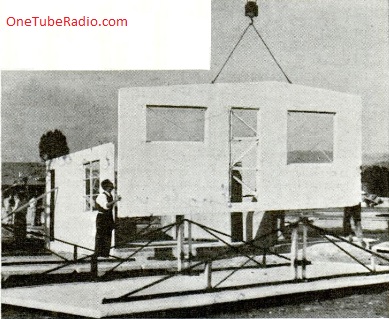
1941 Prefab “Semi-Bombproof” House

1941JunePMprefabSeventy-five years ago, preparedness for war was on everyone’s mind, as shown by this prefabricated three-room house, which was erected in just 23 minutes. The sections were made of concrete which was cast in forms lying on the ground. After drying, cranes lifted them into place, and welders completed the job by welding the sections together. The house was said to be “semi-bombproof,” meaning that it would “stop all but the heaviest flying fragments.” It was designed as quick construction of housing for defense workers.

The company making these, Thermo-Crete Homes, 10846 Ventura Blvd., Los Angeles, California, also made a small A-frame bomb shelter for use in backyards.

The house appeared in the June, 1941, issue of Popular Mechanics.

Click Here For Today’s Ripley’s Believe It Or Not Cartoon


Germany Invades Soviet Union, 1941

Today marks the 75th anniversary of Germany’s invasion of the Soviet Union, Operation Barbarossa, which began on June 22, 1941.

German advances, June – August 1941. US Military Academy, via Wikipedia.

Hitler had stated his desire to conquer the Soviets in his 1925 Mein Kampf, but in the years leading up to the invasion, the two countries had signed political and economic pacts. But Hitler had authorized the invasion in December 1940, originally planned to start in May 1941.

The Germans initially enjoyed resounding victories, pressing to the outskirts of Moscow. When they were pushed back by a Soviet counteroffensive, the war turned into a war of attrition for which Germany was unprepared.

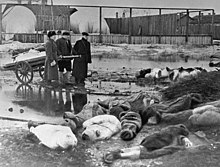
Kiev, June 23, 1941. Wikipedia photo.

Operation Barbarossa was the largest military operation in human history, with a total of 75 percent of the entire German military participating.  The four years of fighting resulted in the deaths of more than 26 million people, more than in all other fighting of World War II.  Soviet casualties in the war, both military and civilian, totalled over twenty million, out of a prewar population of about 196 million, meaning that about one Soviet in nine died as a result of the war.


Read More At Amazon

Click Here For Today’s Ripley’s Believe It Or Not Cartoon


1931 Electronic Television

1931ElectronicTVImageShown here is one of the very earliest examples of an image sent by electronic television. It appeared 85 years ago, in the May-June 1931 issue of Television News, in an article by Baron Manfred Von Ardenne, whom the magazine identified as the “famous European televsision expert.”

Von Ardenne noted that the cathode-ray tube had “long been proposed for television reception and has been used in many more or less successful laboratory experiments. In spite of these extremely
advantageous characteristics, television has thus far been obtained only with mechano-optical means.”  He then went on to discuss some of his improvements.

His system involved using a cathode-ray tube as part of the transmitter.  A film was placed between the tube and a photo-electric cell.  Thus, the tube in the camera could be synchronized with the tube in the receiver scanning at the same rate.  Depending on the configuration of the electronics, the resulting image would be either the positive or the negative of the original film.  A diagram of the system used for transmission is shown here:

1931ElectronicTVtransmission

Von Ardenne made the first public demonstration of this system in August 1931 at the Berlin Radio Show. He successfully transmitted pictures in 1933, and his system was used in the German television service starting in 1934. Regular broadcasting began in 1935 and continued throughout the war.

Bundesarchiv Bild 183-K0917-500, Prof. Manfred v. Ardenne.jpg

Von Ardenne in 1930. Wikipedia photo.

After the war, von Ardenne made contacts with the Red Army and found his way to the Soviet Union, where he was made head of Institute A. He was initially asked to participate in the Soviet atomic bomb project, but declines, realizing that his participation would prevent his return to Germany. Instead, he worked on isotope enrichment. His work included development of an electron microscope, for which he was awarded the Stalin Prize. With the prize money of 100,000 rubles, he purchased the land for a private institute in East Germany, where he was allowed to return in 1954. From 1963 to 1989, he served as a member of the Volkskammer, the East German parliament.  At the time of his death in 1997, he held about 600 patents.

Click Here For Today’s Ripley’s Believe It Or Not Cartoon



WW2 Wireless Code Practice Oscillator

1944JunePM

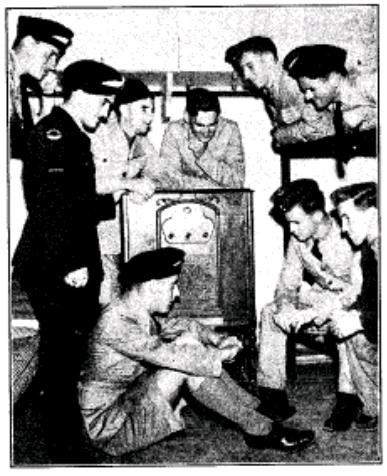
A young man drafted into the military during World War II could give himself an edge by having a useful skill, and the June 1944 issue of Popular Mechanics reported that pre-induction code practice sessions were well attended. This created a problem, since most code practice oscillators used headphones, and acquiring enough headphones presented a logistical challenge for those running the sessions.

1944JunePM2The solution was offered in the form of a three-tube wireless code oscillator which would transmit modulated CW to a nearby broadcast receiver, producing room-filling volume. In light of wartime parts shortages, the circuit called for common receiver tubes which could probably be scavenged from another set. The plans called for a 6C5 rectifier, witn 6J5’s serving as AF and RF oscillators. The 6 volt filament voltage was obtained by wiring a 40 watt lightbulb in series with the filaments. The completed circuit is shown here mounted on a circular cutting board. The output of the oscillator was run to the receiver’s antenna jack, or simply placed near the set’s antenna.

1944JunePM3

Click Here For Today’s Ripley’s Believe It Or Not Cartoon


Flight of Rudolf Hess, 1941

Bundesarchiv Bild 146II-849, Rudolf Heß.jpg

Rudolf Hess. Wikipedia photo.

It was this night 75 years ago that Rudolf Hess made his flight to Britain.

At 17:45 local time on May 10, 1941, the number three Nazi took off from Augsburg, Germany wearing a leather flight suit bearing the rank of Captain. He carried money, toiletries, a flashlight, a camera, maps, medicine, and dextrose tablets to ward off fatigue. After initially setting a course toward Bonn, he flew easterly from near the Frisian Islands across the North Sea. He zig zagged as he approached the British coast to make landfall after dark.

When he was nearly out of fuel over Scotland, he climbed to 9000 feet and bailed out with a parachute. He never managed to negotiate with anyone. He was captured by Scottish plowman David McLean, armed with a pitchfork. The story made the papers in America on May 13, and McLean ‘s account was carried:

I was in the house and everyone else was in bed and I heara a plane roaring overhead. I ran out to the back of the farm. I heard a crash and saw the plane burst into flames about 200 yards away.

I was amazed and a bit frightened when I saw the parachute coming slowly downward. I could see a man swinging from the harness. I concluded it was a German airman bailing out and ran back to may house for help. They were all asleep. I looked around for a weapon, but found nothing except a hay fork.

Fearing I might lose the airman I hurried ’round by myself again back of the house and in the field I saw a man lying down with his parachute nearby.

He smiled and I helped him to his feet. He thanked me but I could see he’d injured his foot some way. I helped him into the house. By this time my mother and sister were out of bed and made tea. He declined the tea and smiled when we told him we were very fond of it. He asked for a glass of water.

We sent word to the authorities and in the meantime he chatted freely to us and showed us pictures of his little boy, of whom he spoke very proudly.

He told us he had left Germany about four hours before and had landed because nightfall was approaching. I could see from the way he spoke that he was a man of culture. His English, although it had a foreign accent, was very clear and he understood every word we said to him.

He was a very striking looking man wearing a magnificent flying suit. His watch and identity bracelet were of gold.

He wouldn’t discuss his hourney. He was most gentlemanly in his attitude to my mother and sister and thanked us for what we had done for him. He was most anxious about the parachute, which he said he’d like to keep because it saved his life. He wouldn’t tell us who he was, and we thought he was just another German airman.

When the officials came he greeted them with a smile and assured them he was unarmed and stood up and allowed them to search him. Then he was taken away.

This account appeared in the Milwaukee Sentinel, May 13, 1941.

Hess remained in custody for the rest of his life, dying at Spandau Prison in 1987 at the age of 93, an apparent suicide.

Read More at Amazon

Click Here For Today’s Ripley’s Believe It Or Not Cartoon


Babette Goes To War: 1959

BabbetteGoesToWar

Shown here under the sheets is Brigitte Bardot from the 1959 French comedy Babette Goes to War (Babette s’en va-t-en guerre). Of particular interest to our readers is, of course, what she’s doing under the sheets, namely, sending CW.  Babette, a French country girl in London, played by Mlle. Bardot, does her part in the war effort by parachuting into German-occupied France to kidnap a German general. She bumbles through her mission with a heroic finish.

In this still from the movie, the naysayer might point out that her technique with the key leaves something to be desired. However, the criticism is unwarranted given the circumstances. She is transmitting from underneath her sheets in the very hotel that was serving as the Nazi headquarters. The German direction-finding truck pinpoints her location, a Nazi bursts into her room, only to retreat when the girl under the sheets protests that she’s naked.

The film was a big hit in France, with over 4.6 million tickets sold. On this side of the Atlantic, the New York Times review proclaimed the film to have “the anomalous distinction of being occasionally farcical and somewhat incomprehensible.” The review lamented that “Bardot is clothed almost as abundantly as an Eskimo most of the way through this World War II spoof, and a fully dressed Mlle. Bardot is downright confusing.”

The movie’s trailer, which includes the exciting scene of Mlle. Bardot being tracked by the Nazi DF’ers, in shown here:

This clip shows her send and receive the complete message;

https://www.youtube.com/watch?v=k6HDBMtshZ0

She sends mostly V’s, and a few other random characters which, according to the CW to French subtitles, mean “ALLO LONDRES – LE LEOPARD EST DAN LA CAGE AUX MOUCHES – STOP – C’EST DU PEU AU JUS – FAITES CHAUFFER LA COLLE.” She gets the message back from London, which sounds like “OK OK” to me, but according to the subtitles means “COMPRIS – TRES BIEN – MESSAGE TERMINE.”

The movie doesn’t appear to be available in North America, but you can get a PAL version at Amazon.

Click Here For Today’s Ripley’s Believe It Or Not Cartoon


1943 Wartime Intercom

1943RadioIntercom

This intercom from the March 1943 issue of Radio News shows the kind of ingenuity that was necessary in the face of wartime shortages on the home front.

The article notes that with defense priorities, many small business firms were in need of interoffice communications but unable to get them. The only immediate answer, according to the article, was to make a small radio do double duty.

The article describes a four-station intercom constructed with a six-tube table radio. The only additional parts, all of which were available at the “radio bargain counter” were nine switches, four speakers, and a roll of shielded cable. The hookup allowed for the station with the radio to serve as the master, able to call or receive calls from the other stations. As an added bonus, any of the four remotes could listen to the radio, but stil l make calls.

Click Here For Today’s Ripley’s Believe It Or Not Cartoon



RCA “Foreign Correspondent” Model 14-X Shortwave

1941RCAforeigncorrespondent

75 years ago, this date’s issue of Life Magazine, February 24, 1941, carried this ad for the RCA Victor “Foreign Correspondent,” also known as RCA model number 14-X.  As the name implies, this set received shortwave as well as standard broadcast, and as the ad points out, the shortwave band was s-p-r-e-a-d for easy tuning.  The set covered 9.5-12 MHz, meaning that it did have reasonably easy tuning of the popular 31 and 25 meter bands.  In the evenings, the set probably did a good job of pulling in war news from Europe.

The set had a price tag of only $14.95, and looks like it was a fairly good performer for the price.  The set was a basic “All American Five,” with a tube lineup of 12SA7 12SK7 12SQ7 50L6GT 35Z5GT.  It had provision for an external antenna.  The limited shortwave frequency coverage probably did make it considerably easier to tune those bands.

A nicely preserved version can be found at the Radio Attic Archives.