Category Archives: World War 2

Guernsey Occupation Crystal Set, 1944

Imperial War Museum image, © IWM (COM 501).

Imperial War Museum image, © IWM (COM 501).

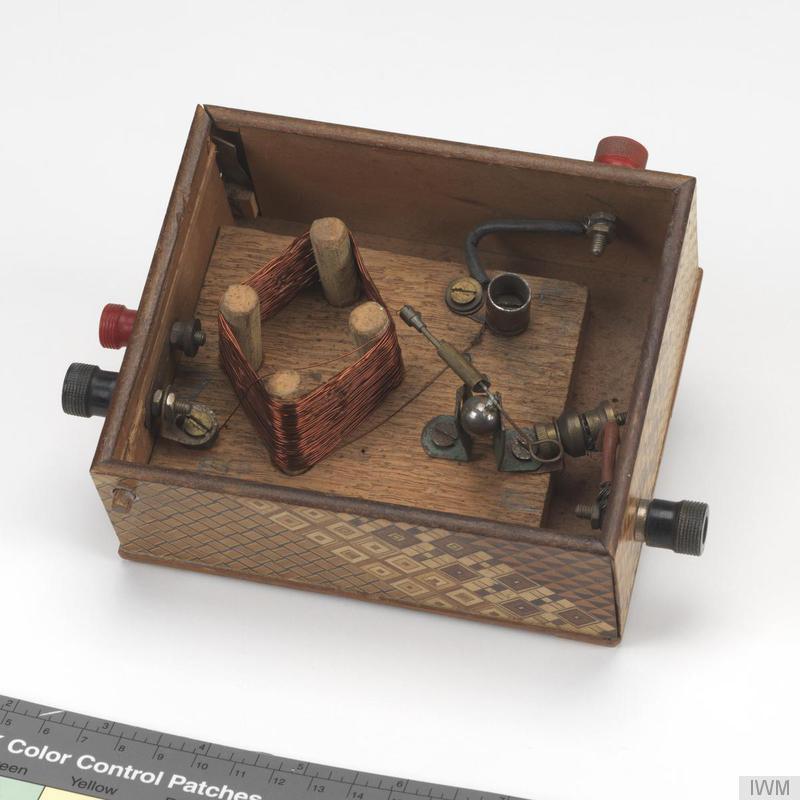
The crystal set shown here is from the collections of the Imperial War Museum.

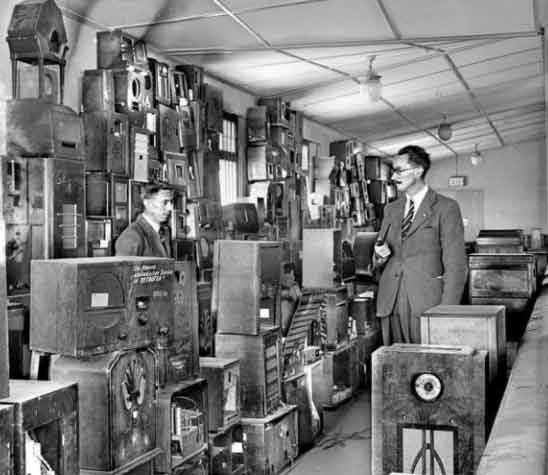
The Channel Islands were the only part of Britain that were under German occupation during World War 2, and while islanders were initially allowed to keep their radio sets, they were eventually confiscated. In response, many residents obtained crystal sets such as the one shown here. This one was manufactured in Guernsey in 1944.

Evening Post photo of confiscated radios in Guernsey, via TheIslandWiki.org.

Evening Post photo of confiscated radios in Guernsey, via TheIslandWiki.org.

The plans for the set were broadcast by “Colonel Britton” of the BBC. This set, along with about 50 others, was manufactured by the person who donated the set to the museum. The coil was made of wire stolen from a German car, and the crystals were made by mixing sufur and lead, baked in a fire in a German rifle cartidge case.

Occasionally, the wavelength of the BBC broadcast would change, at which time “Colonel Britton” would announce that more windings would need to be added to the coil. Either a radio headphone or a telephone receiver could be used to listen.

Read More at Amazon


Click Here For Today’s Ripley’s Believe It Or Not Cartoon


1941: Army Surveys U.S. Hams

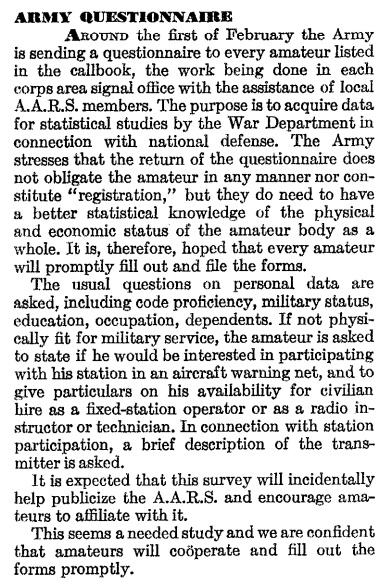
1941ArmyQuestionaireSeventy five years ago, the U.S. was clearly gearing up quickly for war, and the War Department turned its attention to the communications manpower that the war would entail. As reported here in the February 1941 issue of QST, the Army was sending out a questionnaire to all of the hams listed in the call book.

The War Department made clear that response to the survey in no way constituted “registration” and did not impose any obligation, the Army believed that the statistical knowledge was of utmost importance.

The questionnaire asked for data on code proficiency, military status, education, occupation, and dependents. For those respondents who were not fit physically for military service, it asked whether they would be interested in participation in an aircraft warning net, or whether they would be available for civilian positions as radio operators, instructors, or technicians.

In addition, the survey asked for a brief description of the station.

The ARRL opined that “this seems a needed study and we are confident that amateurs will cooperate and fill out the forms promptly.”


POTUS to Military: Read The Bible

FDRBible

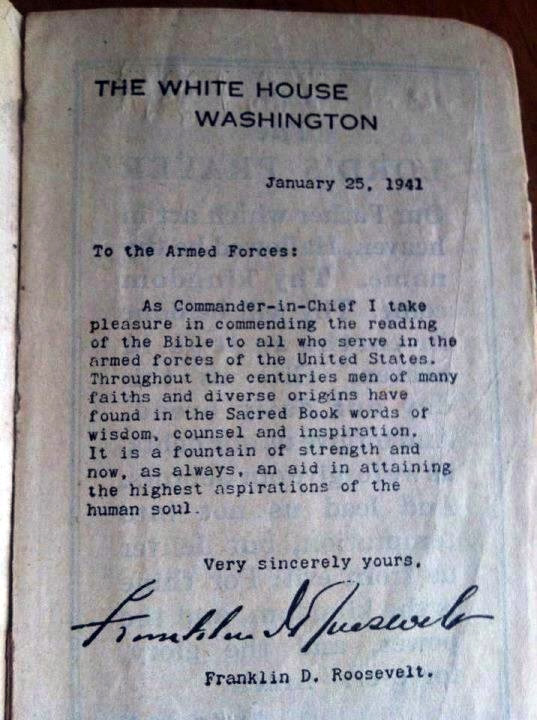
Imagine the outrage that would ensue if the President of the United States penned the following words, knowing that they would be distributed to most members of the Armed Forces:

To the Armed Forces:

As Commander-in-Chief, I take pleasure in commending the reading of the Bible to all who serve in the armed forces of the United States. Throughout the centuries men of many faiths and diverse origins have found in the Sacred Book words of wisdom, counsel and inspiration. It is a fountain of strength and now, as always, an aid in attaining the highest aspirations of the human soul.

But on this day 75 years ago, the Commander in Chief did exactly that.  This personal message by FDR was included in a pocket Gideon Bible (New Testament, Psalms, and Proverbs) distributed to military members.  And apparently no outrage ensued.


American Shortwave Broadcasting, 1941

1946JanPS

Seventy-five years ago, American shortwave broadcasters were clearly gearing up for war, as shown by an article in the January 1941 issue of Popular Science.

The article reports that in 1930, there were only three short-wave stations in Europe, but by 1941, there were at least 40, with more being built all of the time. In particular, the German radio, financed by the government, was pumping out Hitler’s speeches on as many as six transmitters at a time. They were targeting South America in particular, and the Americans wanted to keep up. Two million dollars was being spent on new transmitters, and according to the article, the investment was paying off. America had previously had only two transmitters running 50,000 watts or more, WLWO of Crosely Corporation in Mason, Ohio, and WGEO, owned by GE in Schenectady, N.Y.

New stations coming online included WNBI and WRCA, owned by NBC in Bound Brook, N.J., WCBX in Wayne, N.J., owned by CBS, WCAB and WCAU in Newtown Square, Pa., Westinghouse stations WBOS in Millis, Mass. and WPIT in Saxonburg, Pa., WRUL and WRUW in Scituate, Mass., and GE stations KGEI San Francisco and WGEA South Schenectady, NY.

There were 2.1 million shortwave receivers in South America, and they were a major target for the U.S. signals. NBC reported that in 1936, it reeceived fewer than fifty letters a month from South America, but was then receiving 2500 a month. Most of them were reportedly full of praise and reported their disgust with the propaganda fed by European stations.

For more information on the shortwave broadcast bands during World War II, see some of my previous posts:

Click Here For Today’s Ripley’s Believe It Or Not Cartoon



Virginia Hall: American Spy

CIA image via Wikipedia.

CIA image via Wikipedia.

Shown here at the key of a clandestine transmitter somewhere in German-occupied France is American spy Virginia Hall.

Born in Baltimore in 1908, she had her sights set on a career in the foreign service, and landed a job as a clerk at the U.S. Embassy in Warsaw in 1931. Unfortunately, while hunting in Turkey in 1932, she accidentally shot herself in the left leg, which later had to be amputated. She found herself in Paris at the start of the war and joined a French ambulance corps. After the fall of France, she made her way to London where she volunteered for the British Special Operations Executive (SOE).  Her cover story was as a correspondent for the New York Post, and she spent 15 months in both Vichy and occupied France, helping to coordinate the activities of the French Underground.

Forged identification certificate for “Marcelle Montagne.” Wikipedia image.

In 1942, Hall escaped to Spain and then back to London. In 1944, she joined the U.S. Office of Strategic Services (OSS) and was returned to France. Since her artificial leg prevented her from parachuting in, she was landed at the Brittany coast by a British boat. Using a forged identification for Marcelle Montagne, she contacted the Resistance in central France and mapped drop zones for supplies and commandos.

She died in Maryland in 1982 at the age of 76.

Read More at Amazon

Click Here For Today’s Ripley’s Believe It Or Not Cartoon


Eugène Aisberg, Radio Writer

Eugène Aisberg, 1946.

Eugène Aisberg, 1946.

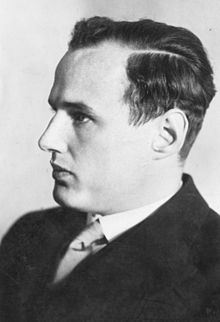
After a wartime absence, the January 1946 issue of Radio Craft carried an article by writer Eugène Aisberg.  While that name might not be familiar to American readers, Aisberg was a prolific author in the early days of radio, and wrote some of the best treatises on radio for the popular audience.  He was fluent in French, Esperanto, German, Russian, and English.

Aisberg was born in Odessa, Ukraine, in 1905, and lived most of his life in France. He was the director of the French magazine Toute la Radio and a prolific author of a number of books. His most popular book, which is still in print, is La Radio? Mais c’est très simple (Radio? But It’s So Simple!)  The book, currently in its 29th edition, an extremely solid background covering all aspects of electronics, and is written in a popular, easy-to-read style. While the book was ultimately translated into several languages, it was apparently never published in English.

The book consists mostly of a dialog between Ignotus and his uncle Curiosus, along with explanations by Professor Radiol, in which the characters explain in an interesting fashion all aspects of electronic theory.

Aisberg’s first radio book was actually published in Esperanto. Jen… mi komprenas la radion (“Now I understand the radio”).

1942 edition of Amélioration et modernisation des recepteurs.

1942 edition of Amélioration et modernisation des recepteurs.

During the war, under the noses of the occupying Germans, Aisberg published a book explaining how to pull in Radio London and other foreign stations. The technical title of the book, Amélioration et modernisation des recepteurs (“Improvement and Modernization of Radio Receivers”) was undoubtedly helpful in getting the book past the German censors.

While his most famous book was never translated into English, his later TV – It’s a Cinch was published in English in 1957. While analog TV is now an obsolete technology, the book is still an extremely interesting read, and the reader walks away knowing how the technology works.

The 1946 article, which marked his return to an American audience after the war, described a radio with automatic selectivity control.  The article also contains the following sidebar, which is a fascinating reminder of conditions prevailing in France immediately after the war:

Aisberg1946b

Because of the conditions prevailing in Paris, instead of a check, Aisberg preferred payment for the article to be in the form of “chocolate, cocoa, toilet soap, shaving cream, corned pork, coffee, needles and thread, canned ham, and high-speed razor blades.”

Aisberg died in Paris in 1980.

See also:  Fall of Paris, 1940

Click Here For Today’s Ripley’s Believe It Or Not Cartoon


WW2 Prisoner Radios

POWradio

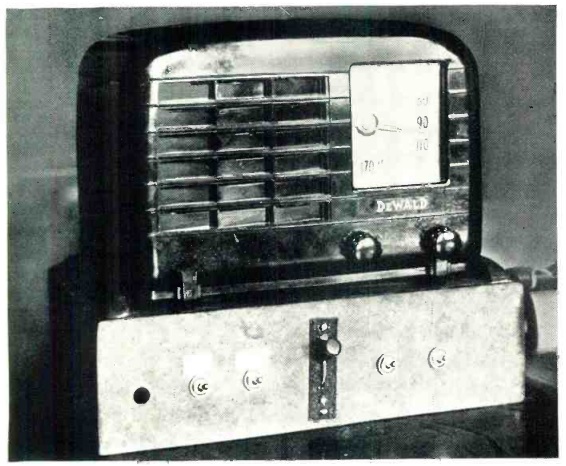
It’s unclear exactly when and where these grainy old photographs were taken, but they depict something rather remarkable.  The top photograph is a radio receiver used by Allied prisoners of war from 1940 until the end of the war in 1945.

This set belonged to the crew of a Canadian merchant ship which was captured early in 1940. They managed to conceal the set in their belongings and smuggle it in to the POW camp near Bremen. The set’s hiding place is the hollowed out butcher’s block shown in the bottom photo.

The photos appear on page 14 of the January, 1946, issue of Manitoba Calling, the monthly magazine and program guide put out by CKY in Winnipeg. The article contains other tales of Allied POW’s managing to listen to the radio during their confinement. The article contains other such stories of how prisoners managed to keep clandestine radio receivers concealed.

In one case, prisoners at a camp in occupied Poland managed to steal a transmitter from a German armored car. When the camp was threatened with an exhaustive search for the stolen set, it was returned, since the men didn’t want to risk losing the twenty clandestine receivers in their possession.

Unfortunately, the article is lacking details on the receivers in use, their power supplies, and other details. Nonetheless, it’s an interesting read, and confirms that Allied prisoners were often able to keep in touch with news from home.

The author of the article was Calvin Peppler, who was employed by CKY before and after the war. During the war, he was a Spitfire pilot in various squadrons for several years. In the last few months of the war, he was shot down and served for several months as a prisoner of war himself, attempting several unsuccessful escapes. Peppler died in Toronto in 2015 at the age of 96.

Click Here For Today’s Ripley’s Believe It Or Not Cartoon


Sinking of the SS Persia, 1915

Today marks the 100th anniversary of the sinking of the SS Persia, with the loss of 343 lives among the 519 aboard.  Without warning on December 30, 1915, off the coast of Crete, the ship was torpedoed by Captain Max Valentiner commanding the U-boat SM U-38.

The passenger ship carried no troops or war materiel of any kind. The 499 foot ship went down in about five minutes in 10,000 feet of water.

The captain’s wife was en route to Malta to spend the winter with her husband, and was advised by wireless of his death.

Dewey1916Among the dead was Marconi wireless operator George Henry Dewey, shown here. After finishing his education, he had initially entered the post office as a telegrapher and clerk, and then studied at the British School of Telegraphy and entered the service of the Marconi company. In his short career, he had served aboard five other ships before his appointment to his position aboard the Persia.

The ship carried a large quantity of gold and jewels belonging to the Maharaja Jagatjit Singh,  who had previously disembarked at Marseilles. Despite the ship being located in 2003 and some artifacts being recovered, that treasure still lies at the bottom of the Mediterranean.

“Spirit of Ecstasy.” Wikipedia image.

Also among the dead was actress and model Eleanor Thornton. While her name might be unfamiliar, she is widely recognized, since she served as the model for the “Spirit of Ecstasy” hood ornament that adorns every Rolls Royce.

U-boat Captain Valentiner was labeled a war criminal for sinking the civilian ship without warning, and between the wars, he lay low under an assumed name. He returned to the Kriegsmarine during World War 2, where he was the group commander of the U-Boots-Abnahmekommision (UAK) in Kiel-Danzig. He died in 1949 of lung disease, probably caused by the inhalation of toxic vapors aboard the U-boats.

References


Click Here For Today’s Ripley’s Believe It Or Not Cartoon


Second Great Fire of London, 1940

Daily Mail showing St. Paul’s Cathedral. Wikipedia image.

Today marks the 75th anniversary of the Second Great Fire of London, as the air raid of the night of December 29/30, 1940, came to be known.

Starting at 6 PM, over 24,000 high explosive bombs and 100,000 incendiary bombs were dropped on the city. The area of destruction was the largest of the war, and greater than that of the Great Fire of 1666.

Churchill urged that St. Paul’s Cathedral be saved at all costs, and both firefighters and volunteer fire watchers worked through the night to fight fires nearby and put out incendiaries landing on the roof.

Over 160 civilians died during that night, with many more dying of injuries in the following days. Fourteen firemen died and 250 were injured. In a successful effort to make firefighting more difficult, the raid was timed to coincide with particularly low tides in the Thames.

The film below, from the British Ministry of Information, shows the fire as seen from the roof of the Cathedral:

The raid came the same night as FDR gave his “Arsenal of Democracy” Fireside Chat:


Click Here For Today’s Ripley’s Believe It Or Not Cartoon


Merry Christmas!

Lighting the Los Angeles Christmas tree, 1940.

Lighting the Los Angeles Christmas tree, 1940.

Merry Christmas from OneTubeRadio.com!

We look back to 1940, as America celebrated its last prewar Christmas. The December 23 issue of Life Magazine proclaimed that “forgetting war and stringing holly, U.S. spends to make Christmas jolly.” The magazine reported that despite the clouds of war, American preparations for Christmas “reflected no hint of anything but peace, prosperity and goodwill.”

1940 electrified Santa on the world's second largest sign.

1940 electrified Santa on the world’s second largest sign.

But the magazine also noticed a mood that contrasted significantly with Christmases of other years. Gone were the Yules filled with the fragrance of evergreens, candles, carols, still snows, and silent skies. Instead, it was filled with streamlined, mass-produced mechanical Santas of identical image grinning and nodding in department store windows. Decorators did tricks with electricity and plastics. Comic strip characters and bathing beauties intruded on a show previously dominated by the Magi and the Virgin Mary.

It said that the new mood wasn’t hard to explain, as the nation had lived with the threat of war for fifteen months. “Only in excitement, in spending, could America forget Coventry, Birmingham, and Alolf Hitler.” And there was a lot of money to spend. With war industries gearing up, Americans were flush with cash.

Click Here For Today’s Ripley’s Believe It Or Not Cartoon