Category Archives: World War 2

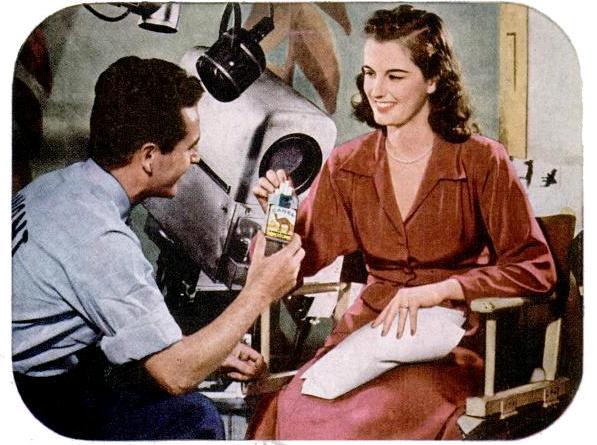
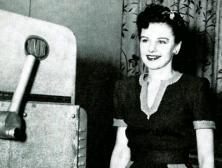
Loretta Brophy, WABD, 1945

1945WABDCamel

Seventy years ago today, life was good. The War was over, television was becoming a reality, and you could buy a pack of Camels whenever you wanted. Shown here in the December 10, 1945, issue of Life Magazine is Loretta A. Brophy, getting ready to enjoy a Camel during a break from her busy job as program director at the New York DuMont television station, WABD.

The ad also showed Miss Brophy rehearsing with a song-and-dance team, but pointed out that the next day, it might be a quiz program or grand opera. Miss Brophy called her job “fast, exciting, fun!”

And when she called “cut,” that meant the show was over, but Camels were still in order. She reported that during the wartime cigarette shortage, “when I couldn’t get Camels, I smoked anything I could get, more different brands than I can remember. That’s when I learned really to appreciate Camels–there’s nothing like a Camel.”

Other than this advertisement, I wasn’t able to find any other references to Miss Brophy, although she was obviously one of the pioneers of television. She wasn’t alone, as women held a number of important positions.

1945WootenWhile not mentioning Miss Brophy, the Spring 1945 issue of Televiser carried a feature entitled “Women in Television.” At WABD, when the wartime manpower crisis put a damper on hiring, “women in slacks blossomed forth as ‘cable engineers’ (studioese for people who haul co-axial cables out of the way of the cameramen). One of WABD’s early staffers was Dotty Wooten, shown here. She was hired as a stenographer in 1943, but was one day called in to fill an emergency slot as announcer. The magazine reported that she had filled the announcing post ever since.

In our previous post about WABD, we noted that the station really had no full-time staff when it first came on the air.  The station was on the air three evenings a week, and was largely staffed by workers at DuMont’s New Jersey war plant.  With men off to war, it wasn’t surprising that women were called on to staff the station.

The same issue of Televiser  gave some insight into the challenges faced by Miss Brophy in her job.  Directing a television program was challenging, as it involved careful choreography of the cameras.  Each of the large cameras was fed with a thick coaxial cable from behind.  Therefore (except perhaps with the assistance of one those cable engineers), it was impossible for one camera to cross behind another.  Therefore, one camera had to be already in place for the next shot before the second camera “dollied in” for a closeup.  Interestingly, the byline for the sidebar explaining this choreography was that of a woman, one Patricia Murray, also on the staff of WABD.

Click Here For Today’s Ripley’s Believe It Or Not Cartoon


FDR’s Secret Radio Car


1945DecemberFDRradiocar

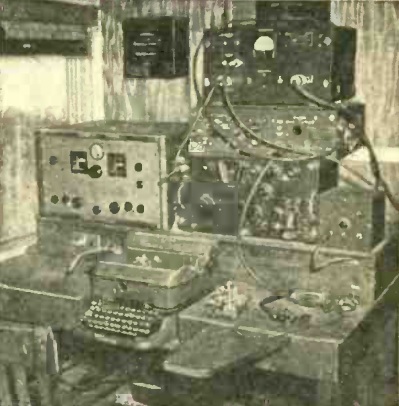
70 years ago, the December 1945 issue of Radio Craft carried this previously secret image of the radio car of FDR’s wartime train.

It noted that the car, known as “No. 1401” was a converted passenger-baggage coach, and from this car, e ran a large part of the country’s war activities. It was equipped with wire and radio equipment that made it possible to telephone anywhere in the United States, carry on a radio teletype conversation “in virtually unbreakable code” at 100 words per minute, send and receive messages to ships at sea, or send and receive telegraph messages.

The article noted that the teletype machine was routed through a scrambler “which puts it into a code difficult to break because of its lack of uniformity.” When the train passed through a tunnel, the sending was automatically halted until the train re-emerged.

Click Here For Today’s Ripley’s Believe It Or Not Cartoon


Pearl Harbor Radio Coverage

imgHandler

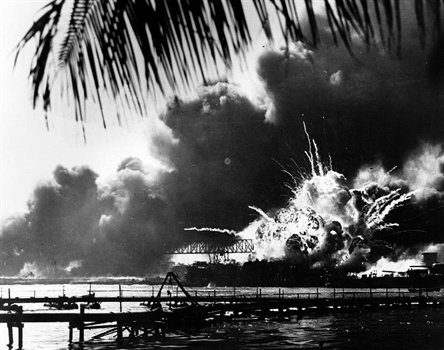
USS Shaw at Pearl Harbor. Defense Department Photo.

Today marks the 74th anniversary of the Japanese attack on Pearl Harbor, December 7, 1941.  A total of 2403 Americans were killed and 1178 were wounded.  Eighteen ships, including five battleships, were sunk or run aground.  Most Americans learned of the attack by radio.  The first announcement was made by CBS’s John Charles Daly, at about 2:35 PM Eastern Time.  That first announcement was never recorded.

The following recording, from Minneapolis station WCCO, apparently starts at about 2:30 Central Time, 3:30 Eastern Time with an announcement of the attack at the conclusion of the New York Philharmonic concert. The concert had started at 3:00 Eastern Time.

https://www.youtube.com/watch?v=mmxrx8ZDEhs


You’ve probably heard an announcement breaking into a symphony mid-note, with the words: “We interrupt this program to bring you a special news bulletin. The Japanese have attacked Pearl Harbor, Hawaii by air.” This was actually from a record produced by CBS in 1948. The first sentence of the announcement was apparently recorded in 1948. The second sentence came from an actual broadcast later in the day. You can hear the original at this link.  You can hear the 1948 recording at 26:50 of this video:

References


Messenger Belfall Reporting: I Have Delivered My Message

Derrick Belfall. Photo courtesy of Mrs. Rita McInnes.

Derrick Belfall. Photo courtesy of Mrs. Rita McInnes.

Today marks the 75th anniversary of the death of a British Boy Scout, Derrick Belfall, who gave his life in the service of his country and his King.

Life111840Just over 75 years ago, the November 18, 1940, issue of Life magazine carried this photo of British air raid wardens gathering prior to having to go to work for the night.  The man on the phone is just receiving the “yellow warning” advising that enemy planes were approaching the country.  The young man resting is probably a messenger, who would be called upon to deliver messages to civilian defense headquarters if the telephones failed.

The men here are in Churchill, a village coincidentally sharing the name of the prime minister, located about 14 miles from the port of Bristol.  These men so far felt a little out of the war, since, there had been nothing to do, no bomb wreckage, no casualties, no fires.  But the same scene was playing itself out in other cities and villages, and many of those men, young and old, would soon be at the heart of the war.

Derric Belfall. Photo courtesy of Mrs. Rita McInnes.

Derric Belfall. Photo courtesy of Mrs. Rita McInnes.

On the night of December 2, 1940, a similar scene was playing itself out just a few miles away in Bristol.  Planes were approaching the country, and the men of Bristol received the warning.  Among them was a fourteen year old Boy Scout,  Derrick Belfall, of 109 Bishop Rd, Bishopston, Bristol, the only son of Cecil Ernest and Mary (née Miller) Belfall.  Like the young man in the photo above, he was a civilian defense messenger.

Under the regulations, the minimum age for messengers was sixteen.  But fourteen-year-old Belfall had been persistent, and his parents and the authorities had finally allowed him to serve.  On December 2, the yellow warning turned into a real attack on Bristol, and the civilian defense volunteers had a long difficult evening ahead of them.

Another Boy Scout messenger explained, in the September 1942 issue of Boys’ Life, the duties of messenger:

When a bomb drops one of the first people on the spot is either the head warden or one of the senior wardens. He always has a messenger with him; one of us Scouts. What he does as soon as he gets there is to make out a report on what has happened, give it to that messenger and the messenger rides down to the post, which we call the pill box.

Inside the pill box there is a telephone. That is the only telephone we are allowed to use during an air raid. But sometimes the telephone lines get broken when a bomb hits the road. Then instead of just having to ride to the post and telephoning, we messengers have got to ride down to the control center. Sometimes it is a long way and sometimes it isn’t. In my case it is three miles; that’s three miles there and three miles back, maybe ten times in one night. Not only do we send one messenger but three minutes after the first messenger is gone we always send another one so if the first one gets bumped off the second one may get through.

The most complete account of Derrick Belfall’s actions that night appeared in the Chelmsford Chronicle, January 17, 1941:

In the six hour long air raid on Bristol early in December last Derrick Belfall took a message regardless of his own safety right through the worst danger area of the city with bombs dropping all around him. He got through with his message and he got back, his hands torn and bleeding. When told to go and rest, he said “No thanks”; please let me have a stirrup pump, I want to put out a fire that I passed down the road.

They told Derrick he was too exhausted to go out again, but the lad took a pump, slipped quietly out and succeeded by himself in getting the fire under control. A little later he rescued a baby from a blazing house.

He reported back at his post and found that telephonic communications had broken down, An urgent message had to be got through. Without a moment’s hesitation Derrick volunteered to take it. Out he went with enemy raiders overhead dropping bombs all along the route. He reached the Central Police Headquarters.

And then a bomb struck him down.

He was rushed to hospital dying “Messenger Belfall reporting – I’ve delivered my message,” he murmured. That was his last breath. Derrick Cecil Belfall died on active service aged 14 years 11 months.

After recounting Scout Belfall’s story and those of other scouts responsible for acts of bravery, the American Chief Scout Executive, James E. West, had this to say:

Of course, all of us hope that none of our Scouts will ever be called upon to face this type of emergency here in America, but it is my conviction that they are qualified to meet any situation in the same spirit.  Bear in mind that these boys are typical of Scouts in your own community, yes, in your own Troop.  That they probably had training no better than what you yourselves and your brother Scouts secured under your own Scoutmaster and other Troop leaders.  They were not specialists but were equipped with only such knowledge as is normally given to Scouts through our Advancement Program.  Yet how nobly these Scouts and Scout Leaders lived up to our Scout Motto “Be Prepared.”

Acknowledgment

I would like to thank Mrs. Rita McInnes, a neighbor of the Belfall family, for providing the photograph of Derrick Belfall, and also for providing the newspaper article quoted above.  The illuminated photograph containing Derrick’s last words hung for many years in the Belfall home, and I am grateful to Mrs. McInnes for preserving it and allowing me to share it.


Click Here For Today’s Ripley’s Believe It Or Not Cartoon


1937 Westinghouse Chairside


1937Westinghouse

This young woman is undoubtedly tuned in to a foreign shortwave broadcast as she shows off her 1937 Westinghouse chairside console. The seven tube set featured a slanted dial panel for easy chairside tuning. The accompanying caption in the November 1937 issue of Radio Retailing notes that the set also featured vertical grille pilasters to add a distinctive note to the cabinet. It tuned 540 kHz to 18 MHz and included a “precision eye” tube.

The magazine didn’t include a model number, and I wasn’t able to track one down. If you have more information on this set, please leave a comment below.

To get some idea of what signals she might have been trying to pull in, the August 21, 1937, issue of Radio Guide gives some ideas. The MacGregor Arctic Expedition was underway aboard the General A.W. Greely, en route to Fort Conger, Ellesmere Island. The NBC network was carrying updates, which originated from W10XAB, a 400 watt transmitter aboard the ship.

Another curious broadcast, which took place on August 17 is somewhat chilling in light of the fact that the Nazis were by then firmly in control of Germany and the stations in question. The German stations DJB and DJD were to “feature a special broadcast to the State of Minnesota. Just seventy-five years ago to this very day, the Sioux Indians made their last assault on New Ulm, Minn., founded by German emigrants from Swabia, from the old town of Ulm, famous for its cathedral. This event and more so, the quick reconstruction of New Ulm, are fine examples of the part which German settlers had in making Minnesota a prosperous and busy state. The station hopes listeners in New Ulm will be particularly interested in tuning in this broadcast.”

Click Here For Today’s Ripley’s Believe It Or Not Cartoon


1941 Dictator: The Ideal Gift for the Whole Family!

1941Dictator

By November 1940, Canada had been at war with dictators for over a year.  But this ad invited Canadians “in tune with the times, for Christmas, give a 1941 Dictator, the ideal gift for the whole family!”  This ad appeared 75 years ago today, in the November 28, 1940, issue of the Vancouver Sun.

At some point in the 1930’s, someone at the Hudson’s Bay Company department stores decided that “Dictator” would be a good name for their own brand of radios, most or all of which were manufactured by Dominion Electrohome Industries Limited of Kitchener, Ontario.  Presumably, they had a lot of nameplates printed up, so they continued to use them on early wartime models such as this one.

Both the six tube ($74.50) and eight tube ($94.50) featured pushbutton tuning, and both covered short wave, so I suppose both of them could, indeed, bring a dictator into your living room as you tuned the wartime shortwave bands to listen to the voices of Hitler or Mussolini.


Click Here For Today’s Ripley’s Believe It Or Not Cartoon


1943 One Tube AC-DC Regen

1943OneTubeACDCIf you were lucky enough to have in your wartime junkbox a dual triode such as the 6C8G, you could turn it into a regenerative receiver suitable for both broadcast and shortwave bands.  This circuit was sent in to the March 1943 issue of Radio Craft by one Leo Silber of Springfield, Mass., who appears to have been a high school senior at the time.  It used one half of the tube as a rectifier, with the other half serving as a regenerative detector. To deliver the filament voltage, the set used a 390 ohm “curtain burner” line cord. With four plug-in coils, the set would cover 500 to 15 meters.

Mr. Silber reported that the set pulled in signals from all over the world. His best DX was apparently logged before the War, KC4USB at Little America.  He doesn’t appear to have been licensed before the War, but the 1949 call book shows him as holding W1NRP.  A 1981 biography is available at this link.

Click Here For Today’s Ripley’s Believe It Or Not Cartoon


Happy Thanksgiving!

On this Thanksgiving, we look back to Thanksgiving seventy years ago, when America and the world gave thanks for final victory, as expressed by President Truman:

In this year of our victory, absolute and final, over German fascism and Japanese militarism; in this time of peace so long awaited, which we are determined wit all the United Nations to make permanent; on this day of our abundance, strength, and achievement; let us give thanks to Almighty Providence for these exceeding blessings.

We have won them with the courage and the blood of our soldiers, sailors, and airmen. We have won them by the sweat and ingenuity of our workers, farmers, engineers, and industrialists. We have won them with the devotion of our women and children. We have bought them with the treasure of our rich land. But above all we have won them because we cherish freedom beyond riches and even more than life itself.

We give thanks with the humility of free men, each knowing it was the might of no one arm but of all together by which we were saved. Liberty knows no race, creed, or class in our country or in the world. In unity we found our first weapon, for without it, both here and abroad, we were doomed. None have known this better than our very gallant dead, none better than their comrade, Franklin Delano Roosevelt. Our thanksgiving has the humility of our deep mourning for them, our vast gratitude to them.

Triumph over the enemy has not dispelled every difficulty. Many vital and far-reaching decisions await us as we strive for a just and enduring peace. We will not fail if we preserve, in our own land and throughout the world, that same devotion to the essential freedoms and rights of mankind which sustained us throughout the war and brought us final victory.

Now, Therefore, I, Harry S. Truman, President of the United States of America, in consonance with the joint resolution of Congress approved December 26, 1941, do hereby proclaim Thursday November 22, 1945, as a day of national thanksgiving. May we on that day, in our homes and in our places of worship, individually and as groups, express our humble thanks to Almighty God for the abundance of our blessings and may we on that occasion rededicate ourselves to those high principles of citizenship for which so many splendid Americans have recently given all.

Click Here For Today’s Ripley’s Believe It Or Not Cartoon


1943 Code Oscillator and Regenerative Receiver

1943Regen

Amateur station licenses weren’t being issued during the war, but the FCC continued to conduct exams and issue operator licenses. And there was a big demand for operators, both in the military and commercially, so learning Morse Code would be an important skill in 1943, and the January and March, 1943, issues of Popular Mechanics carried companion projects to assist a student in learning the code. The January issue carried plans for a simple code practice oscillator using a 25A7GT tube which ran on 120 volt house current. The set was billed as a “safety code oscillator,” the safety feature being that both the filament and B+ were dropped down to 25 volts by use of a “curain burner” resistance line cord.

The writer, W9SFW, seems to have realized, however, that the setup wasn’t totally safe. Depending on how the plug was inserted, there was a 50/50 chance that the exposed “ground” connections on the exposed chassis were actually hooked directly to 120 volts. The solution was to plug it in the other way. In the case of the code oscillator, this would be apparent, since the oscillator would make noise even with the key up.

The March issue carried a simple one-tube regenerative receiver, using the same tube and many of the same parts. Since listening to actual code on the air was the best way to learn, this set would allow the builder to tune about 6-11 MHz, frequencies that would have been packed with CW signals during the war. The author notes that “once some code efficiency is obtained, listening-in on actual code signals is the best way to increase your code receiving speed and learn real message-handling procedure that will be of help in service training.

Since unlike the oscillator, the receiver would operate just fine even with the chassis “hot,” the article advises that the polarity of the cord should be tested and then marked. To test it, a light socket was hooked to one of the ground points, with the other side to an actual ground. If the bulb lit up, then the plug was the wrong way and should be reversed. With the correct polarity and the “curtain burner” cord dropping the voltage, the set would be relatively safe.

It should be noted that there’s really no safe way to build this set on an exposed breadboard without the “curtain burner” cord. Even though polarized cords are available, which are a step in the right direction, there’s another problem. One could use a sufficiently large 330 ohm resistor to drop the voltage, but one end of that resistor would still have 120 volts on it. If you do overcome that safety obstacle (by not leaving connections exposed), all of the parts required for this simple set should be readily obtainable. The set uses two variable capacitors, one for tuning and the other for regeneration. As discussed in the article, the exact values are not critical. The coil is wound on a cardboard form. The fixed capacitors are readily available, with the added bonus of the modern equivalents being much smaller than the 1943 versions.

The tube is a dual tube, and in both circuits, half the tube is used as the rectifier.

Click Here For Today’s Ripley’s Believe It Or Not Cartoon


Sealing of Warsaw Ghetto, 1940

Seventy-five years ago today, November 16, 1940, the Nazis sealed the Warsaw Ghetto, after moving about 400,000 people into the 1.3 square mile area. The total death toll is estimated to be at least 300,000. At least 254,000 of this number were sent to the Treblinka extermination camp. Average food rations for the residents were 184 calories, as compared to 2613 calories for Germans.

Immediately before the war, Warsaw had a Jewish population of 300,000.  It’s estimated that fewer than ten percent survived the war.

Click Here For Today’s Ripley’s Believe It Or Not Cartoon