Category Archives: World War 2

Coventry Blitz, 1940

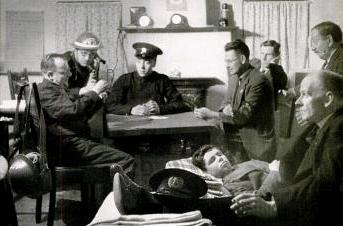
One of the most devastating air attacks of World War II occurred 75 years ago tonight, with the bombing of Coventry, November 14, 1940.

The city, with a population of about 238,000, was an industrial center, with residential areas interspersed amongst the factories. That night, in an operation code named Operation Mondscheinsonate (Moonlight Sonata), 515 German bombers took off to destroy the city’s industrial capacity. The 36 anti-aircraft guns protecting the city managed to shoot down only one bomber. One of the first waves of incindiary bombing started over 200 fires, and also destroyed much of the telephone network, making command of the fire brigades nearly impossible. Damage to water mains also made it impossible to fight many of the fires.

4300 homes were destroyed, with about two thirds of the city’s buildings suffering damage. Much of the city’s center was destroyed, and over a third of the city’s factories were put totally out of commission.

Over five hundred were killed in the raid, with over a thousand injured.

https://www.youtube.com/watch?v=PHknZf4AXKc

Read More at Amazon

Fiction

For Younger Readers

Also on this day in history:  One hundred years ago today, November 14, 1915, Booker T. Washington died.  Born into slavery in Virginia in 1856, Washington rose to prominence, serving as head of the Tuskegee Institute.  Among those he led was George Washington Carver, whom he hired in 1896.  Washington was the first African-American to be invited to the White House, by President Theodore Roosevelt, in 1901.

Click Here For Today’s Ripley’s Believe It Or Not Cartoon


1945 Stromberg Carlson Radio

1945StrombergCarlson

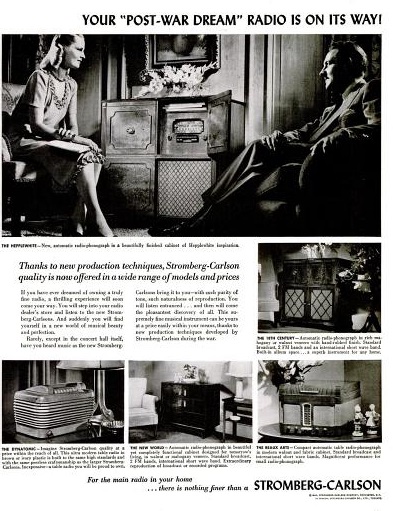
Seventy years ago, the War was over, and American radio manufacturers were getting ready to deliver on the pent-up demand for radios, which had been out of production since early 1942. Stromberg-Carlson was no exception, as shown by this ad in Life Magazine, November 12, 1945, promising that the sets shown here would soon be available.

Interestingly, the FM sets covered two bands.  Since some prewar stations were still on the air on the old band, the sets covered 42-49 MHz.  But since that band would soon be depopulated and the stations moved to the new band, they also covered the modern 88-108 MHz FM band.

Click Here For Today’s Ripley’s Believe It Or Not Cartoon


FDR Wins Third Term, 1940

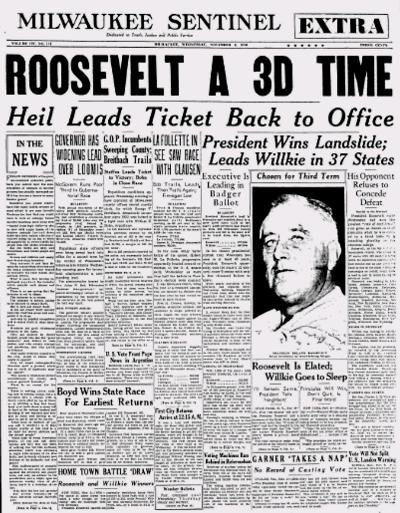
Seventy-five years ago today, November 5, 1940, it was the first Tuesday after the first Monday in November, and Roosevelt was elected to an unprecedented third term as President.

Click Here For Today’s Ripley’s Believe It Or Not Cartoon


Desmond Doss, Medal of Honor

Seventy years ago today, U.S. Army Corporal Desmond Doss, a conscientious objector, was awarded the Medal of Honor by President Truman. Doss, a devout Seventh-Day Adventist, was drafted in 1942. Because of his religious beliefs, he refused to kill or carry a weapon. He was made a medic in the Pacific Theatre.

When his battalion assaulted a jagged escarpment, it was met by a heavy concentration of artillery, mortar, and machine gun fire, resulting in 75 casualties. Doss refused to seek cover, cared for the men, and carried all 75 casualties, one by one, to the edge of the escaprment where he lowered them on a rope-supported litter. His heroics continued on subesequent days when he rescued injured men forward of the lines.

He was subsequently injured by a grenade, but rather than risking another aid man’s life, he treated his own wounds and waited five hours before litter bearers reached him. Upon seeing a more critically injured man, he crawled from the litter and directed the litter bearers to care for that man first. He was then struck by a sniper’s bullet, suffering a compound fracture. He splinted his own wound before crawling to the aid station.

Shortly before leaving the army, Doss was diagnosed with tuberculosis, which eventually cost him a lung. Doss died in 2006 at the age of 87.

Click Here For Today’s Ripley’s Believe It Or Not Cartoon
Taiwan Retrocession Day, 1945

Chen Yi (right) accepting surrender of General Rikichi Andō (left), last Japanese Governor-General of Taiwan, Taipei City Hall, October 25, 1945. Wikipedia photo.

Today marks the 70th anniversary of Taiwan’s Retrocession Day, October 25, 1945. It marked the end of a half century of colonial rule by the Japanese.  The anniversary remains a public holiday in Taiwan.


1941 Model RCA Victor Radios

1941RCA75 years ago today, the October 21, 1940, issue of Life Magazine carried this two-page ad showing what would be some of its last prewar radios, from the company’s 1941 model year. The ad points out that even for your home’s extra radio, you can get RCA Victor quality at a low price, since the models start with the the model 45X-1, later dubbed the “Little Nipper,” for $9.95.  This inexpensive set was billed as having, in addition to standard broadcast, “one police band.” A closer inspection reveals, however, that the “police band” means only that it tunes above the standard broadcast band to 1720 kHz, so that police calls in many cities could be heard at the top of the standard AM dial.

Families wishing to tune in to foreign broadcasts with their “extra” set could do so for as little as $19.95 with the model 16X-11, which tuned standard broadcast and one short wave band. Many of the sets featured a “plug-in for Victrola,” meaning that an external phonograph could be added. The least expensive combination radio-phono was the model V-100 for $29.95.

With the end of civilian radio production on April 22, 1942, virtually all of these sets would see service for the next five years, providing war information to their owners.


Hytron Tube Test Station, 1944

Hytron1945The wartime Hytron Corporation worker shown here is using a tube tester, but it’s probably a bit bigger than the one down at the drug store. She is operating a master test station for measuring various attributes of transmitting vacuum tubes. It was described in the October 1944 issue of Radio News.

A year later, the editors were undoubtedly looking for a stunning picture for the cover, so they went ahead and used it 75 years ago this month, in the October 1945 issue.

The test station had various power supplies, as well as precise measuring instruments for voltages and currents to each tube element. The nicely crafted drawers provided storage space for jumper cables and adapters. The heights and angles of all of the meters were carefully considered to avoid paralax errors.

Hytron was acquired by CBS in the 1950’s, and was a major producer of tubes under the Hytron CBS label.

Click Here For Today’s Ripley’s Believe It Or Not Cartoon


1945 Car Radio Conversion

1945CarRadioConversion

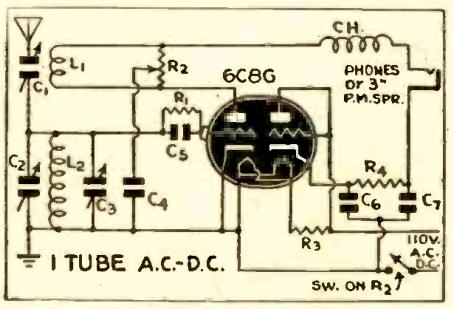
Seventy years ago, the war was over, but radios were not yet available to consumers, since production had been shut down on April 22, 1942.  Gasoline rationing had already ended, but after years of tight restrictions on both tires and gasoline, it was likely that there were a lot of car radios that weren’t seeing much use.  Therefore, it’s quite likely that many owners of car radios took the lead of the gentleman shown here, and converted the car set for use inside.  The October 1945 issue of Popular Mechanics showed how to make the relatively simple conversion.

The conversion required only a few parts.  First of all, the car’s 6-volt battery was replaced with a 4-amp filament transformer.  Since the transformer put out AC, the vibrator in the car radio was no longer necessary.  Therefore, it was simply removed and jumpered.  The car radio would have a speaker with a 6-volt dynamic coil, which wouldn’t work well with AC.  Therefore, it was simply replaced with a permanent magnet speaker.  The rectifier tube, a 0Z4, was replaced with a 6X5.  Since the set’s existing power supply filter might not be up to the job of getting rid of all of the 60 cycle hum, the article showed where a choke could be added if hum was still a problem.

The set could be housed in a new cabinet or, as shown here, in a desk drawer.

Click Here For Today’s Ripley’s Believe It Or Not Cartoon


Radio Keeps a Government Girl Company, 1943

Image via Wikimedia.

Image via Wikimedia.

By 1944, with able-bodied men off to war, a third of the Civil Service was composed of women, and thousands of “Government Girls” descended on Washington to do their part to win the war by taking jobs in the quickly expanding federal government.

This brought acute housing shortages, and many of them lived in boarding houses.  Among them was the young woman shown here in this iconic photograph by government photographer Esther Bubley.  Bubley was herself one of those Government Girls.  She grew up in Superior Wisconsin.  After graduating from high school in the late 1930’s, she attended Superior Teachers College (now University of Wisconsin-Superior) before studying photography at the Minneapolis School of Art (now the Minneapolis College of Art and Design).

"I come in here pretty often, sometimes alone, mostly with another girl, we drink beer, and talk, and of course we keep our eyes open--you'd be surprised at how often nice, lonesome soldiers ask Sue, the waitress, to introduce them to us" Wikimedia.

“I come in here pretty often, sometimes alone, mostly with another girl, we drink beer, and talk, and of course we keep our eyes open–you’d be surprised at how often nice, lonesome soldiers ask Sue, the waitress, to introduce them to us” Wikimedia.

She moved to Washington in 1942, eventually landing a job as a photographer with the Office of War Information, where she documented the home front, including the lives of her fellow civil servants, such as the one shown above, taken in January 1943, with the caption:   “A radio is company for this girl in her boardinghouse room.”  Another civil servant is shown in the picture to the left.

The girl in the radio picture is, according to this source, quite likely one of Bubley’s sisters.  The boardinghouse project was Bubley’s first in Washington.  Even though she started out as a microfilm clerk, the results launched her career as a photographer.

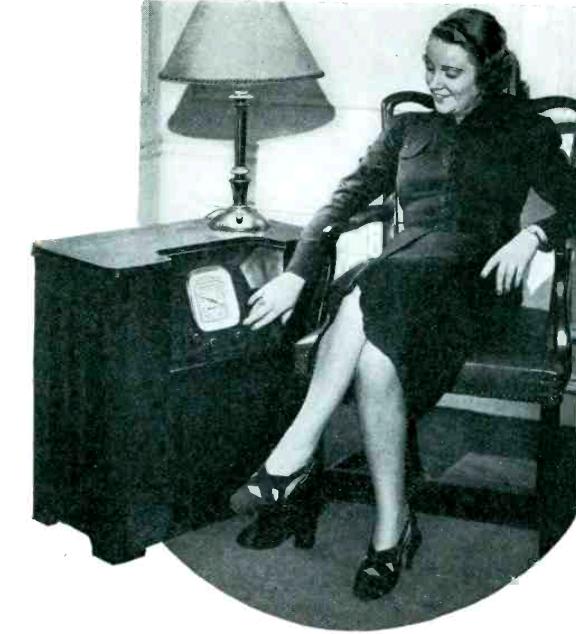
The other star of the photo is, of course, the radio.  It can be examined in better detail in the available high resolution scan.  There aren’t enough details to positively identify it.  I thought that the unusual octagonal tuning dial would make the job easy, but I was wrong.

Stromberg-Carlson did have a number of sets with the distinctive octagonal tuning dial, but this doesn’t appear to be a Stromberg-Carlson.  First of all, the set is just too low-end for that company’s line.  It has only two controls, and the tuning knob is connected directly to the tuning condenser, with no kind of gearing visible.  More importantly, the Stromberg-Carlson name is not visible.  It would almost certainly have appeared on the dial itself, but the only markings on this one are “kilocycles” and “meters.”

There is a brand name visible under the speaker, but it’s not possible to make it out.  It appears to start with either an M or a W, but it certainly isn’t the same script used by Stromberg-Carlson.  Despite the passing resemblance to some of Stromberg-Carlson’s sets, I have to rule it out.  If anything, it’s a cheap knockoff of a Stromberg-Carlson.

It’s most likely that the radio had its beginnings in the nebulous radio history of Chicago.  There’s a good chance that it was manufactured in a mysterious facility known only as “Plant A,”  1217 W. Washington Blvd. Chicago was the home of many small radio factories, the largest of which was “Plant A.” They were known only by the source given on the label in back, which also recited that they were manufactured under license of the patent holders. And good number of them identified the source as being “Plant A.” Plant A turned out radios under the names of Clinton, Corona, Crusader, Cub, Bostonian, Buckingham, Federal, Harmony, Marshall, Nightengale, Universal, and Westminster. In most cases, these were the house brands of individual stores who contracted with the owners of Plant A.

It’s really not known who the owners of Plant A and the other Chicago plants were. One source lists the owner as being Clinton Mfg. Co., but it’s not entirely clear whether Clinton owned the plant, or whether it was simply one of the brands manufactured there.

In any event, the circumstantial evidence seems strong that the radio came from one of these Chicago plants.  Civilian radio production ended on April 22, 1942, and the set resembles the inexpensive four-tube radios that were available in about 1940.  For example, the circuit is probably very close to the Tiny Knight from Chicago’s Allied Radio, or the 1940 Aetna Midget from Chicago-based Walgreen’s.  Like those sets, the Government Girl probably paid about $7.95 for it at a drug store, tire store, or some other store that contracted with a factory in Chicago to put their name on it.

The closest match I was able to find to the Government Girl’s radio is this Clinton Model 440 4-tube TRF receiver.  The general layout is the same, and it’s quite possible that there’s an identical chassis inside.  In fact, the Clinton seems to have a permanently attached antenna wire, which is visible in the Government Girl’s window.

Now that we have a good suspicion of what the radio was, I’m sure you’re wondering what station the Government Girl was listening to.  The dial pointer is visible in the high resolution photo, but it’s impossible to read the numbers.  But the top scale is clearly frequency in kilocycles, and the bottom scale is wavelength in meters.  The numbers are closer together at the left on the meter scale, indicating that this is the top of the dial (190 meters, or 1600 kilocycles).  With that hint, it’s clear that the dial is set to 250 meters, meaning that the position of the top scale is 1200 kilocycles.

The Winter 1943 issue of White’s Radio Log shows that the most likely station as  WOL, on 1260 with 1000 watts.  The closest possible other contenders would have been 50,000 watt stations WBAL in Baltimore, on 1090, or WRVA on 1140 in Richmond, but it doesn’t appear that the dial is set low enough for either of those stations.  In fact, with the simple 4-tube receiver and dubious window antenna, the signal from the Richmond station would probably have been too weak to keep the set’s owner company.

Incidentally, even though the caption says that the radio was keeping her company, it was turned off when the picture was taken.  Even a humble radio such as this one would have had a dial light.  The dial light wasn’t there as a convenience for the user; that was just a convenient side-effect.  In a radio such as this with the tube filaments wired in series, the dial lamp is in parallel with some of the tubes to limit the current to them.  Without the dial light, those tubes would fail prematurely, especially when the set is first turned on.  So even the radio that a Government Girl bought at the drug store for $7.95 would have had one.

I would like to thank the QRZ.com members who helped me figure out the mysteries of this radio, in particular KP4SX and KC8VWM.  And if anyone has further details, please share them, either by e-mail or in the comments.

Read More at Amazon


Click Here For Today’s Ripley’s Believe It Or Not Cartoon


September 16, 1940: First Peacetime Draft


Seventy-five years ago, Pearl Harbor was still more than a year away.  But it was clear that it was only a matter of time before the United States was at war.  And the clearest sign came 75 years ago today, when President Roosevelt signed the Selective Training and Service Act of 1940, which put into place the first peacetime draft in U.S. history. Initially, all men between 21 and 35 were required to register. If drafted, a man would serve for twelve months, with the service to be limited to the Western Hemisphere or U.S. possessions. Under the act, up to 900,000 men would be undergoing training at any given time.

The term of service was extended beyond twelve months in August 1941, and a handful of desertions occurred when the initial one-year obligation had expired. The age limits for registration were also subsequently extended, and by the end of the war, all men between the ages of 18 and 65 were required to register.


Click Here For Today’s Ripley’s Believe It Or Not Cartoon