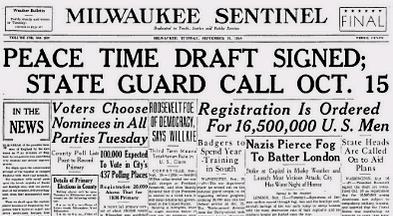
Category Archives: World War 2

September 15 1945 Florida Hurricane

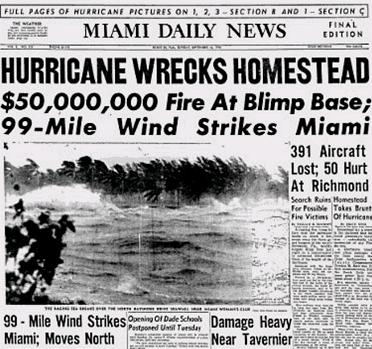
Miami Daily News, Sept. 16, 1945.

Miami Daily News, Sept. 16, 1945.

Seventy years ago today, September 15, 1945, a hurricane made landfall in Key Largo and then swept across Miami and Homestead, Florida. It was a Category 4 storm, and winds of 145 mph were clocked at Homestead Army Air Corps Base. Most of the city of Homestead was destroyed, and at Richmond Naval Air Station, a fire ignited during the storm burned down three hangars. 1632 homes were destroyed in Florida, and there were four deaths.

Amateur radio had not yet returned to the air after V-J Day, but hams were still available to help, since they formed the core of the War Emergency Radio Service, which had been formed during the War to allow hams to provide emergency communications for both civil defense and during natural disasters.

The November 1945 issue of QST reported “September Hurricane Finds Miami WERS Ready.” The Dade County civil defense operated under the call sign of WKNW, which used hams to link ten district headquarters stations to the main control station on the roof of the fifteen-story Technical Vocational Building. A Red Cross mobile disaster unit was also equipped with radio, as were a number of privately owned mobile units. Operations began as soon as the wind subsided enough for operators to get to their designated stations.

At the peak of the storm, all lines to the civil defense headquarters were down, and the WERS station, manned by hams and powered by an emergency generator, was the only link. When the phone line to Jackson Memorial Hospital went out, one of the mobiles was dispatched to that location, and contact was re-established in fifteen minutes.

When it was clear that Homestead had suffered damage, a convoy of vehicles set out from civil defense headquartrs. The antenna at headquarters had been repeatedly destroyed, and a temporary antenna was set up inside, with only limited range. Since it couldn’t reach Homestead, one of the mobile hams in the convoy backtracked until reliable communications was established. However, with the 2-1/2 meter equipment in use, it was not possible for that station to reach all the way to Homestead. It wasn’t until the third day that a reliable link was established between Miami and Homestead, after which a considerable amount of traffic flowed.

Singled out for praise were W4NB, W4AFF, W1KVB, W4CFC, w1JMT, and W4ANP, along with two other hams who were licensed after Pearl Harbor and hence had no amateur call sign.  Of those calls, the only one where I could find any later reference was Francis W. Jenard, W1JMT, who died in 1999, according to a QST Silent Key listing.  He was a member of the ARRL A-1 Operators Club, and you can see his 1963 QSL card at this link.


Click Here For Today’s Ripley’s Believe It Or Not Cartoon


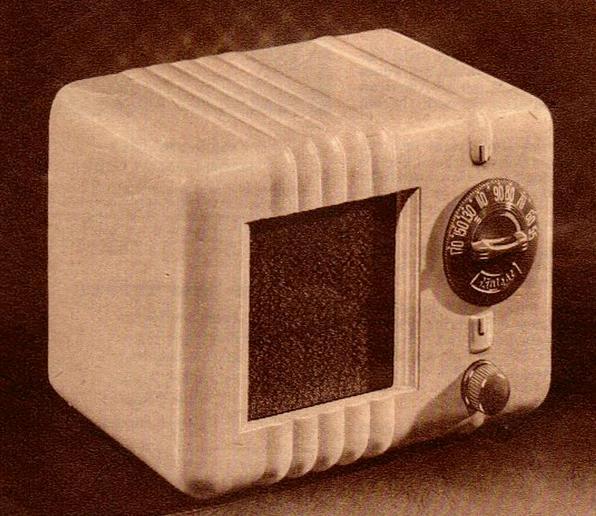
Allied “Tiny Knight” Model B10509 & B10510, 1941


1941Allied4TubeIn an earlier post, we showed an inexpensive 1940 four-tube broadcast radio for $7.95 available at Walgreen’s. A modest radio such as this one would probably stay in service until the end of the War, because on April 22, 1942, the War Production board ended the production of civilian radio receivers. So if you had a radio, that’s the one you would have for the duration.

Shown here is probably one of the least expensive prewar receivers of all. This model, the “Tiny Knight” from Allied Radio is shown here in the 1941 Allied catalog, and had a catalog price starting at $5.30. It measured 6-1/2 by 4-1/4 by 4-1/2 inches and weighed four pounds, and was billed as being something that you could hold in the “palm of your hand.” It was marketed as a second radio, or for travel: “It’s so small you can pack it into any size suit-case or overnight bag and take it along when you travel.” But it was also billed as being “so low-priced that anyone can afford it.” At the tail end of the depression, it’s likely that more than a few households had a set similar to this one as their only radio. And with the ban on the manufacture of new radios, quite a few of these sets were what many families depended upon for war news.

The set’s four tubes consisted of a 12K7GT RF amplifier, 12J7GT detector, and 50L6GT audio amplifier, with a 35Z5GT serving as the rectifier. It tuned as high as 1720 kHz, making it capable of picking up police calls in many areas.

This set was a TRF (tuned radio frequency) receiver. On the same page, Allied showed its least expensive superhet, a five-tube model starting at $8.30.

The four-tube set was Allied model B10509 or B10510, depending on the cabinet.

Click Here For Today’s Ripley’s Believe It Or Not Cartoon



Cave Paintings of Lascaux, 1940

Lascaux_painting

220px-Lascaux_01Seventy-five years ago today,  September 12, 1940, eighteen-year-old apprentice mechanic Marcel Ravidat was exploring the caves near his home in Lascaux, France. The war was over in the “Free Zone” of Vichy France, and young Marcel went exploring a hole he had discovered a few days earlier, opened the prior winter as an oak tree had been uprooted by a storm.

What Marcel saw hadn’t been seen in over 15,000 years. He had 220px-Lascaus,_Megalocerosstumbled upon the entrance of a cave containing some of the most spectacular cave paintings ever found. He and his friends kept the cave a secret until finally revealing its location to a teacher known to be a scholar of the other less spectacular paintings in the area. During the war, the cave was used by resistance fighters to store weapons. In 1948, the cave was opened to the public. But the breath of the constant stream of visitors, along with exposure to the atmosphere, began to take a toll. The cave was finally closed to the public in 1963.

220px-Lascaux_IIAll images here are from Wikipedia.

References


Read More at Amazon


KGEI, GE’s Shortwave Station

KGEI

Photo courtesy of John Schneider and Bay Area Radio Museum. Used with permission.

Seventy five years ago, this date’s issue of Radio Guide magazine concluded a two-part feature on GE’s short wave station KGEI.  Part 1 appeared in the August 31, 1940 issue, and part two appeared on September 7.

The station was owned and operated by General Electric and went on the air in San Francisco in March 1939. Short wave broadcasting was not new to GE. It first put a short wave signal on the air with station W2XAF in Schenectady, New York. That station later became WGEO. The next year, another transmitter was installed at the same site with call letters W2XAD, later WGEA. By 1940, WGEO was transmitting with 100,000 watts and was the world’s most powerful station. The two stations were popular with listeners in Europe and Latin America.

Golden Gate International Exposition, 1929-40. Wikipedia image.

Golden Gate International Exposition, 1939-40. Wikipedia image.

By 1940, KGEI was running 20,000 watts, but there were plans to increase it to 50,000. The Schenectady stations operated on 9.53, 15.33, and 21.5 MHz. KGEI broadcast on 9.67 and 15.33 MHz, and provided an additional signal to Latin America as well as Asia and Oceania. The station, both studio and transmitter, was part of GE’s exhibit at the Golden Gate International Exposition, and was located on Treasure Island, between San Francisco and Oakland. The Island was also to serve as a terminus for Pan American‘s Clipper ships, and the station was used to promote Pan American as well as GE. According to the article, “one of the most interesting and colorful programs is ‘Clipper Departure.’ This program is a dockside complementary describing the actual departure of the China Clipper for Hawaii, Guam and points westward. The captain and various members of the crew of the Clipper are interviewed, each contributing some bit about the interesting aerial journeys to and fro across the Pacific. Passengers ready to embark give their reactions as they prepare to set forth on their fascinating trip. The program concludes with the roar of the Clipper’s motors as it moves down the ramp and into the bay off to Hawaii on the first leg of its voyage to Manila and Hong Kong.”

THe station had a studio on the Exposition grounds, and it also carried network programming, such as Burns and Allen, Bing Crosby, and the Don Ameche Show.

Photo courtesy of xxxxx. Used with permission.

Photo courtesy of John Schneider and Bay Area Radio Museum. Used with permission.

The picture at the top of the page was taken in late 1939, and bears the KGEI call letters.  The picture of the transmitter and enclosed studio at the left was taken earlier in the year and shows the W6XBE call sign.  The public was allowed to be in the same room as the 50 kW transmitter, separated only by a flimsy guardrail.

After the Exposition, the station continued operation.  During the War, it remained under GE’s control, but at the request of the Government, did carry programming that was recommended.

The station was widely listened to, especially in the Phillipines. Many resistance fighters listened to the station,, which included broadcast in Tagalog. In 1954-55, the station carried broadcasts from Stanford University, billed as “The International University of the Air.” During that period, the University received 12,000 letters from listeners in Latin America.

In 1960, the station was acquired by the Far East Broadcasting Company, a religious broadcaster. Even though FEBC operated other stations in Asia and the Pacific, KGEI was directed mostly to Latin America, billing itself as La Voz de la Amistad (The Voice of Friendship). During the 1962 Cuban Missile Crisis, the station once again put under Government control. In fact, a Cuban listener wrote to the station in 1962, and his letter included the exact positions and descriptions of Russian missile sites. This hadn’t been publicized in the world press yet, but KGEI decided to reproduce this interesting letter in one of its fundraising letters. Unbenknownst to KGEI, that mailing list included the CIA, which hastily arranged a meeting and asked that such letters be made available to them prior to making them public.

A few months later, presidential Press Secretary Pierre Salinger called and informed the station that the President was requesting use of the station to rebroadcast the VOA. The station was reluctant, since it valued its voice as being independent of the U.S. Government. But FEBC was eventually convinced of the need to “volunteer” the station, and it carried VOA programming during the crisis.

KGEI remained on the air until 1994. The original 50 kW GE transmitter was donated to another Christian organization organization for use in Liberia. However, it was destroyed by rebels prior to going on the air. The station’s then main transmitter, capable of 250 kW, was donated to another organization for use in broadcasting to Russia from Alaska.

Acknowledgment

I would like to thank John Schneider and the Bay Area Radio Museum for allowing me to use the photos shown on this page, and for providing much of the information for this post.  More information about KGEI can be found on the Museum’s website.

References 

Read More at Amazon

Click Here For Today’s Ripley’s Believe It Or Not Cartoon


MacArthur Arrives in Japan, August 30, 1945

ChiTrib083045

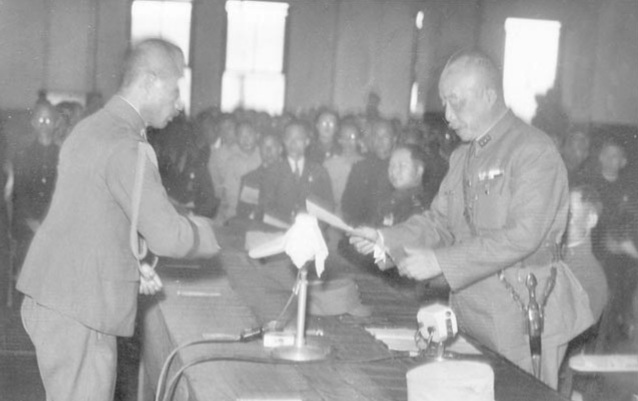
Seventy years ago today, August 30, 1945, the Japanese naval base at Yokohama surrendered to General Douglas MacArthur, who arrived there in anticipation of the formal surrender ceremony a few days later.  The headline here is from that day’s Chicago Tribune.

Click Here For Today’s Ripley’s Believe It Or Not Cartoon


Boy Scout Civilian Defense Volunteers in WW2

Boy+Scout+CD+7-26-15+001

Photo courtesy of W8KBF, Yahoo War Emergency Radio Service group.

During World War II, Boy Scouts in both America and Britain were called upon to serve as volunteers in civil defense. In the July 1942 issue of Boys’ Life, BSA Chief Scout Executive James E. West wrote an editorial encouraging Scouts to volunteer in the Messenger Service of the Citizens Defense Corps. The Office of Civilian Defense recommended that six messengers and two adult leaders be recruited for each 1000 persons in a community. Even though others were eligible to join, both the BSA and the Office of Civilian Defense believed that Scouts, due to their training and qualifications, would be ideal. The editorial stressed that during an emergency, other means of communications could be disrupted, and that written messages might be the only means of communication. West concludes:

This is one of the most important national service projects that has been requested of the Boy Scouts of America. It requires the utmost effort on the part of our organization to fulfill the responsibility which has been assumed. Let us face resolutely whatever the enemy has in store for us, and BE PREPARED to do what we are asked to do to the best of our ability.

Franklin County, Ohio, identification card for Boy Scout CD messenger.  worthingtonmemory.org photo.

Franklin County, Ohio, identification card for Boy Scout CD messenger. worthingtonmemory.org photo.

British Scouts Tour America

Visiting British scouts with James E. West and BSA foreign relations chairman Thomas J. Watson.

Visiting British scouts with James E. West and BSA foreign relations chairman Thomas J. Watson.

A few months later, a group of British Scouts who had served in civilian defense roles during the Battle of Britain made a tour of Canada and the United States, including a meeting with West, and their heroic tales were written up in the magazine’s September 1942 issue.   These Scouts represented four towns that had been heavily hit by bombing. Scout Stanley Newton of London explained:

Our Troop went through six months of heavy bombing in London. I cannot say that we came off unharmed. Our two Troop headquarters were wiped out, one was burned down and the other was blown to pieces. Several of the boys lost their parents and their homes and two of the younger boys were killed in those raids. But we were glad that we could go through them and do something to use our training as Scouts in helping some way or another.

Another of the Scouts, John Bethell of Birkenhead, describes the work the messengers did during the Blitz:

When a bomb drops one of the first people on the spot is either the head warden or one of the senior wardens. He always has a messenger with him; one of us Scouts. What he does as soon as he gets there is to make out a report on what has happened, give it to that messenger and the messenger rides down to the post, which we call the pill box.

Inside the pill box there is a telephone. That is the only telephone we are allowed to use during an air raid. But sometimes the telephone lines get broken when a bomb hits the road. Then instead of just having to ride to the post and telephoning, we messengers have got to ride down to the control center. Sometimes it is a long way and sometimes it isn’t. In my case it is three miles; that’s three miles there and three miles back, maybe ten times in one night. Not only do we send one messenger but three minutes after the first messenger is gone we always send another one so if the first one gets bumped off the second one may get through.

Derrick Belfall (1926-1940):  I Have Delivered My Message

Derric Belfall.  Photo courtesy of Mrs. Rita McInnes.

Derrick Belfall. Photo courtesy of Mrs. Rita McInnes.

Indeed, one of those Scouts, Derrick Belfall, was “bumped off” in the course of his duties as a civilian defense messenger.  Fourteen year old Belfall lived at 109 Bishop Rd, Bishopston, Bristol.   He was the only son of Cecil Ernest and Mary (née Miller) Belfall, who died in 1983 and 1964, respectively.

The official minimum age for messenger service was sixteen, but due to his insistence, Derrick was allowed to join the service.  On the night of December 2, 1940, he was dispatched with a message.  He delivered it successfully, and upon returning to his post, he found a house beginning to burn and he stopped to put out the fire.  He then heard cries from another house where he rushed in to save an injured baby. Shortly after effecting these rescues, the air raid still underway, Derrick was injured by an exploding bomb and taken to the hospital with injuries that proved fatal. As one of the visiting Scouts confirmed, his last words at the hospital were: “Messenger Belfall reporting.  I have delivered my message.”

Defused German parachute mine.  Wikipedia photo.

Defused German parachute mine. Wikipedia photo.

A Narrow Escape

Bethell, one of the British Scouts touring America, also recounted his own tale of being thirty yards away from an exploding parachute mine which killed two other civil defense workers:

A warden and I were riding along the streets on our bikes and saw a couple of parachutes coming down. Well, first we thought they were German airmen bailing out and we were just going to run towards them and give them something like what we would like to give Mr. Hitler–a kick in the pants or something like that–and then we realized that they were what are known as parachute mines…. We started to ride towards them to see if we could help in the rescue work we knew would follow….

We saw a couple of chaps running up in front of us also going on the same job. Just then we heard something flapping. It was only very faint but we realized that it was another parachute with a mine coming down. We knew if we were able to hear that flapping we must be pretty close to it. We got down on the ground and shouted to the other two chaps. But unfortunately they didn’t hear us. The roar of anti-aircraft fire drowned out our shouts. They went on. The mine went off just thirty yards ahead of us. We were just blown across the street but otherwise all right. But those other two chaps standing up under the full blast–it got them right in the chest and blew their lungs out and killed them.

American Scouts In Action

ScoutCD1943

The American Scouts shown here in the February 1943 issue of Boys’ Life are participating in a civil defense exercise.  The display shown at the top of the page is the uniform of a Scout as he would have appeared in 1943 as a civil defense messenger in Mercer County, Pennsylvania.  It was put together by W8KBF of the Yahoo War Emergency Radio Service group.

While American Scouts and other civilians escaped the harrowing experiences of their British counterparts, it is clear that they lived up to the Scout Motto to Be Prepared.   And as the British Scouts proved, a scout is brave.

As Scout Executive West wrote, these Scouts “were not specialists but were equipped only with such knowledge as is normally given to Scouts through our Advancement Program. Yet how nobly these Scouts lived up to our Scout Motto ‘Be Prepared.’ We, too, have a job to do!”

Acknowlegments

DerrickI would like to thank Mrs. Rita McInnes, a neighbor of the Belfall family, for providing the photograph of Derrick Belfall.  This photograph hung for many years in the Belfall home as part of the illuminated photo shown here containing Derrick’s last words. (Click on the small image to view the full image.)

I would also like to thank Sam Hevener, W8KBF of the Yahoo War Emergency Radio Service group for allowing me to use the photo of the American Scout messenger’s uniform at the top of the page.

Additional References

Read More at Amazon


Order to Liquidate Allied Prisoners: 22 Aug. 1945


Louis Zamperini in 1943. Wikipedia photo.

Louis Zamperini in 1943. Wikipedia photo.

Today marks the 70th anniversary of an event that thankfully never happened.

In 1944, the Japanese War Ministry issued orders to prison camp commandants for the “final disposition” of Allied prisoners of war. Under those orders, all POW’s were to be killed at such time as Allied forces landed in the territory in which they were being held. The rationale behind the order was to prevent the POW’s from being repatriated and becoming a part of the liberating force.

For example, on December 14, 1944, about 150 prisoners of war at Palawan in the Philipine Islands, were ordered to the air raid shelters, at first in apparent response to an actual air raid. But after the raid, because of a mistaken belief that an invasion of the island was underway, they were ordered to remain, at which time the wooden structure was doused with gasoline and set afire.

According to the book Unbroken by Laura Hillenbrand, the date set for at least one camp on the home islands was 70 years ago today, August 22, 1945.

That book is the story of Louis Zamperini, a record-breaking track star of the 1930’s. Among his claims to fame was a personal meeting with Hitler at the 1936 Olympics. In 1943, his plane crashed in the Pacific and he drifted in a small raft for 47 days until his “rescue” by the Japanese. He remained a prisoner until the end of the war, enduring much torture. After the war, haunted by nighmares of his experience, he drifted into alcoholism until attending a Billy Graham crusade in California.

Because of the Japanese decision to surrender, motivated at least in part by the bombings of Hiroshima and Nagasaki, the orders to execute Zamperini and other prisoners in Japan were never carried out.

References

Read More At Amazon

Click Here For Today’s Ripley’s Believe It Or Not Cartoon


V-J Day 1945

19450815MilwJour

After the atomic bombings of Hiroshima and Nagasaki on August 6 and 9, 1945, surrender quickly followed. The Japanese communicated their intention to surrender on August 15 Japan time, which was the evening of August 14 in the United States. While the official U.S. date for V-J day was the date of the surrender in Tokyo Harbor, September 2, V-J Day was celebrated in the United States the night of August 14 and August 15. The newspaper shown here is the Milwaukee Journal, August 15, 1940.

US Navy photo, via Wikipedia.

US Navy photo, via Wikipedia.


Scenes such as the one shown here in New York were common around the country.  (The photo shown here is a public domain picture taken by an employee of the U.S. Navy.  It is not the iconic copyrighted photo of the same scene that appeared in Life Magazine.)  The Milwaukee paper, for example, reported that thousands of families spontaneously gathered in downtown Milwaukee, their car horns blaring.

1955 British Two-Valve Receiver

1955AugustPracticalWireless

Sixty years ago, the British magazine Pracitcal Wireless, August 1955, carried the plans for this “sensitive two-valver” receiver suitable for local broadcast reception. It featured a regenerative detector and one stage of audio amplification sufficient to drive a speaker. It ran off the 230 volt AC mains, but employed a transformer to isolate the chassis. The article noted, however, that it could be used without the isolation transformer, but warned that if constructed without one, “the operator must stand on a dry board when touching metal parts of the live chassis.” The set was designed to be sensitive enough to be used with a short one-foot antenna. The article noted that neither of the alternatives, either “a few feet of wire hanging from the back” or a frame aerial, add to the decorative effects of a room.

EF50 tube, Wikipedia photo. https://commons.wikimedia.org/wiki/File:EF50.jpg By RJB1 (Own work) [GFDL (http://www.gnu.org/copyleft/fdl.html) or CC BY-SA 4.0-3.0-2.5-2.0-1.0 (http://creativecommons.org/licenses/by-sa/4.0-3.0-2.5-2.0-1.0)], via Wikimedia Commons

EF50 tube, Wikipedia photo. By RJB1 (Own work) [GFDL  or CC BY-SA 4.0-3.0-2.5-2.0-1.0.

The two tubes employed by the set were the EF50, which were probably available in large supply from surplus equipment. The tube, which has been called “the Tube that helped to Win the War,” was a major concern during the early days of the war. It was very versatile with uses in VHF and radar equipment. And it was manufactured by Philips in Holland, which was about to be overrun by the Nazis. Just before the invasion, the British managed to import a truckload of 25,000 of the tubes, along with more of the bases. Philips hurriedly dismantled its Dutch assembly line for transport to England. Members of the Philips family, along with members of the Government, escaped the day before Rotterdam was flattened aboard a British destroyer. They carried with them a wooden box containing the diamond dies that were required to make the tungsten wires inside the tubes.

Click Here For Today’s Ripley’s Believe It Or Not Cartoon


Bombing of Nagasaki, August 9, 1945

19450809Seventy years ago today, August 9, 1940, a second atomic bomb was dropped on the Japanese city of Nagasaki, as shown here in that day’s issue of the Chicago Tribune.  If the Japanese needed further convincing to surrender, that day also brought news that the Soviets had declared war on Japan and were attacking Japanese forces in Manchuria.

The video below is a broadcast that day by President Truman promising that the bombings would continue until the Japanese surrendered.  The war would be over in a few days.

Click Here For Today’s Ripley’s Believe It Or Not Cartoon