Category Archives: World War 2

Bombing of Hiroshima, 1945

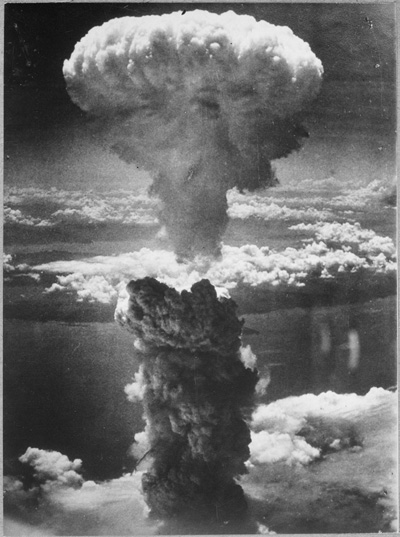
Seventy years ago today, August 6, 1945. the United States dropped the atomic bomb on Hiroshima, Japan, killing at least 129,000.  The gun-type weapon (one sub-critical mass fired into another subcritical mass) exploded 2000 feet above the city, unleashing the power equivalent to 12 to 15 thousand tons of TNT.

The Potsdam declaration, demanding unconditional surrender, had been broadcast directly to Japanese civilians over KSAI radio, and millions of leaflets had been dropped.

Preparations were underway for an invasion of the home islands, and U.S. planners estimated U.S. casualties between 130,000 and 220,000, with between 5 and 10 million Japanese deaths. Nevertheless, the Japanese leadership did not heed the Potsdam Declaration, and made preparations to continue defending against an apocalyptic invasion.

On August 14, only after the bombings of Hiroshima and Nagasaki, Hirohito addressed the nation by radio:

Moreover, the enemy now possesses a new and terrible weapon with the power to destroy many innocent lives and do incalculable damage. Should we continue to fight, not only would it result in an ultimate collapse and obliteration of the Japanese nation, but also it would lead to the total extinction of human civilization.

Such being the case, how are We to save the millions of Our subjects, or to atone Ourselves before the hallowed spirits of Our Imperial Ancestors? This is the reason why We have ordered the acceptance of the provisions of the Joint Declaration of the Powers.


References


Click Here For Today’s Ripley’s Believe It Or Not Cartoon


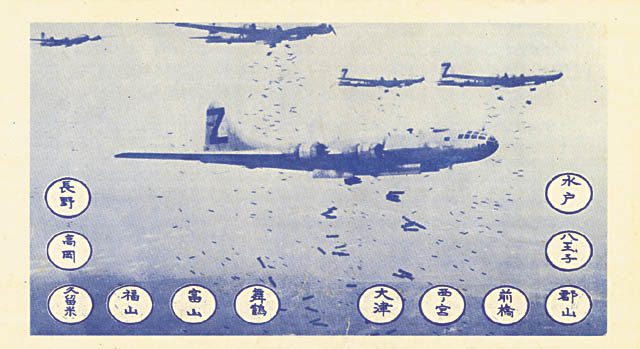
Leafleting of Japanese Cities, 1 August 1945

1 August 1945 leaflet.  From CIA website.

1 August 1945 leaflet. From CIA website.

70 years ago today, August 1, 1945, five days before the bombing of Hiroshima, the United States dropped millions of copies of this leaflet on 35 Japanese cities, including Hiroshima and Nagasaki.

The Japanese text on the reverse read as follows:

Read this carefully as it may save your life or the life of a relative or friend. In the next few days, some or all of the cities named on the reverse side will be destroyed by American bombs. These cities contain military installations and workshops or factories which produce military goods. We are determined to destroy all of the tools of the military clique which they are using to prolong this useless war. But, unfortunately, bombs have no eyes. So, in accordance with America’s humanitarian policies, the American Air Force, which does not wish to injure innocent people, now gives you warning to evacuate the cities named and save your lives. America is not fighting the Japanese people but is fighting the military clique which has enslaved the Japanese people. The peace which America will bring will free the people from the oppression of the military clique and mean the emergence of a new and better Japan. You can restore peace by demanding new and good leaders who will end the war. We cannot promise that only these cities will be among those attacked but some or all of them will be, so heed this warning and evacuate these cities immediately.

This warning had been preceded, starting on July 26, of transmission by by 50,000 watt KSAI Radio in Saipan the contents of the Potsdam declaration, warning the Japanese people of the “prompt and utter destruction” of Japan if the Japanese government failed to surrender.   KSAI’s medium wave signal (1010 on the standard broadcast dial) was as strong as any Japanese domestic station, and could be heard by millions of Japanese.

After the bombing of Hiroshima, an updated leaflet was prepared, stressing the special nature of the Hiroshima bomb, and warning of the same fate to other cities.  Similar warnings were transmitted by KSAI and repeated every fifteen minutes.

For more information on leafleting and other allied propaganda operations, see my earlier post.

References


Click Here For Today’s Ripley’s Believe It Or Not Cartoon
USS Indianapolis

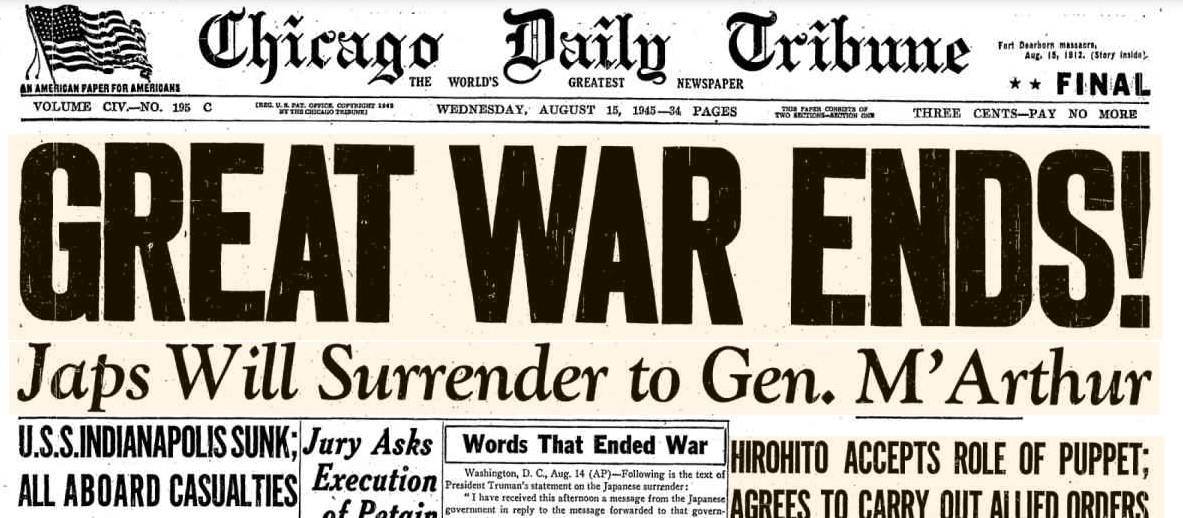
Front page story announcing ship's loss, Chicago Tribune, Aug 15 1945.

Front page story announcing ship’s loss, Chicago Tribune, Aug 15 1945.

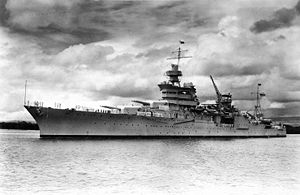
Today marks the 70th anniversary of the greatest loss of life in American Naval history, the sinking of the U.S.S. Indianapolis on July 30, 1945. On July 16, the Indianapolis left San Francisco with the enriched uranium which would be used in the Hiroshima atomic bomb. She reached Pearl Harbor on July 19 and raced on to Tinian with the cargo, where she arrived on July 26. After delivering this top secret cargo, the ship continued to Guam and then Leyte, where the crew was to receive training.

USS Indianapolis in 1937. Wikipedia photo.

USS Indianapolis in 1937. Wikipedia photo.

Shortly after midnight on July 30, she was struck by two Japanese torpedoes, sinking in minutes. About 300 of the 1196 crewmen went down with the ship. The remainder were set adrift with few lifeboats and many without lifejackets.

Due to radio silence and general miscommunication, the ship was not missed when its scheduled arrival time passed. The 880 men drifted forgotten. Most perished from exposure and dehydration, although the attack is most famous for the sharks the men had to contend with. Undoubtedly, some of the men were killed by sharks, but it is more likely that most of the victims succomed to exposure and dehydation, with the dead being driven off by sharks.

The men were discovered by accident three and a half days later when Lt. Wilbur “Chuck” Gwinn and Lt. Warren Colwell spotted the men adrift during a routine patrol fight.

Only 317 men ultimately survived. Over 800 men lost their lives.

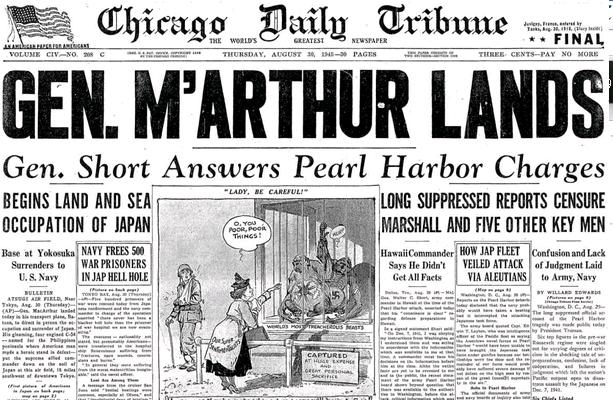
Ironically, the disaster was not reported by the newspapers until August 15.  The greatest naval disaster in American history was decidedly a less important news story that day, since the papers also reported Japan’s surrender and the end of the war.

Of interest to radio amateurs is the recreation of the ship’s radio installation (whose call letters were NABD) at the USS Indianapolis Memorial.

References

History at USSIndianapolis.org


Click Here For Today’s Ripley’s Believe It Or Not Cartoon


U.S. Coast Guard SPARS Radio Operator, 1943

1943USCGradioThe cover of this wartime issue of Radio Craft magazine, May 1943, shows a radioman, as her designation is called, of the U.S. Coast Guard.  The accompanying article explained that she was a membe of SPARS,  the U.S. Coast Guard Women’s Reserve, which had just been created in November of 1942, and largely followed the Navy’s WAVES model of allowing women to serve in stateside positions. More than 11,000 women served in SPARS during the war.

The article explained that the women who would serve as radiomen underwent a sixteen-week training at the University of Wisconsin, which included Morse code, typing, and radio procedure and theory. At the conclusion of the training, the women would pass a code test at 22 words per minute, at which time they received a rating of Radioman 3rd Class.


Click Here For Today’s Ripley’s Believe It Or Not Cartoon


1940 Crosley Radio Glamour

1940CrosleyGlamor

When I think of glamour, one of the first things to cross my mind would be a wooden five-tube broadcast/shorwave receiver, and in this 1940 advertisement, the Crosley Radio Corporation agrees with me. It is taken from the July 15, 1940, issue of Life Magazine.

According to the ad, certain cities such as Paris and Hollywood have Glamour. (Apparently even Nazi occupation can’t erase the glamour of the City of Lights.) Glamour can be found in certain ships and trains. And it can be found in certain people: Athletes, actors, statesmen, and musicians.

And there was glamour in the Glamour Tone of the Crosley Radio, “a new type of fidelity in sound.”

The glamorous object shown here is the Crosley model 18AN, a five-tube two-band AC-DC superheterodyne which retailed for $19.95 (slightly higher in the West and South). It featured a personal tone control and tuned both the standard broadcast band and shortwave for pulling in war news direct from Paris and other capitals of Europe.

Another nice example of this radio can be found at the Radio Attic Archives.

Click Here For Today’s Ripley’s Believe It Or Not Cartoon


Les Paul’s Radio Station, 1940

LesPaul1940


75 years ago, 25-year-old Les Paul had his own radio station in the basement of his New York apartment building, as shown here in the July 1940 issue of Popular Science.  Paul had moved to New York in 1938, performing with Chet Atkins‘ older brother on Fred Waring and the Pennsylvanians radio program.

The building was equipped with an antenna and ground wire that had never been used, and Paul took advantage of it by installing his station’s studio in a soundproof room near the furnace.  A control room was located in his second-floor apartment.  On Friday and Sunday evenings, they transmitted to the other tenants in the building.  Occasionally, big-name guest musicians and announcers would drop by to take their turn at the mike.

The next year, Paul nearly electrocuted himself while experimenting in his apartment.  He relocated to California where he recuperated.  In 1943, he was drafted and served as a performer on the Armed Forces Radio Network.


Click Here For Today’s Ripley’s Believe It Or Not Cartoon


1945 Lifeboat Radio

LifeboatRadio

Seventy years ago, the cover of Radio Craft magazine, July 1945, featured this new radio designed for use in lifeboats. The lifeboats of passenger ships were required to be equipped with radio, and when the U.S. entered the war, this requirement was extended to cargo ships as well. The early sets were battery operated on 500 kHz and had limited range and transmitting time. The Germans were the first to develop a lifeboat radio similar to this one, the Notsender NS2. It was powered with a hand crank, and designed to be held between the operator’s legs. In addition to powering the unit, the crank keyed the transmitter, sending SOS, alternating with long dashes to facilitate direction finding. It also had provision to be keyed manually. It operated on the distress frequency of 500 kHz, and utilized a wire antenna held aloft either by a hydrogen balloon or kite.

American BC-778 "Gibson Girl."  Photo by ArnoldReinhold via Wikipedia, file licensed under the Creative Commons Attribution-Share Alike 3.0 Unported license. https://creativecommons.org/licenses/by-sa/3.0/deed.en

American BC-778 “Gibson Girl.” Photo by ArnoldReinhold via Wikipedia, file licensed under the Creative Commons Attribution-Share Alike 3.0 Unported license.

The British soon captured a few examples, and duplicated them as transmitter type T1333. In 1941, the British, recognizing that they didn’t have the industrial capacity to manufacture the sets in quantity, sought a North American builder. The U.S., recognizing the value of the unit, proceeded with the project jointly, resulting in the BC-778, later upgraded to the AN/CRT-3, which became known as the “Gibson Girl” transmitter. The earlier version, the BC-778, operated on 500 kHz exclusively. Later models also operated on 8280 or 8364 kHz. The American version could also use the generator to power a signal light.

All of the wartime units included a hydrogen generator to fill the balloon, as well as a box kite which could be used to hoist the antenna.

The accompanying article was written by an executive of the manufacturer, Radiomarine Corporation of America, and touted the advantages of the new set. It operated on both 500 kHz and on 8280 kHz, and the primary means of hoisting the antenna was with a balloon, but one filled with a helium cannister. But it had two notable differences. First of all, it was capable of transmitting radiotelephone signals as well as radiotelegraph. But it also included a receiver capable of tuning 8100 – 8600 kHz. Thus, it would allow the occupants of the lifeboat to communicate with rescuers, and also with neighboring lifeboats.

While it was not used during the war, it appears that sets similar to the one shown in the article did go into production. The model ET-8053 appears to have most of the same features, albeit in a more portable set. The model ET-8030 appears to be very similar to the one shown.

References

Click Here For Today’s Ripley’s Believe It Or Not Cartoon


Trinity A-Bomb Test, 1945

Today marks the 70th anniversary of the Trinity nuclear test, the world’s first nuclear explosion, shown here 16 milliseconds after detonation.  The possibility of a fizzle led the team to construct a containment vessel dubbed “Jumbo,” a steel vessel measuring 25 by 10 feet, with steel walls 14 inches thick, capable of handling pressures of 50,000 PSI.  Brought from Ohio, it was the largest object ever transported by rail.

The blast was seen and felt in an area extending from El Paso, Silver City, Gallup, Socorro, and Albeuquerque.  One news article  quoted a blind woman 150 miles  away who asked, “what’s that brilliant light?”


The army issued a press release that a “remotely located ammunition magazine containing a considerable amount of high explosives and pyrotechnics exploded. There was no loss of life or injury to anyone, and the property damage outside of the explosives magazine was negligible. Weather conditions affecting the content of gas shells exploded by the blast may make it desirable for the Army to evacuate temporarily a few civilians from their homes.”

Other versions of the press release had been prepared noting fatalities.  The author of the press release realized that he might have been writing his obituary.


Click Here For Today’s Ripley’s Believe It Or Not Cartoon


Sackville and Dixon Transmitters, 1945

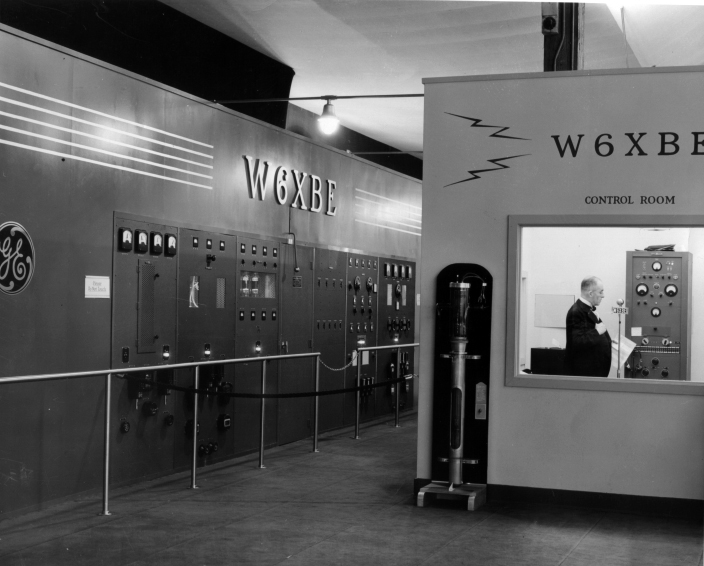
Control room of Dixon shortwave transmitters.

Control room of Dixon shortwave transmitters.

Seventy years ago, two famous RCA transmitter installations were featured in the company’s quarterly journal, Radio Age, July 1945.

The first was Canada’s shortwave transmitter at Sackville, New Brunswick, which opened on February 25, 1945. What was then referred to as “Canada’s Loudest Voice” featured two 50,000 watt RCA transmitters. The 213-acre site had been selected due to the lack of unfavorable magnetic conditions and because the moist earth was conducive to radio transmission.

Main control console at Sackville.

Main control console at Sackville.

While Canada had a number of commercial shortwave broadcasters, the intent of the station was to provide a voice comparable to that of the United States and England, in order to communicate news and entertainment to soldiers, placing the Canadian point of view before Allied nations, and to “join their fighting allies in telling the enemy the real uncolored truth about the war’s progress.”

V-E Day eliminated the need for some types of programs, but the article notes that other features would continue to expand.

Sackville transmitter site.

Sackville transmitter site.

The station, operating with the rarely stated call letters CKCX, continued in operation until 2012. In addition to CBC programs, it served as a relay for a number of other broadcasters, including Radio Japan, China Radio International, Voice of Vietnam, BBC World Service, Deutsche Welle, and Radio Korea. In addition to international programming, it broadcast CBC Northern Service programs in English, French, and Innuit.

The other RCA transmitter featured in the issue was that of the station that later became the Voice of America relay station in Dixon, California. Under contract with the Office of War Information, both CBS and NBC were contracted to construct shortwave transmitters on the West Coast to provide a strong signal to the Far East. The CBS effort resulted in what later became the VOA relay station in Delano, California. And the NBC station with its RCA transmitters featured in the RCA publication, became the VOA station in Dixon, California. That location was on a great circle that included both Asia and Latin America. Therefore, by reversing the direction of the antenna, it could cover two target areas. By beaming North, the station could provide a signal to Asia. And by beaming South, the same booming signal would carry the American message to Latin America.

The Dixon station was operated by NBC until 1963, with call letters KNBA, KNBC, KNBI, and KNBX In 1963, the federal government assumed control until the station was shut down in 1979. The installation was mothballed, and resumed operation in 1983, at which time its primary function was to transmit Spanish programming to Central America until 1988. The site was sold by the federal government in 1993, and has been used by Globe Wireless since then as KFS, providing wireless HF e-mail service to maritime interests.

Click Here For Today’s Ripley’s Believe It Or Not Cartoon


Capt. Colin P. Kelly, Jr.

Capt. Colin P. Kelly, Jr.,  Air Power Gallery at the National Museum of the U.S. Air Force, painted by Deane Keller of Yale University. (U.S. Air Force photo, via Wikipedia).

Capt. Colin P. Kelly, Jr., Air Power Gallery at the National Museum of the U.S. Air Force, painted by Deane Keller of Yale University. (U.S. Air Force photo, via Wikipedia).

Today would have been the 100th birthday of U.S. pilot Colin Kelly, Jr., who was killed in action in the early days of World War 2. On December 10, 1941, his B-17C took off from Clark Field in the Phillipine Islands in a bombing run, in which his flight inflicted damage on the Japanese cruiser Natori. On its return flight, the plane was engaged by Japanese fighters who attacked it, followed it, and attacked again. When the plane began to burn near Clark Field, Kelly ordered the crew to bail out. After the crew was safely out of the plane, it blew up, killing Kelly.

Kelly was posthumously awarded the Distinguished Service Cross. President Roosevelt wrote a letter to “The President of the United States of America in 1956” asking for an appointment for Kelly’s infant son. In 1959, President Eisenhower honored the request and appointed Colin Kelly III to West Point.
Click Here For Today’s Ripley’s Believe It Or Not Cartoon