Category Archives: World War 2

Victory Eclipse of 1945

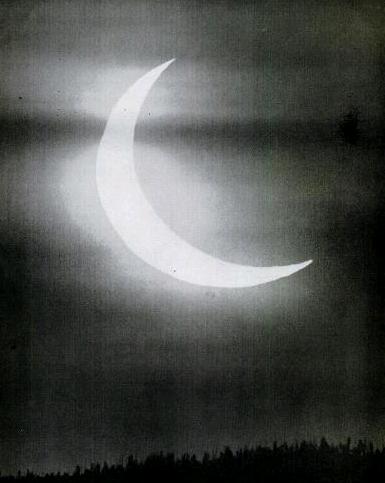
1945EclipseSeventy years ago today, July 9, 1945, a narrow strip of Idaho and Montana experienced a total eclipse of the sun.  From its sunrise beginning in the northwestern United States, the path of totality passed through Canada, Greenland, Scandinavia, and the Soviet Union. The photo here was taken near Butte, Montana, were the sun rose almost fully eclipsed, with totality a few minutes later. The photo was taken by Peter A. Leavens, and appeared in Life Magazine on July 23, 1945.

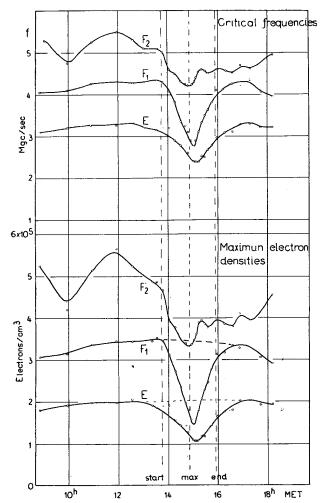
Critical frequency during eclipse.

Critical frequency during eclipse.

Ionospheric scientists at Tromsø, Norway, only two moths after liberation, took the opportunity to measure the effects of the eclipse on the ionosphere. Their results show a pronounced dip in the critical frequency during the eclipse.

Interestingly, their report also notes that the Germans had an ionospheric station at Kjeller, used to determine radio communication frequencies after the war. When the station was taken over by Allied forces, the German peronnel were ordered to continue their work, and observations were made at that station as well.

Click Here For Today’s Ripley’s Believe It Or Not Cartoon


June 1945: Publishers Appeal for War Bonds

1945JuneRadioCraft

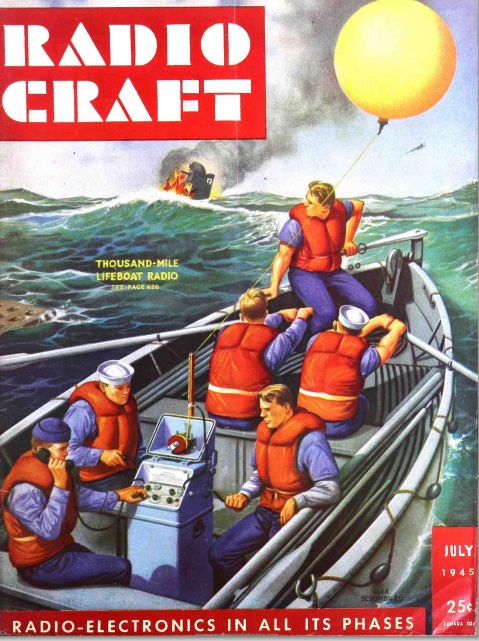
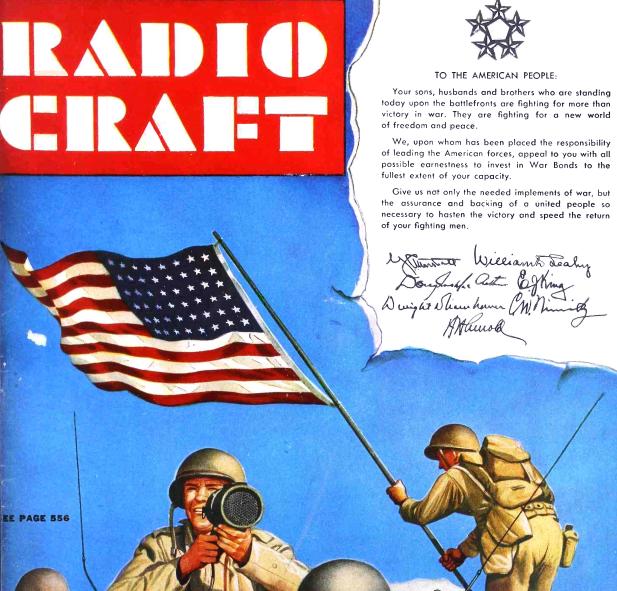
Seventy years ago this month, every newsstand in America was a billboard for war bonds.  Almost every magazine published that month carried the same message, shown here on the cover of Radio Craft, June 1945, urging Americans to continue buying war bonds.

The identical message was carried on the cover of most magazines and was signed by the five-star generals of the army and the admirals of the navy:

TO THE AMERICAN PEOPLE:

Your sons, husbands and brothers who are standing today upon the battlefronts are fighting for more than victory in war. They are fighting for a new world of freedom and peace.

We, upon whom has been placed the responsibility of leading the American forces, appeal to you with all possible earnestness to invest in War Bonds to the fullest extent of your capacity.

Give us not only the needed implements of war, but the assurance and backing of a united people so necessary to hasten the victory and speed the return of your fighting men.

Most magazines also included a message from the publisher urging readers to buy bonds.  QST, for example, had the following commentary:

With victory in Europe the war is half won–but only half, for there are numerous treacherous Japs still to be beaten. The surest way that we can help finish the job is to buy War Bonds–and keep buying them. It is in this cause that the five-star generals of our Army and admirals of the Navy have addressed to the American people the appeal reproduced on the cover this month. Won’t you help put the “Mighty Seventh” War Loan Drive over the top, so our fighting men can raise the American flag in the heart of the enemy’s domain?


Click Here For Today’s Ripley’s Believe It Or Not Cartoon



Fall of Paris, 1940

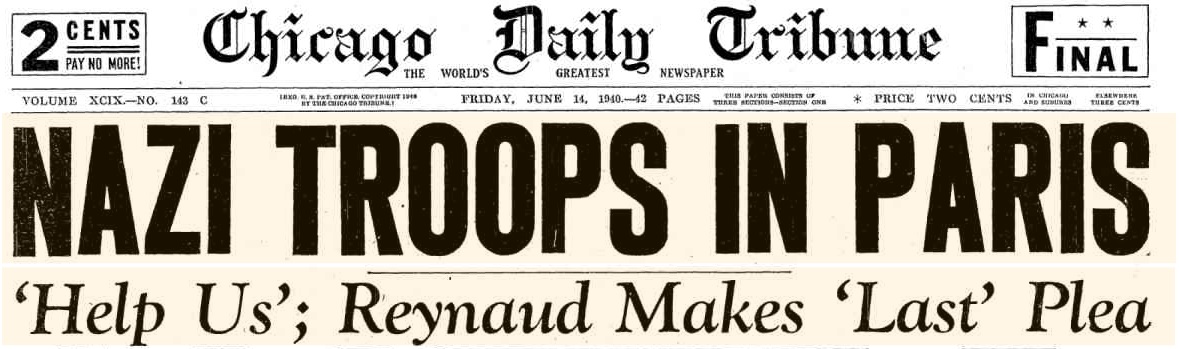
Seventy-five years ago today, the city of Paris fell to the Nazis as German troops marched in during the early morning hours. By morning, tanks rumbled past the Arc de Triomphe. They met no opposition, as French troops had retreated to the south to spare the city. Within a week, newly appointed prime minister Philippe Pétain had signed an armistice, taking France out of the war.

Wikipedia photos, "Battle of France collage" by User:DIREKTOR - Top left: File:Bundesarchiv Bild 101I-055-1599-31, Frankreichfeldzug, Panzer IV.jpgTop right: File:Bundesarchiv Bild 101I-126-0347-09A, Paris, Deutsche Truppen am Arc de Triomphe.jpgMiddle left: File:French soldiers on Maginot Line.jpgBottom left: File:British prisoners at Dunkerque, France.jpgBottom right: File:Renault 35 montant en ligne sedan.jpg. Licensed under CC BY-SA 3.0 via Wikimedia Commons - http://commons.wikimedia.org/wiki/File:Battle_of_France_collage.jpg#/media/File:Battle_of_France_collage.jpg

Wikipedia photos, “Battle of France collage” by User:DIREKTOR – Top left: File:Bundesarchiv Bild 101I-055-1599-31, Frankreichfeldzug, Panzer IV.jpgTop right: File:Bundesarchiv Bild 101I-126-0347-09A, Paris, Deutsche Truppen am Arc de Triomphe.jpgMiddle left: File:French soldiers on Maginot Line.jpgBottom left: File:British prisoners at Dunkerque, France.jpgBottom right: File:Renault 35 montant en ligne sedan.jpg. Licensed under CC BY-SA 3.0 via Wikimedia Commons –

Click Here For Today’s Ripley’s Believe It Or Not Cartoon


Crosley Looks Forward to Postwar Radio

CrosleyLife061145

In June 1945, the war in the Pacific was still raging, American industry was still on a wartime footing, and the War Production Board still prohibited the manufacture of radios and phonographs. But the end was in sight, and radio manufacturers were engaged in intense advertising. These ads often highlighted the company’s contributions to the war effort, and they were also advertising their future products in anticipation of serving the pent up demand as Americans would cash in their war bonds and buy a new set at the final conclusion of hostilities.

The Crosley Corporation was no exception, as it carried this heartwarming story 70 years ago today, in the June 11, 1945, issue of Life Magazine. It tells the story of “Jerry and Barbara.” Jerry is a serviceman, apparently home on leave, and he is shown dancing to the Crosley radio-phono console with his betrothed, Barbara.

Barbara recounts their very first dance at the prom. She wore a red dress and the moment she danced with Jerry, she confesses “that’s when everything began for me.” Jerry quickly interjects, “for us. The minute I danced with you I knew, “This is IT.

The war intervened, and Jerry apparently had to go do his part to deal with the Nazis. Now, he is home on leave before he goes to finish the job in the Pacific. They are dancing again, this time to the Crosley, and Barbara closes her eyes and tells him that it’s a wonderful record.

Jerry quickly adds, “It’s a wonderful phonograph.” He points out that he and his father bought it for his mother right before the war, that it plays records a new way. He adds that the secret of the Crosley’s wonderful tone is in the needle, and that it was “the kind for us when I come home for keeps.”

There is a pause in the story as the ad explains that secret, namely Crosley’s patented “Floating Jewel Tone System.” The story concludes in the not-too-distant future, as we see Jerry and Barbara, with their Crosley radio-phono console, which appears identical in every respect to his mother’s.

To Jerry and Barbara–and to all the Jerrys and Barbaras–Crosley wishes that all their dreams come true. They point out that they are currently producing fighting materials to help win the war, but are looking ahead to being able to once again produce Jerry and Barbara’s console, and other radios, radio-phonos, and other home appliances.

Click Here For Today’s Ripley’s Believe It Or Not Cartoon


1945 Postal Censorship

PostalCensorshipI found this “Stray” in QST 70 years ago (June 1945) interesting. When servicemen wrote home about ham radio, phrases unfamiliar to the censor were frequently deleted. But when the serviceman wrote a marginal note to the censor explaining the meaning, then the term was passed without censorship.

Click Here For Today’s Ripley’s Believe It Or Not Cartoon


Allied Psy Ops, 1945

Preparing to launch psy ops balloons over German lines.

Preparing to launch psy ops balloons over German lines.

Seventy years ago this month, the June 1945 issue of Popular Science
carried an interesting article on psychological warfare in all of its forms. The main method of directly reaching enemy troops was the leaflet, which could be dropped from airplanes, balloons, or even artillery shells.

In an earlier series of posts, we looked at the Japanese balloons designed to travel from Japan to North America, and the ingenious control mechanism to keep them at altitude. Since Allied propaganda balloons had a much shorter distance to travel, they simply employed a fuse that would burn the ropes at the proper time, or maybe drop some ballast for longer flights.

SurrenderPassThe leaflet shown here was typical. According to the article, the Japanese text read as follows:

SOLDIERS OF THE IMPERIAL ARMY!

You have fought well, but the battle is lost. You are cut off with no hope of escape. Soon your food and ammunition will be gone.

You have only two fates–annihilation because unwise commanders sent you into our trap. Or good treatment behind the Allied lines.

Think it over. Ghosts in Yasukuni cannot help Japan. Death without meaning is only for fools.

Some of your friends know this. They have come over to us and they are safe. They are eating rice, smoking cigarettes, sleeping in peace. They know that life is precious. They are not ashamed to live.

Join them now. You will receive plenty of good food and kind treatment. Your identity will not be disclosed.

This is our only offer. If you do not accept it, we will be forced to destroy you.

–THE COMMANDER

The leaflet went on to give directions for safe surrender. Japanese were told to approach Allied positions singly by day and without arms. They were told to raise their hands and wave the pass.

AlliedSoundTruck

For encouraging hold-out snipers to surrender, the army also employed trucks with large sound systems. But since bullets can travel about as far as sound, this was the most dangerous activity for psychological operations personnel.

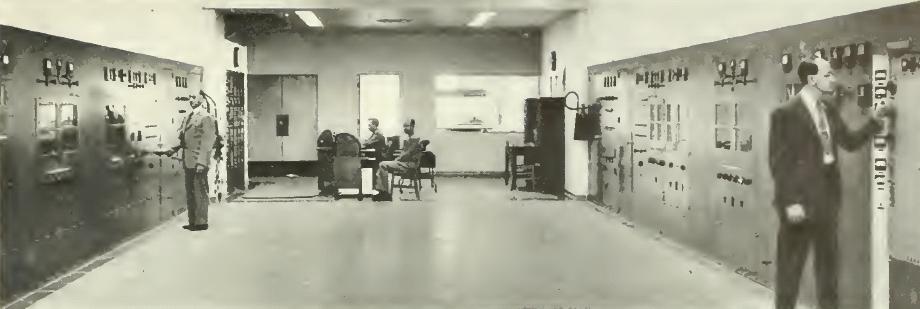
The article also talked about the use of radio for psychological operations purposes. It noted that before the war, the U.S. had 11 shortwave stations, but now had 40, including six putting out 200 kilowatts. On the west coast, KGEI had been the only shortwave station, but now there were ten. There were also shortwave transmitters in Honolulu, Saipan, and the Phillipine Islands. Powerful mediumwave stations were in place in North Africa and England broadcasting to Europe. As soon as countries were liberated, a priority was getting broadcast stations on the air.

Click Here For Today’s Ripley’s Believe It Or Not Cartoon


Berlin Declaration, 1945

Generals Montgomery, Eisenhower, Zhukov, de Lattre at signing of Berlin Declaration. Wikipedia photo.

Generals Montgomery, Eisenhower, Zhukov, de Lattre at signing of Berlin Declaration. Wikipedia photo.

Today marks the 70th anniversary of the Berlin Declaration, with which the Allies formally assumed control of German territory, divided it into four sectors, and dissolved the Third Reich.

Among other things, Article 9 ordered that “all radio and telecommunication installations and other forms of wire or wireless communications, whether ashore or afloat, under German control, will cease transmission except as directed by the Allied Representatives.”

It appears that Berlin radio was already off the air.  While Berlin was still listed in the station list of the June 1945 issue of Radio Craft, it was absent from the July list.

Click Here For Today’s Ripley’s Believe It Or Not Cartoon


The Millionth of an Inch Girls: 1943

MillionthOfAnInchGirls

The New York war workers shown here are the “millionth of an inch” girls of Reeves Sound Laboratories. They are etching quartz crystals to set the exact transmitting frequency of the completed crystal.

Prior to World War 2, quartz crystals were not manufactured in large quantities. But wartime needs called for crystals in massive quantities. One of the manufacturers that went to work to fill the need was Reeves Sound Laboratories of New York City. In October 1942, the company procured the equipment and leased a former furniture warehouse at 52 West 47th Street, near Times Square. In the first month of production, the company turned out sixteen crystals. The company had a contract to ship 1600 crystals by the end of December, and actually shipped 2200. By February, it was shipping 8700 per month.

The whole painstaking process of turning raw quartz from Brazil into precisely cut crystals can be seen in the army film in the video below. The purity of the crystal, the angle of the cut, and the exact thickness of the crystal are all critical in determining the crystal’s operating frequency. The “millionth of an inch girls” shown above were the last step in the manufacturing process. They carefully etched the crystal by hand that last millionth of an inch while checking their work with an oscillator showing whether the crystal was on frequency. It was highly skilled, but also highly monotonous, work.

https://www.youtube.com/watch?v=b–FKHCFjOM

References

Read More at Amazon

Click Here For Today’s Ripley’s Believe It Or Not Cartoon


After my series on the Japanese Fu-Go fire balloons of World War II, a reader forwarded this cartoon, which appeared in the Chicago Tribune on August 8, 1945, about three months after the fatal Oregon attack.  It appears to be warning kids to stay away from unexploded bombs.  And while it doesn’t match exactly, the last panel sure looks to be bombs mounted on a balloon, complete with Japanese lettering on the side of the bombs.Balloon Bomb Warning


Thank you to Ed Maurus for sharing this!

Dunkirk Evacuation, 1940.

Seventy five years ago today began the evacuation of Dunkirk. 40,000 British soldiers were stranded in France.  They were miraculously evacuated with a flotilla of hundreds of ships.  Since the soldiers were stranded on shallow beaches, larger ships were unable to approach the shore.  Admiralty officials scoured the Thames looking for suitable vessels, and the “Little Ships,” 700 smaller boats were hastily requisitioned.

Contrary to popular perception, most of these craft were not crewed by their owners, although a few were.  In most cases, they were crewed by the Royal Navy.  Most were used to shuttle soldiers to larger ships, but in many cases, the rescued soldiers made the crossing in these smaller vessels.

A number of recordings of broadcasts are available at the BBC.

Click Here For Today’s Ripley’s Believe It Or Not Cartoon