Category Archives: World War 2

America Needs You, Harry Truman/Mister, We Could Use a Man Like Herbert Hoover Again

Seventy years ago today, President Harry Truman sent this handwritten letter to former president Herbert Hoover, inviting him to come to the White House to discuss the brewing humanitarian crisis in Europe.  With the war in Europe over, the population would need to be fed.

As Hoover would put it the next year, “we do not want the American flag flying over nationwide Buchenwalds,”

In making this invitation, Truman set aside partisan differences to seek out the man with a proven record in fighting wartime hunger.  Both during and after the First World War, he had headed American relief efforts.  They started in 1914 assisting Americans who had found themselves stranded in Europe at the outbreak of war.  From his own resources, he made loans and cashed checks for Americans.  He went on to save millions of lives, first in Belgium, and then elsewhere in Europe at the war’s end.

It was a welcome change.  In the days following Pearl Harbor, President Roosevelt had summoned adviser Bernard Baruch and asked who was best fit to organize the home front.  Baruch quickly replied that Hoover would be best suited, but the suggestion was rebuffed.  Since Hoover was a convenient scapegoat throughout Roosevelt’s presidency, Roosevelt reportedly replied, “I’m not Jesus Christ. I’m not raising him from the dead.”

After Truman’s summons, Hoover approached the problem the same way he had approached it during and after the First World War, as an engineering problem.  He set out on a tour of Europe to determined the needs and resources of each country, and saw to it that resources were directed appropriately.

There was a lifetime friendship between the two presidents.  Truman spoke at the dedication of the Hoover presidential library in 1962 and told the crowd, “I feel sure that I am one of his closest friends and that’s the reason I am here.”  Later that year, Hoover wrote to Truman:

Yours has been a friendship which has reached deeper into my life than you know.  I gave up a successful profession in 1914 to enter public service. I served through the First World War and after for a total of about 18 years. When the attack on Pearl Harbor came, I at once supported the President and offered to serve in any useful capacity. Because of my various experiences . . . I thought my services might again be useful, however there was no response. My activities in the Second World War were limited to frequent requests from Congressional committees. When you came to the White House, within a month you opened a door to me to the only profession I know, public service, and you undid some disgraceful action that had been taken in prior years.

Truman had the letter framed and placed on his desk at the Truman library.

Harry, is there something we can do to save the land we love?

References

Read More at Amazon

Click Here For Today’s Ripley’s Believe It Or Not Cartoon


D-Day Army Radio Link

RadioCraftMay1945

In an earlier post, we looked at a 3-element VHF yagi shown in a historical photo of the Siege of Bastogne in December 1944. It was part of a U.S. Army Signal Corps FM relay which linked the isolated forces to the Army landline telephone network.

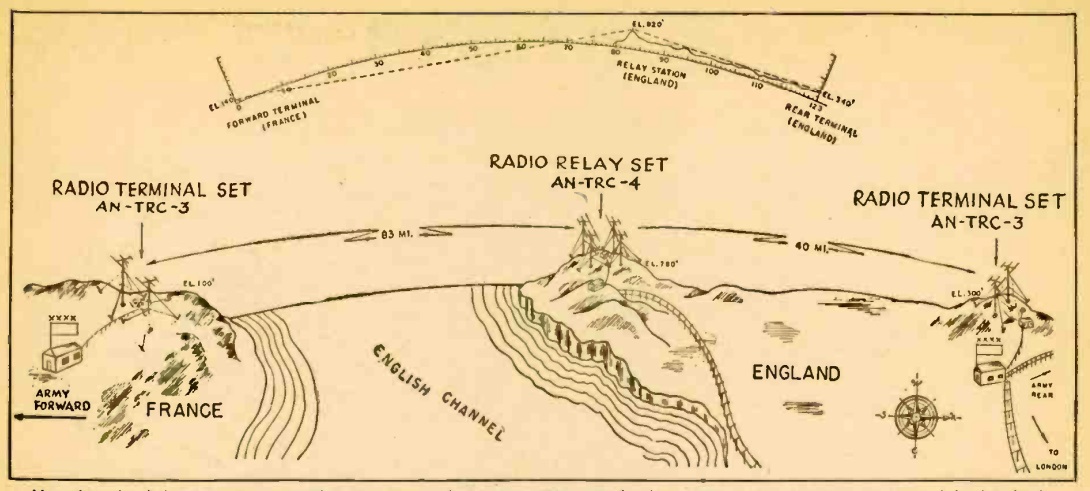
A similar setup was used a few months earlier on D-Day, as shown from this diagram in the May 1945 issue of Radio Craft magazine.  The link shown here was operational the second day after the initial Normandy landing and carried facsimile and voice traffic from London to the front. Within a few months, additional stations were added to the network, and the magazine notes that the network thus established covered an area equivalent to that from New York to Chicago and Detroit to Atlanta.

The army primarily relied upon wire communications, but even on the continent, radio links such as these provided an important backup function. On one occasion, the main cable across France had been cut, but nearly 2709 messages were handled during a 24 hour period.

Click Here For Today’s Ripley’s Believe It Or Not Cartoon


Japanese Fu-Go Fire Balloons of WW2: Part 4

US Army photo, via Wikipedia.

US Army photo, via Wikipedia.

In part 3 of this series, we looked at some of the remarkable distances covered by the Japanese Fu-Go fire balloons of World War II.  Some of these balloons were found far inland in North America, including balloons found in Iowa, South Dakota, Manitoba, and Michigan.  There’s no record of any of these balloons making it to Minnesota (although there’s the possibility that somewhere in Minnesota lies the rusting wreckage of one).  But one of them played an interesting role in Minnesota postwar aviation.

As we covered in part 3, one of the balloons landed near Grand Rapids, Michigan.  It was largely intact, and quickly whisked away by the FBI.  It ultimately found its way to Lakehurst Naval Air Station in New Jersey, where it remained until the end of the war.  In 1946, a young sailor named Don Piccard was stationed there, and was tasked with taking the craft to the dump.  (The balloon was labeled as having come from Flint, Michigan, but it’s believed that it was actually the Grand Rapids balloon.)

Lakehurst is famous for lighter-than-air flying, and Piccard was undoubtedly stationed there for a reason. His family had long been active in ligher-than-air flight.  His father was Swiss-born Jean Felix Piccard, then a professor of aeronautical engineering at the University of Minnesota.  His mother was Jeanette Piccard.  Jean Felix and Jeanette in 1933 had piloted a balloon 57,579 feet into the stratosphere.  This constituted the world record altitude for flight by a woman, a record held for 29 years until Valentina Tereshkova became the first woman in space.    If Wikipedia is to believed, Gene Roddenberry named the character Jean-Luc Picard after Jean Felix Piccard or his brother Auguste, another aviation pioneer.  In fact, Jean-Luc is supposed to be a descendant of one of the men.

(Jeanette also became, in 1974, the first woman ordained as an Episcopal priest.  At the age of 11, in response to the question of what she wanted to be when she grew up, she answered “a priest.”  Her mother reportedly ran out of the room in tears.  But after her long career in aviation, at the age of 79, she was ordained as one of the “Philadelphia Eleven.”)

Rather than taking the balloon to the dump as directed, the younger Piccard obtained a property pass to keep possession of the war trophy.  Upon his discharge, he became a student at the University of Minnesota where his father taught.  And he set out figuring out how to fly the balloon.

The Civil Aviation Agency had, at that time, the category of free balloon pilot, but no such license had been issued.  A license for an airship pilot carried privileges for free balloons, and Piccard had accomplished most of his flight requirements in balloons with airship pilots.  But he had not yet soloed, and he saw the war souvenir as an opportunity to do just that.

While the balloon was apparently in relatively good condition, it did have tears and was in need of repair.  A glue adequate to do the job had to be procured.  In addition, he needed funds to purchase the hydrogen, as well as kiln-dried sand to serve as ballast.  (Sand with moisture would freeze, making for a lethal projectile when dropped.)

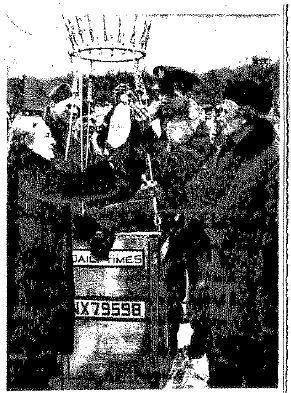
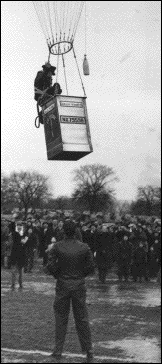
Piccard preparing for the 1947 flight.  Image courtesy of Michigan Aviation Archaelogy.

Piccard preparing for the 1947 flight. Image courtesy of Michigan Aviation Archaelogy.

To get the necessary funding, he sought the sponsorship of the Minneapolis Daily Times, which was granted, and the craft bore the paper’s name, above its N number, NX79598.  Piccard was also a member of the Army Air Corps ROTC, which became the U.S. Air Force days before the flight.   It was also sponsored by the ROTC, and Piccard wore a hastily assembled U.S. Air Force uniform during the flight.  He later recounted that not only was his the first U.S. Air Force flight to take place in Minnesota, but also that his was quite possibly the first U.S. Air Force uniform ever worn.

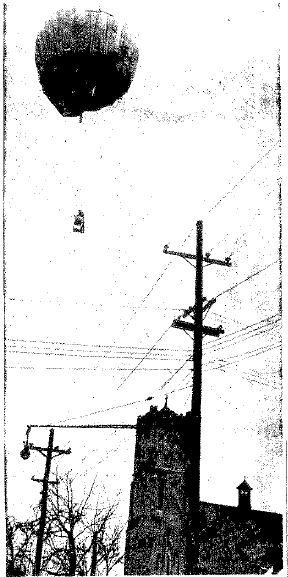
The flight took place on February 16, 1947, from Minneapolis to White Bear Lake.  After launch, apparently from South Minneapolis, Piccard had to maintain his altitude by venting the balloon and dropping ballast.  He had originally intended to climb to the calculated maximum altitude of 12,000 feet and then begin his descent.  But an overcast required him to control the altitude throughout the flight.  The winds carried him to White Bear Lake, during which time Piccard had remained aloft for more than the two hours necessary to qualify for his solo flight, and he the CAA subsequently issued him the first ever free balloon pilot license.  (This was the balloon’s last flight.  Since Piccard didn’t have a bill of sale for the Japanese balloon, he was unable to register the craft.)

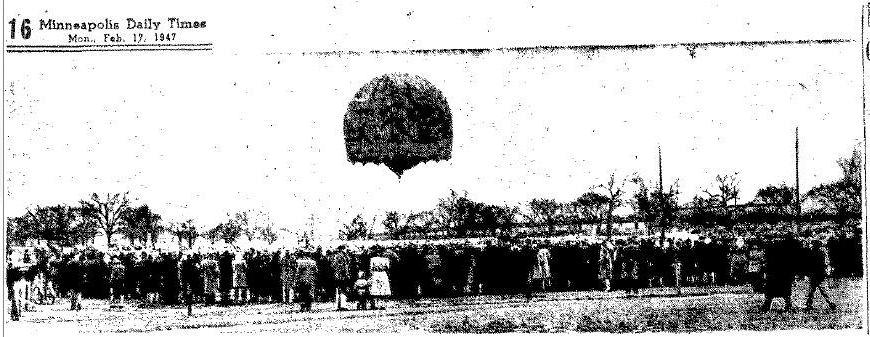
The flight received media attention nationwide, and also caused quite a commotion as it landed in White Bear Lake.  Apparently, nobody had told the White Bear Lake Police Department that the flight was headed their way, and they were unprepared for the resulting commotion as hundreds of curiosity seekers flooded the area, trespassing on private property.  At one point, the officers threatened to arrest the army personnel in the chase vehicle, who they determined must be responsible for the breach of the peace.

Scene of the landing in White Bear Lake.  Image courtesy of Michigan Aviation Archaeology.

Scene of the landing in White Bear Lake. Image courtesy of Michigan Aviation Archaeology.

The last flight of a Fu-Go balloon.  Image courtesy of Michigan Aviation Archaeology.

The last flight of a Fu-Go balloon. Image courtesy of Michigan Aviation Archaeology.

Since the Daily Times was actually an afternoon newspaper, the morning papers all managed to scoop the sponsor of the flight, although they didn’t refer to it in print as being the Daily Times Flight.  Piccard later wrote a detailed account of his flight for Air & Space Smithsonian.

Don Piccard. Licensed under Public Domain via Wikimedia Commons - http://commons.wikimedia.org/wiki/File:Don_Piccard-011.jpg#/media/File:Don_Piccard-011.jpg

Don Piccard. Licensed under Public Domain via Wikimedia Commons.

Piccard is regarded as the driving force behind the sport of ballooning, and is still active with his company, Piccard Balloons.  When I looked at Piccard’s personal web page, www.N6US.com, I mistakenly assumed that he was a ham.  While the URL looks like an Amateur Radio call sign, it should be remembered that aircraft tail numbers (or whatever they’re called on balloons) also use the same international prefixes as radio call signs.  In this case, N6US is not a radio call sign issued by the FCC, but an aircraft registered to Mr. Piccard.

In 2008, Piccard was inducted into the Minnesota Aviation Hall of Fame.  (The other member of the Minnesota Aviation Hall of Fame who has been mentioned in this blog was Sherman Booen, about whom we wrote in connection with the 1940 Armistice Day Blizzard.)

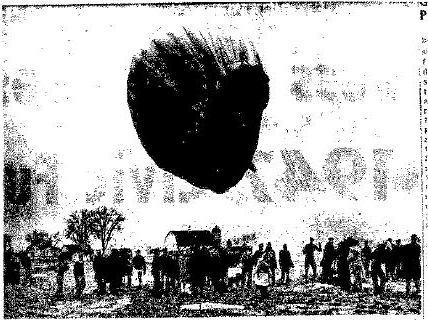
The balloon after launch.  Image courtesy of Michigan Aviation Archaeology.

The balloon after launch. Image courtesy of Michigan Aviation Archaeology.


Acknowledgement

I would like to thank Jeffrey Benya of Michigan Aviation Archaelogy for giving permission to use the images of the newspaper clippings shown here.

References

Read More at Amazon

Click Here For Today’s Ripley’s Believe It Or Not Cartoon


Japanese Fu-Go Fire Balloons of WW2: Part 2

In part 1 of this series, we looked at the ingenious control mechanism employed by the Japanese Fu-Go fire balloons of World War II. The balloons were launched from Japan and traveled to North America where they dropped incendairies. They were also equipped with a demolition charge set to destroy the weapon after it had served its purpose.

One of these balloons was responsible for the war’s only civilian deaths within the 48 United States caused by enemy action. The last balloon was launched in April 1945, but the deaths occurred seventy years ago this month, on May 5, 1945.

Southern Oregon was seemingly far removed from the war. Victory in Europe was only three days away, and the war raging in the Pacific seemed far away. The papers that Saturday morning were full of war news, but the news was all good, such as this photo of American POW’s being liberated in Germany.

Archie Mitchell was the 27-year-old pastor of the Christian and Missionary Alliance Church in Bly, Oregon. His wife, née Elsie Winters, 26, was five months pregnant.

On May 5, 1945, Rev. and Mrs. Mitchell took a group of five children from the church on a picnic and fishing trip at Gearhart Mountain, on land within the Fremont National Forest owned by the Weyerhaeuser Timber Company. The road near Leonard Creek was under construction. Mrs. Mitchell and the children got out of the car while Rev. Mitchell turned the car around and started getting out the picnic lunch.

While hiking around the area, Mrs. Mitchell and the children spotted one of the Japanese balloons. Due to the news blackout, they were oblivious as to its possible origin. One of the road workers nearby saw the six gathered around in a semicircle, but wasn’t able to see what they were looking at. Mrs. Mitchell called out to her husband to come look at it, and he responded that he would come and look.

But before he could get there, there was a huge explosion, throwing debris over 150 yards. Rev. Mitchell and the worker ran to the scene, only to find four of the children already dead. Mrs. Mitchell and the other child died within a few minutes, never regaining consciousness.

The victims of the attack were:

  • Elsie Mitchell, age 26
  • Jay Gifford, age 13
  • Edward Engen, age 13
  • Dick Patzke, age 14
  • Joan Patzke, age 13
  • Sherman Shoemaker, age 11

These were the only civilians killed by enemy action within the continental United States during the war.

Because of the deaths, the news embargo was lifted a few weeks later. By this time, however, the Japanese had abandoned the program.

One would think that this is the end of the story. But Rev. Mitchell had not seen the end of wartime tragedy. Within two years, he was remarried to Betty (née Patzke) and the couple was called as missionaries to Asia. Eventually, they were stationed in Vietnam and worked at the Ban Me Thuot Leprosarium, located about nine miles from the town of Ban Me Thuot. By 1962, the couple had four children, ages 4-13.

At dusk on May 30, 1962, the staff of the leprosarium were gathering for their weekly prayer meeting when twelve members of the Viet Cong entered the grounds. The missionaries convinced the Viet Cong that if they left Mrs. Mitchell and the children alone, that they would fully cooperate. They left the compound a couple of hours later with Rev. Mitchell and two other captives.

Military intelligence was able to track the hostages’ location for a number of years, but a military rescue mission was not possible. The Christian and Missionary Alliance engaged in negotiations to free the three, but the negotiations collapsed in 1969.

In the next part of this series, we’ll look at some of the extraordinary distances covered by some of the balloons, some of which were recovered in places like Nebraska, Iowa, and Michigan.  Click here to continue to part 3.  In the final installment, we’ll learn how one of these balloons found its way to Minnesota.

References

Read More at Amazon

Click Here For Today’s Ripley’s Believe It Or Not Cartoon



Japanese Fu-Go Fire Balloons of WW2: Part 1

Japanese Fu-Go Balloon Control System Schematic. U.S. Navy Image.

Japanese Fu-Go Balloon Control System Schematic. U.S. Navy Image.

Many Americans are vaguely aware that the Japanese launched fire balloons at the continental United States during World War II. While relatively little damage was done, they were responsible for six fatalities seventy years ago this month, in Oregon in May, 1945. In the next part of this series, we’ll look at that attack, and the interesting connection that attack had with the Vietnam war a generation later. A few of these balloons drifted far inland, as far as Nebraska, Iowa, and Michigan. We’ll look at those cases in part 3. And in part 4 of this series, we’ll look at an interesting connection one of these balloons had with the State of Minnesota.

The balloons, known in Japan as fūsen bakudan or “Fu-Go,” were launched from Japan and designed to rise to a level of 30,000 feet. During the winter months, the prevailing winds at this level were about 100 miles per hour, allowing the balloons to make landfall in North America in about four days.

Those who are aware of these balloons generally think of them as primitive devices which the enemy simply released and hoped for the best. But this is far from the truth. They were actually quite ingenious and sophisticated. There was, of course, no way to steer the balloon after launch, but the direction and velocity of the prevailing winds were well known. As long as the balloon was maintained at the proper altitude, its ultimate destination was readily ascertainable. And the method of maintaining altitude was quite ingenious.

This is best seen from this 1945 Navy training film, which appears to be made for those who might be called upon to disarm the devices:

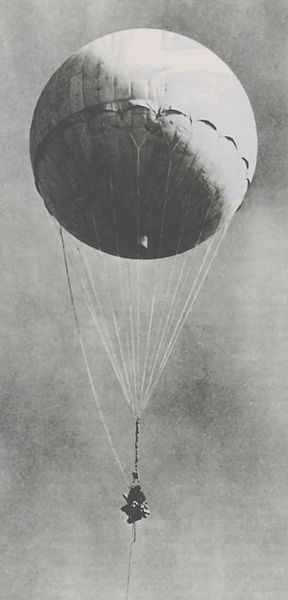
US Army photo, via Wikipedia.

US Army photo, via Wikipedia.

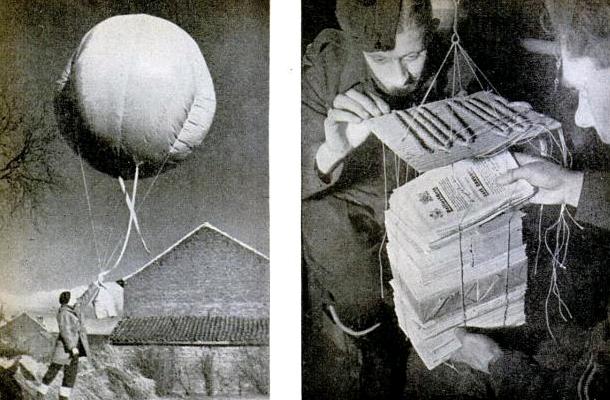
The balloon itself was made of rice paper or rubberized silk and was about 30 feet in diameter. It held about 19,000 cubic feet of hydrogen. The key to making the balloon reach America was maintaining its altitude, since the prevailing winds would inevitably deliver it to its destination, as long as the balloon was at a known altitude.

Each balloon’s payload consisted of about four incendiary bombs, designed to set fires after the craft reached the United States. But the bulk of the payload consisted of ballast sandbags which were part of the altitude control mechanism. The payload also contained a number of barometers used for measuring altitude.

The balloon contained a relief valve which vented excess gas when it reached its cruising altitude. This was a simple spring-loaded valve at the base of the balloon set to 9/10 ounce per square inch pressure. This valve would vent due to the reduced pressure at the higher altitude.

When the balloon began to lose altitude, it would begin dropping ballast. With modern electronics, it would be quite easy to build the necessary circuits. Indeed, even in the 1940’s, it would have been relatively easy to build the electronics, but it would have been impossible to power the necessary vacuum tubes for the long flight. Therefore, another method was required.

When the balloon descended to about 27,000 feet, one of the barometers would trip a switch which would blow an explosive charge in two blast plugs that were holding the first sandbag in place. The sandbag would drop, and the balloon would begin rising. It would then be necessary to arm the plugs holding the second sandbag. But a delay would be necessary. If the second sandbag were armed immediately, while the balloon was still at the lower altitude, it would drop immediately, followed quickly by all of the remaining sandbags. It was necessary to build in a delay before the second sandbag was armed. This delay was accomplished by means of a fuse. The charge used to drop the first sandbag also ignited a fuse that was sufficiently long (2-1/4 minutes) to allow the balloon to rise to its cruising altitude. Only after this time had elapsed was the next sandbag armed. The balloon would continue cruising at 30,000 feet. When it again dropped to 27,000 feet, the second sandbag would be dropped and the fuse for arming the third sandbag would be lit.

This process would continue until the 36th and final sandbag had been dropped, at which point the balloon would be over the United States. The final drops would then consists of the incendiary bombs, controlled in the same way. After the final one was dropped, a fuse was lit to a demolition charge to self-destruct.

The electrical power was provided by a two-volt lead-acid battery, which was housed inside of a box containing a solution of calcium chloride to serve as a thermal ballast to keep the temperature of the battery as constant as possible. This was housed in another box with an air chamber to provide some insulation.

The first balloon was launched in November, 1944, and examples were found in Alaska, Washington, Oregon, California, Arizona, Idaho, Montana, Utah, Wyoming, Colorado, Texas, Kansas, Nebraska, South Dakota, North Dakota, Michigan and Iowa, as well as Mexico and Canada. An unexploded bomb was found as late as 2014 in British Columbia, and was detonated by the Canadian Navy. The single fatal attack took place on May 5, 1945, when Elsie Mitchell and five children, ages 11-14, were killed near Bly, Oregon during a Sunday school picnic. This was the war’s only lethal attack to take place in the 48 United States, and we’ll look at it in more detail in our next installment.

Newsweek carried an article on January 1, 1945, about a “balloon mystery,” and a similar story appeared in newspapers. However, the Office of Censorship asked papers not to mention balloon bomb incidents. After the deaths, however, the total press blackout was lifted.  One of the first accounts can be seen in the Milwaukee Journal, May 23, 1945.  The AP story notes that “some may be buried in melting snow.  With the coming of warm weather and the end of the school session it is desirable that people and especially children, living west of the Mississippi river, be warned of this possible hazard and cautioned under no circumstances to touch or approach any unfamiliar object.”  The article does not, however, mention the May 5 fatalities.

The blackout was largely successful, however, since the Japanese believed that the attacks had been unsuccessful, even though they had some measure of success. In addition, attacks had destroyed most of Japan’s hydrogen production, and the project was abandoned.

Part 2 will remember the victims of the May 1945 attack and the curious connection to the Vietnam War. Click here to go to part 2.  Part 3 will look at some of the balloons that reached far inland to the Midwest. And Part 4 will show the flight of one of these balloons to Minnesota.

References

Read More at Amazon

Click Here For Today’s Ripley’s Believe It Or Not Cartoon


V-E Day

VEDay

70 years ago today, May 8, 1945, was V-E Day:  Victory in Europe.  It is heralded here on the front page of that day’s Chicago Tribune.   Following Hitler’s suicide on April 30, the surrender was authorized by his successor as head of state, Karl Dönitz.

You can hear CBS coverage of V-E day at YouTube:

https://www.youtube.com/watch?v=Fh8M6CEh5Jk


Click Here For Today’s Ripley’s Believe It Or Not Cartoon


The Army Hour, NBC Radio, 1945

1945NBCfamily

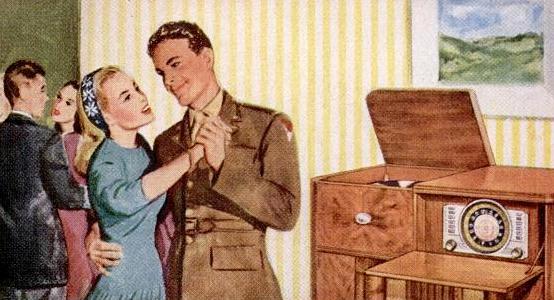
The family shown in this photo appeared in an ad for the NBC network in the April 1945 issue of Tune In magazine.  They are gathered around the family console, which is adorned by a photo of their young serviceman. The ad notes that NBC acts as a two-way pipeline between the men of the armed forces and their families back home. Not only do the servicemen tune in to their favorite NBC broadcasts via the regular network and shortwave, but NBC also broadcasts for the people at home the “Army Hour,” a weekly production of the War Department and NBC.

The picture was undoubtedly taken at 3:30 Eastern War Time on a Sunday afternoon, when the Army Hour was broadcast.

Click Here For Today’s Ripley’s Believe It Or Not Cartoon


Radio Station WAR, 1945

WARtapemachineSeventy years ago, April 1945, Popular Mechanics carried a feature about the War Department’s Signal Center in Washington and its radio station, which bears the call letters WAR. The article noted that the station at this nerve center of the War Department handled 8-9 million words per day, with direct hookups to forces throughout the world. The WAC operator shown here is overseeing tapes on an automated code sending machine. At the other end of the circuit is the station at Bougainville shown below.


Bougainville

The call sign WAR is heard on the airwaves at least once a year during the annual Armed Forces Day Cross-Band Communication Test when the station, along with other military stations, makes contact with amateur operators.

Click Here For Today’s Ripley’s Believe It Or Not Cartoon


Kate Smith Gives Advice on Wartime Meals

Kate Smith

Kate Smith

Seventy years ago, rationing was in effect for most meats, dairy products, sugar, and even some canned vegetables. Therefore, meals required careful planning. CBS radio personality and singer Kate Smith took the time in the April 1945 issue of Radio Mirror to explain the rationale behind the rationing rules. For example, she notes that 2 billion less pounds of meat would be produced in 1945 than had been produced in 1944. But the needs of servicemen and commitments to the Allies hadn’t changed. Therefore, those two billion pounds would have to come from the civilian supply.

Despite the seriousness of the situation, she reminds the readers that there was no excuse for preparing a meal that didn’t measure up to pre-war standards. “The trick lies in your own ingenuity–in how well you can learn to plan menus around the foods that, although restricted in variety, are still available to us in sufficient quantity.”

With that in mind, she presents the following menus. As you can see, they lean heavily on eggs. Since she assumes that most of the lunches will be eaten from a lunchbox, most consist of sandwiches, and the dessert is generally left over from the prior evening’s meal.

1945Menu

Click Here For Today’s Ripley’s Believe It Or Not Cartoon