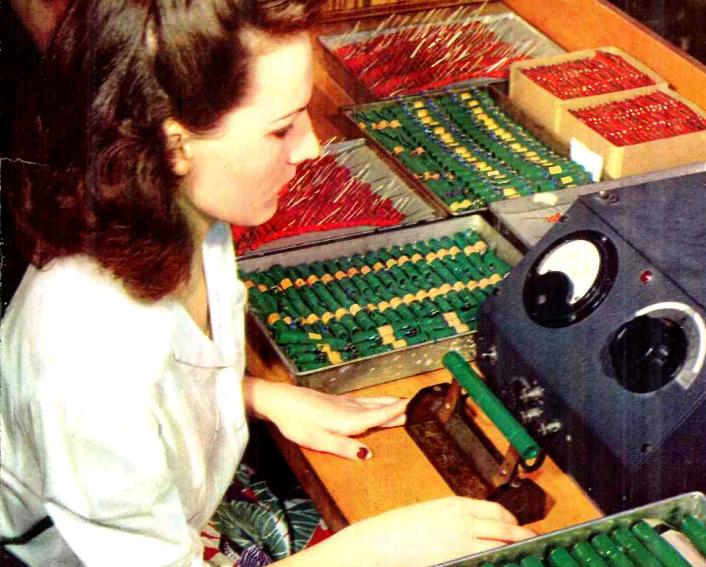
Seventy years ago, American war production was going strong, as demonstrated by this worker at the Ohmite Manufacturing Company plant in Chicago. This worker, shown here on the cover of the February, 1945, issue of Radio News, is testing transmitter RF chokes for their “Q” factor.
Like virtually all American industry, the company was engaged entirely in war production. The company had been founded in 1925 and, as suggested by its name, primarily engaged in the manufacture of resistors. It’s currently headquartered in the Chicago area, with its production and distribution facilities moved to Matamoros, Mexico and Brownsville, Texas, one of many maquiladoras along the U.S.-Mexico border.
I’ve always been aware that civilian radio sets were not manufactured during World War 2, but I never knew the details. Those details are reported on page 22 of Broadcasting, March 16, 1942.
On March 7, 1942, the War Production Board, which had itself been created by executive order on January 16, 1942, issued its order regarding radio equipment. Under that order, all manufacture of civilian receiving sets was to cease on April 22 in preparation for the conversion of the 55 manufacturers to war production. Sets in production as of that date were allowed to be finished, but only if not more than $500 in materials (not including wooden cabinets) were used.
30,000 were employed by these firms, and they had collectively produced more than 13 million sets prior to the order. They had done $240,000,000 in business during 1941, and all of their resources were now to be turned to war production.
War orders for all of the companies were already in place, and they were to begin gearing up for war production as soon as the manufacture of civilian sets ended.
The War Production Board estimated that the firms would turn out about three million more sets before the deadline, which would increase the total number of civilian sets to about 60 million.
Those sets would need to be kept in good shape, since the Board doubted that even replacement parts would be manufactured for the duration of the war. The Board even hinted that rationing and registration might be required, noting that some homes had more than one good set, and extras could be used in homes having none. But the Board’s chairman believed that the current supply of sets, along with those in production and on retailer’s shelves, would be sufficient for the nation’s needs.
The next month, Hugo Gernsback, editor of Radio Craft magazine, opined in an editorial as to the possibilities this situation presented for America’s youth: “Young men between the ages of 12 and 17 who are not subject to the draft have time on their hands, which they now can turn into cash by building sets not only for their friends and relatives–yes, but even sell them to radio stores. It is certain that if a number of boys gang together and manufacture a few sets every week in their spare time, and providing the sets are made right, they can be sold to the trade.”
Gernsback noted that millions of obsolete sets cluttering up storerooms would be a source of parts, as would automobile junk yards and junk shops, since they were loaded with a goldmine of parts. He pointed out that readers could “perform a patriotic service to conserve whatever substitute materials we have and turn such materials into radio sets.”
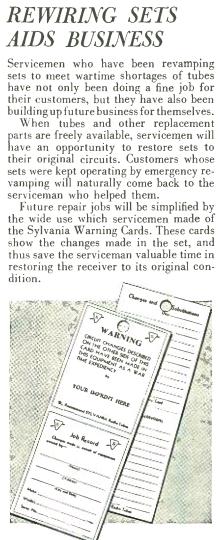
Early in the war, manufactured parts were hard to come by. By the end of the war, some common parts were becoming available for civilians, but most were in limited supply, and most could be sold only to those attesting that they would be used to make repairs to existing sets. But throughout the war, radio service men had to be creative due to the absence of needed parts. The February 1945 issue of Radio News reported that, barring a miracle, civilian production would not resume until victory over Japan. That issue also contained an ad by Sylvania, a portion of which is shown here. When a service man had to make an emergency repair by re-wiring the set to make use of available parts, he could document the change on the card in order to facilitate restoring the set to its original condition when parts became available after the war.
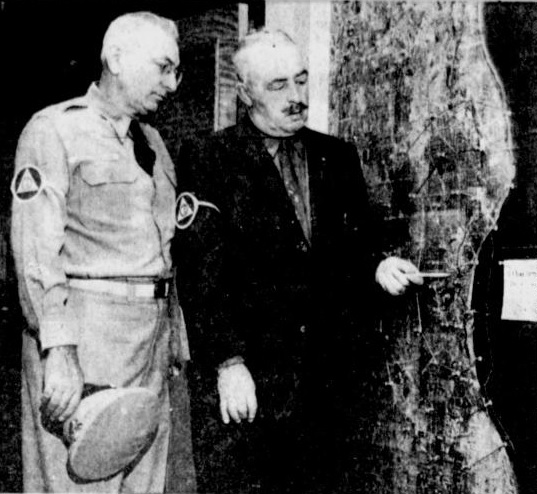
Milwaukee Civil Defense Director Don E. Carleton and Col. Anthony F. Levno assess damage after simulated attack on Milwaukee. Milwaukee Journal, Jul. 20, 1956.
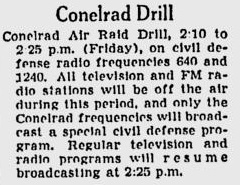
At 3:10 PM Eastern Standard Time on July 20, 1956, CONELRAD conducted its first (and as far as I can tell, only) nationwide test. At that time, all radio and television stations left the air for 15 minutes, and the only broadcast signals coming from the United States were those of the CONELRAD system on 640 and 1240 kHz.
CONELRAD was obsolete almost as soon as it was put into effect, but the idea was that during an enemy attack, attacking bombers must be deprived of the ability to use American broadcast stations for direction finding and navigation. Aviation routinely made use of AM stations for navigation, and the locations of broadcast stations and their frequencies are still printed on aviation charts. It was a reasonable concern, but it became much less critical when the bomber was replaced by the ICBM as the main component of both Soviet and American strategic war planning.
CONELRAD was created by President Truman in 1951, and hung on until 1963, when it was replaced by the Emergency Broadcast Sytem, in which participating stations continued to broadcast on their normal frequency.
Under CONELRAD, all stations in the U.S. would operate on the same two frequencies. The navigator of an enemy bomber tuning to either of those frequencies would be confronted with hundreds of stations on the same frequency, rendering them useless for navigation. And each station would transmit for only a few seconds or minutes. In smaller markets with only one station, the station would quickly give instructions, and then sign off for a few minutes. In larger cities, the stations would be linked together by telephone lines. A continuous program could be sent, but it would switch quickly from one transmitter to another, hopelessly confusing enemy bombers.
But for those 12 years, CONELRAD was the method by which Americans would be warned of war, and in 1956, it was put to a test. At 3:10 PM Eastern Time, each participating station was to transmit the program which had been delivered by record. The introduction to this broadcast can be heard at the following YouTube video:
In many cities, such as Chicago, the CONELRAD test was conducted in conjunction with other civil defense exercises. The Chicago Tribune for July 20, 1956, details some of the preparations being made there. The next day’s paper reports 325,000 simulated deaths in the Land of Lincoln.
There was surprisingly little reporting on how well the test went: Namely, whether the public was actually able to hear the broadcasts. One of the few actual tests was carried out by Radio News magazine, and reported in the October 1956 issue.
The magazine arranged receiving sites at four locations around the New York area. They were in a steel building in Brooklyn, a steel building in Manhattan, a home about 25 miles from the city, and a home about 50 miles from the city. At each location, writers for the magazine had multiple receivers ready for the test. They then rated the percentage of the broadcast they were able to receive intelligibly.
An outdoor antenna proved to be the greatest asset. At the home 25 miles from the city, the editor reported a 100% satisfactory signal using a Hallicrafters S-40 hooked to an outside TV antenna, and also with a Heathkit crystal set with a 100 foot outdoor antenna. At the same location, a Westinghouse battery portable without external antenna gave only 75% satisfactory reception.
In Brooklyn, the best performer turned out to be the Regency TR-1 transistor portable,
which gave a 100% reliable signal, but with continual retuning as the signal shifted from one transmitter to another. At the same location, the Knight tube portable was only 75% satisfactory, with the remaining signal too weak without reorienting and retuning the radio.
In Manhattan, the transistor portable, a Zenith Royal 500, outperformed the tube portable, with 85% satisfactory reception compared to 65%.
50 miles from the city, a Grundig tube portable gave 85% satisfactory reception, outdoing the Zenith portable, which had only 60% reliability. At this more distant location, the main problem came from interference from stations in other cities’ CONELRAD networks.
It is somewhat surprising that so much “retuning” was necessary. Presumably, the stations all had a crystal for their assigned frequency (the article didn’t state whether New York was using 640 or 1240), so it’s unlikely that the individual transmitters were drifting. More likely, some of the individual transmitters were slightly off frequency, resulting in the need to retune when the signal switched from one to another.
The article did stress the importance of having nondirectional antennas, something that was lacking in most AM portables. Most of the receivers, other than those using outdoor antennas, had to be reoriented when the signal switched transmitter locations. The article noted that extreme sensitivity wasn’t necessarily a good thing, because of the danger of interference from adjacent networks. These two factors explain why the crystal set had such good results in the test.
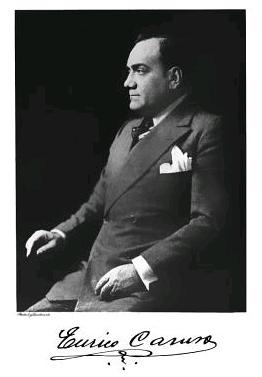
A hundred years ago today was perhaps the first example of a pirate broadcasting music over the airwaves. The New York Tribune, January 31, 1915, reported a mysterious broadcast of a phonograph record of Enrico Caruso. The previous year, Caruso had taken part in a broadcast from the roof of the Wanamaker Department Store, as previously reported here.
But this was apparently an unauthorized broadcast, and the source of the January 1915 signal was a mystery. The paper reported that amateur wireless operators were surprised by the broadcast on the afternoon of January 30, which came from somewhere New York, and on a wave legth a few hundred meters below that used by the government. In what was perhaps the first recorded pirate radio broadcast, someone played, without further comment, a phonograph recording of Enrico Caruso singing an aria.
The article went on to point out predictions that within the year, there would be wireless telephone messages “flying through the air instead of code messages.”
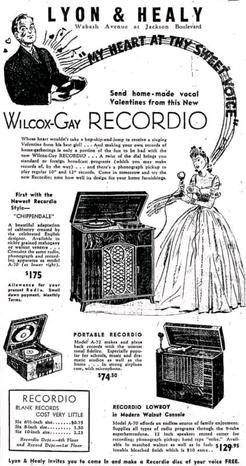
75 years ago, it was possible to do audio recording at home, but it was a pricey proposition. Magnetic recording didn’t really become possible until after the war, and very few homes would have owned a tape recorder prior to 1970. But for someone who really wanted to immortalize their voice in 1940, it was possible to purchase the Recordio, shown in this advertisement from the Chicago Tribune, January 28, 1940. Just in time for Valentine’s Day, the ad shows a well-dressed young woman recording a “home-made vocal Valentine,” presumably for the love-struck gentleman shown at the top of the ad.
The deluxe model into which the young woman is singing sold for $175, and included a radio covering standard broadcast and short wave. The ad noted that it was possible to make records off the air, and the unit also functioned as a player for purchased records. The same electronics in a more modest lowboy console was also available for $129.95, and a portable unit (apparently without radio) was available for $74.50.
That wasn’t the only expense involved, however. The blank records ranged in price from 75 cents for six 6-1/2 inch disks, up to $2.25 for the same number in the 10-inch size.
The final product, which could of course not be erased, meaning that only one take was available, was a standard 78 RPM record that could be played on any phonograph, such as that owned by the gentelman shown at the top of the ad.
The manufacturer, Wilcox-Gay Corp. of Charlotte, Michigan, had been in business since 1910, making radios and dictation machines. The Recordio came out in 1939, and reportedly sold 25,000 units the first year. The company continued to make similar machines in the 1950’s, but later models included a magnetic recorder in the same unit, which would allow recording a master before cutting the disk. If you search YouTube, you’ll find surviving examples of the disks, such as this one of some aspiring musicians offering their rendition of “My Bonnie Lies Over the Ocean.”
Musicians such as Les Paul and Johnny Cash were known to have used Recordios at some point in their careers.
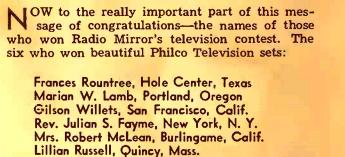
Seventy-five years ago this month, Rev. Julian S. Fayme of New York City was truly blessed. He was the winner of a new Philco television, and he had some channels that he could watch. When he received his windfall in January, 1940, there were three stations on the air in New York, W2XBS, W2XAX, and W2XAB. I previously wrote about one of those stations. W2XBS (later WNBC) came on the air on April 30, 1939. W2XAB and W2XAX were both licensed to CBS and later became WCBS-TV. And the DuMont station, W2XWV (later WABD) was soon to come on the air, as I wrote previously.
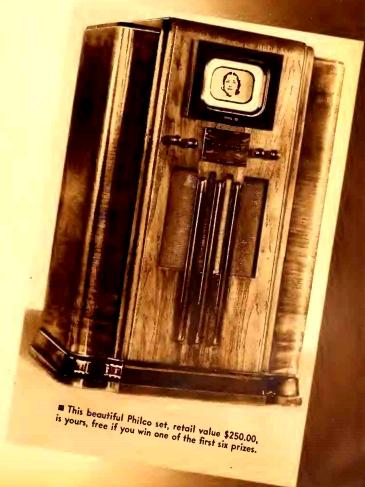
Lillian Russell of Quincy, Mass., was almost as lucky, since she was also a winner, and was within range of W1XG in Boston. Fayme and Russell were among the six winners of the set shown above, in the announcement of a quiz contest in the September 1939 issue of Radio Mirror.
But in the full list of winners is shown below (in the January 1940 issue), a problem is apparent.
The other four winners didn’t have anything to watch. There were no TV stations on the air in Portland, San Francisco, or Burlingame, California. And there certainly weren’t any stations anywhere near Hole Center, Texas, undoubtedly much to the dismay of Frances Rountree. Indeed, I can’t find any record of a town by that name, although there is a Hale Center about 30 miles north of Lubbock. But Hole or Hale, that new Philco wasn’t of much use to the Rountree family.
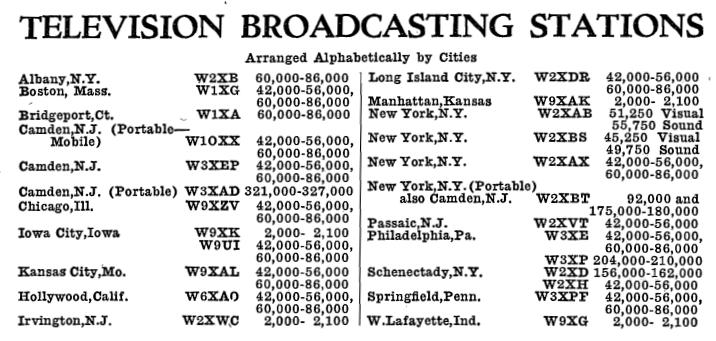
The TV stations on the air as of 1940 are shown on this excerpt from White’s Radio Log, Jan.-Feb. 1940. (This list includes three mechanical television stations operating on 2000-2100 kHz, which the more modern Philco wouldn’t have been able to receive. So winners in Irvington, N.J. or West Lafayette, Ind., wouldn’t have fared any better.)
It turns out that the four hapless winners weren’t totally out of luck, since the fine print of the contest rules did show some foresight: “And if, perhaps, you live in a section of the country where television programs cannot yet be received, this quiz still carries a prize for you. Any winning contestant can have, if he wishes, a de luxe Philco radio set instead of the television receiver.” So the winners in California, Oregon, and Texas, presumably gathered around their de luxe Philco console radios and dreamed of television, which for them would have to wait until after the war.
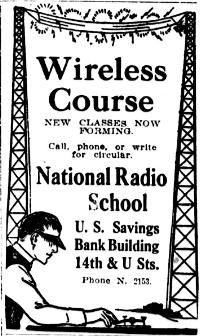
This small ad for the National Radio School appeared a hundred years ago today, in the Washington Times, January 24, 1915. The ad announces the upcoming wireless course. This school had recently been formed, and went on to have a long history. If you were involved in radio or electronics over the next several decades, you probably heard of them.
At some point, the name changed to the National Radio Institute. It was founded in Washington in 1914 by James E. Smith, who headed up the school until 1968, when it was purchased by McGraw-Hill. Smith continued as the school’s chairman until his death in 1973. McGraw-Hill began to phase out the school in 1999, and it ceased operations in 2002.
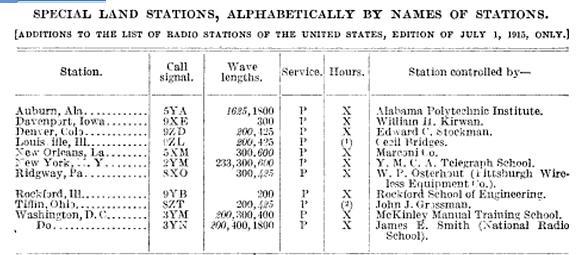
1915 and 1921 call books show the call 3YN assigned to Smith and to the school. This 1915 listing shows the school’s station as licensed to operate on 200, 400, and 1800 meters:
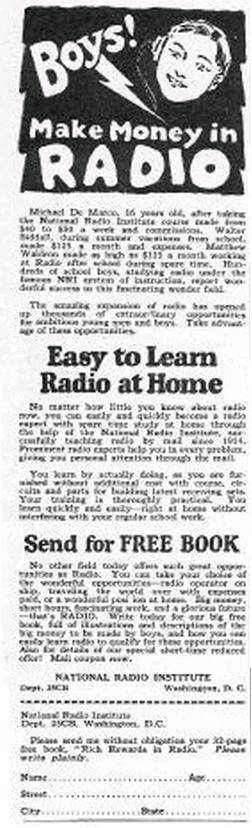
Over the years, the school advertised extensively, and virtually any magazine relating to radio or electronics for several decades contained an ad for NRI. The ad shown here is from Boys’ Life magazine, January 1925, and offered boys the promise of making money in radio.
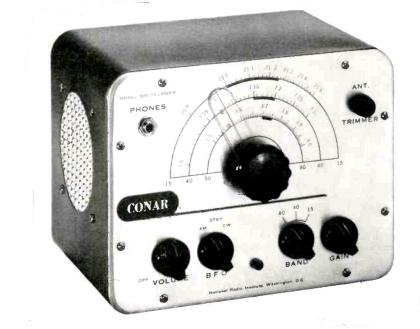
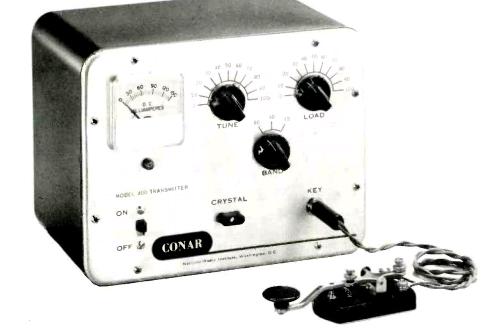
If the name NRI only vaguely rings a bell, then the name CONAR will probably sound more familiar. The school sold a wide variety of electronic kits (and some assembled products) under that name. The CONAR name was never as famous as Heathkit, but it had almost as wide a variety of products. You can view the 1966 catalog at this link at americanradiohistory.com.
Among hams, one of the most famous (or perhaps infamous) of these products was the “CONAR Twins,” a transmitter and receiver designed for the novice ham. These radios were available in kit form (along with a copy of the ARRL license manual and a key) for $64. They were also available assembled. The transmitter used a single tube, a 6DQ6, which put out 15 chirpy watts on 80, 40, and 15. The receiver, while basic, was actually fairly good. It was a four-tube superheterodyne covering the same bands. The two units were available separately as well, with the transmitter selling for $32.50 in kit form, and the receiver for $37.50. One way the costs were kept down was the use of the same cabinet as most of CONAR’s test equipment. KB8TAD’s site shows a nice example of the sets in excellent condition. The images from the 1966 catalog are shown below.
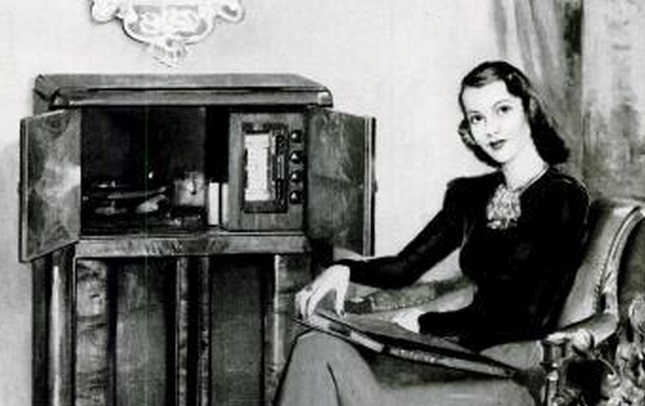
This RCA ad appeared in Life Magazine 75 years ago, January 22, 1940. It shows opera singer and RCA recording artist Lily Pons listening to her RCA Victrola Model U-42 radio-phonograph. Thishandsome console contained 8 tubes, and tuned both standard broadcast and short wave. The record changer was automatic, and the receiver feathured pushbutton tuning and a 6U5 “tuning eye.”
The schematic for this receiver is available at Nostalgiaair.
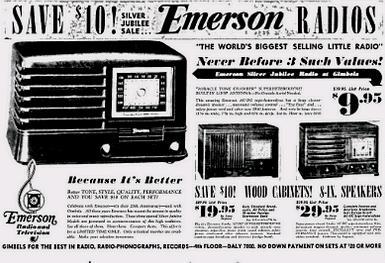
For $9.95, you could get the standard broadcast receiver with a “miracle tone chamber” and built-in loop antenna. It came with a “safety power cord,” which apparently meant that it didn’t have a “curtain burner” cord with built-in dropping resistor for the filaments. This appears to be the Emerson Model 330 in a bakelite case. You can see the radio in operation at this YouTube video. Another nice example, along with the schematic, can be found at RadioMuseum.org or at N9DD’s site.
$19.95 would get you a six-tube set that tuned police calls as well as the 49-meter shortwave band. It appears to have two bands, meaning that the police calls were probably at the top end of the standard broadcast band.
And for $29.95, you could get the seven-tube set which also covered the broadcast and shortwave bands for “complete foreign and American Broadcasts” with “EXCELLENT tone.” This one appears to be similar to the Emerson Model 356, but with a slightly different cabinet. A nice video of a restored model in operation can be found at YouTube.
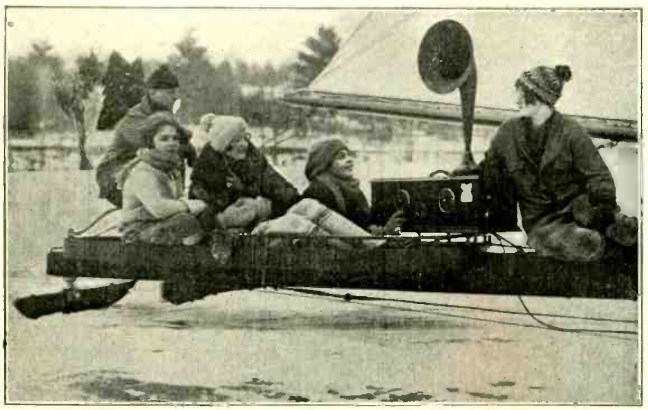
Ninety years ago, DeWolf Barton discovered the secret of attracting the girls: Just offer them the chance to go out for a spin on the ice of Lake Placid aboard his ice yacht. Barton, shown to the left piloting the craft, is joined by Virginia Markel of Cambridge, Mass., Dorothy Knoepke of South Orange, N.J., Patricia Schmidt of New York City, and Eloise Thompson of New Haven.
The radio is said to be a superhetrodyne fed by a “concealed loop” for an antenna. Mr. Barton was apparently a particularly skilled navigator of the craft, since there’s no mention of the boom of the sail knocking over the precariously placed speaker. This photo appeared in the January 17, 1925, issue of Radio World.
Miss Markel was apparently no stranger to winter sports. She is shown here skiing at Lake Placid, from the December 27, 1928, issue of the Niagara Falls Gazette.