Category Archives: Radio history

Foxhole Radio Update


Gould's rendition of the foxhole radio.

Gould’s rendition of the foxhole radio.

A few months ago, we posted about the history of the “foxhole radio,” a crystal set made with a razor blade detector,  As reported in the New York Times in June 1944 and Time Magazine in July, soldiers at the beachhead in Anzio made these receivers to pass the time. The receiver was later popularized in Jack Gould’s book All About Radio and Television.

Among those to see the plans was Radio Craft editor Hugo Gernsback.  In the September issue of Radio Craft, he pointed out that the original Razor Blade Radio Detector had actually been published by him, in the January 1909 issue of Modern Electrics. He also shows two other similar detectors published in 1906.

The 1909 razor blade detector actually differed from the “foxhole” version, however. The Modern Electrics detector uses two razor blades with a pencil lead balanced on top. The razor blade seems to be serving the function of “cat’s whisker,” as opposed to being the crystal in the foxhole version.

GernsbackRazorBlade


Click Here For Today’s Ripley’s Believe It Or Not Cartoon


Crosley Looks Forward to Postwar Radio

CrosleyLife061145

In June 1945, the war in the Pacific was still raging, American industry was still on a wartime footing, and the War Production Board still prohibited the manufacture of radios and phonographs. But the end was in sight, and radio manufacturers were engaged in intense advertising. These ads often highlighted the company’s contributions to the war effort, and they were also advertising their future products in anticipation of serving the pent up demand as Americans would cash in their war bonds and buy a new set at the final conclusion of hostilities.

The Crosley Corporation was no exception, as it carried this heartwarming story 70 years ago today, in the June 11, 1945, issue of Life Magazine. It tells the story of “Jerry and Barbara.” Jerry is a serviceman, apparently home on leave, and he is shown dancing to the Crosley radio-phono console with his betrothed, Barbara.

Barbara recounts their very first dance at the prom. She wore a red dress and the moment she danced with Jerry, she confesses “that’s when everything began for me.” Jerry quickly interjects, “for us. The minute I danced with you I knew, “This is IT.

The war intervened, and Jerry apparently had to go do his part to deal with the Nazis. Now, he is home on leave before he goes to finish the job in the Pacific. They are dancing again, this time to the Crosley, and Barbara closes her eyes and tells him that it’s a wonderful record.

Jerry quickly adds, “It’s a wonderful phonograph.” He points out that he and his father bought it for his mother right before the war, that it plays records a new way. He adds that the secret of the Crosley’s wonderful tone is in the needle, and that it was “the kind for us when I come home for keeps.”

There is a pause in the story as the ad explains that secret, namely Crosley’s patented “Floating Jewel Tone System.” The story concludes in the not-too-distant future, as we see Jerry and Barbara, with their Crosley radio-phono console, which appears identical in every respect to his mother’s.

To Jerry and Barbara–and to all the Jerrys and Barbaras–Crosley wishes that all their dreams come true. They point out that they are currently producing fighting materials to help win the war, but are looking ahead to being able to once again produce Jerry and Barbara’s console, and other radios, radio-phonos, and other home appliances.

Click Here For Today’s Ripley’s Believe It Or Not Cartoon


1940 Two Tube Shortwave Receiver

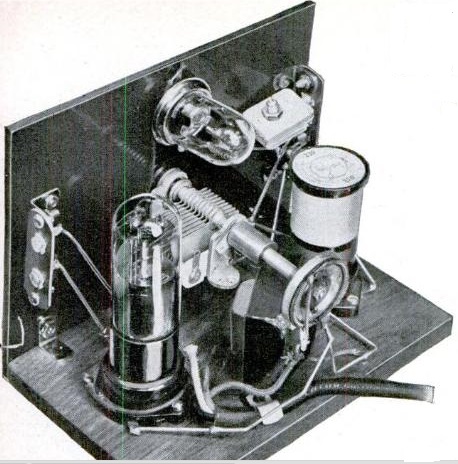
1940PS2tubeThis cute little two-tube broadcast/short wave receiver appeared in Popular Science 75 years ago this month in the June 1940 issue.

1940PlugInCoilsIt used  ready-made coils which plugged into the top of the set to change bands. Back in the day, you could buy the coils pre-wound, such as the ones shown here in the 1940 Allied catalog. A set of four coils covering 17-270 meters would cost $1.80. If you wanted to get the bottom of the broadcast band, the coil covering 250-650 meters would be an additional 75 cents.  Plug-in coils are unobtanium these days, but AA8V has a good description of how to make your own forms from a defunct tube and section of PVC.

A 1N5 tube was used as the regenerative detector, with a 1A5 serving as an audio amplifier to drive a built-in speaker. It was powered by a 1.5 volt battery for the filaments, with a 90 volt B battery, also tapped at 22.5 volts.

The builder of this set probably heard a lot of interesting signals on the shortwave bands during the war.

The 1N5 and 1A5 tubes are available at Antique Electronic Supply.  All other parts are readily obtainable, other than the plug-in coils, which you can wind yourself. For ideas on where to find parts, visit my crystal set parts page or my how to stock your junk box page.

1940PS2tubeSchematic

Click Here For Today’s Ripley’s Believe It Or Not Cartoon


1945 Postal Censorship

PostalCensorshipI found this “Stray” in QST 70 years ago (June 1945) interesting. When servicemen wrote home about ham radio, phrases unfamiliar to the censor were frequently deleted. But when the serviceman wrote a marginal note to the censor explaining the meaning, then the term was passed without censorship.

Click Here For Today’s Ripley’s Believe It Or Not Cartoon


Allied Psy Ops, 1945

Preparing to launch psy ops balloons over German lines.

Preparing to launch psy ops balloons over German lines.

Seventy years ago this month, the June 1945 issue of Popular Science
carried an interesting article on psychological warfare in all of its forms. The main method of directly reaching enemy troops was the leaflet, which could be dropped from airplanes, balloons, or even artillery shells.

In an earlier series of posts, we looked at the Japanese balloons designed to travel from Japan to North America, and the ingenious control mechanism to keep them at altitude. Since Allied propaganda balloons had a much shorter distance to travel, they simply employed a fuse that would burn the ropes at the proper time, or maybe drop some ballast for longer flights.

SurrenderPassThe leaflet shown here was typical. According to the article, the Japanese text read as follows:

SOLDIERS OF THE IMPERIAL ARMY!

You have fought well, but the battle is lost. You are cut off with no hope of escape. Soon your food and ammunition will be gone.

You have only two fates–annihilation because unwise commanders sent you into our trap. Or good treatment behind the Allied lines.

Think it over. Ghosts in Yasukuni cannot help Japan. Death without meaning is only for fools.

Some of your friends know this. They have come over to us and they are safe. They are eating rice, smoking cigarettes, sleeping in peace. They know that life is precious. They are not ashamed to live.

Join them now. You will receive plenty of good food and kind treatment. Your identity will not be disclosed.

This is our only offer. If you do not accept it, we will be forced to destroy you.

–THE COMMANDER

The leaflet went on to give directions for safe surrender. Japanese were told to approach Allied positions singly by day and without arms. They were told to raise their hands and wave the pass.

AlliedSoundTruck

For encouraging hold-out snipers to surrender, the army also employed trucks with large sound systems. But since bullets can travel about as far as sound, this was the most dangerous activity for psychological operations personnel.

The article also talked about the use of radio for psychological operations purposes. It noted that before the war, the U.S. had 11 shortwave stations, but now had 40, including six putting out 200 kilowatts. On the west coast, KGEI had been the only shortwave station, but now there were ten. There were also shortwave transmitters in Honolulu, Saipan, and the Phillipine Islands. Powerful mediumwave stations were in place in North Africa and England broadcasting to Europe. As soon as countries were liberated, a priority was getting broadcast stations on the air.

Click Here For Today’s Ripley’s Believe It Or Not Cartoon


Two 1945 Crystal Sets

1945PMXtalSet1Seventy years ago this month, the June 1945 issue of Popular Mechanics carried the plans for the two crystal sets shown here. As the article points out, crystal sets can come in two varieties. The simplest set has little selectivity, and is suitable only for tuning in the one strongest station in a given area. For more variety, a more complex set with more selectivity is required. The magazine showed two sets, one in each category.

The simple set had its coil and all of the other parts mounted on a plastic drinking cup. The more selective set contained two variable condensers, both salvaged from old broadcast radios. Complete crystal detectors could be purchased for about 25 cents, or the builder could make one with a piece of galena. Thus, even with wartime parts shortages, most hobbyists would be able to scavenge together the needed parts.1945PMXtalSet2

For those wishing to replicate one of these designs today, I have ideas for finding parts on my crystal set parts page.

Click Here For Today’s Ripley’s Believe It Or Not Cartoon


First Broadcasts: Paris, 1891, Newark, 1911.

Most will be surprised to learn when the first broadcasts took place. In other words, people in their homes could, for the first time, listen to music, news, or entertainment originating from a central studio. The answer, it turns out, is Paris in 1891, when the Theatrophone first started broadcasting.

The Theatrophone didn’t use radio–it broadcast programs to subscribers’ homes by telephone line into a dedicated telephone instrument. Surprisingly, despite the later competition from radio, the Paris Theatrophone held on until 1932. Similar systems were soon in operation in Budapest and London.

In about 1911, a group of New Yorkers were traveling in Budapest and were surprised to find the service available in their hotel. Upon doing some investigation, they decided to offer a similar service. It was decided to install the new system in Newark, New Jersey, and later expand to New York. They formed the New Jersey Telephone Herald Company and began operations either in late 1911 or early 1912.

NJTelHeraldRxThe drawings of the home receiver instrument and main studio shown here are from the June 1925 issue of Radio News.  The article notes how similar the studios of the Telephone Herald were to those of a radio broadcast station of 1925. Broadcasting took place from 9:00 AM to 11:00 PM daily, and included, music, news, market reports, and even bedtime stories.

The company leased telephone lines from the New York Telephone Company in order to bring the service to individual city blocks. From that point, the Herald had its own lines to run the programs to individual subscriber homes. There were some mechanical amplifiers used in the distribution process, consisting of telephone receivers and transmitters connected by a rod. The main downfall of the system was the limitations in amplifying the telephone signal, which could never get above headphone volume. As the Radio News article pointed out, the system would have worked quite well had vacuum tube amplifiers been available. But they were a few years off, and radio had a firm hold on broadcasting by the time they were available.

The New Jersey Telephone Herald office and studios.

The New Jersey Telephone Herald office and studios.

Interestingly, the New York Telephone Company was initially unwilling to lease the lines, and the Telephone Herald had to go to the New Jersey Board of Public Utility Commissioners to force the telephone company to lease the lines. The Commision agreed with the Telephone Herald.  The Commission held that the Telephone Herald was not a “public utility,” but instead just another telephone customer, and they telephone utility was obligated to make the lines available on the same terms as for any other customer.

The price of the service was $1.50 per month, or “five cents per day,” as the marketing people put it. At its peak, the New Jersey system had about 5000 subscribers. However, as the novelty wore off, many subscribers defected, and the service seems to have ended by the end of 1912.

A similar service, the Oregon Telephone Herald, was operated in Portland, Oregon, in 1912. The 1913 advertisement shown below is for the San Francisco Telephone Herald Company, which apparently never began operations, but planned a similar service.

References

Click Here For Today’s Ripley’s Believe It Or Not Cartoon


Berlin Declaration, 1945

Generals Montgomery, Eisenhower, Zhukov, de Lattre at signing of Berlin Declaration. Wikipedia photo.

Generals Montgomery, Eisenhower, Zhukov, de Lattre at signing of Berlin Declaration. Wikipedia photo.

Today marks the 70th anniversary of the Berlin Declaration, with which the Allies formally assumed control of German territory, divided it into four sectors, and dissolved the Third Reich.

Among other things, Article 9 ordered that “all radio and telecommunication installations and other forms of wire or wireless communications, whether ashore or afloat, under German control, will cease transmission except as directed by the Allied Representatives.”

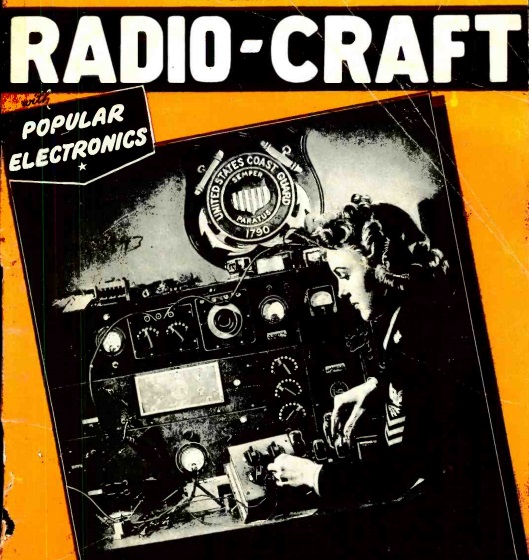
It appears that Berlin radio was already off the air.  While Berlin was still listed in the station list of the June 1945 issue of Radio Craft, it was absent from the July list.

Click Here For Today’s Ripley’s Believe It Or Not Cartoon


Tinfoil Hat Early Adopter

WashTimes060415

A hundred years ago today, June 4, 1915, the Washington Times carried this story relating the theory of an unnamed patient at the Colorado state asylum. The patient believed that wireless stations were preying upon him and sapping his strength. He wanted the practice of wireless communication banned worldwide.

Click Here For Today’s Ripley’s Believe It Or Not Cartoon


Secret Transmitter at the Hauptmann Trial?

LindberghCourtroomOn February 13, 1935, the jury in the Lindbergh kidnapping case returned its verdict, finding Bruno Richard Hauptmann guilty, and recommending the death penalty.

The case was the “crime of the century,” and the reporters present at the trial were eager to scoop their colleauges. The courtroom was locked when the jury returned, but the Associated Press figured out a way to get the news out of the courtroom. Their reporter carried a small transmitter in his briefcase, and upon hearing the verdict, he was to send a prearranged code with the news. A nearby AP telegrapher would be listening, and immediately telegraph the news to AP headquarters.

The code for guilty, but with a recommendation for mercy, meaning life in prison, was four dots. That night, the AP scooped the competition, and radio listeners around the country heard the news that Hauptmann would get life in prison. But unfortunately for the listening public (and for Hauptmann), the verdict was actually guilty of first degree murder, meaning the electric chair. The AP issued a correction a few minutes later.

The little mixup was caused by someone else having the same idea. The New York Daily News also came up with the idea of smuggling a transmitter into the locked courtroom, and the Daily News’ signal of four dots meant merely that the jury had entered the courtroom.

This story was recounted 80 years ago this month in the June 1935 issue of Shortwave Craft magazine. The article is probably written by publisher Hugo Gernsback, and as with most of what he wrote, it contains a good bit of self-promotion. He included the photo of a briefcase shortwave receiver that had been featured in the magazine three years earlier, in the June 1932 issue.

SWCraftJune1932

Undaunted by the fact that what he had published had been a receiver, he notes that “with a slight change in the connections, this receiver is easily converted into a transmitter for code signals, such as those used at the Hauptmann trial.”

I haven’t found any corroboration of this incident. Gernsback’s support of his theory comes from his assertion that the reporters in question didn’t deny it when he asked about it. It seems a bit far-fetched, since it depends on both the AP and the Daily News happening to use the same frequency for their clandestine transmitters. Since the transmission would necessarily be so short, it would be imperative for the listener to be tuned to the exact frequency prior to the signal. It seems that the chances of both papers using the same frequency just by chance are pretty slim.

Click Here For Today’s Ripley’s Believe It Or Not Cartoon