Category Archives: Radio history

Minnesota State Fair

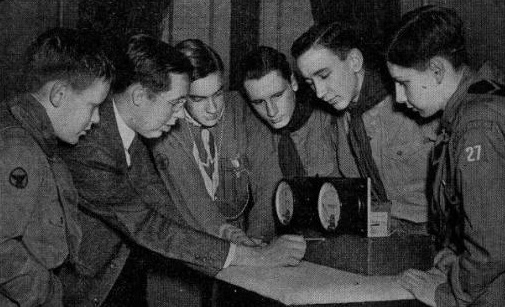
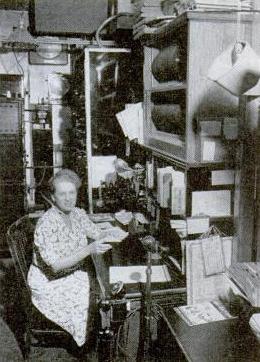
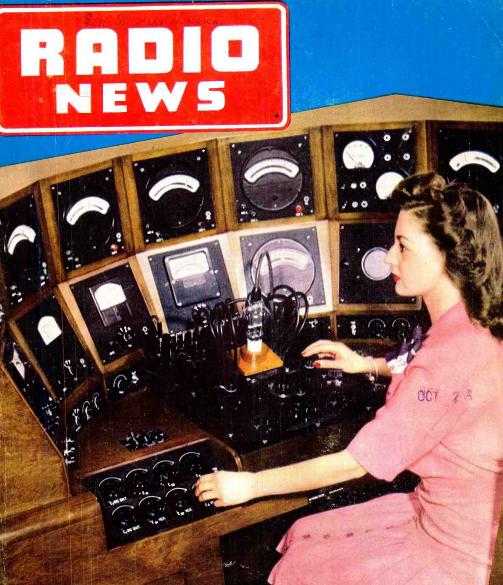
Welcome to OneTubeRadio.com. This blog covers a variety of subjects, including radio history, Minnesota history, World War I, World War II, and scouting.

MinnStateFair1915

Minnesota State Fair, 1915.


Today, we offer these images of the Minnesota State Fair as it appeared a hundred years ago in 1915. The scene above is the bandstand. Visible in the background  is the dome of the Agriculture Building.  A closer images of this building is also shown here, from the fair’s 1915 annual report.agriculturebldg

1922 Aeronautical Wedding

Bride, groom, and pilot at 1922 aeronautical wedding at grandstand.

Bride, groom, and pilot at 1922 aeronautical wedding at grandstand.

The grandstand, in the 1915 postcard shown below, is immediately recognizable to a modern visitor.  As previously reported here, in 1922, the grandstand served as the wedding venue of Edwin Moline and Zelma Olson, who were married aboard an airplane flying above the grandstand.  The presiding minister, Rev. E.A. Jordan, at 220 pounds, was too heavy to fit inside the airplane along with the pilot, bride, and groom.  Therefore, he officiated from a pagoda within the grandstand, receiving the couple’s vows by a radio which was carried aboard the plane.

grandstand1915

Ye Old Mill at 100 Years

Ye Old Mill, 2008. Photo, placeography.org, Licensed under the Creative Commons Attribution-ShareAlike License v. 3.0:

Ye Old Mill, 2008. Photo, placeography.org, Licensed under the Creative Commons
Attribution-ShareAlike License v. 3.0.

This year, the “Ye Old Mill” attraction at the Minnesota State Fair celebrates its 100th Anniversary. Many visitors are surprised to learn the nearly identical attractions with the same name at the Iowa State Fair (dating to 1921) and Kansas State Fair (also dating to 1915).

Radio at the Minnesota State Fair

Radio has a long tradition at the Minnesota State Fair. Indeed, the photo of the grandstand shows on the field what certainly appears to be a wireless antenna of some sort, although I don’t have any details of the old image. In 1914, the fair’s governing board considered a proposition made by one Philip Edelman of St. Paul for the installation of a wireless station at an esimated cost of $200. The board decided to continue discussions with Edelman as to whether such an exhibit could be made in a future year at less cost.

The Minneapolis sign of Sterling Electric Company, 1920 state fair exhibitor. Google books.

The Minneapolis sign of Sterling Electric Company, 1920 state fair exhibitor. Google books.

One of the earliest references I could find to radio at the State Fair was the December 1920 issue of Electrical Contractor Dealer, which detailed the experiences of the Sterling Electric Company of Minneapolis. At the 1920 Fair, the company had a large booth in the Electrical Building which included a wireless station that sent and received messages daily. The company followed up with a Saturday morning class in wireless telegraphy, in which there was considerable interest.

Shortly thereafter, the company, along with the Journal Printing Company, was the licensee of one of the area’s first broadcast stations, WBAD. That license was issued on April 25, 1922, according to the May 1922 issue of Radio World.  It is likely, therefore, that the honors for being the first radio station at the fair go to WBAD.  Since then, of course, local broadcasters have a long history of broadcasting from the fair.  The image below from a WCCO promotional item shows the station’s then location in the Agriculture-Horticulture building.

wcco1952statefairmap

Read More at Amazon


Click Here For Today’s Ripley’s Believe It Or Not Cartoon


Boy Scout Civilian Defense Volunteers in WW2

Boy+Scout+CD+7-26-15+001

Photo courtesy of W8KBF, Yahoo War Emergency Radio Service group.

During World War II, Boy Scouts in both America and Britain were called upon to serve as volunteers in civil defense. In the July 1942 issue of Boys’ Life, BSA Chief Scout Executive James E. West wrote an editorial encouraging Scouts to volunteer in the Messenger Service of the Citizens Defense Corps. The Office of Civilian Defense recommended that six messengers and two adult leaders be recruited for each 1000 persons in a community. Even though others were eligible to join, both the BSA and the Office of Civilian Defense believed that Scouts, due to their training and qualifications, would be ideal. The editorial stressed that during an emergency, other means of communications could be disrupted, and that written messages might be the only means of communication. West concludes:

This is one of the most important national service projects that has been requested of the Boy Scouts of America. It requires the utmost effort on the part of our organization to fulfill the responsibility which has been assumed. Let us face resolutely whatever the enemy has in store for us, and BE PREPARED to do what we are asked to do to the best of our ability.

Franklin County, Ohio, identification card for Boy Scout CD messenger.  worthingtonmemory.org photo.

Franklin County, Ohio, identification card for Boy Scout CD messenger. worthingtonmemory.org photo.

British Scouts Tour America

Visiting British scouts with James E. West and BSA foreign relations chairman Thomas J. Watson.

Visiting British scouts with James E. West and BSA foreign relations chairman Thomas J. Watson.

A few months later, a group of British Scouts who had served in civilian defense roles during the Battle of Britain made a tour of Canada and the United States, including a meeting with West, and their heroic tales were written up in the magazine’s September 1942 issue.   These Scouts represented four towns that had been heavily hit by bombing. Scout Stanley Newton of London explained:

Our Troop went through six months of heavy bombing in London. I cannot say that we came off unharmed. Our two Troop headquarters were wiped out, one was burned down and the other was blown to pieces. Several of the boys lost their parents and their homes and two of the younger boys were killed in those raids. But we were glad that we could go through them and do something to use our training as Scouts in helping some way or another.

Another of the Scouts, John Bethell of Birkenhead, describes the work the messengers did during the Blitz:

When a bomb drops one of the first people on the spot is either the head warden or one of the senior wardens. He always has a messenger with him; one of us Scouts. What he does as soon as he gets there is to make out a report on what has happened, give it to that messenger and the messenger rides down to the post, which we call the pill box.

Inside the pill box there is a telephone. That is the only telephone we are allowed to use during an air raid. But sometimes the telephone lines get broken when a bomb hits the road. Then instead of just having to ride to the post and telephoning, we messengers have got to ride down to the control center. Sometimes it is a long way and sometimes it isn’t. In my case it is three miles; that’s three miles there and three miles back, maybe ten times in one night. Not only do we send one messenger but three minutes after the first messenger is gone we always send another one so if the first one gets bumped off the second one may get through.

Derrick Belfall (1926-1940):  I Have Delivered My Message

Derric Belfall.  Photo courtesy of Mrs. Rita McInnes.

Derrick Belfall. Photo courtesy of Mrs. Rita McInnes.

Indeed, one of those Scouts, Derrick Belfall, was “bumped off” in the course of his duties as a civilian defense messenger.  Fourteen year old Belfall lived at 109 Bishop Rd, Bishopston, Bristol.   He was the only son of Cecil Ernest and Mary (née Miller) Belfall, who died in 1983 and 1964, respectively.

The official minimum age for messenger service was sixteen, but due to his insistence, Derrick was allowed to join the service.  On the night of December 2, 1940, he was dispatched with a message.  He delivered it successfully, and upon returning to his post, he found a house beginning to burn and he stopped to put out the fire.  He then heard cries from another house where he rushed in to save an injured baby. Shortly after effecting these rescues, the air raid still underway, Derrick was injured by an exploding bomb and taken to the hospital with injuries that proved fatal. As one of the visiting Scouts confirmed, his last words at the hospital were: “Messenger Belfall reporting.  I have delivered my message.”

Defused German parachute mine.  Wikipedia photo.

Defused German parachute mine. Wikipedia photo.

A Narrow Escape

Bethell, one of the British Scouts touring America, also recounted his own tale of being thirty yards away from an exploding parachute mine which killed two other civil defense workers:

A warden and I were riding along the streets on our bikes and saw a couple of parachutes coming down. Well, first we thought they were German airmen bailing out and we were just going to run towards them and give them something like what we would like to give Mr. Hitler–a kick in the pants or something like that–and then we realized that they were what are known as parachute mines…. We started to ride towards them to see if we could help in the rescue work we knew would follow….

We saw a couple of chaps running up in front of us also going on the same job. Just then we heard something flapping. It was only very faint but we realized that it was another parachute with a mine coming down. We knew if we were able to hear that flapping we must be pretty close to it. We got down on the ground and shouted to the other two chaps. But unfortunately they didn’t hear us. The roar of anti-aircraft fire drowned out our shouts. They went on. The mine went off just thirty yards ahead of us. We were just blown across the street but otherwise all right. But those other two chaps standing up under the full blast–it got them right in the chest and blew their lungs out and killed them.

American Scouts In Action

ScoutCD1943

The American Scouts shown here in the February 1943 issue of Boys’ Life are participating in a civil defense exercise.  The display shown at the top of the page is the uniform of a Scout as he would have appeared in 1943 as a civil defense messenger in Mercer County, Pennsylvania.  It was put together by W8KBF of the Yahoo War Emergency Radio Service group.

While American Scouts and other civilians escaped the harrowing experiences of their British counterparts, it is clear that they lived up to the Scout Motto to Be Prepared.   And as the British Scouts proved, a scout is brave.

As Scout Executive West wrote, these Scouts “were not specialists but were equipped only with such knowledge as is normally given to Scouts through our Advancement Program. Yet how nobly these Scouts lived up to our Scout Motto ‘Be Prepared.’ We, too, have a job to do!”

Acknowlegments

DerrickI would like to thank Mrs. Rita McInnes, a neighbor of the Belfall family, for providing the photograph of Derrick Belfall.  This photograph hung for many years in the Belfall home as part of the illuminated photo shown here containing Derrick’s last words. (Click on the small image to view the full image.)

I would also like to thank Sam Hevener, W8KBF of the Yahoo War Emergency Radio Service group for allowing me to use the photo of the American Scout messenger’s uniform at the top of the page.

Additional References

Read More at Amazon


1915 Receiver

1915AugustBLOne hundred years ago, a Boy Scout interested in wireless could get this complete receiving station for only $2.85, as advertised in the August 1915 issue of Boys’ Life.  It’s unclear whether the headphone was included for that price. While a headphone is shown in the picture, it’s not mentioned in the description, which leads me to suspect that a few Scouts might have learned the disappointing phrase “sold separately” after placing the order.

In any event, the set was probably capable of picking up the time and weather signals of NAA, at least for those within a few hundred miles of Arlington, Virginia. The set is described as consisting of “bare wire wound double slide tuner, our new two cup triple action cat whisker detector, tubular fixed condenser, buzzer and switch to tell if your detector is working, a silk wire wound high 6-capacity loading coil that allows you to get Arlington, Va., and the long wave stations.”

In addition to the possibly missing headphones, the owner of the set would need to come up with some wire for an antenna and ground connection. But the set appears to be capable of picking up NAA and other stations. As the ad mentions, the test buzzer would be helpful in making sure the cat whisker was set to a “sweet spot” on the crystal. A battery would also be necessary to operate the test buzzer.

The set was offered by the Handel Electric Company of 138-140 Centre Street, New York.

Click Here For Today’s Ripley’s Believe It Or Not Cartoon



TV Comes to Marathon, Ontario, 1953

GreenBayMarathonIn 1953, Marathon, Ontario, was a full 300 miles away from the nearest TV station, WBAY channel 2, in Green Bay, Wisconsin. That distance didn’t stop Grant Ross from deciding that the town needed television, and he set out to deliver. He discovered that from a hill 300 feet above the shore of Lake Superior, the signal was perceptible, and he set out to get reliable reception. Half of the path between Green Bay and Marathon was over the waters of Lake Superior. However, Green Bay was on the shores of Lake Michigan, and the signal had to cross 152 miles of Wisconsin  and Upper Michigan countryside before reaching the unobstructed waters of Lake Superior. But it did so, and Ross was intent on providing a signal to the town. He wound up constructing a rhombic array on 45 poles mounted atop the hill. This signal was fed down to the town on an 1800 foot transmission line. A 1955 report showed that he received “excellent” signals at least 40% of the time. Reception was “poor or useless” only 20% of the time.

Ross signed up over 400 homes for his pioneer Community Antenna Television (CATV) systam, collecting a $50 installation fee from each. In addition, the monthly subscription for the service was $2.50.

A few years later, channel 2 came on the air in Port Arthur, Ontario (now Thunder Bay), and he switched the service to that. The rhombic was rebuilt to receive the new signal from WLUC in Marquette, Michigan, which was a relatively easy catch, being 166 miles away, but with a path entirely over the waters of Lake Superior.


Click Here For Today’s Ripley’s Believe It Or Not Cartoon


1935 Two-Tube Shortwave Portable

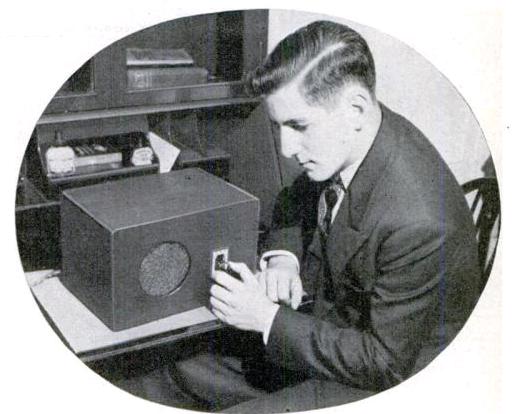
1935AugPSSW1This little two-tube portable receiver appeared in Popular Science
80 years ago this month, August 1935. It featured two type 30 triodes, one serving as the regenerative detector, with the other one providing one stage of audio amplification. With four plug-in coils, the set would tune 17 to 270 meters.

One novel feature was the inclusion of the antenna trimmer condenser inside the plug-in coil. This would allow the antenna to be separately tuned to each band, without having to fiddle with that adjustment when plugging in a different coil. The coils were changed through an opening in the top of the cabinet, with a removable cover to keep dust out.

1935AugPSSW2

Click Here For Today’s Ripley’s Believe It Or Not Cartoon


1925 Four Tube Loudspeaker Set

1925AugPM

Ninety years ago this month, Popular Mechanics, August 1925, carried the plans for this four-tube receiver. The set contained four type 201 tubes, and featured a tapped loop antenna. The set had very good selectivity by virtue of having the tapped loop. By changing the taps, the set tuned different portions of the broadcast band. On one tap, it tuned 370-550 meters (545 through 810 kHz). On another tap, it tuned
224-400 meters (750 through 1340 kHz). By breaking up the tuning in this fashion, a smaller range of frequencies was tuned by the single tuning condenser, resulting in greater separation between the stations.

The article noted that during testing in Chicago, even with the Chicago stations transmitting full blast, it was possible to receive more distant stations with the speaker.

Click Here For Today’s Ripley’s Believe It Or Not Cartoon


K2BSA in 1975

K2BSA1975Shown here is the flagship Amateur Radio station of the Boy Scouts of America, K2BSA, as it appeared 40 years ago this month, in the August 1975 issue of Boys’ Life.

As reported in the magazine, the station was then located at the Johnston Historical Museum, on the grounds of the BSA’s then national headquarters in North Brunswick, New Jersey. K2BSA is still active, although it no longer has a fixed location from which it operates. It is on the air on multiple bands and modes at BSA Jamborees. At the most recent one in 2013, I was on staff, and thousands of contacts were made around the world. In addition, the station call sign and even portable equipment are available for loan by licensed hams who are scouts and scouters for use at scouting events. In this way, the call sign is frequently heard during Camporees and other events at which scouts get a chance to experience amateur radio.

The article notes that in 1975, the station was put on the air on weekends on a monthly basis to allow visitors to speak to other Scouts around the country.

A larger reincarnation of the museum is open to the public at the National Scouting Museum near the organization’s present headquarters in Irving, Texas.

(Scouts who are working on the Scouting Heritage or Radio merit badges will find helpful information for both at my website.)

Click Here For Today’s Ripley’s Believe It Or Not Cartoon


1940 Boy Scout’s Radio

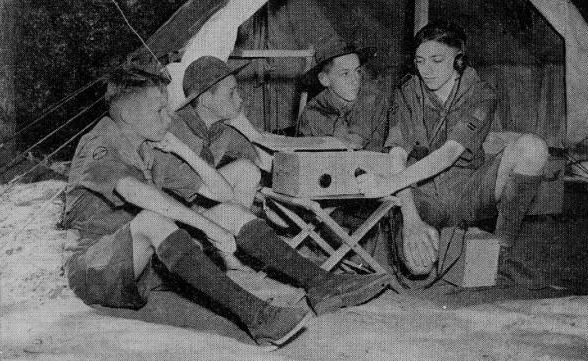
1940AugBLSeventy-five years ago, this unnamed California Boy Scout decided to bring his radio to camp. The set was one he built himself in a cigar box. The caption in this picture from the August 1940 issue of Boys’ Life reveals that the picture was taken at the Camporee of the BSA’s Oakland Area Council.

Click Here For Today’s Ripley’s Believe It Or Not Cartoon


1915 Galveston Hurricane

Flooding in Galveston after 1915 hurricane.  Wikipedia photo.

Flooding in Galveston after 1915 hurricane. Wikipedia photo.

A hundred years ago, a major hurricane hit the United States, leaving between 275-400 dead and $50 million in property damage. Adjusted for inflation, this made the storm the fourth costliest in U.S. history. The storm brought winds and heavy rains to the Leeward Islands, Puerto Rico, Hispaniola, and Cuba. Like the deadly hurricane of 1900, it made landfall in Galveston, Texas. The 1900 hurricane had caused thousands of deaths, and some lessons had been learned. In particular, in the wake of the 1900 hurricane, Galveston saw construction of a seawall. The structure was only partially effective in 1915, but still limited the destruction and saved many lives. It did cause flooding, and the beach was eroded to the point where it became an offshore sandbar.

This was one of the first natural disasters in which radio played a role in relief efforts, as reported in the September 1915 issue of Wireless Age.  The magazine, published by the Marconi Company, reports that “in a tornado [sic] which blew continuously for eighteen hours in southeastern Texas, leaving death and destruction in its path, Marconi wireless telegraphy and Marconi men showed their worth by keeping the residents of Galveston in touch with the rest of the world when all other means of communication had failed.”

Port Arthur Marconi station, 1915.

Port Arthur Marconi station, 1915.

The aerial mast of the Galveston Marconi station was destroyed, and some of the ground plates and mast anchors were swept away. But even though flood waters reached the station house, the equipment was undamaged. A Marconi superintendant in New Orleans came to Galveston to investigate, and arrived on August 19, three days after the winds had started their fury. By that time, an army transport had already established radio contact with Forst Sam Houston, 250 miles away, but with only limited success. A Marconi-equipped steamship, the Concho, was in port, and the Galveston Marconi operators reported for duty aboard that ship. On August 20, they established contact with the Marconi station at Port Arthur, Texas. This was the only reliable communications link between Galveston and the outside world, and many messages were handled for the steamship companies, the military, and the general public.

At some point, the mast at the Port Arthur station gave way, at which time messages were sent and received from another Marconi-equipped steamer, the Wild Duck.

After unleashing its fury on Texas, the storm turned toward the Ohio Valley, finally fading out on August 23.


Click Here For Today’s Ripley’s Believe It Or Not Cartoon


Philco Model 41-841

20150814_102532

Many Point Scout Camp is owned and operated by the Northern Star Council of the Boy Scouts of America, and has been in operation since 1947. Local scouts and scouters don’t always realize what a gem it is, and those in other parts of the country are often unable to comprehend its sheer size. It covers 2400 acres and nine miles of shoreline on two lakes, Many Point and Round Lake. At 15 miles per hour, it’s about a 30 minute drive from one end of the camp to the other, and it’s another 30 minute drive to the nearest full-service gas station or supermarket. Therefore, it provides a real wilderness experience to thousands of scouts.

Because of its size, it lies on land that has seen its share of history, and since 1996, it has included a very nice History Center to showcase some of that history. In addition to the scouting that’s taken place there since 1947, the museum contains displays regarding the earlier users of the land. Therefore, it has displays about the Native Americans, the fur traders, the loggers, and the sportsmen. In the first half of the 20th century, several resorts were located on the land where Many Point is now located, and one of these is recreated in the museum.   (A complete guide to the History Center is available online.)

20150814_102540What caught my eye, of course, was the Philco portable radio shown here. The set, it turns out, is a Philco model 41-841, which would have been manufactured shortly before the War in 1941. So as far as the age of the set, it’s consistent with the display.

It is a battery-operated portable, which ran off a 3 volt A battery for the filaments, and a 90 volt B battery. It was also capable of running off household current, using a 117Z6G rectifier for the B+. When run on household current, the filament voltage was provided by simply dropping the rectified power supply through two resistors. The set’s schematic can be found at this link, and you can read more discussion at this link and this link.

In addition to the rectifier, the set has four tubes, a 1A7G, 1N5G, 1H5G or 1LD5, and 3Q5G. It’s a fairly typical superheterodyne, and has provisions for external antenna and ground. At night, the fishermen sitting around the table would be able to hear scores of stations from the Twin Cities, Chicago, and around the country. One of the strongest stations at night probably would have been WDGY, whose nine-tower array cast a formidable signal to the north.

During the daylight hours, the set would probably get a fairly good signal from WDAY in Fargo, North Dakota.  In addition, it might possibly have pulled in 50,000 watt WCCO or then 25,000 watt KSTP in the Twin Cities during the daylight hours.