Author Archives: clem.law@usa.net

N9ZGB QSL Card, 1938

n9zgbHere’s an unusual example of an “N” amateur call sign from 1938, from the June 1938 issue of All Wave Radio magazine.  The card was actually for a QSO by W9GZB, but the owner of that call, Arthur “Musty” Musgrave, 527 Union St., Emporia, Kansas, was a member of the Naval Communication Reserve, for which the corresponding “N” call sign was used. That service dates back to at least 1929, since there is an editorial in the August 1929 issue of QST encourage amateurs to consider enlistment.

According to an editorial in QST for August 1940, the Naval Communication Reserve was open to men aged 15-35. Former servicemen in any branch of the military were eligible up to the age of 50. Amateur radio operators could enlist as seamen and were immediately eligible to take the examination for the radioman rating. Physical fitness requirements were the same as those for the regular Navy. Experienced radiotelegraph operators were especially desired, since the need for signalmen at the time exceeded the need for radiomen.

Musgrave, the sender of this card, was a linotype operator with the Emporia Gazette newspaper. According to the December 20, 1940, issue of that paper, he was called up to service in 1940 and assigned to the San Diego naval base.  After the war, Musgrave’s call became W0ZGB, which he held until at least 1960.  He died in Kansas in 1971.

The signature on the left-hand margin of the card is the reason why the QSL was shown in the magazine.

This is the signature of William Allen White. W4DVO had sent it to the magazine along with the story of working Musgrave on 80 meter CW. After copying the QTH, the Florida station mentioned that Emporia “owed its place on the map to William Allen White.” To that, Musgrave replied, “you’re telling me!”, and told the Florida contact that he had worked for him for over twenty years. To prove the point, he had his boss autograph the card. According to the magazine, “something tells us that ZGB is going to be a popular station with the autograph hunters.”

WP William Allen White.jpg

William Allen White. Wikipedia image.

William Allen White was, indeed, the owner and editor of the Emporia Gazette, where Musgrave worked as a linotype operator.  White, was regarded as a spokesman for Middle America and was dubbed the “Sage of Emporia.”  Earlier a supporter of Teddy Roosevelt’s run for President on the Bull Moose ticket, he was later tapped by FDR to help generate support for the Allies before America’s entry into the Second World War.


KNX Victory Garden, 1943

1943Jun7BCShown here is the victory garden of KNX, Los Angeles. The picture appeared 75 years ago today in the June 7, 1943, issue of Broadcasting magazine.

According to the ad, the station went to work after the call went out from Washington to raise vegetables. It noted that the soil under glamorous Hollywood had been, just a few years earlier, fertile farm land.

So the station ripped out the terrace in front of its studio, plowed the soil, fertilized and cultivated it. As a model to its listeners, the station grew vegetables to show what California was capable of.

The station’s first crop went to the Los Angeles Orphans’ Home. The practical experience of growing crops went by proxy to many thousands of listeners.


How To Avoid Electric Shocks: 1918

1918JunElecExp

A hundred years ago this month, the June 1918 issue of Electrical Experimenter carried these hints on how to avoid electric shocks. They’re all still good advice these days, but they were even more important then, since there was no effort made to polarize electric receptacles.  At the time, they were intended for light bulbs, but people were plugging all kinds of useful devices into them.  Thus, there was a 50/50 chance that any exposed conductors were “hot.”

1918JunElecExp2The specific advice given in these illustrations was:

  • Don’t touch water spigot and electric socket at same time.
  • Never touch electric wires or fittings when in bath tub.
  • Don’t touch radiator and electric fan.
  • Don’t stand on heating register when extinguishing electric fires.
  • Leave fallen wires alone–they may be “alive”.
  • Don’t use telephone during thunderstorms.
  • Keep away from radiators when using electric curling irons.
  • Boys: don’t throw wires over trolley lines.
  • 3rd Rail!
  • Don’t stand on ground and touch “live” electrical switches.
  • Don’t stand on ground and touch “live” circuits or apparatus.
  • Don’t touch brass nozzle in fighting fires.

To these tips we will add that girls shouldn’t throw wires over trolley lines, either.


High School Radio Training, 1943

1943JuneQSTShown here in the June 1943 issue of QST are students at Northbridge Senior and Junior High Schools, Whitinsville, Mass., learning Morse Code under the tutelage of assistant principal James Perkins Saunders, W1BDV.

Before the War, there had been some instruction in radio for interested students, but it had consisted mostly of informal coaching of students interested in obtaining their ham licenses. But with war, radio became a vital skill, and the school vigorously undertook pre-induction training in the radio arts, including both theory and Morse Code.

1943JuneQSTKeyTo accommodate code training, the school’s schedule was adjusted. Two minutes were shaved off each of the seven class periods, and the lunch period was reduced by one minute. This allowed the time period from 8:05 to 8:20 AM to be set aside exclusively for code practice. Each day, Saunders manned the key in the school office, as shown here, and code was piped throughout the building. Later, a tape machine was procured, and Army-Navy code training tapes were played. A student assistant monitored the tapes and copied along, and at the end of the session, he read back the text that had been sent.

The code training was intended primarily for students in the high school, but since the P.A. system was shared with the junior high, the younger students were also encouraged to participate.

Participation was optional, and some students used the period as a study hall. Initially, 250 students were participating, but this number dropped to 75 at the end of the term.  Each week, a test was given, and teachers sent the classroom’s copy to the office for scoring.  At the start of the next term, the program again started from scratch, with advanced students moving on to a dedicated 45 minute class.

1943JuneQSTMillThe typing class, shown here, was conducted by Saunders one day a week. Instead of their normal typing lesson, the students listened to code being sent by Saunders, and they learned to copy on the “mill”.

Other typing students were trained to transcribe the paper tapes being used to run the code machines. They intently watched a character of the tape be revealed and typed the corresponding letter. Many students were particular fond of this activity, and expressed disappointment that the fun ended when the bell rang.

Students were also trained to copy by flashing light. After they had mastered copying code by sound, they were instructed to watch a flashing light which flashed along with the aural code. Then, the sound was turned off, and they continued to copy by sight.

Sending practice was also given, with sending stations being set up on old laboratory tables. These were wired up so that students could listen to perfect code from the machine and then listen as they tried to duplicate the sounds with their own fists.

1943JuneQST4Interested students, both boys and girls, also took part in classes in radio theory, largely following ARRL study materials. By rounding up defunct receivers, they were able to scrounge components to build projects such as code oscillators, as the students here demonstrate.

Saunders reported that it had been a lot of work getting the school geared up to study radio, but he and the students were very enthused about it. He reported that the many extra hours spent at school working on it were a suitable substitute for ham radio’s being off the air for the duration. In fact, his wife reported that “it is even worse now than before the war” since he was at least at home–albeit in his shack–in the prewar years.


1943 One Tube BC/SW Regen

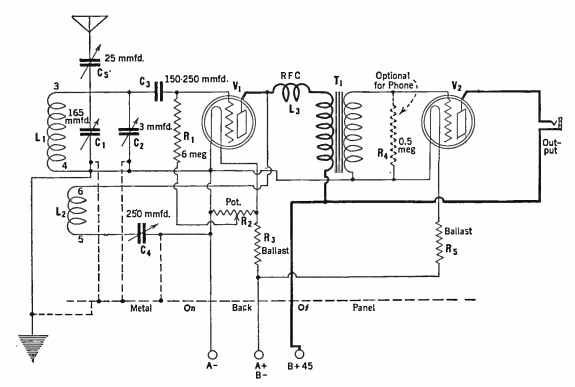
1943JuneRadioCraftSeventy-five years ago this month, the June 1943 issue of Radio Craft carried this schematic for a simple one-tube all-wave receiver.  The set used a single  6F7 dual tube, half of which was used as the regenerative detector, with the other half serving as an audio amp. The circuit had been sent to the magazine by one Allan Hurd of Kelworthy, Ontario, who reported that the set pulled in the local stations with loudspeaker volume, and would even provide loudspeaker volume on shortwave from the London and Berlin stations. Presumably, weaker DX required headphones.

He also reported that no bandspread condenser was needed, as long as a good vernier dial was used on the main tuning condenser.


WTCN Minneapolis Remote Unit, 1948

1948JuneFM

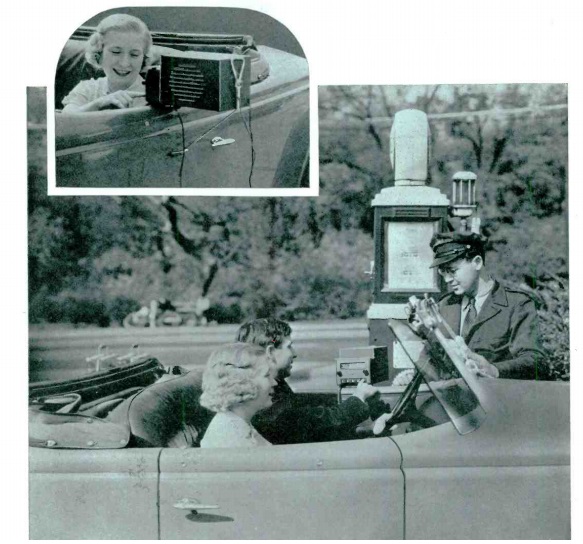
This picture of the remote unit of WTCN radio in Minneapolis appeared in the June 1948 issue of FM and Television magazine. It operated in the 152-162 MHz range. According to the accompanying article, the FCC had moved the allocation for that service to the 450-460 MHz band, which caused some consternation for broadcasters, since equipment for that band was not yet available. Existing licensees would be able to continue on the old allocation for a few more years, but the cost of installing a new system would be prohibitive, since it could be amortized over only a few years, due to the pending change.

The WTCN system was provided by Link Radio Corporation of 125 W. 17th Street, New York. The mobile unit was a 50 FM transmitter operated by a 12 volt dynamotor. Twelve volts was chosen rather than six due to the power consumption and long duty cycle. It was also possible to switch over to operation from AC power where available. A vertical antenna was mounted on the roof.

At the receiving end, the station had a vertical antenna mounted on top of its FM broadcast antenna on the Foshay Tower, which was also pictured in the article. A rack-mounted receiver picked up the program for delivery to the station. Other types of antennas could be employed.

Bell 47B. Wikipedia photo.

For a history of the WTCN call sign, see this link and this link.  The station was owned by the Twin Cities Newspapers, hence the call sign.  Since the article is about the remote unit, there’s no explanation of the Minneapolis Star and Tribune helicopter shown next to it.  It appears to be a two-seat Bell 47B, as shown at left.


Claire Trevor, CBS Radio 1938

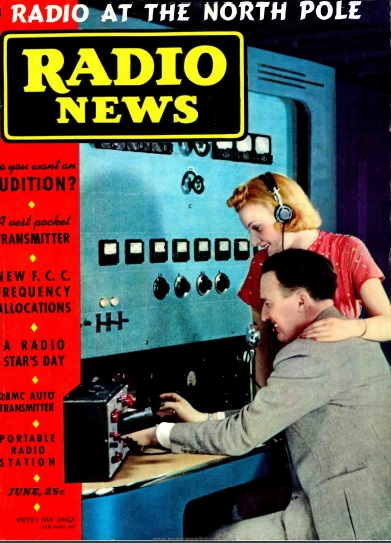
1938MayRadioNewsCoverUndoubtedly, most of the hams who bought the May 1938 issue of Radio News did so for the articles, such as the one on page 37 showing how to build a portable six-tube transmitter for 28 MHz. But the issue’s cover shows actress Claire Trevor at the CBS microphone, performing her role of Lorelei opposite co-star Edward G. Robinson in the series Big Town.

Miss Trevor is most famous for her film roles, including an Oscar for best supporting actress in 1948’s Key Largo. According to the magazine, she made her stage debut in 1930 and appeared in numerous Broadway plays. She made a number of film shorts before going to Hollywood in 1933.

According to the magazine, it was hard to say whether her popularity was due to moving pictures or radio, but that she was a talented, versatile, and beautiful artist.

She died in California in 2000 at the age of 90. Her only son, Charles, was killed in 1978 in the crash of Pacific Southwest Airlines flight 182.


Memorial Day 1943

1943MemorialDayMemorial Day 75 years ago, 1943, was the second since America had entered the war.  This photo was taken at Arlington National Cemetery by Office of War Information photographer Esther Bubley.  The scout, who was serving as one of the color bearers, listens to the ceremony.


1958 One Tube Transmitter

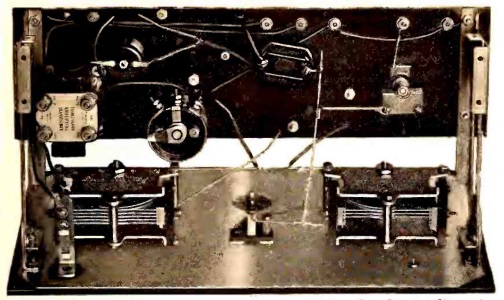
Screen Shot 2018-05-08 at 11.00.50 AMSixty years ago this month, the May 1958 issue of Popular Science showed how to make this compact one-tube transmitter for local or standby use. The set used a 117P7 or 117L7 tube, which combined a rectifier and pentode, to put out about six watts on 80 or 40.  Band choice was accomplished with plug-in coils, and the rig ran directly off AC power.

Since the Altoid tin had apparently not been invented, a card file box was used for the enclosure.

Screen Shot 2018-05-08 at 11.07.08 AM


Hugo Gernsback’s Vision of the Telephot, 1918

1918MayElecExpCoverShown here on the cover of Electrical Experimenter a hundred years ago this month, May 1918, is Hugo Gernsback‘s vision of Skype, or what he called “telephot, an apparatus attachable to our present telephone system so that when we speak to our distant friend, we may see his likeness not only as an immovable picture, but we will see his image exactly as we see our own image when looking into a mirror. In other words, the apparatus must faithfully follow every movement of our distant friend whether he is only five blocks away or one thousand miles. That such an invention is urgently required is needless to say. Everybody would wish to have such an instrument, and it is safe to say that such a device would revolutionize our present mode of living, just as much as the telephone revolutionized our former standard of living.”

Gernsback reported that inventors were working on the problem, but the main catch was what we would today call the bandwidth, since it had to be “possible to attach it to the present-day telephone lines,” which to him was a single wire and a ground return wire. “In most of the schemes offered by inventors heretofore, a plurality of wires was necessary; in some cases several thousand pairs of wires. No matter how well such an instrument might work, this alone would doom it to certain failure.”