Author Archives: clem.law@usa.net

Listening In On Enemy Trenches: 1918

1918MayElecExpThis diagram appeared a hundred years ago this month in the May 1918 issue of Electrical Experimenter, and explains why users of field telephones in the trenches had to maintain security in their communications, even though there was no possibility that the line was tapped.

The diagram shows the Germans listening in on the Americans’ telephones, but it could just as easily be the other way around. By running a line parallel to the other side’s line, it was possible to pick up the conversation inductively. A powerful amplifier might be used, but in many cases, it was possible to listen in with an ordinary telephone receiver hooked to both ends of the line.


1938 U.S. Radio Census

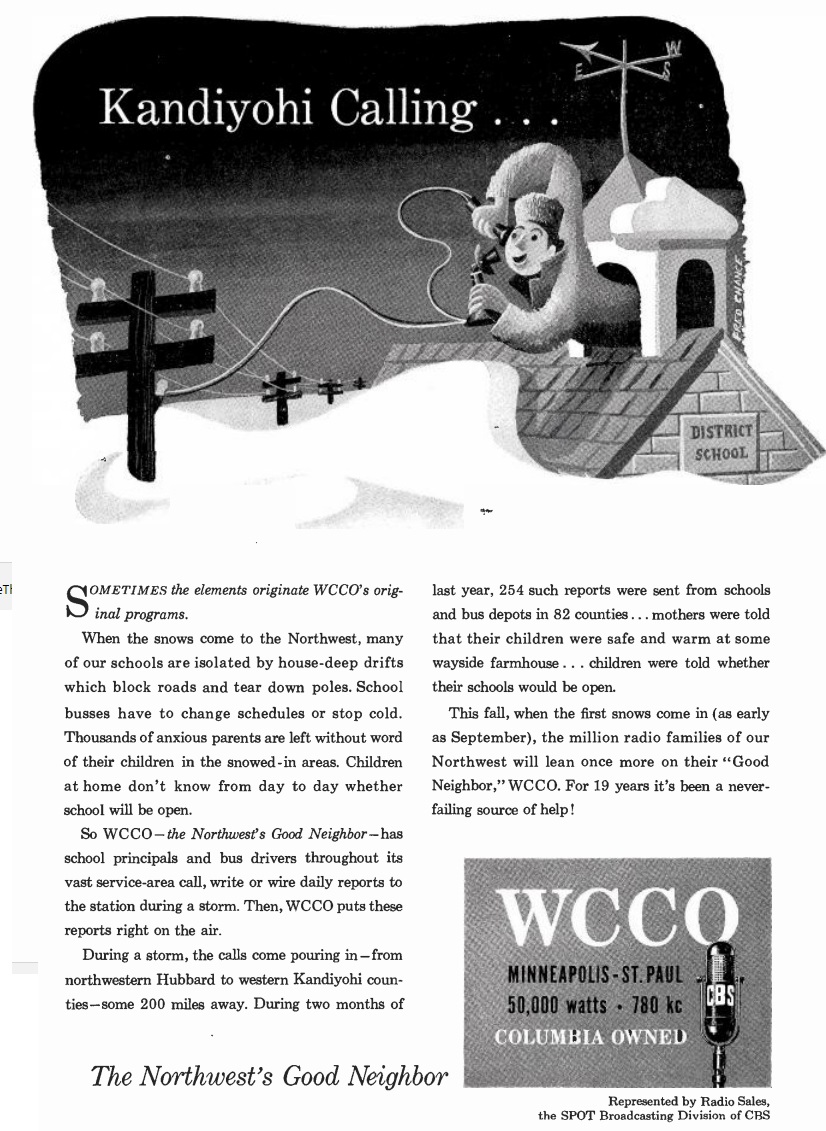
Screen Shot 2018-05-14 at 12.18.17 PMEighty years ago today, the May 15, 1938, issue of Broadcasting carried this snapshot of the adoption of radio in the United States, including figures broken down by state and county.

Nationwide, 26,666,500 homes had a radio, representing 82% of the nation’s families. The highest adoption was in California, Nevada, Oregon, and Washington, with 95% of households having a radio. Mississippi brought up the rear, with only 42% of the state’s households having a radio.

Minnesota was well served by radio. 93% of urban households and 77% of the rural had a radio, for a statewide rate of 85%.


Portable Radio Rental, 1948

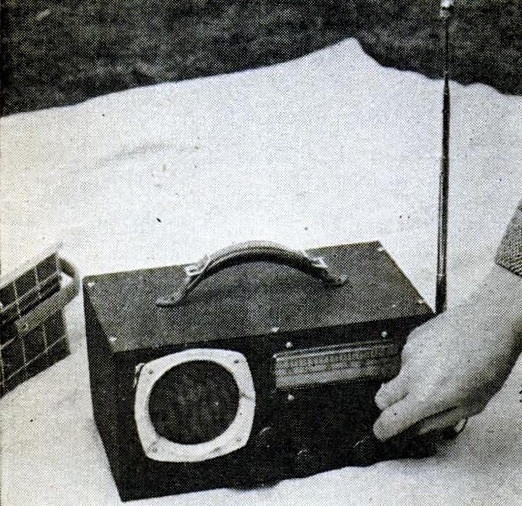
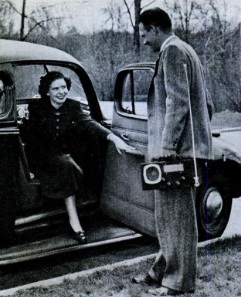
1948MayRadioNewsShown here on the cover of the May 1948 issue of Radio News is Diane VanDusen. But the radio isn’t hers. It’s a rental, and the magazine provides some pointers for radio dealers thinking of getting in on the lucrative portable radio rental market.

The article details the experiences of a radio dealer in Brighton Beach, Brooklyn, New York. He reported great results simply from positioning himself in front of his store on Coney Island Avenue with a sign reading “Portable Radios for Rent.” He charged 35 cents an hour, with a $1 minimum, and reported being sold out every sunny day.

The article stressed that an over-emphasis on security would be conterproductive, since the secret of success was a volume business, and being able to quickly get the transaction over with was key. The sets were marked in large letters “Brighton Rental,” but the dealer required only payment of the fee, as well as a glance at some identification. Despite the casual nature of the transaction, he reported zero thefts.

A batteries were reported to last a couple of days, with B batteries needing replacement every hundred hours or so. Therefore, cost of batteries was a small percentage of the fee.

The dealer reported that he also benefited from sales of portables, since the rental system allowed prospective customers to check out a portable, which listed for $39.50.

Miss VanDusen rented her radio from some other dealer, since she was relaxing at the beach in Florida.  She was one of the famous Aqua-maids at Cypress Gardens in Winter Park, Florida, now part of Legoland Florida.


Mamas, Don’t Let Your Babies…

1918MayPS

…grow up to be–er, I mean, suck on telephone cords.

As a public service announcement, we bring you this reminder, which originally appeared in Popular Science a hundred years ago this month, May 1918.

There was apparently at that time a veritable epidemic of babies sucking on phone cords. According to the magazine, a woman called the complaint office of the phone company to report a malfunction in her instrument.  The phone company employee, who had apparently heard it all, immediately suggested that the customer check the cord of her phone to see if there was a dark and wet spot.

The customer confirmed that it was wet, and indignintaly replied, “baby was playing with the cord this morning and took it in her mouth, sucking at it for a while. Surely there can be no harm and that.”

The complaint clerk, according to the magazine, “had heard the same story many times,” callously told the woman to have the baby knock it off.

Insulation quality is probably better these days. But still, you shouldn’t let your baby suck on any kind of electrical cord. And if someone suggests otherwise, please don’t indignantly tell them that there’s nothing wrong with it.


Irving Vermilya, W1ZE 1890-1964

1938VermilyaEighty years ago this month, the May 1938 issue of Radio News carried a biography of Irving Vermilya, W1ZE, who had a rather compelling claim as being the first amateur radio operator. Not only did he have the first license, but he got his first receiver from Marconi himself, before there was even anything on the air to listen to.

In 1901, after hearing that Guglielmo Marconi had received the letter S across the Atlantic by wireless, the eleven-year-old Vermilya, then of Mt. Vernon, NY, was determined to visit Marconi in Newfoundland. According to the 1938 article and later accounts, Vermilya’s parents granted permission after the family minister, Dr. Charles H. Tyndell, offered to accompany him, and Vermilya traveled to Newfoundland and attended a presentation put on by Marconi. Marconi took notice of the young man in the midst of scientists and engineers, and gave him a coherer and tapper, which he took home and assembled into a receiver.

Vermilya’s own account, however, in two 1917 QST articles, is slightly less dramatic.  Vermilya mentions nothing about a trip to Newfoundland or a personal audience with Marconi.  Instead, he reports that the minister eventually contacted Marconi and obtained the parts, which he passed along to young Vermilya.

1938Vermilya2But one way or another, Vermilya got a receiver from Marconi.  There were yet no transmitters on the air, but Vermilya was assured that the set was working, since he could detect the ringing of doorbells up and down the street.

In 1907, Vermilya took his first job in radio aboard the steamer Caracas to South America. He went on to serve as general manager of press station WCC, and later other marine, broadcast, and police stations. By 1937, his home contained the 175 foot mast shown here, which was reportedly visible for miles.

Vermilya’s claim as the first amateur was strengthened by the fact that he was also the first licensed amateur. When the government began licensing in 1912, he hurried to the Brooklyn Navy Yard where he was issued “Certificate of Skill” number 1.

Vermilya died in 1964 at the age of 73.

References


History of “Handle” and “Skip”

1938MayRadioNews

In a January 2018 editorial, former ARRL CEO Tom Gallaher, NY2RF, wound up with a bit of egg on his face by asking readers whether the term “handle just set your teeth on edge? It makes mine grind. It’s on my top-ten list with ‘good buddy,’ and it conjures up visions of bears and green stamps,” presumably because it originated on CB.

He tells how he wrote to CBS-TV to tell them that “to a ham radio operator, handle is an odious term because, not only do hams not use “handles,” we also regard the term and the practice as belonging to lesser practitioners than ourselves.”

Unfortunately, Gallaher set a few teeth on edge himself, since the term handle predates CB by decades, and has long been in use by hams as a synonym for name, as evidenced by the clip shown above from Radio News, May 1938.

Occasionally, I hear similarly misguided commentary that the term skip is similar taboo as having allegedly originated on 11 meters. This myth should also be put to rest, as shown from the clip below from the same magazine:

1938MayRadioNews2


1958 Self-Driving Car

Screen Shot 2018-05-08 at 10.45.41 AM

James P. Butler was a little bit ahead of his time, as evidenced by this article in the May 1958 issue of Popular Electronics.  We think of the self-driving car as a modern phenomenon, but Butler was developing an early prototype sixty years ago.

Butler’s car allowed the driver to relax at the wheel, while the car itself took care of many of the mundane aspects of driving.  The car stayed on the road by monitoring the crown of the road.  If the vehicle drifted to one side, hydraulic cylinders steered the tie rods back into the lane.  One minor glitch, that Butler was sure he could work out, was RFI from strong transmitters.  If a police car keyed up, this might override the system.  Of course, if a police car was in the vicinity, it was probably best for the driver to put his hands back on the wheel.  Sonar would allow the vehicle to brake automatically if an obstacle was encountered.

Control was effected by means of a TV channel selector.  What could possibly go wrong?


1948 IBM Computer

1948MayRadioCraftSeventy years ago this month, the cover of the May 1948 issue of Radio Craft showed the latest in electronic computing equipment, this 12,000 tube electronic brain, the IBM Selective Sequence Electronic Calculator.

Along with those 12,000 tubes, the computer contained 21,400 relays and 40,000 pluggable connections.  Power consumption was about 180 kilowatts, and the machine had an extensive fire suppression system built in.  The accompanying article began with an example of computing the position of the moon, given a starting point of December 31, 1899. This task would take a human about three weeks, but the IBM was able to crank out the calculations in a mere seven minutes.

The computer covered the walls of a specially designed room measuring 40.6 by 86.6 by 14 feet. In a minute, it was capable of 3500 additions or subtractions of 19 digit numbers, 50 multiplications or 30 divisions of 14 digit numbers. Logarithms and trigonometric functions were stored on magnetic tape, and when one of these functions was required, the required value was looked up from the table prerecorded on the tape. Punched cards or magnetic tape were used for storage and input and output.

Memory during the arithmetic functions was handled by trigger circuits using ordinary 12SN7 dual triode tubes.

According to IBM President Thomas J. Watson, “this machine will assist the scientist in institutions of learning, in government, and in industry, to explore the consequences of man’s thought to the outermost reaches of time, space, and physical conditions.”  But the machine “cannot, and never will, replace the human scientist as its purpose is only to follow his commands.  If the incorrect instructions are given to it, it will follow them.  The scientist is supreme over the great electronic calculator, which is his child to assist him in exploring the ever-profound depths of science.”


1928 Three Tube LW/MW/SW Receiver

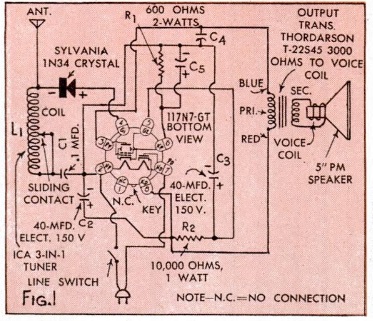
1928MayPMThe plans for this handsome three-tube set appeared 90 years ago this month in the May 1928 issue of Popular Mechanics.

This was a time when gentlemen still donned a bow tie to work on their radios.

This was a time when gentlemen still donned a suit, including bow tie and vest, to work on their radios.

The set used three 301 tubes, one serving as regenerative detector, with the other two providing enough audio for room-filling volume in the loudspeaker, even with DX stations. Other tubes could be substituted, and the cost of parts was about $27.75. Plug in coils allowed for a tuning range of 30 to 1500 meters, covering much of the longwave, medium wave, and shortwave spectrum. The article recommended a 100 foot antenna for the broadcast band, or 50 feet for shortwave.

1928MayPMSchematic


Girls in the BSA

A few months ago, the Boy Scouts of America (BSA) announced that membership in its Cub Scout (ages 6-10) and Boy Scout (ages 11-17) programs would be open to girls.  For decades, the organization’s Exploring and Venturing programs for youth ages 14-21 have been open to young women.  But the most important part of the change is that female members will be eligible to earn the BSA rank advancements, including the prestigious Eagle Scout award.

After the initial announcement, there was some discussion on social media and elsewhere, but it seems to have hit a frenzy after the announcement this week fleshing out some of the details.  This week, the BSA began registering girls for the Cub Scout program, and announced that the Boy Scout program will be known as “Scouting BSA,” with the name of the organization being unchanged.

Local Option for Separate Troops

Admission of young women will be on a local option basis.  In keeping with long-standing practice, individual troops and packs, which are “owned” by community organizations such as churches and service clubs, will make their own local decision of whom  a particular troop will admit.  If individual Cub Scout packs (up to age 11) so chose, they will be able to form separate dens (small groups of a single grade level) for girls.  Girls and boys will be in separate dens, although at the Cub Scout level, these dens may be part of a Pack made up of both boys and girls.  Typically, the entire pack meets about once a month.

At the Scout level (ages 11-17), girls and boys will be in separate troops which community organizations will now have the option to form.  (They way the change has been structured, it will actually be impossible for a girl to join any existing troop.)  In many cases, one community organization will form two troops in order to serve both boys and girls, but this will not be required.  The two troops will be permitted to have the same committee of adult leaders overseeing both troops, although each troop must have its own separate trained scoutmaster.

It is quite possible that troops made up of boys and troops made up of girls might have some activities together.  In fact, because of the local autonomy that scout troops have always had, it has always been possible for troops to pair up with girl scout troops, or any other organization, for joint activities.  But boys and girls will be in separate troops.  In short, very little will change for boys currently in the program.


In general, three groups have commented, and I think it’s safe to say that most of the discussion comes in three categories.

The first group is those (like me) who are currently involved in the BSA as parents or volunteers.  Many of these comments (such as mine) are favorable.  And the comments in opposition have generally focused on practical concerns, some of which are quite reasonable.

The second group consists of those connected with the Girl Scouts of the USA (GSUSA).  It’s safe to say that most of those comments are angry, since many in the GSUSA believe that the BSA is trying to steal membership away.

Outside Intermeddlers Crying “Political Correctness”

But the largest group of comments seems to be from those who are not involved in scouting in any way.  Many of these commenters, even though they are not involved, believe that the BSA caved to political correctness.  They generally believe that they know better than the BSA how the program should be run, even though they don’t express any desire to help the BSA run the program.  In general, they’re outside intermeddlers, and I want to spend most of my time addressing them.

I am not an outside intermeddler.  I am an Eagle Scout (1978), and also an active volunteer.  I currently serve as Assistant Scoutmaster of my son’s troop (and hope to have a similar role in my daughter’s future troop) and merit badge counselor.  In the past, I have served as Cubmaster, and member of troop and pack committees.  I’ve served on the staff of a national scout jamboree, attended a national jamboree as a youth, and I’ve been involved in district and council activities.  As a youth, I served as a lodge officer in the Order of the Arrow (OA), and am a Vigil member of the OA.

Many of these complainers believe that girls should be in the Girl Scouts, boys should be in the Boy Scouts, and the two programs should be kept separate.  There’s a certain logic to this argument, and it would even be a sound argument if the BSA and GSUSA were two branches of one larger scouting organization.  But they are not.  BSA and GSUSA are completely separate entities, and there is essentially no cooperation between them.  The programs they run are very different.  Girls currently have no program comparable to the BSA’s program.  The only connection between the BSA and GSUSA is that they are both members of international scouting organizations.  The BSA is a member of the World Organization of the Scouting Movement (WOSM), and GSUSA is a member of the World Association of Girl Guides and Girl Scouts (WAGGGS).  Since both are closed organizations,  there is no possibility for youth in the USA  being part of a scouting program sanctioned by them, other than the BSA and the GSUSA.

As far as I know, GSUSA does not allow boys to join, so boys can join only the BSA.  Until now, BSA did not allow girls under 14 to join,   So girls who wanted to join scouting had no choice but to join the GSUSA.  (When they turned 14, many made an exodus to the BSA Venturing program.)

Now, fortunately, girls under 14 have a choice.  They can join the BSA starting in kindergarten.  And when they turn 11, they will be eligible to earn BSA rank advancements, up to and including the rank of Eagle Scout.

No Changes in Requirements

The requirements for advancement will not change.  The requirements are similar to what they’ve been for years.  And importantly, they are very similar to what the GSUSA requirements were in past decades, before the GSUSA largely watered down the program.

When Juliette Gordon Low founded the GSUSA, the program was remarkably similar to the BSA’s.  It focused on outdoor activities such as camping, and even the rank advancements were very similar to the BSA’s.  For most of the 20th Century, American girls had the opportunity to take part in a program as good as, or perhaps better than, the BSA’s.

At some point, however, this changed.  The BSA is often accused of having a right-wing political agenda, but the GSUSA has a justifiable reputation of having a left-wing political agenda.  While there are many local exceptions of GSUSA troops providing excellent outdoor programs, this is no longer the norm, and GSUSA’s national leadership does not concentrate on the kind of traditional scouting program envisioned by Juliette Gordon Low.

Some girls have been able to find the good GSUSA programs.  But unfortunately, many have not been able to find traditional scouting available to them.  Even when good troops exist in an area, they are often closed to new members, whereas BSA troops are almost universally welcoming to all new members.

There is no longer an internationally sanctioned traditional scouting program for young women under 14, and someone needed to fill the gap.  And in the United States, there is only one other WOSM or WAGGGS member organization eligible to provide an internationally sanctioned scouting program.  That organization is the BSA.  With the BSA’s recent announcement, virtually all American girls who want to take part in a traditional scouting program will be able to do so, just like their brothers and 14 year old sisters have been able to do all along–they can join the BSA.

In short, the BSA had not caved in to political correctness.  The GSUSA caved into political correctness long ago by departing from the traditional outdoor program of scouting.  The one organization that was able to correct this injustice, the BSA, did so, and I applaud their courage for making a quality program available to all American youth.

Not a “Watered Down” Program

Now, let me address those who believe that allowing girls into the BSA somehow waters down the accomplishment of those–such as me–who earned the rank of Eagle Scout as a youth.   My accomplishment is not watered down just because young women are now able to join me in achieving those same requirements.  The requirements for Eagle Scout are tougher now than when I earned the award.

My Dirty Little Secret About a “Watered Down” Program

I became an Eagle in 1978, which was during a time when the BSA had switched over to an “improved” scouting program.  In a misguided attempt to become “relevant” to 1970’s urban youth, the BSA did, indeed, “water down” the requirements.  And I became an Eagle during the time that the requirements were watered down.

Before I joined scouts, there were many requirements for the rank of Eagle.  A young man (and I always disliked referring to scouts as “boys”) had to do a number of things.  He had to camp many nights.  He had to hike many miles.  He had to know how to swim.  In fact, he had to know how to swim well enough to earn the Lifesaving Merit Badge.  He had to cook meals while camping.  He had to show a lot of practical skills, most of which focused on the outdoors.

Until the early 1970’s, it was impossible to earn Eagle without doing all of these things.  That changed while I was a member.  I was not required to camp a single night.  I wasn’t required to learn how to swim.  I wasn’t required to hike even one mile.  I wasn’t required to cook a single meal.

If I had wanted to, I could have earned Eagle without setting foot outdoors.  But I didn’t, and I don’t know any scouts who did.  I was in a good troop, and we kept doing the things that scouts did.  I earned Camping Merit Badge, which required me to camp.  I earned Canoeing Merit Badge, which required me to canoe.  I earned Hiking Merit Badge, which required me to hike.  I earned Swimming Merit Badge, which required me to swim.  And I even earned Lifesaving Merit Badge, although I have to admit that I was tempted to skip it, since it was no longer required.  In short, I did all of the same kinds of things that scouts had done in the decades before me.  The only difference was that they had to do those things.  I didn’t have to, but I did them anyway.  I did them because I was in a good troop, and these were the things that good troops did.

Somewhere, there are probably a handful of 1970’s scouts who took advantage of the “watered down” requirements.  Somewhere, I’m sure there’s a 1970’s Eagle Scout who never camped a day in his life, never got in the water, and never left the comfort of his living room.  I never met one, because the troops in my area were all good troops.  But I’m sure there are a handful of them out there who took advantage of the “watered down” requirements.  Does the existence of that scout diminish my accomplishment?  I don’t think so.

Fortunately, the BSA saw the error of its ways.  They brought in William “Green Bar Bill” Hillcourt to bring the program back to its past glory.  A few years after I earned Eagle, the “watered down” requirements were erased, and once again, the Eagle rank proved that a scout knew how to camp, knew how to cook a meal outdoors, knew how to swim, and had accomplished all of the traditional things we associate with scouting.  And the fact that a handful of scouts earned the rank in the 1970’s without knowing those things doesn’t diminish the honor.

For the most part, those same requirements are in effect today.  When a youth earns the rank of Eagle, it means that he has camped a lot, that he knows how to swim, and that he’s been engaged in a vital outdoor program.  Today, more so than in my day, it also shows that the scout took part in a meaningful leadership service project.  Starting now, just as in Juliette Gordon Low’s day, American girls can prove themselves in the same way.

In a few years, the first young woman will achieve the rank of Eagle Scout.  When she does, she will have proven that she accomplished all of the same things I accomplished in scouting, even though I was not required to.  Perhaps the case can be made that those “improved” scouts of the 1970’s watered down the award.  But I’ll proudly shake the left hand of that young woman, because I will know that she proved herself more than I was required to.

For those who do object to having girls under 14 in the program, individual troops are not required to have girls as members.  (For some reason, nobody seems to object to the 14-21 year old young women who have been in the BSA venturing program for years.)  In fact, I suspect that within a few years, we will see BSA Scout troops and patrols of boys, others of girls, and probably some mixed.  Since BSA troops and packs are owned by their chartered organization, there has always been considerable local autonomy.  So there will be young men in all-boy troops earning Eagle.  The fact that some young women across town earned the award by doing the exact same requirements does not diminish that young man’s accomplishment.

Perhaps it would be better if there was a solid scouting program by the GSUSA for girls, and a totally separate BSA program for boys.  Unfortunately, the GSUSA has made this impossible for American girls.  The programs are very different, and I wish the GSUSA the best in carrying out its good, but very different, program.  But for those girls who want traditional scouting, I applaud the BSA for coming forward and making it available.  They took this action not because of misguided political correctness, but because of a sincere desire to provide for girls something that the GSUSA is not providing.

The New Name:  Scouts BSA

Finally, some have complained about the new name of the BSA’s program for 11-17 year olds, “Scouts BSA”.  This is actually not a new name.  From 1973 until 1978, the uniform I wore said “Scout BSA” above the pocket.  Prior to 1973, it said “Boy Scouts of America.”  And after 1978, it once again said “Boy Scouts of America.”  This is the one change made by the “improved” scouting program that I actually agreed with, and I’m glad this name is back.

Yes, I guess I was a Boy when I showed up at my first troop meeting in 5th grade.  But the whole point of the program was to turn me into an adult.  And it worked.  It never felt right to me to call the scouts “boys.”  We were scouts, and I always refer to youth members as scouts, rather than boys.

In a year, there will be female youth joining Scouts BSA.  But I won’t call them girls, just as I don’t call the current members boys.  They’ll be scouts, just like I was, just like the current members are, and just like the members of GSUSA were back in the organization’s history.

I’ll be proud to call them scouts, and I’ll be proud to wear with them the uniform of Scouts BSA.  And when they earn the rank of Eagle, I’ll be proud to welcome them into the ranks.  And I’m sure they’ll welcome me, even though I became an Eagle during the “watered down” requirements of the 1970’s.