Author Archives: clem.law@usa.net

1939 One Tube Regen

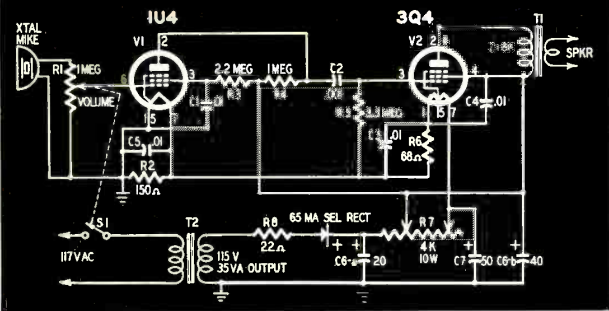
1944AprPS1Eighty years ago this month, the April 1939 issue of Popular Science showed how to put together this simple one-tube regenerative receiver.

The set employed a 25A7GT tube, which combined rectifier and pentode. The article noted that the set had a range of about a thousand miles on the broadcast band, but the parts list called for “a set” of plug-in coils. So there’s no reason why the set, with appropriate coils, couldn’t pull in shortwave signals.

The set uses the familiar “curtain burner” line cord to step down the filament voltage. Also, if you’re considering building such a set, there is an important safety reminder. Depending on which direction the line cord is plugged in, there’s a possibility that the chassis is hot. Even if you use a polarized cord to make sure the chassis is neutral, then the rectified line voltage is hooked directly to the headphones. So if you plan to recreate this particular set, please use extreme caution.

1944AprPSschematic


Rolite Trailers, 1969

1969AprPMThis ad for Rolite trailers appeared fifty years ago this month in the April 1969 issue of Popular Mechanics. The Rolite was a solid-walled trailer that folded down. A 12-volt electric motor raised the roof and front and rear walls. The side walls were then raised manually, after which the roof was jogged down a couple of inches to lock everything in place.

Rolite was originally manufactured in Grantsburg, Wisconsin, in the mid-1960’s.  By the time this ad appeared, they had become part of Larson Industries, 5000 Normandale Rd., Minneapolis.  More information on the Rolite can be found at this Facebook group.

The ad was part of a 30-page supplement on camping, which also included the ads shown here:

1969AprPM21969AprPM3

The first is for a 5 horsepower motorbike kit (with optional ski), with a name familiar to regular readers, namely Heathkit!  You can read more about the GT-18 at this link.

The second ad is for a class of product that has largely ceased to exist, namely, inexpensive, lightweight, no-frills tent trailers.  They still exist, but most are marketed as motorcycle tent trailers.  However, there’s no reason why one can’t be pulled behind a car.  While I don’t think they are available in the U.S. any more, shown below is the 1980’s era Danish made Combi-Camp trailer we owned for a few years.  Its empty weight was only a couple hundred pounds and could easily be towed by any car.  Most importantly, it allowed you to camp but sleep off the ground, which is a huge luxury, but provided even by the simple trailer shown above.

For more information about the Appleby trailer shown in the ad, see this link or this Facebook page.

CombiCamp


1934 Radio Trading Co. Transmitters

1934AprSWcraft4This ad for the Radio Trading Company, 100A Park Place, New York, appeared 85 years ago this month in the April 1934 issue of Short Wave Craft.  The top transmitter put out 15-30 watts, depending on tubes used, and retailed for $5.94.  This price included a set of coils for 160 meters, but did not include tubes.  Coils for other bands were also available.  The accompanying power supply sold for $7.98, but did not include the rectifier tube.

The transmitter at the bottom was for ten meters, and ran a dual triode push-pull.


The Radium Radio: 1944

1944Aprradiocraft1Occasionally, the radio art produces a true visionary who is many years ahead of his time. For example, most amateurs are familiar with the groundbreaking work of Larsen E. Rapp, WIOU.

Another similar visionary appeared on the pages of Radio Craft, in the magazine’s April 1944 issue.   There, Mohammed Ulysses Fips writes of the Radium Radio receiver. The set was so powerful that it required but a single tube to achieve loudspeaker volume. But the most revolutionary aspect of the set was the fact that it required no power source. Since the radium in the tube emitted radiation for thousands of years, no further power supply was necessary. And because of the power of the tube, very few other components, such as capacitors or resistors, were required. Some of Fips’ designs are shown here. As you can see, one incorporates an alarm clock feature and an ad blocker.

As might be expected, Fips proved a threat to various commercial interests, such as the Big Radio Companies, the Big Tube Companies, and the Big Battery Companies. Fips faced persecution and even kidnapping. In fact, his pet aardvark had also been kidnapped by one of the Big Radio Companies. Because of the threats, Fips decided to publish his ideas rather than attempt to personally profit from them.

For those wishing to duplicate Fips’ work, the schematic is shown below. I haven’t been able to locate the required RA-RA 4-1 tube, although like anything, I assume they show up on eBay occasionally.

1944Aprradiocraft2


How to Make a Rope Ladder

1959MarBL3If you ever need to make a rope ladder, the March 1959 issue of Boys’ Life magazine shows you exactly how to do it. This design has two great advantages. First of all, no steps are required, since the rope itself is used. And once you’re done with the ladder, you can easily undo it and have your rope back in its full length.

An even number of steps ensures that you have an even number of ends of the rope when you’re finished.


1969 High School Radio Club

1969MarPE3

Shown here are members of the radio club of William Henry Harrison High School, Evansville, Indiana. The picture appeared in the March 1969 issue of Popular Electronics, which noted that the school claimed to have the only high-school amateur TV station. The club members built the station from modified military and commercial equipment and transmitted with 100 watts on 445 MHz from an 80 foot tower.

The magazine noted that 26 members had general class licenses.


Hallicrafters Skyrider 5-10 Receiver, 1939

1939MarSWTVThe March 1939 issue of Radio and Television magazine carried this review of the new Hallicrafters Skyrider 5-10 receiver for the “ultra highs,” which at that time meant 25-66 MHz, in two bands, 25-44 and 38-66 MHz.

This, of course, covered the prewar FM band, but the biggest market for the receiver was hams, since the set covered the 10 and 5 meter bands. The set contained nine tubes, including one RF stage and two IF stages. The IF was 1600 kHz, and the second IF tube also served as BFO.

The RF stage was a new UHF tube, the 1852. The reviewer, J. Gordon Taylor, W2JCR, noted that the new tube “really provides respectable gain.” Each stage was separately shielded. To put the new receiver through its paces, the reviewer used it at his home station and at the stations of a number of other New York hams with good 5 and 10 meter equipment. It outperformed all of the existing receivers, with one exception. That exception was the station of W2AMJ, which consisted of a Hallicrafters SX17 with a homebrew 5 meter converter. The review noted that between the receiver and converter, the W2AMJ setup had a total of 15 tubes, as compared to nine with the 5-10. The 5-10 was able to pick up all of the same stations, but the homebrew converter and receiver had greater volume.


Helium, 1919

Screen Shot 2019-03-21 at 9.52.23 AMContrary to your first guess, no, this is not a picture of the Hindenburg.  Instead, the picture appeared on the cover of Popular Science one hundred years ago this month, March 1919, a full 18 years before the Hindenburg’s crash on May 6, 1937.  The picture is actually of an explosion during inflation of an observation balloon at Fort Sill, Oklahoma.

The article explained that this scene was a thing of the past thanks to the discovery of the element helium, and its great availability as a byproduct of the decay of radium in Kansas,  Oklahoma, and Texas.  But the article hints at the later disaster by asking how the first world war might have been different if the Germans had helium for their zeppelins.

As we previously wrote, despite the Roosevelt Administration’s eagerness to sell the strategic gas to Germany, Interior Secretary Harold Ickes nixed the idea, keeping helium out of the hands of the Germans.


1959 Boys’ Life Code Oscillator

1959MarBL1959MarBL2Sixty years ago this month, the March 1959 issue of Boys’ Life showed scouts how to put together this two-transistor code practice oscillator. Powered by six penlight cells, one 2N107 transistor served as oscillator, with the other as an audio amplifier. So chances are, the output was both clean and loud. The set featured both tone and volume controls, and had provision for headphones or a built-in speaker.


Live TV Blood Donation: 1944

1944FebMarNRIWe have to admit that today’s vintage TV program isn’t quite as good as the one we shared yesterday, in which a shortwave receiver was built from scratch before live TV cameras. But radio parts were hard to find during the war, so WRGB in Schenectady, NY, had to work with what was available, and that was blood.

The February-March 1944 issue of National Radio News detailed another “first” in American television, namely the first broadcast of an actual blood donation. As part of a three-part broadcast showcasing the American Red Cross, the blood donation was done live on the air. Another part of the broadcast showed it being processed into plasma.

The program concluded with the scene shown above, the staging of a battlefield scene where the plasma was administered.