End of Wartime Civilian Radio Production

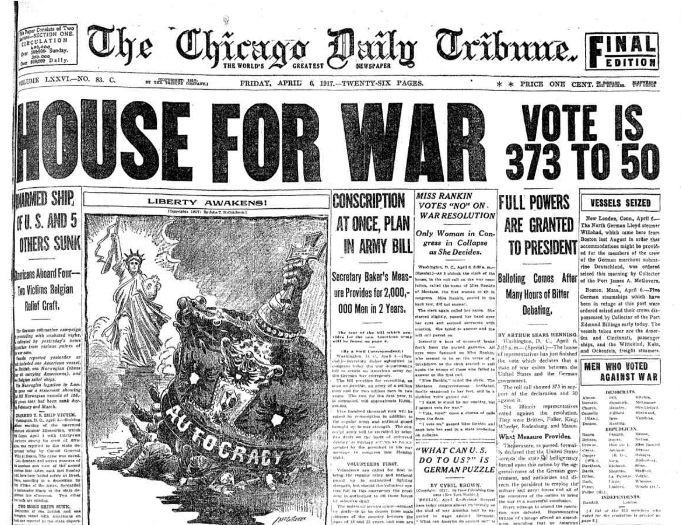
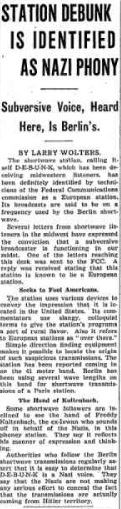
1942Mar8ChiTribWPBOn this day 75 years ago, March 7, 1942, the War Production Board (WPB) ordered that civilian radio production would cease on April 22, as reported in this clipping from the March 8 Chicago Tribune.

As of that date, the entire industry would be on a wartime footing, and the entire industry, with the exception of replacement parts production, would be converted to war production.

A billion dollars worth of war orders were already in the pipeline, and half of that business was to companies making home radio sets. The WPB acknowledged that some unemployment would result as companies switched over to war production, but it was estimated that 95 percent of the conversion would be complete by the end of June.

The board estimated that when the last civilian set rolled off the assembly lines, there would be 60 million sets in operation, with a set in 87% of American homes.

More details of the order can be found at our earlier post.


1947 Portable Phono-Radio

1947MarPS

Seventy years ago this month, the March 1947 issue of Popular Science showed how to put together this portable radio phonograph.  It was by no means deluxe, but it was the epitome of portability.  The magazine noted that in most cases, the “portable” terminology meant only that a handle had been slapped onto the cabinet, and the set was still tethered by the need for electrical current.   But in this case, a crank-up phonograph motor and a one-tube battery powered amplifier meant that it was truly portable.

The electronics consisted of a 1D8GT tube powered by two batteries, a 1.5 volt cell for the filaments, and two 67.5 volt batteries providing 135 volts B+, although it noted that it would work with as little as 90 volts.

The magazine noted that the spring motor should be set to 80, which would result in it running at the desired 78 RPM with a record on the platter.

The radio was simply a crystal set with a fixed crystal, which could be switched in place of the phonograph’s pickup cartridge.  While the radio strength was not great, it would serve to pull in local stations, especially with an external antenna and ground of some sort.

1947MarPSschematic


Underground Dutch WW2 Radio Receivers

Another collection of clandestine Dutch radios.

Another collection of clandestine Dutch radios.

Clandestine radio concealed in book.

Clandestine radio concealed in book.

When the Nazis invaded the Netherlands, they didn’t want to deal with the possibility of the Dutch tuning in foreign radio broadcasts. So in the spring of 1942, they simply confiscated all radio receivers.

Undaunted, Dutch radio enthusiasts simply went underground and constructed sets to listen to the BBC and Radio Boston to learn how the war was going. A number of interesting radios were described in the March 1947 issue of Radio Craft, in an article by one Mr. J. Maquerinck, who described sets built by himself and others.

The simplest, or course, was the venerable crystal1947MarRadioCraft3 set, such as the one shown here, constructed by one of the author’s friends. This set pulled in England quite well and was constructed in a wooden box. When the friend wanted to listen, he opened the box, hooked up an antenna and ground, and tuned in the BBC.

Another friend, who had in his possession a vacuum tube, constructed the simple one-tube set1947MarRadioCraft4 shown here. This friend had no variable capacitor, but the coil wound on an iron core provided adequate selectivity, and was sensitive enough to pull in England.

1947MarRadioCraft1The author himself wanted to avoid the complication of an external antenna, which could be seen. He was fortunate enough to own a dual tube, which he was able to use in the circuit shown here as RF amplfier, grid-leak detector, and audio amplifier. To conceal the set, he hollowed out his telephone and built it inside the phone cabinet. His finger served as enough of an antenna to pull in the BBC on 200 kHz. The telephone’s ground connection served as the radio’s ground.

To avoid detection, he had the phone set up so that the dial had to be turned to 7 to power up the radio. As an added precaution, he placed above the radio the sign shown here, meaning “Take care, don’t use. Defective!” He noted that the loss of the telephone wasn’t much of a loss, since it had been out of order most of the time anyway.

1947MarRadioCraft5

This “real radio-telephone” was never discovered. In September 1944, the civilian population of the author’s town was evacuated. When he returned, everything else in the house had been stolen, but the receiver remained.  I guess even Nazis were afraid of messing with the telephone company’s equipment.

The author was evacuated to the town of Aalten, population 10,000. The owner of the home in which the author resided had not previously owned a radio, but the town’s serviceman constructed a regenerative which used plug-in coils, one for 200 kHz and the other for 1000 kHz. The 200 kHz frequency was used to tune in the BBC, and 1000 kHz was the frequency of a station in a part of Holland that had already been liberated.

For another look at clandestine radio receivers used during the war, see our prior post on radios in occupied Guernsey.

Radio concealed in camera, constructed by of , Holland.

Radio concealed in camera, constructed by F.M. Leopold of Eindhoven , Holland.


1942 Popular Mechanics Phono Oscillator

1942MarPM11942MarPM2

Seventy-five years ago this month, the March 1942 issue of Popular Mechanics carried a construction article for this portable phonograph oscillator.  Mounted in the always available cigar box, the one-tube record player used a 117L7-GT tube to produce a signal that could be tuned in on any nearby radio.

The tone arm could be removed when not in use, and plugged in with two phone tip plugs to hold it in place and make the electrical connection.

Since the phono oscillator only required one tube, and didn’t need an expensive speaker or transformer, they were quite popular for playing records for those who already had a radio.

For use right next to the radio, no external antenna was required.  For a bit more range, a short piece of wire could be added.  The coil inside was wound on a one-inch piece of cardboard, and a variable condenser could be tuned to a blank spot on the dial.

1942MarPMschematic


1937 Snow Speaker

1937MarchRadioCraftSnowSpeaker

March is the snowiest month, so there should still be plenty of time to construct the speaker shown here. This speaker was shown 80 years ago in the March, 1937, issue of Radio Craft, and had a number of technical advantages. Since the packed snow has no resonant frequency of its own, the overall frequency characteristics of such a speaker would be excellent. And since the construction material is free for the taking, it allowed a large true exponential curvature.

1937MarchRadioCraftSnowDrillTo construct, simply take a snowball and roll it around until it’s about five feet in diameter. Then, you take your previously prepared “drill,” the exponentially-shaped board, and push it into the snowball untill a cone-shaped hole has been cut. You smooth out the interior by hand, and then place an 8 inch speaker at the back of the snowball (using wax paper or cloth to separate the speaker from the snow).

The magazine suggested that this speaker would be ideal at venues such as skating rinks, hockey games, toboggan slides, or winter carnivals. You can construct a number of them and connect them to a suitable radio or PA amplifier.

Not only will such a snow speaker produce a fine quality of reproduction, but it attracts a great deal of interest.


U.S. Marine Corps Mimeograph, 1942

1942Mar2Life

75 years ago today, this ad in the March 2, 1942, issue of Life magazine reminded readers that there was a war to be won, and the United States Marines were busy doing just that. And you can’t win a war without making sure your duplicating needs were taken care of.

The Marine shown here “stands for no nonsense, asks no quarter and gives none when the honor of the Corps is at stake. But he keeps a fatherly watch on the young recruits, start them off on the was to promotion and pay, sees that they stay on the track.”

Corps equipment, like the Corps itself, had to be rugged and ready. And that’s why the busiest, most trusted means of communications in the Corps was the Mimeograph duplicator. It had accuracy and speed, and its black-and-white crispness stodd up when the going got tough. “With its integrated stencil sheets and inks, it is on duty wherever Marines are stationed.”


1942 Popular Mechanics “Little Giant” Receiver

1942MarPMLittleGiantEach March, Popular Mechanics carried plans for a receiver dubbed the “Little Giant,” and the 1942 version is shown here.

With a war going on, this one differed in that it had been stripped of all unnecessary frills and designed for economy.  But the little four tube AC-DC set still offered high grade performance with its superheterodyne circuit, featuring automatic volume control, an electro-dynamic speaker, and vernier tuning.  The set’s open chassis construction also made it easier to build than earlier models.  It tuned from the bottom of the broadcast band to 18 MHz, with three plug-in coils used to change bands.

1942MarPMLittleGiantSchematic


Erec-Tronic Kit, 1957

1957FebRadioElec

Sixty years ago this month, the February 1957 issue of Radio Electronics featured this electronic kit for beginners, the Erec-Tronic. The magazine noted that similar outfits had been around for a long time, but they usually amounted to a wooden breadboard with a few rows of Fahnestock clips. But the Erec-Tronic was the ultimate in educational kits, thanks to the Jiffy-Clip, which could be used horizontally as an alligator clip, as shown on this illustration. But it could also be slid over the pins banana-plug style for quick assembly and disassembly.

The set was touted as a natural for the boy who was just taking an interest in things electronic. It quickly de-mystified schematic diagrams, since the parts could simply be placed right on top of the schematic template to form circuits, such as the code practice oscillator shown here.

The Jiffy connector also removed the necessity for the “mess, dirt, or danger” of solder for the young electronic experimenter. The set shown here sold for about $17, and a transistor version was also available for $13. But these sets were not limited to beginners. Big kits for industry or education were also available with over 300 resistors, 100 capacitors, and scores of sockets and potentiometers, with large basis for assembling advanced circuits. These sold for up to $395.


1937 Popular Mechanics Hurricane Receiver

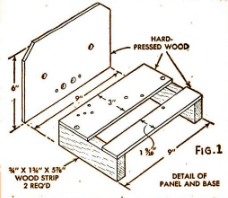
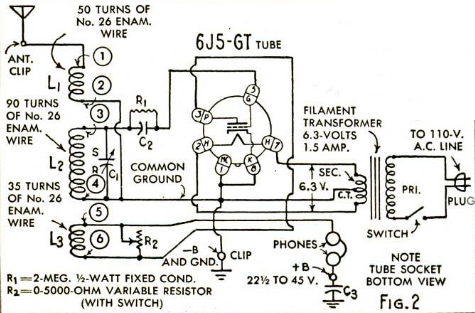
1937FebPM4Eighty years ago this month, the February 1937 issue of Popular Mechanics carried the plans for this “hurricane receiver.”

Even though it required only about $5 worth of parts to build, the ultracompact set would serve as a rugged portable set which could pull in news during emergencies such as hurricanes. The set, both B+ and filaments, required only 6 volts, and could be run off dry cells for about 12 hours, or from a 6 volt car battery for about 75 hours.

The circuit was a regenerative detector followed by one stage of audio amplification to drive headphones. A 25 foot antenna was recommended, and the set was able to pull in stations up to 500 miles away.

If this set looks familiar, it’s because we’ve featured it here before.  After the plans were published in Popular Mechanics, the set was available as a kit from the  1939 Allied Radio catalog, as we featured in an earlier post.  We’ve also covered an updated 1943 version of the set, which was billed as a wartime emergency blackout set.

1937FebPM5


Justice William O. Douglas, 1947

1947Feb24Life

Shown here 70 years ago at the soda fountain of a drug store near the U.S. Supreme Court is Associate Justice William O. Douglas.

The 17 year old soda jerk serving him is his daughter, Mildred Douglas, and the picture appeared in the February 24, 1947, issue of Life magazine. According to the magazine, she was somewhat abashed by the publicity, and announced that she took the job for the money, earning 65 cents per hour. Her younger brother, Bill, 14, had a paper route.

Douglas was four times married and three times divorced. He divorced Mildred’s mother, also named Mildred, in 1953.  The children were subsequently estranged from their father, and the younger Mildred was later quoted as saying that the Justice “never talked to us like we were people” that “when he got angry at us, which was often over the slightest things, he would simply not speak to us for days on end,” and that she “didn’t like him very much because of the way he treated my mother.”

When the elder Mildred died, the Justice was not immediately informed, since neither sibling felt the desire to inform him.