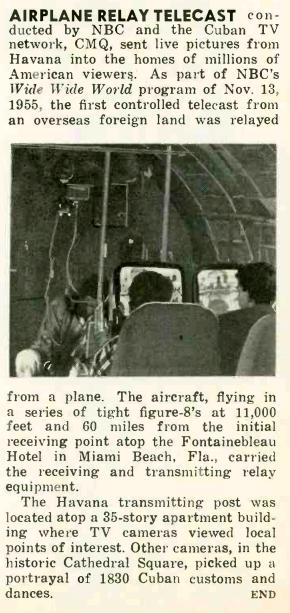
Sixty years ago this month, the January 1956 issue of Radio Electronics carried this item about a relay of a telecast from Cuba to the United States. The program, carried by NBC, originated with CMQ in Havana.
Cuba was the first country in Latin America with television, and by 1954, it had a national network, with CMQ as its flagship station.
This 1955 program was relayed from atop a 35-story apartment building in Havana to an aircraft doing figure 8’s halfway between Havana and Miama. It relayed the program to NBC’s receiving equipment atop the Fontainbleau Hotel in Miami Beach.
For more discussion of the use of aircraft to relay TV signals, see my earlier post about Stratovision.
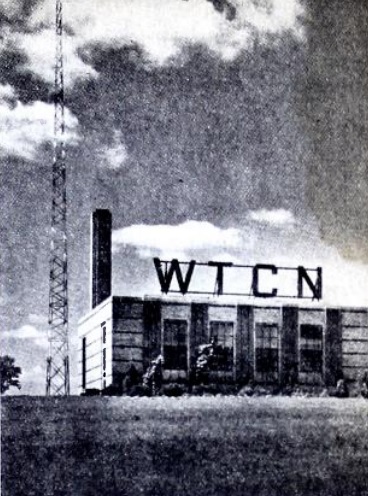
Shown here is a photo of WTCN radio in Minneapolis as it appeared in 1935. The image is from the January 1936 issue of Radex magazine.
The station originally came on the air as WRHM, licensed to Rosedale Hospital at 4429 Nicollet Avenue in Minneapolis. In 1929, it became a CBS affiliate, switching to the NBC Blue Network in 1937.
In 1934, then on 1250 kHz, the station was sold to Twin Cities Newspapers, a partnership of the St. Paul Pioneer Press and the Minneapolis Tribune, at which time it took the WTCN call letters for “Twin Cities Newspapers”. The transmitter building shown here was near Snelling Avenue and Highway 36 in Roseville, where it remained until 1962. In March 1941, the station moved to 1280 kHz in accordance with NARBA. In 1964, the station took the WWTC call letters.
The WTCN call letters were used two other times in Minnesota broadcast history. The second television station in the area, channel 4, was originally co-owned with WTCN radio, and signed the WTCN-TV call letters. The call was later held by channel 11. The call letters are now gone from the Minnesota airwaves, instead being used by a low power station in Florida.
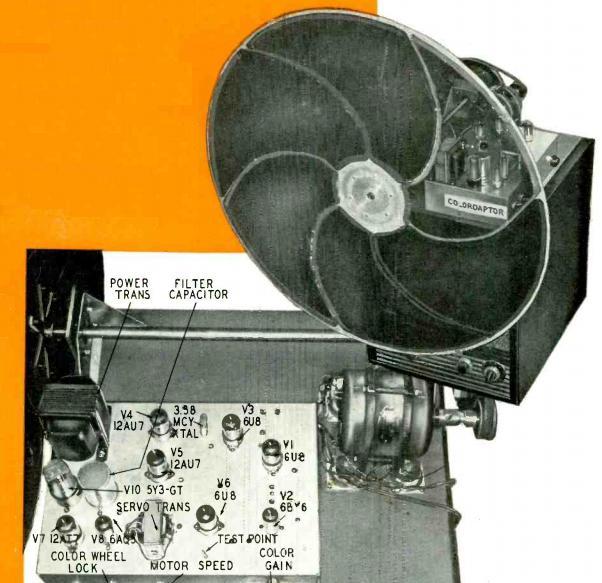
Sixty years ago, the next big thing was color TV, and if you really wanted color, the January 1956 issue of Radio Electronics showed you the cheapest way to do it. All you needed was your existing black and white set, and for about $85 ($50 if you had a well-stocked junk box), you could build yourself a Colordaptor.
The general idea is apparent from the picture above. A color wheel in front of the screen would alternate red, green, and blue filters. All that needed to be done was to synch them with the corresponding colors being transmitted. This was accomplished with the six tube circuit shown in the article. Some of the parts were available from the Colordaptor Company of Palo Alto, California, which also sold the device commercially.
Since the color wheel needed to cover the entire screen, it also extended above the screen, so it was hardly a compact design. But if you didn’t mind the contraption on top of your set, and you didn’t mind it spinning while you watched, you would probably be the first on your block with a color TV.
The chasis of the Colordaptor could mount permanently on top of the set. The color wheel could be removed for viewing black and white programs.
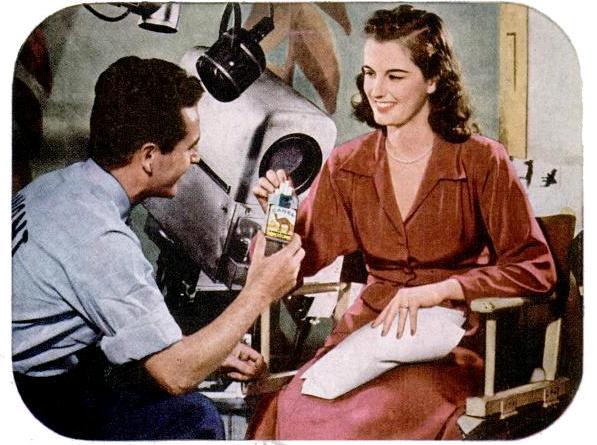
Seventy years ago today, life was good. The War was over, television was becoming a reality, and you could buy a pack of Camels whenever you wanted. Shown here in the December 10, 1945, issue of Life Magazine is Loretta A. Brophy, getting ready to enjoy a Camel during a break from her busy job as program director at the New York DuMont television station, WABD.
The ad also showed Miss Brophy rehearsing with a song-and-dance team, but pointed out that the next day, it might be a quiz program or grand opera. Miss Brophy called her job “fast, exciting, fun!”
And when she called “cut,” that meant the show was over, but Camels were still in order. She reported that during the wartime cigarette shortage, “when I couldn’t get Camels, I smoked anything I could get, more different brands than I can remember. That’s when I learned really to appreciate Camels–there’s nothing like a Camel.”
Other than this advertisement, I wasn’t able to find any other references to Miss Brophy, although she was obviously one of the pioneers of television. She wasn’t alone, as women held a number of important positions.
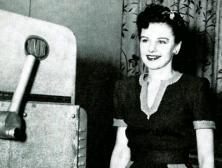
While not mentioning Miss Brophy, the Spring 1945 issue of Televiser carried a feature entitled “Women in Television.” At WABD, when the wartime manpower crisis put a damper on hiring, “women in slacks blossomed forth as ‘cable engineers’ (studioese for people who haul co-axial cables out of the way of the cameramen). One of WABD’s early staffers was Dotty Wooten, shown here. She was hired as a stenographer in 1943, but was one day called in to fill an emergency slot as announcer. The magazine reported that she had filled the announcing post ever since.
In our previous post about WABD, we noted that the station really had no full-time staff when it first came on the air. The station was on the air three evenings a week, and was largely staffed by workers at DuMont’s New Jersey war plant. With men off to war, it wasn’t surprising that women were called on to staff the station.
The same issue of Televiser gave some insight into the challenges faced by Miss Brophy in her job. Directing a television program was challenging, as it involved careful choreography of the cameras. Each of the large cameras was fed with a thick coaxial cable from behind. Therefore (except perhaps with the assistance of one those cable engineers), it was impossible for one camera to cross behind another. Therefore, one camera had to be already in place for the next shot before the second camera “dollied in” for a closeup. Interestingly, the byline for the sidebar explaining this choreography was that of a woman, one Patricia Murray, also on the staff of WABD.
The war was over, and the American public was hungry for television. A handful of markets already had stations using the same format that would remain in use for seventy years. For example, the predecessor of WNBT-TV came on the air in New York in 1939. And the predecessor of WABD signed on in 1944. And starting in 1942, Los Angeles had the station that would become KTLA. But most of the nation was dark as far as television signals. To get signals to a significant proportion of the populations would require hundreds of stations. And getting network programs to those stations would require either hundreds of microwave relay stations, are a coaxial network estimated to cost a hundred million dollars.
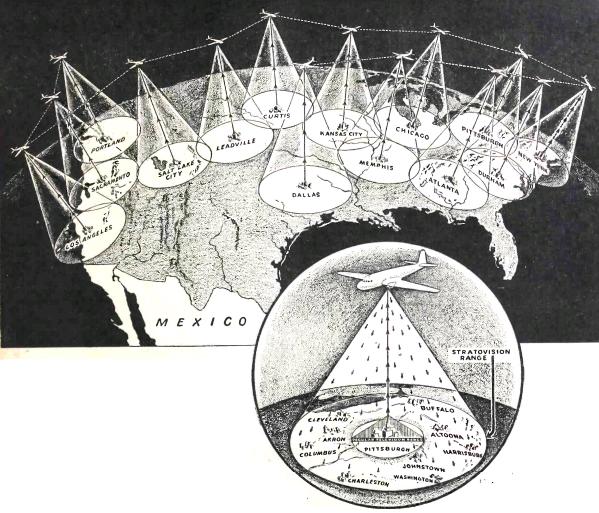
Stratovision provided an alternative. The plan was proposed in 1945 by Westinghouse, and was the brainchild of engineer C.E. Nobles. Under the plan, fourteen aircraft would fly at the predetermined locations shown on the diagram at an altitude of 30,000 feet where they would continually orbit their designated location. They would transmit VHF and UHF television signals, as well as FM broadcasts. Because of the antenna height, each plane would provide a good broadcast signal to an area 422 miles in diameter. And because there would be no terrain that would need to be overcome, the transmitters could operate with much less power than ground-based stations.
The system also solved the problem of delivering network programming. Only eight planes would be required to link New York with Los Angeles. The planes would establish a reliable network whenever they were in flight, and the fourteen planes would provide broadcast television to 78% of the country’s population. The plan called for each plane to broadcast four television and five FM signals.
The plan may appear far fetched to some, but it is sound, and would result in a workable national network. The system was tested by Westinghouse in 1948 and 1949, as seen in this photo. In one 1949 test, the aircraft shown here, a B-29, relayed the signal of WMAR-TV in Baltimore on channel 6, using a 5 kW video and 1 kw aural transmitter. In June 1948, the same aircraft was used to rebroadcast the Republican National Convention in Philadelphia for one hour. As part of the test, a receiver was set up in Zanesville, Ohio, where it was used to demonstrate to the gathered newspaper reporters that the system was capable of reaching small town and farm homes.
Reception reports were solicited, and many were received. From the reports, Westinghouse confirmed that eight planes would provide the transcontinental relay.
There’s nothing technically unfeasible about Stratovision. The reason why it never took off (pardon the pun) was probably the mere fact that broadcast stations did spring up nationwide. They were initially provided with programs by kinescope recordings, but microwave and coaxial transmission quickly came into place. For example, by 1950, the Minneapolis/St. Paul market was getting the national networks live, by means of a coaxial cable from Des Moines, which was in turn linked to Chicago by microwave relay. Once the network signal was in place, there was no need for Stratovision’s relay services. And by this time, most major cities had multiple stations, and smaller markets had at least one. And for those far in the hinterlands, there were herculean efforts to get the distant terrestrial signals, such as those use in the tiny communities of Ellensburg, Washington and Marathon, Ontario.
But despite the fact that Stratovision was never adopted for its intended purpose, it did live on, and continues to do so, in some specialized niches. For example, between 1961 and 1968, educational programs were broadcast from two DC-6AB aircraft based at Purdue University by the Midwest Program on Airborne Television Instruction (MPATI). The MPATI aircraft would fly in a figure-8 pattern for six to eight hours at a time at 23,000 feet above a point just north of Muncie, Indiana. Prerecorded educational programs were broadcast on UHF channels 72 and 76, with call letters KS2XGA and KS2XGD. The transmission diameter was 200 miles, and covered both the Chicago and Detroit metropolitan areas.
Between 1966 and 1972, the U.S. Navy used Stratovision to broadcast two channels in the area surrounding Saigon, South Vietnam. One channel was intended for the Vietnamese audience, with the other providing information and entertainment programs to U.S. servicemen. Armed forces programs were carried on channel 11, with call letters NWB-TV, with the Vietnamese program on channel 9 with call letters THVN-TV. The aircraft also broadcast on 1000 kHz AM and 99.9 MHz FM. The Vietnamese program typically ran 1-1/2 hours per day, with the armed forces channel running three hours per day. American programs included Bonanza, Perry Mason, Ed Sullivan, and the Tonight Show.
Pennsylvania Air National Guard Commando Solo aircraft preparing to depart for emergency broadcasts to Haiti in 2010. Department of Defense photo.
The U.S. military continues to use EC-130 Commando Solo aircraft to provide PSYOPS broadcasts during war. Most recently, only radio programming has been used. But the aircraft is capable of television transmissions. For example, in 1999 in the former Yugoslavia, some television programming, using Yugoslavian broadcast format, was transmitted from aircraft. Typically, Commando Solo transmits an FM program, along with broadcasts on the standard AM band and short wave. For AM and short wave, the airborne transmitter has no particular advantage, other than providing a secure location to house the station. But on FM, the signal, like the original Stratovision concept, takes advantage of the aircraft’s altitude, and can provide a strong broadcast signal over a large area with a relatively low powered transmitter. The photo here shows a Pennsylvania Air National Guard Commando Solo aircraft preparing to depart for Haiti to make emergency broadcasts in the wake of the 2010 earthquake.
During the 2011 attack on Libya, Commando Solo aircraft broadcast information. Transcripts of the broadcasts are available at PsyWar.org. Since the Libyan broadcasts were carried on short wave as well as FM, they were heard by short wave listeners worldwide, including myself. A recording of the transmissions can be found at this video:
Seventy years ago today, NBC took out a two-page ad in Life Magazine, October 15, 1945, promoting itself as America’s No. 1 Network.
In addition to promoting its radio programs, it offers a reminder that “‘The Tomorrow’ people talked of only a short time ago, is here today.” It points out that thousands in New York were already enjoying visual entertainment, news, sports, fashion shows, dramas and other programming from WNBT. The ad points out that five large advertisers were already on board, and as more sets became available, larger TV audiences would be able to find visual pleasure in the words, “This is the National Broadcasting Company.”
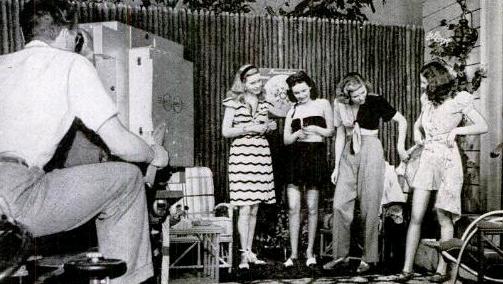
The production shown here is apparently one of those fashion shows going out over the station which had first signed on in 1939. The station already had competition from two other stations, including Dumont station WABD.
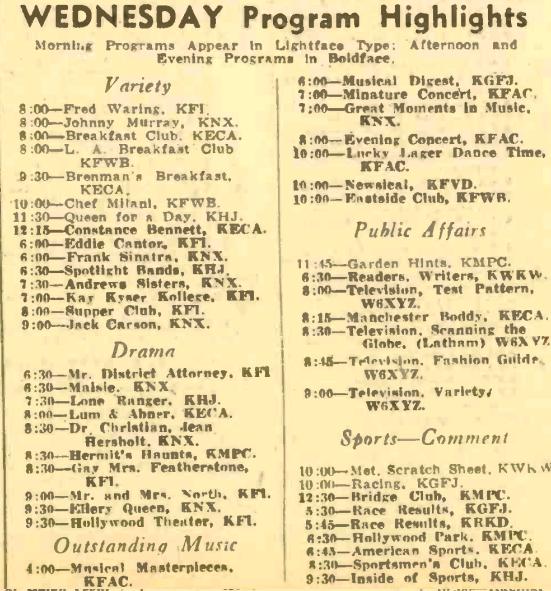
Here is what was on the radio 70 years ago today, October 10, 1945, in Los Angeles. This listing is taken from that week’s issue of Radio Life, which contains, in addition to these highlights, the complete program listings.
You’ll see that there are three television programs, on station W6XYZ, the predecessor of KTLA. The station was owned by Paramount, received its construction permit in 1939, and came on the air for the first time in 1942, on channel 4. The station received its commercial license and the KTLA call letters in 1947, the first commercial television station west of the Mississippi.
On this day, starting at 8:00 PM, the station signed on with a test pattern that ran for a half hour, followed by “Scanning the Globe” at 8:30, “Fashion Guide” at 8:45, and “Variety” at 9:00.
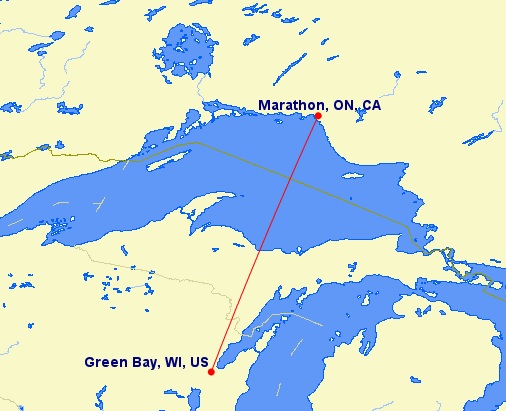
In 1953, Marathon, Ontario, was a full 300 miles away from the nearest TV station, WBAY channel 2, in Green Bay, Wisconsin. That distance didn’t stop Grant Ross from deciding that the town needed television, and he set out to deliver. He discovered that from a hill 300 feet above the shore of Lake Superior, the signal was perceptible, and he set out to get reliable reception. Half of the path between Green Bay and Marathon was over the waters of Lake Superior. However, Green Bay was on the shores of Lake Michigan, and the signal had to cross 152 miles of Wisconsin and Upper Michigan countryside before reaching the unobstructed waters of Lake Superior. But it did so, and Ross was intent on providing a signal to the town. He wound up constructing a rhombic array on 45 poles mounted atop the hill. This signal was fed down to the town on an 1800 foot transmission line. A 1955 report showed that he received “excellent” signals at least 40% of the time. Reception was “poor or useless” only 20% of the time.
Ross signed up over 400 homes for his pioneer Community Antenna Television (CATV) systam, collecting a $50 installation fee from each. In addition, the monthly subscription for the service was $2.50.
A few years later, channel 2 came on the air in Port Arthur, Ontario (now Thunder Bay), and he switched the service to that. The rhombic was rebuilt to receive the new signal from WLUC in Marquette, Michigan, which was a relatively easy catch, being 166 miles away, but with a path entirely over the waters of Lake Superior.
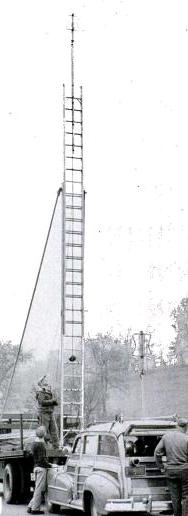
The contraption shown here was part of a 1950 RCA test of the capabilities of UHF television. The truck, carrying an extension ladder, cruised the streets of Bridgeport, Connecticut, to test the signal being put out by its experimental UHF television station, KC2XAK.
Inside the station wagon was a TV receiver evaluating the quality of the picture being received from the antenna atop the ladder.
The article from which this picture is taken, the August 1950 issue of Popular Science, points out that cities such as Bridgeport faced challenges getting television. With only twelve VHF channels allocated, the stations in New York had already filled the quota. Bridgeport was too far away for good over-the-air reception, but too close to use the same channels in use in New York or the adjacent ones. The solution was seen in setting up a “slave” UHF station. KC2XAK was rebroadcasting the signal of WNBT in New York, to about 100 homes in Bridgeport that had been equipped with UHF converters. The video was received by the relay station from a microwave feed from the Empire State Building. The audio was simply received over the air for retransmission.
The article noted that reception by the test households was good, and that UHF offered a promising way to deliver television to smaller cities.
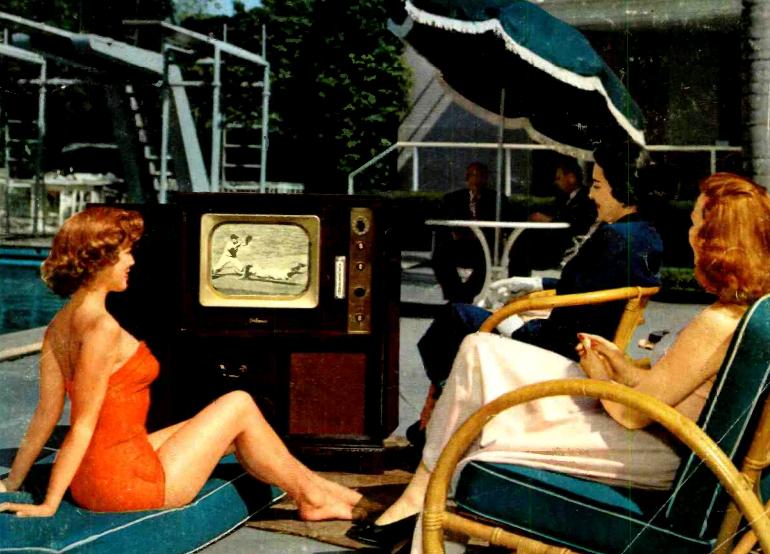
65 years ago, the young women shown here were enjoying the Hoffman Model 947 television poolside at the Beverly-Wilshire Hotel in Beverly Hills. The accompanying article in the July 1950 issue of Radio News notes that until recently, such activity would have been impossible, since full enjoyment of the program necessitated darkness or semi-darkness, not to mention what to do with the unwieldy line going to the antenna.
But that was all in the past, since black-faced picture tubes and improved circuit designs had resulted in greater brightness and better receiver sensitivity. A prominent motion picture star had been discussing the problem with the president of the set’s manufacturer, and had been enjoying programs poolside for quite some time. The idea soon spread, not only to the Hollywood elite, but to the area hotels.
At the Beverly-Wilshire, every warm day would find a group of swimming and sunbathing guests clustered around the set that had been wheeled out for their viewing pleasure.
And if the set ever needed servicing, the same issue advertised, for only $6.95, a high voltage probe rated at 30,000 volts, just the thing the serviceman would need if some unfortunate guest splashed a little too much water on it.

 Sixty years ago this month, the January 1956 issue of Radio Electronics carried this item about a relay of a telecast from Cuba to the United States. The program, carried by NBC, originated with CMQ in Havana.
 The plan may appear far fetched to some, but it is sound, and would result in a workable national network. The system was tested by Westinghouse in 1948 and 1949, as seen in this photo. In one 1949 test, the aircraft shown here, a B-29, relayed the signal of WMAR-TV in Baltimore on channel 6, using a 5 kW video and 1 kw aural transmitter. In June 1948, the same aircraft was used to rebroadcast the Republican National Convention in Philadelphia for one hour. As part of the test, a receiver was set up in Zanesville, Ohio, where it was used to demonstrate to the gathered newspaper reporters that the system was capable of reaching small town and farm homes.