Category Archives: Television History

TV in New York Taverns: 1941

1941AugRadioRetailing1

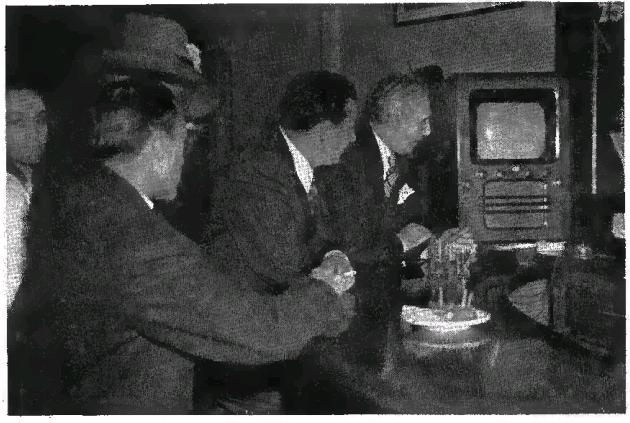
Seventy-five years ago, television was making its appearance in New York taverns, as reported in the August 1941 issue of Radio Retailing magazine.

In the photo above, the set is placed at a spot in the bar “where it keeps feet on rails longer,” while some other highbrow establishments had built the set into the wall.

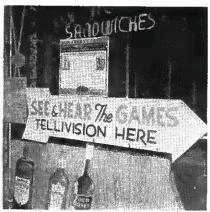
1941AugRadioRetailing2The article noted that hundreds of Du Mont sets had been installed in public places around New York. The public intitially flocked to them out of curiosity, but when commercial broadcasting was authorized on July 1, 1941, having a set in a tavern or cafe became a practical trade benefit.

The biggest draw was sports, with boxing, wrestling, baseball, basketball and football being the most popular, in that order. However, other programs proved popular, such as news events. “Some taven and cafe owners even advise that fashion programs have brought in some ladies!”

Sets were typically placed in the bars on a trial rental basis for a month or two.  Almost invariably, after the initial term, owners discovered that the sets were paying for themselves in increased trade.  They then had the option of continuing the rental, or applying rental payments to purchase of the set.

Click Here For Today’s Ripley’s Believe It Or Not Cartoon


First Televised Wedding, 1931

1931JulyTVNews

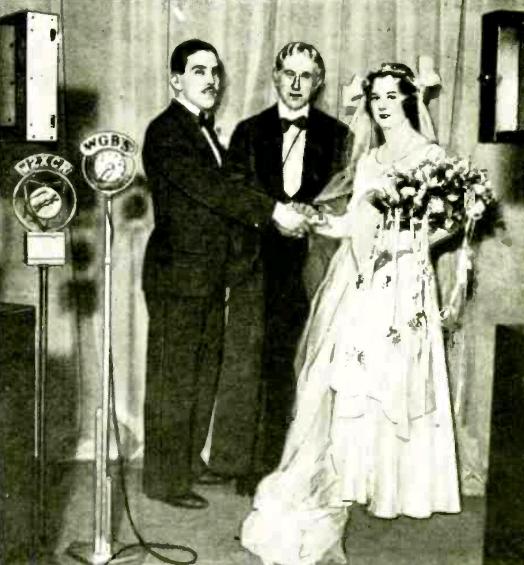
The first ever televised wedding took place 85 years ago, as shown here from the July-August 1931 issue of Television News.

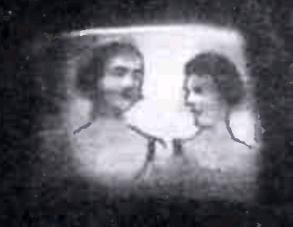
The bride and groom, Grace Jones and Frank Du Vall were wed by Dr. A. Edwin Keigwin of the West End Presbyterian Church over the airwaves of W2XCR-WGBS. The video was transmitted over W2XCR, with the synchronized audio being transmitted over WGBS. The magazine reported that thousands of visualists were trilled by this marvel of modern science.  Du Vall was apparently a station engineer

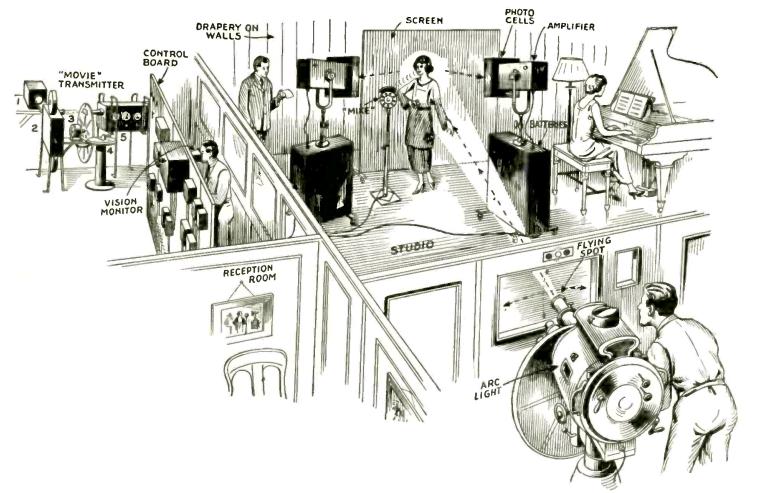
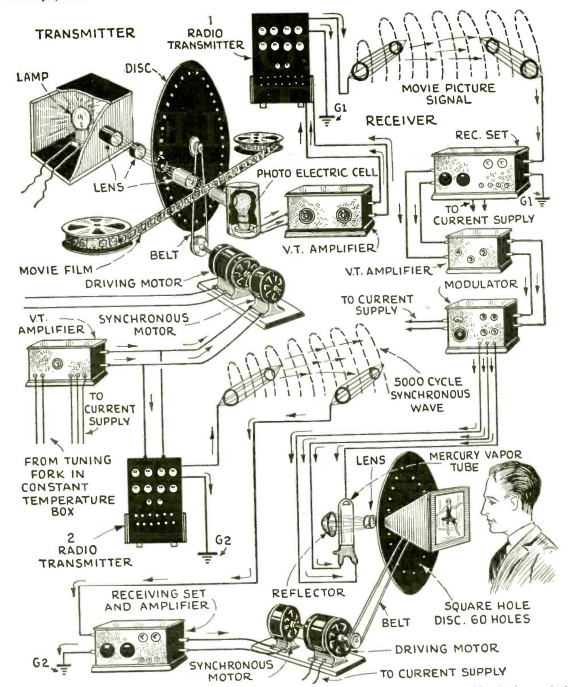
The television studio and 500 watt transmitter were located at 655 Fifth Avenue, New York City. The station used a mechanical system employing a strong arc light with a rotating disc with a “flying spot” to do the scanning. The visual pickup consisted of fixed photocells. The more conventional system at the time placed the spinning disc in front of the photocell. The system used by W2XCR essentially consisted of a beam of light that scanned the subject, synchronized with the spinning disc on the receiver. The system used 60 lines and scanned 20 pictures per second.  The general idea is shown in the illustration here:

1931JulyTVNews2

The sound was sent by wire to WGBS at Astoria, Long Island.  According to the Spring-Summer 1931 issue of White’s Radio Log, WGBS operated on 600 kHz with 250 watts of power.  The station’s call sign represented its owner, Gimbel’s Department Store, and the station is the predecessor of WINS.

 W2XCR, licensed to Jenkins Television Corporation, operated on 2000-2100 kHz or 2750-2850 kHz.

According to the 1940 census, the couple was happily married and living in Essex, New Jersey, on their ninth anniversary.  The clergyman, Dr. Keigwin, appears to be the author of the 1899 hymn, The Someday By and By.

Click Here For Today’s Ripley’s Believe It Or Not Cartoon


Commercial TV Turns 75

Today marks the 75th anniversary of commercial television broadcasting in the United States.

On May 2, 1941, the FCC issued the first ten commercial television licenses. (Many of these stations had been operating under experimental licenses prior to this date.) Under the license terms, the stations were required to broadcast fifteen hours per week.

The first television commerical is shown in this video. It aired on WNBT New York before a baseball game between the Brooklyn Dodgers and Philadephia Phillies.

References

Radio Today, July 1941, p. 28.

 
Click Here For Today’s Ripley’s Believe It Or Not Cartoon


TV Pioneer Eleanor Thomas, W9XBY/W9XAL, Kansas City, 1936

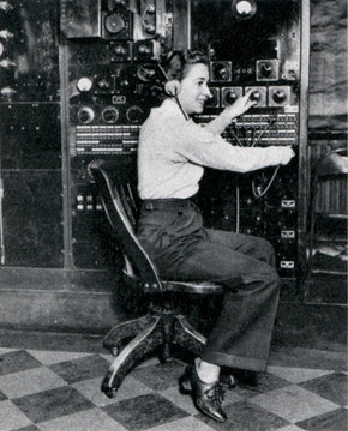
1936JuneModernMechanEighty years ago, this month’s issue of Modern Mechanix, June 1936, featured eighteen-year-old Eleanor Thomas, the assistant engineer of stations W9XBY and W9XAL, Kansas City, Missouri. Billed as a “mathematical genius for a girl,” Miss Thomas reportedly found life on a college campus too prosaic, and instead entered an engineering school, namely the training division of First National Television, Inc.

First National Television was the licensee of the two stations. According to its 1934 QSL card, W9XBY was one of four “high fidelity” stations operating in the United States, just above the top end of the standard broadcast band, which then extended to 1500 kHz, at 1530 kHz. The 1000 watt station operated from the 29th floor of the Power and Light Building, and had its transmitter near 86th and Wornall Road.

W9XBY operated as the voice channel for television station W9XAL, one of the first television stations to operate on the VHF band, licensed to operate on 42-56 MHz. While the station was initially a mechanical television station, it had both electronic and mechanical equipment in 1936. By 1939, it was all electronic.

The article noted that Miss Thomas was the “youngest member of her sex ever to pass the difficult examinations for a first class operator’s license from the Federal Communications Commission.

More information about the station can be found in the July 1991 issue of Popular Communications.

Click Here For Today’s Ripley’s Believe It Or Not Cartoon


1931 Electronic Television

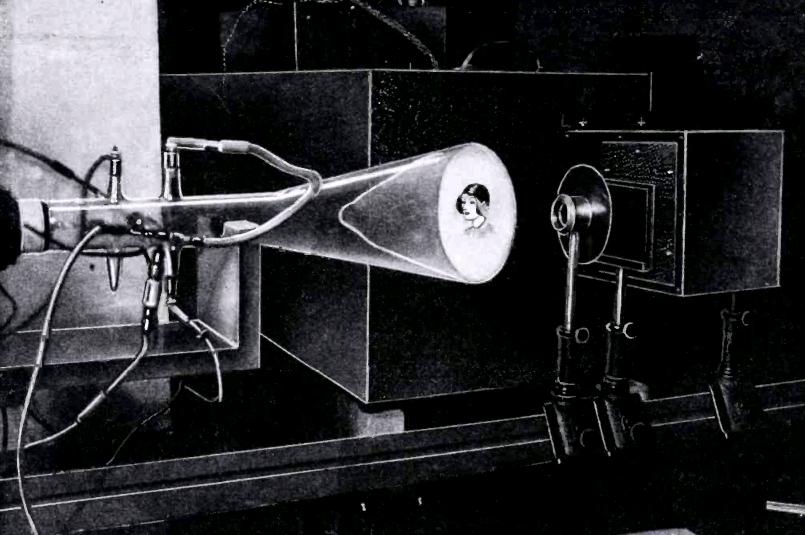
1931ElectronicTVImageShown here is one of the very earliest examples of an image sent by electronic television. It appeared 85 years ago, in the May-June 1931 issue of Television News, in an article by Baron Manfred Von Ardenne, whom the magazine identified as the “famous European televsision expert.”

Von Ardenne noted that the cathode-ray tube had “long been proposed for television reception and has been used in many more or less successful laboratory experiments. In spite of these extremely
advantageous characteristics, television has thus far been obtained only with mechano-optical means.”  He then went on to discuss some of his improvements.

His system involved using a cathode-ray tube as part of the transmitter.  A film was placed between the tube and a photo-electric cell.  Thus, the tube in the camera could be synchronized with the tube in the receiver scanning at the same rate.  Depending on the configuration of the electronics, the resulting image would be either the positive or the negative of the original film.  A diagram of the system used for transmission is shown here:

1931ElectronicTVtransmission

Von Ardenne made the first public demonstration of this system in August 1931 at the Berlin Radio Show. He successfully transmitted pictures in 1933, and his system was used in the German television service starting in 1934. Regular broadcasting began in 1935 and continued throughout the war.

Bundesarchiv Bild 183-K0917-500, Prof. Manfred v. Ardenne.jpg

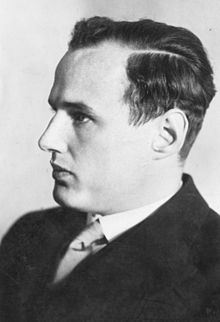
Von Ardenne in 1930. Wikipedia photo.

After the war, von Ardenne made contacts with the Red Army and found his way to the Soviet Union, where he was made head of Institute A. He was initially asked to participate in the Soviet atomic bomb project, but declines, realizing that his participation would prevent his return to Germany. Instead, he worked on isotope enrichment. His work included development of an electron microscope, for which he was awarded the Stalin Prize. With the prize money of 100,000 rubles, he purchased the land for a private institute in East Germany, where he was allowed to return in 1954. From 1963 to 1989, he served as a member of the Volkskammer, the East German parliament.  At the time of his death in 1997, he held about 600 patents.

Click Here For Today’s Ripley’s Believe It Or Not Cartoon


Carol Bruce, NBC Radio and WKRP


1941CarolBruce

Shown here from the February 1941 issue of Radio Mirror is actress Carol Bruce.  In addition to her film and theater credits, she appeared on the Ben Bernie broadcast on NBC radio.

One of her most famous roles, however, also involved radio.  She played Lilian Carlson, the owner of WKRP in Cincinnatti and the mother of station manager Arthur Carlson.

She died in California in 2007 at the age of 87.


Cuba-U.S. TV Broadcast Aircraft Relay

1956JanRadioElecSixty years ago this month, the January 1956 issue of Radio Electronics carried this item about a relay of a telecast from Cuba to the United States.  The program, carried by NBC, originated with CMQ in Havana.

Cuba was the first country in Latin America with television, and by 1954, it had a national network, with CMQ as its flagship station.

This 1955 program was relayed from atop a 35-story apartment building in Havana to an aircraft doing figure 8’s halfway between Havana and Miama.  It relayed the program to NBC’s receiving equipment atop the Fontainbleau Hotel in Miami Beach.

For more discussion of the use of aircraft to relay TV signals, see my earlier post about Stratovision.


WTCN Minneapolis, 1936

WTCN1936


Shown here is a photo of WTCN radio in Minneapolis as it appeared in 1935.  The image is from the January 1936 issue of Radex magazine.

The station originally came on the air as WRHM, licensed to Rosedale Hospital at 4429 Nicollet Avenue in Minneapolis. In 1929, it became a CBS affiliate, switching to the NBC Blue Network in 1937.

In 1934, then on 1250 kHz, the station was sold to Twin Cities Newspapers, a partnership of the St. Paul Pioneer Press and the Minneapolis Tribune, at which time it took the WTCN call letters for “Twin Cities Newspapers”. The transmitter building shown here was near Snelling Avenue and Highway 36 in Roseville, where it remained until 1962. In March 1941, the station moved to 1280 kHz in accordance with NARBA. In 1964, the station took the WWTC call letters.

The WTCN call letters were used two other times in Minnesota broadcast history. The second television station in the area, channel 4, was originally co-owned with WTCN radio, and signed the WTCN-TV call letters. The call was later held by channel 11.  The call letters are now gone from the Minnesota airwaves, instead being used by a low power station in Florida.


Click Here For Today’s Ripley’s Believe It Or Not Cartoon


Color TV With the 1956 Colordaptor

1956ColorTV

Sixty years ago, the next big thing was color TV, and if you really wanted color, the January 1956 issue of Radio Electronics showed you the cheapest way to do it.  All you needed was your existing black and white set, and for about $85 ($50 if you had a well-stocked junk box), you could build yourself a Colordaptor.

The general idea is apparent from the picture above.  A color wheel in front of the screen would alternate red, green, and blue filters.  All that needed to be done was to synch them with the corresponding colors being transmitted.  This was accomplished with the six tube circuit shown in the article.  Some of the parts were available from the Colordaptor Company of Palo Alto, California, which also sold the device commercially.

Since the color wheel needed to cover the entire screen, it also extended above the screen, so it was hardly a compact design.  But if you didn’t mind the contraption on top of your set, and you didn’t mind it spinning while you watched, you would probably be the first on your block with a color TV.

The chasis of the Colordaptor could mount permanently on top of the set.  The color wheel could be removed for viewing black and white programs.

Click Here For Today’s Ripley’s Believe It Or Not Cartoon