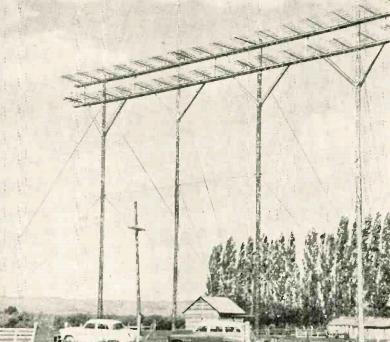
Sixty years ago, this was the community television antenna in Ellensburg, Washington, located about 100 miles east of Seattle, with a mountain range in between. It consists of sixteen stacked yagis, half for channel 4, and half for channel 5.
The system was shown in the June 1955 issue of Radio-Electronics,
which reported that the people of Ellensburg were receiving nearly perfect pictures with the new antenna system. The two Seattle stations were KOMO-TV on channel 4, and KING-TV on channel 5.
The same issue lists KCTS as being on the air on channel 9 in Seattle. That noncommercial educational station had just gone on the air in December 1954.
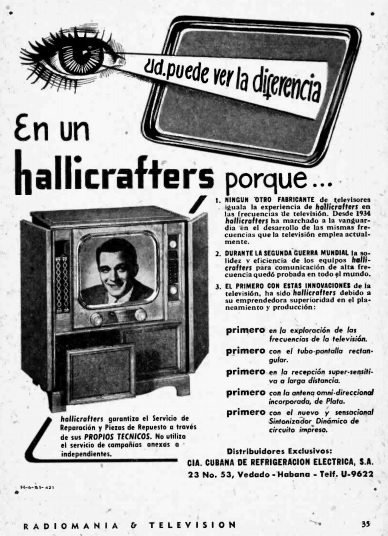
The magazine Radiomania y Television gives an interesting look at pre-revolution Cuba. This Hallicrafters TV ad appeared in the January 1952 issue. In addition to the equipment ads, it gives an interesting look at the programming, which appears to have been mostly produced in Cuba. In addition to about two dozen standard broadcast stations, the island had one FM station (CM2IL on 102.7 MHz) and two TV stations, CMUR-TV, channel 4, and CMQ-TV, channel 6.
Interestingly, the Hallicrafters dealer seems to have an indirect connection with the revolution. As seen in the ad, the exclusive Hallicrafters dealer was Cia. Cubana de Refrigeracion Electrica, S.A. About this same time, the bookkeeper at the company was one Reinaldo Boris Luis Santa Coloma. At some point, he lost his job for trying to organize a union, and later got a job at Sears. At some point in 1952, he was at the law office of a young attorney named Fidel Castro, where he met his mistress and the mother of his child.
The next year, he was one of 135 revolutionaries who, along with Castro, attacked the Moncada Barracks, which is widely regarded as the start of the Cuban Revolution.
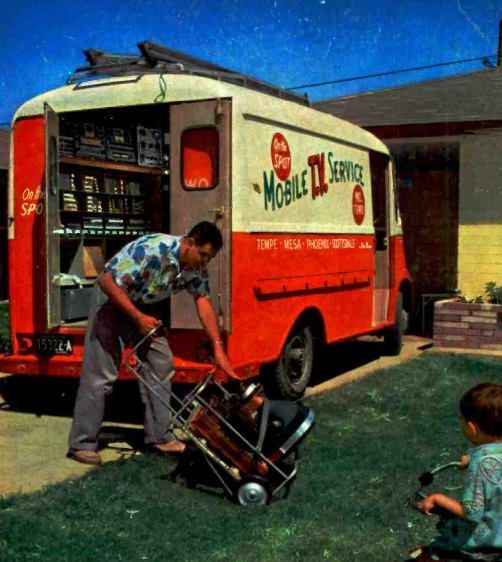
This photo from 60 years ago shows someone doing a job that doesn’t exist any more, namely, TV repair. In particular, it shows Tempe, Arizona, TV serviceman Dick Ramos, owner of the three person company. In addition to himself, he employed an assistant who rode with him on the truck, and an office girl who staffed the shop downtown, taking phone calls and walk-in service requests. Ramos pointed out that it wasn’t necessary to hire a highly trained television repairman to staff the shop. “In a short time an intelligent office girl will know more about a television set than 95 per-cent of the customers she deals with.” Ramos contracted with a radio paging service to relay messages during the day, and he maintained an efficient operation. The truck contained a complete shop with a full array of test equipment, as well as a complete set of service bulletins.
I’ve shared previously about my deprived childhood. We didn’t have a color TV. We didn’t have a real fireplace–we had a carboard fireplace. I didn’t have a TV in my room. We didn’t even own a robot, which I was convinced that most more affluent families owned. Yes, it was horrible.
But before you express too much sympathy, I guess I had better ‘fess up. We had a built-in TV. That’s right, down in the basement rec room, we had a TV that was permanently built in to the wall. As far as I know, it came with the house. In a small locked room, which we called “the TV room,” for want of a better name, the chasis of the set was there in all of its glory, with a piece of twin-lead cut as an antenna.
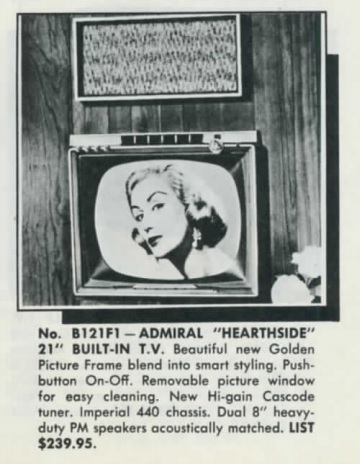
I remember that the set was an Admiral, and I’ve been able to figure out that it was a 1958 model, designed to be built in. The set tuned VHF only, meaning that it couldn’t be used to watch the fleeting signals of our only UHF station, channel 17.
I was able to find out some information thanks to the apparent practice of the Miami News to simply run a company’s press release as news. The August 4, 1957, edition of that paper carries a story under the headline “Built-In TV Announced By Admiral,” which almost certainly describes the model that was embedded in our wall. The article/press release enthusiastically reports that Admiral’s television sales manager, Ross D. Siragusa, Jr., had just announced the set’s 110-degree angle picture tube, along with the slim chassis depth of only 16 inches, made it the first nationally advertised set suitable for built-in applications or custom cabinetry.
The article identifies our set as being Admiral model B121F1, and that it included the “Imperial 440 chassis.” I found the image of this set, identical to the one in our basement, in a furniture catalog, apparently from 1958.
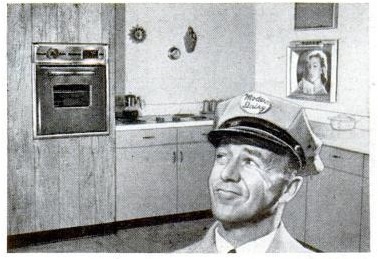
Our TV even made Life Magazine. The April 7, 1958, issue carries an Admiral advertisement masquerading as an article, given away by the tiny word “ADVERTISEMENT” at the beginning. (We see that Admiral was able to quite successfully push the envelope when it came to publicity.) The “article” recounts the experiences of an Elgin, Illinois, milkman who found himself inspired by visiting the modern kitchens of the well-to-do residents of Elgin. He was very impressed by the built-in appliances in their homes. He came to the realization that he could duplicate the effect in his own kitchen on a milkman’s salary by using free-standing Admiral appliances with the “built-in look.”
In the picture shown here, we can see him being inspired in one of those upper-class kitchens. And sure enough, one of the luxuries enjoyed by those high-class Elgin residents was a built-in Admiral TV. They were so rich that they were able to incongruously put the $239 21-inch TV right in the kitchen.
Both renditions had the dual speakers mounted in a grill right above the set, just like ours.
Those of us who weren’t quite so well to do didn’t have a TV in the kitchen, much less a gigantic 21-inch model. We had to settle for having it in the basement, and we couldn’t even get the elusive Channel 17. But that stands to reason, since we didn’t even have our own robot like those rich folks in Elgin probably did.
Our built-in B121F1 appears to be identical to the T21E21 which came with cabinet. It also appears to be identical with the console shown in this ad.
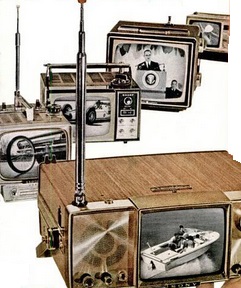
Here’s something I lusted after as a youngster: A battery operated TV! Fifty years ago, the February 1965 issue of Popular Science reviewed the available options, and proclaimed that all of the eight models tested performed so well that they can’t help but be popular. It noted that most of the portables with telescoping antennas outperformed home sets with outside antennas. They all had good picture and sound quality. They ranged in size from “the size of a desk dictionary” up to “as big as a bowling ball bag.” The article noted that models using rechargable batteries, which were good for about 50 charges, would work out to about 6 cents per viewing hour. Normal dry cell batteries would work out to about 40 cents an hour.
Screen sizes ranges from four inches up to nine. The article noted that the four-inch models were useful only for one person viewing, but the nine-inch models would accomodate a group. All of the sets could also be powered with household AC current, and many came with the plug to watch in the car on 12 volts.
But alas, for an impecunious youngster, the prices were all well out of reach, ranging from $149.95 up to $199.95.
Note: If you’re looking for a modern battery operated or 12 volt TV, please visit the guide on my website.
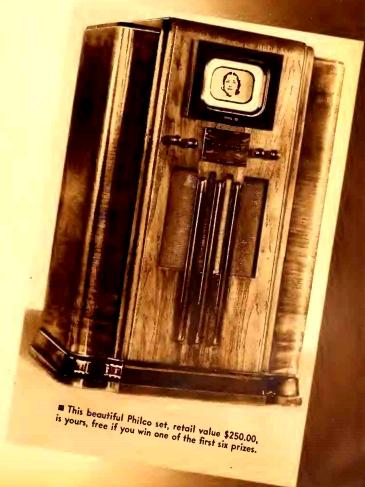
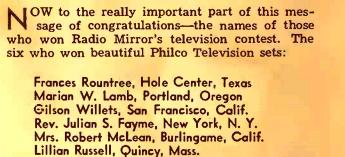
Seventy-five years ago this month, Rev. Julian S. Fayme of New York City was truly blessed. He was the winner of a new Philco television, and he had some channels that he could watch. When he received his windfall in January, 1940, there were three stations on the air in New York, W2XBS, W2XAX, and W2XAB. I previously wrote about one of those stations. W2XBS (later WNBC) came on the air on April 30, 1939. W2XAB and W2XAX were both licensed to CBS and later became WCBS-TV. And the DuMont station, W2XWV (later WABD) was soon to come on the air, as I wrote previously.
Lillian Russell of Quincy, Mass., was almost as lucky, since she was also a winner, and was within range of W1XG in Boston. Fayme and Russell were among the six winners of the set shown above, in the announcement of a quiz contest in the September 1939 issue of Radio Mirror.
But in the full list of winners is shown below (in the January 1940 issue), a problem is apparent.
The other four winners didn’t have anything to watch. There were no TV stations on the air in Portland, San Francisco, or Burlingame, California. And there certainly weren’t any stations anywhere near Hole Center, Texas, undoubtedly much to the dismay of Frances Rountree. Indeed, I can’t find any record of a town by that name, although there is a Hale Center about 30 miles north of Lubbock. But Hole or Hale, that new Philco wasn’t of much use to the Rountree family.
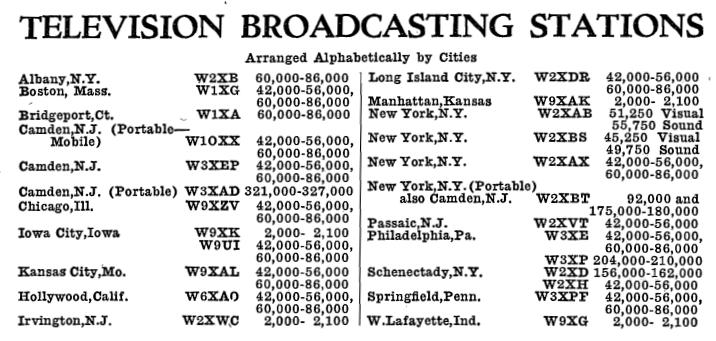
The TV stations on the air as of 1940 are shown on this excerpt from White’s Radio Log, Jan.-Feb. 1940. (This list includes three mechanical television stations operating on 2000-2100 kHz, which the more modern Philco wouldn’t have been able to receive. So winners in Irvington, N.J. or West Lafayette, Ind., wouldn’t have fared any better.)
It turns out that the four hapless winners weren’t totally out of luck, since the fine print of the contest rules did show some foresight: “And if, perhaps, you live in a section of the country where television programs cannot yet be received, this quiz still carries a prize for you. Any winning contestant can have, if he wishes, a de luxe Philco radio set instead of the television receiver.” So the winners in California, Oregon, and Texas, presumably gathered around their de luxe Philco console radios and dreamed of television, which for them would have to wait until after the war.
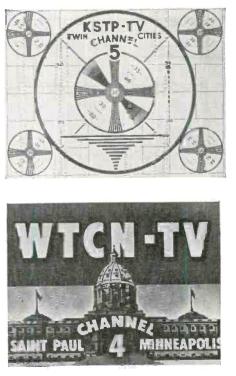
65 years ago, the January 1950 issue of Radio Craft magazine carried a complete roster of U.S. television stations on the air as of November 15, 1949, and included a copy of the identification slides used by each station. By that time, Minnesota had two stations on the air. The test pattern for KSTP-TV, channel 5, which came on the air in 1948, is shown here. Also shown is the station identification slide for WTCN-TV, as channel 4 was then known.
Channel 4 came on the air on July 1, 1949, originally as WTCN-TV. Its main affiliation was with ABC, but it also carried CBS and DuMont programs.
By the end of 1949, there were 60,000 television sets in service in the Twin Cities able to tune in to the two stations. In 1949, weatherman Bud Kraehling joined the station where he stayed until his retirement in 1996. 1950 saw newscaster Dave Moore join the station’s staff. In 1950, the coaxial cable arrived in the Twin Cities, allowing the stations to broadcast live network programming. Minnesota’s connection to the national networks was actually through a coaxial cable to Des Moines, Iowa, which was in turn linked by radio relays to Chicago.
Those of us who grew up in the 1960’s and 1970’s recognize the WTCN call letters as belonging further up the dial on channel 11. In 1952, the owners of channel 4 and WTCN radio sold the radio station and merged with WCCO Radio, and the station became WCCO-TV. The same year, an application was filed with the FCC for a construction permit for channel 11. This became WMIN-TV, and in 1953, WTCN-TV showed up again, also on channel 11. The two stations cooperatively shared airtime and transmission facilities. WTCN-TV studios were at the Calhoun Beach Hotel (the location, of course, of Grandma Lumpit’s Boardinghouse), where they remained until the 1970’s. WMIN-TV sold out in 1954, at which point channel 11 became WTCN-TV full time.
The WTCN call letters date back originally to 1934, when the predecessor of WWTC radio (currently at 1280 on the AM dial) was purchased by the Minneapolis and St. Paul newspapers. The WTCN call sign stood for Twin City Newspapers. Channel 11 had no connection with the earlier radio station other than the use of the historic call letters, which remained in use until 1985, when they became WUSA, and then KARE in 1986.
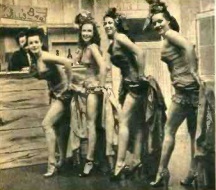
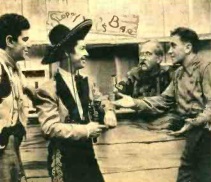
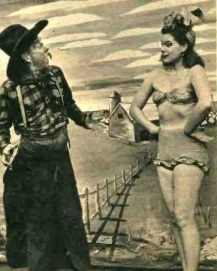
The three still photos shown here are, as far as I can tell, about the only remaining tangible evidence of a first in television history. They are from the September 28, 1944, telecast of the musical comedy The Boys From Boise, which was televisted by the New York DuMont station, WABD. The station originally came on the air as experimental station W2XWV, and in 1944 became the city’s third commercial station. As detailed in an earlier post, broadcasting as it came to be known after the war started in 1939. With the war, the other stations cut back on their programming, with much of it being devoted to civil defense training.
But flush with cash from helping develop radar for the army, founder Allen B. Dumont (the station bore his initials) invested $5 million in the company and expanded programming.
According to a January 1945 QST article, most of the staff of WABD was made up of hams. It was on the air three nights a week from 8:00 until 11:00. Practically the entire staff was working at the TV station on an overtime basis after working their normal day jobs at the DuMont war plant in Passaic, N.J. The station was located at 515 Madison Avenue on the 42nd floor. According to QST, the transmitter (which is described in detail) put out 6 kW. The QST article contains an additional image from the production of Boys from Boise.
According to the QST article, the station was on what was then known as channel 4, 78-84 MHz. When the channels were reallocated slightly in 1946, it moved to channel 5, which was then 76-82 MHz. The station is currently WNYW, the Fox network flagship.
One of the more ambitious projects was the production of The Boys from Boise. The program had a budget of $10,000. Given the scarcity of television sets capable of viewing the program, it’s very unlikely that the program made any money. It was sponsored by Esquire Magazine, which included three commercials during the intermissions.
The music and lyrics were written by Sam Medoff, who conducted the orchestra, and the production was directed by Ray Nelson. The show featured the following musical numbers. I haven’t been able to find any recordings of the music, or any of the scores.
Girls of the 8-to-the-Bar-X-Ranch
I’ll Take the Trail to You
Sunset Trail
That Certain Light in your Eyes
Chiki Chiquita
Thousand Mile Shirt
It’s a Mystery to Me
Broken Hearted Blues
Come Up and See Me Sometime
You’ll Put Your Brand on My Heart
Rodeo
Western Omelet
I’m Just a Homebody
Star-Spangled Serenade
The production had a cast of twenty. The only recording I’ve been able to find of Medoff is his recording of the Bridegroom Special on the American Jewish Hour program on WHN radio.
According to Billboard, the evening of this program was “the night television came of age. For the first time someone had guts enough and confidence enough to dig deep into the grouchbag for a lot of lure and put on a full-fledged show for the television cameras and audience.”
The Billboard review noted that by top-notch Broadway standards, the show wasn’t too much. But it drew praise as an example of what television was capable of. The reviewer noted that two hours was too long, and that future musicals should be capped at 60 minutes. It also noted that the cast was too large, and the dance numbers too elaborate, for the TV screen.
The plot, according to Billboard, was a “complicated, albeit typical musical, setting for the boy-girl theme.” A troupe of showgirls was stranded in Boise and had to take jobs as cowgirls to earn their fare home. There are rustlers, a villanesse who wants to foreclose the mortgage, and an undercover FBI agent.
It’s unlikely that any recording was made of the program. And even if there were, the old DuMont kinescopes reportedly wound up in the East River in the 1970’s. The still pictures shown here are probably among the few reminders of this first in TV history.
Update: It’s always great to hear from relatives of people I’ve featured here. In some cases, it clears up a mystery. When I originally wrote this post, I wasn’t able to find much information about Sam Medoff, the composer of the music and lyrics for Boys from Boise. I received a nice e-mail from his son, Mitch Manning, who pointed out that Medoff changed his name to Dick Manning, who went on to pen many familiar songs such as Fascination, Papa Loves Mambo, Hot Diggity, Allegheny Moon, Takes Two to Tango, and Hawaiian Wedding Song. You can listen to an interesting 1971 interview with Manning, including a performance of Fascination, at the video below. (This is a link to someone else’s video, and I’m told that the photo is not actually Manning’s.)
If you went to school in Minneapolis in the 1970’s, I bet these pictures look vaguely familiar. This is a 1972 ad from Setchell-Carlson, then known as SC Electronics, Inc., a subsidiary of Audiotronics Corporation, with an address of 530 5th Avenue NW, New Brighton, MN. This ad appears in the March 1972 issue of Broadcast Engineering.
The Minneapolis Public Schools were equipped with what I believe was the model at the left. I’m showing the one on the right to show the distinctive controls in the center, which are hidden behind the optional “tamper-proof control compartment door” of the black and white model on the left. I don’t think that Minneapolis had the door, or else the doors were routinely left open.
At Waite Park Elementary School, I don’t believe that every classroom was equipped with a TV. There were one or two of these that were wheeled in as needed.
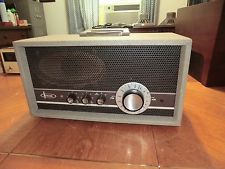
Every room, as far as I can recall, was equipped with a radio, although it was rarely used. The radio, shown here, was the Newcomb Model AV-750. This was an 8-tube AM FM receiver, and was obviously built for severe service. I’m sure I’m the only kid who noticed, but it had a connection on the back for an external AM antenna and ground. I was always jealous of that radio, since I dreamed of all the exotic broadcast band stations it would pull in if connected to an external antenna. There was also a connection on back for audio input, so it could be used as an audio amplifier.
I’m not positive, but I believe this Audiotronics phonograph was the standard issue model in the Minneapolis schools. Again, I believe one was issued to each classroom, and they saw a bit more use than the radio.
The televisions were made not far from the school. Setchell-Carlson made some consumer radios in the 1940’s, and TV‘s in the 1950’s and 1960’s. They were never a big name nationally, although they did have a strong presence in their home state of Minnesota. By the 1970’s, they had abandoned the consumer market, but they continued to make the institutional models shown above.
The company was founded in St. Paul in 1928 by Bart Setchell and Carl Donald Carlson as “Karadio Corporation.” As the name suggests, the company manufactured auto radios. Setchell claimed later to have been the “first” to use vibrators to power the car radio. The author of this article disputes that claim, but it is clear that Setchell-Carlson was one of the pioneers. In 1934, the company became Setchell Carlson, Inc., and made a few radios before the war. During World War II, the company was a defense contractor, and made products for the military, the most famous of which was the aviation receiver shown here. (For more information on this device, see my earlier post.)
In 1949, the company moved to New Brighton,
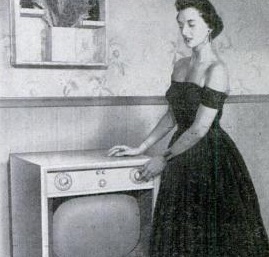
A Setchell Carlson TV from 1954, back when people apparently dressed up to watch TV. Popular Mechanics, Dec. 1954
Minnesota, and went into the TV business, which lasted until the 1960’s. At its peak, the company employed about 500, and also had a plant in Arden Hills. Setchell was later inducted into the Minnesota Broadcasting Hall of Fame.
One final note on the audio-visual equipment in use at my elementary school. The Minnesota Historical Society has this photo of the school’s public address system. The photo is dated about 1955, but based upon the one or two times I saw it, this is the same console that was in use in the 1960’s and 1970’s when I was a student there. Interestingly, the caption of this photo bills it as a “school broadcasting lab” and shows students at the mike. I never recall the console being used by students, certainly not on a routine basis.
The couple of times I saw this, I was quite impressed. It was in a separate room off the office, and in addition to the PA console, there was a radio receiver. I remember one dial being for the standard AM band. The other dial was calibrated in some numbers that did not look at all familiar to me. In retrospect, it’s possible that they were FM channel numbers, which were used for a short time on some FM receivers. Click Here For Today’s Ripley’s Believe It Or Not Cartoon
Seventy-five years ago, television looked like it was ready to take off, but it didn’t become a widespread reality until after the war. There had been experimental transmissions for a few decades, and by 1939, sets were being advertised. April 30, 1939, marks the day from which TV has been continually broadcast in the United States.
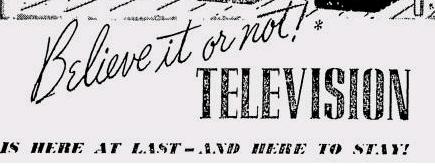
The Newark Sunday Call for that day contains at least three television advertisements. One is this ad for Wilderotter’s, which announces that “television becomes an actuality for the public today!” It announced a special 3-1/2 hour program to be telecast from the World’s Fair by NBC, featuring an address by president Roosevelt. It announces that the store will be open from noon until 1 P.M. on Sunday for the public to hear and see this special program. It also includes the NBC television schedule, which included programming on Wednesday and Friday from 4 P.M. to 9 P.M., “outdoor telecasts of news events” on Wednesday through Friday afternoons, and “film transmissions” on Monday, Tuesday, and Thursday from 11 A.M. to 4 P.M.
The Griffith Piano Company has this ad announcing that it, too was ready to put a television receiver in your home. The advertised prices ranged from $199.50 to $600.
Unlike earlier television system, these models were electronic. They used a system similar to postwar television, but were 441 lines. The station, then will the call sign W2XBS, remained on the air only until 1940 or 1941 in the original 441 line format. It received a commercial license in 1941, and became WNBT. But at that time, it began using what is usually call the “postwar” format of 525 lines. Some broadcasting continued during the war, but the station was used mostly by the New York Police Department for civil defense training. The station, now WNBC, does have the distinction of being the nation’s oldest continuously operating TV station. And it celebrates its 75th birthday on April 30, 2014.
So Kresge’s was correct in saying on April 30, 1939, that television was here to stay. But unfortunately for those who purchased a $600 set in 1939, the device became obsolete in two years with the switch to the 525 line format.


 )
)