Category Archives: Radio history

RCA Victrola V-225 Radio-Phono, 1941

1941OctNatlRadioNewsAs we’ve noted before, people used to dress up to listen to the radio or play records, as shown by this photograph on the cover of the October 1941 issue of National Radio News.

The woman operating this phonograph had a good reason to get dressed up, because the radio-phono was the RCA Victrola model V-225. The radio pulled in standard broadcast and two shortwave bands, and it had an automatic record changer.

But calling it an “automatic record changer” is a serious understatement. It was actually a miracle of engineering. Not only would it play the records automatically, but it would play both sides of each record, thanks to a dual tone arm with a needle on both the top and bottom. To play the “B” side, the motor would stop and then change direction. The system is explained in detail in the magazine:

The “Magic Brain,” RCA Victor’s new automatic record playing mechanism illustrated on the front cover of this issue, is magical in its uncanny, almost human operation. The mechanism, by use of a radical new Tandem Tone Arm, plays both sides of records without turning them over.

The turntable automatically moves aside to discard a record which has been played on both sides, and returns to position and finds the center hole of the next record to be played. This feature is unique in automatic record changing devices and is made possible by the use of two motors. one to drive the turntable and the other to operate the automatic mechanism. This also makes it possible to increase the capacity of the mechanism to fifteen 10-inch records or twelve 12-inch records.

As soon as the Tandem Tone Arm bas played both sides of a record, it swings free to permit the turntable assembly to tip over to the left, gently carrying the record into the padded pocket below the mechanism. While the turntable is in this position, the next record in the stack drops silently to the heavily felted motor board. The turntable then returns to its original position, raising the record from the motorboard enroute. While the record is held in position by the record support posts, the turntable spindle seeks out the center hole of the record to be played and finds it, positioning the record for playing. The turntable is no larger than the size of the record label, in order to permit the lower section of the Tandem Tone Arm to play the under side.

The Tandem Tone Arm is actually two complete Magic Tone Cell pick-ups set, one above the other. into a tune arm shaped somewhat like at tuning fork. Its action is completely automatic from the time it leaves the rest position at the touch of the starting button, until it returns to rest after the last record has been played. Since the vibrating parts of the unit weigh less than a postage stamp, no undesirable mechanical noise or needle chatter is created.

Among the many other features which are attracting much interest as the ‘Magic Brain” is demonstrated are the Magic Tone Cell (or pickup cartridge), the Flexible Toue Bridge and the Jewel-Lite Scanner. The Tone Bridge connects the sapphire Jewel-Lite Scanner (replacing the standard needle) to the Magic Tone Cell.

The new “Magic Brain” with its Tandem Tone Arm is incorporated in the 1942 RCA Victrola model V-225 combination three -baud receiver and automatic phonograph, which is the receiver pictured on the front cover.

You can see this remarkable changer in action at the following video:


1941 Electro-Mechanical Oscillator

GeneralRadioExperimenterThis site often features science fair projects, and we often specialize in impressive projects that can be whipped together in one evening. This project doesn’t come in that category, but the advanced student who is willing to do some tinkering can replicate this tuning fork oscillator from the October 1941 issue of General Radio Experimenter.

Shown above is a tuning-fork oscillator utilizing a vacuum tube and a tuning fork. It is used to produce a very precise audio tone using an electro-mechanical process. The vacuum tube serves as the oscillator (and a modern recreation could just as easily use a transistor), and a mechanical tuning fork serves to determine the frequency. A simplified schematic diagram is shown below. The tuning fork needs to be ferrous in order for it to work.

WWV 1927 frequency standard. Wikipedia image.

WWV 1927 frequency standard. Wikipedia image.

A similar circuit was used for the frequency standard for WWV in 1927, as shown at the left.  Advanced students wishing to duplicate this project will find some guidance at this site and this site.  Students looking for the more familiar last-minute but impressive projects can browse our science fair category for ideas.

GeneralRadioExperimenter2


CBS Berlin Correspondent William Shirer

1941Oct11RadioGuideShown here, in the October 11, 1941, issue of Radio Guide is a photo of CBS correspondent William Shirer, conferring with a German naval officer acting as his censor. Shirer had recently returned to America after being posted in Berlin, and the magazine offers some of his recollections.

For most of his term in Berlin, Shirer had lived in an apartment, but for the last year of his assignment, he had lived at the Adlon Hotel.  Since the hotel catered to foreigners, it was one of the last places in Berlin to have hot water constantly available. In fact, Shirer often met with officials in his room, and was able to provide those officials with a hot bath.

The article served partially as a tease for Shirer’s forthcoming book, Berlin Diary,  which is still available. The book recounted his years in Berlin. Shirer is best known as the author of The Rise and Fall of the Third Reich.


Some links on this site are affiliate links, meaning this site earns a small commission if you make a purchase after clicking on the link.

1951 Mobile TV Service

1951OctRadioElectSeventy years ago, the state of the art in television service was provided by Appliance Distributors Inc. of Chicago using a fleet of vehicles that included three mobile service vans like the one shown here. Repairs were usually done the same day thanks to a very efficient operation. The company had begun by having servicemen in cars, and the system worked well, since most repairs could be done in the field with limited tools, and only about 10% of the jobs required bringing the chassis back to the shop. But with a large business, that ten percent amounted to a lot of work, and those sets would take a few days to finish.

To streamline the process, the shop purchased three vans like the one shown here. At the beginning of the day, the trucks, along with servicemen in cars, would be stationed strategically throughout the city, often at service stations. The men in cars would handle the calls, but if the job required time in the shop, the truck was dispatched right to the home in question. The chassis was brought outside and worked on in the truck. Power was provided by a shore power cord that could be plugged in to the customer’s house. In situations like an apartment building, where no outlet was available, the set could be taken to a nearby service station where the company made arrangments to use the power. Virtually all jobs could be finished the same day, meaning that customers could watch their programs.

The company also serviced radios and phonos, but time was less critical on these jobs, and they were handled back at the shop.

The photo and accompanying article appeared in the October 1951 issue of Radio-Electronics.


9YY, University of Nebraska, 1921

1921OctRadioAgeShown here, on the cover of the October 1921 issue of Wireless Age, is H.O. Peterson of the University of Nebraska, Lincoln, at the controls of station 9YY, which he had designed. The station was part of the laboratory equipment of the Department of Electrical Engineering.

The station used four 50-watt type 203 tubes, and an additional two five watt audio tubes.

The station transmitted musical concerts twice daily at noon and 7:30 PM, and had been picked up in Nebraska, South Dakota, Iowa, Minnesota, Missouri, and Kansas. During daylight hours, the station had been pulled in 340 miles away in Aberdeen, South Dakota.

One summer concert had been carried live from the American Legion Band at a local amusement park. It was picked up by three microphones at the park, carried by Lincoln Telephone Company lines to the station, and transmitted to listeners in the neighboring states.

The station was under the general supervision of Dean O.J. Ferguson of the University’s Engineering College.


Wiring Churches for Sound: 1941

1941OctRadioRetailingThere was a time, not so long ago, when an absolutely necessary skill for any kind of orator was the ability to project one’s voice. Entire books were written on the subject, such as this one that notes:

Bear in mind that as voice is dependent upon a copious supply of air, under the control of the will, so breathing is dependent upon pure blood, which, in turn owes its existence to proper and sufficent food and physical exercise.

Whenever you read a speech that predates electronic amplification, whether it is the Gettysburg Address or Teddy Roosevelt’s “Big Stick” speech, it is well to remember that if those in the crowd heard what the speaker was saying, it was only because they were able to hear the voice. This began to change in the 1930s and 1940s. For example, we previously reported, the legislative chambers of the Iowa State Capitol were first wired for sound in 1939. Before that date, the legislators had to project their voices so that they could be heard throughout the chamber.

And a member of the clergy had to have something besides a grasp of theology, Greek, and Hebrew. He had to have a strong enough voice. Eighty years ago this month, the October 1941 issue of Radio Retailing put it this way:

Many an earnest young divinity student was advised to leave the ministry because his voice was not considered strong enough.

But the magazine also noted that “today, this condition no longer applied,” and it presented an opportunity for the entrepreneur able to supply the requisite sound system.

The magazine carried the case study of Harbison Chapel at Grove City College, Pennsylvania, which was brought into the twentieth century by F.C. Millard’s Modern Sound Systems of Pittsburgh.

The Gothic chapel could seat 900 and was long, narrow, and tall. Millard was able to provide a satisfactory system at a cost of $632.80 (according to this inflation calculator, almost $12,000 in 2021 dollars), plus installation and wiring. The system consisted of two Western Electric 633A “saltsharker” microphones, one each at the pulpit and lectern, a 12-20 watt 124D amplifier, and a single horn speaker above the pulpit. A mixer was installed at the rear of the balcony.

The college’s president, Dr. Weir C. Ketler, noted that the system functioned so smoothly that the congregation could hear well yet be scarcely conscious that amplification was in use.


October 5, 1946, Radio Listings

1946Oct5WashStarHere’s what was on the radio 75 years ago today, from the Saturday, October 5, 1946, issue of the Washington Evening Star.  (For a larger view, click the image above.)

Highlights included the Philadelphia Orchestra on WTOP (now WFED) under the direction of Eugene Ormandy. On the 7:00 “Americana Quiz” program on WMAL (now WSBN), high school students answered questions on American history. At 9:00 on WRC, the “Saturday Roundup” program starred Roy Rogers, Dale Evans, George “Gabby” Hayes, and the Sons of the Pioneers.

A few smaller stations didn’t warrant listings in the main grid, but had their separate listings, such as WPIK (now WTNT) .  The station had just signed on the previous December at 730 kHz.  The daytimer signed off at 5:30 PM. Two FM stations also had listings. W3LX operated on 98.9 MHz from 11:30 to 9:00 PM. WINX-FM was on the air from 9 AM to 11:15 PM, and simulcast the programs of the AM station. It was operating on two frequencies–43.2 MHz on the old prewar band, and at 92.9 MHz on the new FM band.


Some links on this site are affiliate links, meaning this site earns a small commission if you make a purchase after clicking on the link.

1961 Soviet Radio Hobbyists

1961OctPEThe cover of the October 1961 issue of Popular Electronics had a teaser saying, “you wouldn’t want to be an electronics hobbyist in the U.S.S.R.” The accompanying article, however, didn’t really deliver on that premise. I wouldn’t have wanted to be anything in the old Soviet Union, but as the article shows, a hobby in electronics would actually be a bright spot in an otherwise bleak existence.

The Soviets recognized that a hobby in electronics prepared young people for a career in science, and they did a lot to encourage it, by providing awards for copying Morse code and direction finding and even on-the-air contests. Club stations were plentiful, so a young person wishing to get on the air had many opportunities. The Young Pioneers youth organization employed instructors in Morse code and radio theory.

Along with rifle, parachute jumping, and motorcycle clubs, radio clubs were affiliated with the Red Army through ДОСААФ (DOSAAF), the Volunteer Society for Cooperation with the Army, Aviation, and Navy.

Radio and electronics magazines, many of which we feature here, were popular in the Soviet Union. To view a treasure trove of these and other magazines, be sure to visit Журналы СССР.

The magazine even provided the Moscow phone number of the Central Radio Club, K-5-92-71, and noted that if a reader ever found themselves in Moscow, they should give them a call.

The beginner wishing to get a start in radio needed to first complete the basic DOSAAF electronics course, at which point he or she would take the SWL test to get the SWL license necessary to listen on the ham bands. This included a 10 WPM code test, as well as a written test on subjects such as operating procedures, Q codes, international prefixes, and even first aid.

After some experience, and as long as the prospective ham was at least 14 years old, he would then be allowed to take the test to become a ham. This required a 12 WPM code test and a fairly rigorous written test. Higher class licenses were available with code speeds of 18 WPM and a rather difficult test. There was also a no-code license which allowed 5 watts on 144 and 420 MHz, available to those 12 and older.

For another look at amateur radio in the Soviet Union in 1934 and 1965, see our earlier post.


Emerson Model 523 Portable: 1946

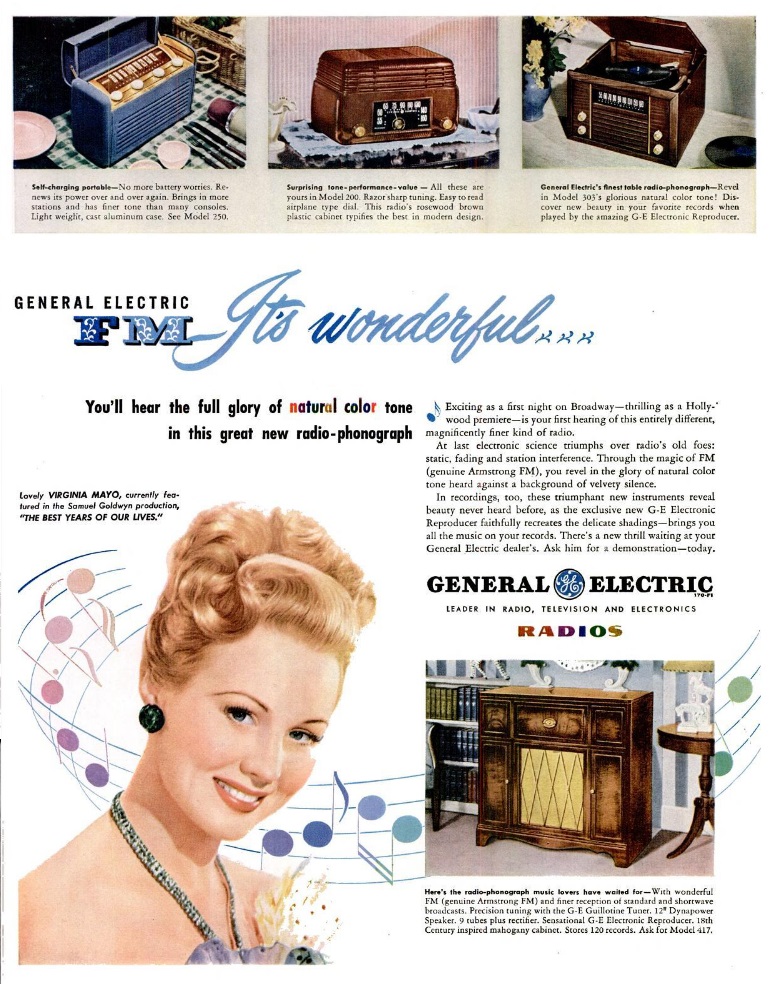
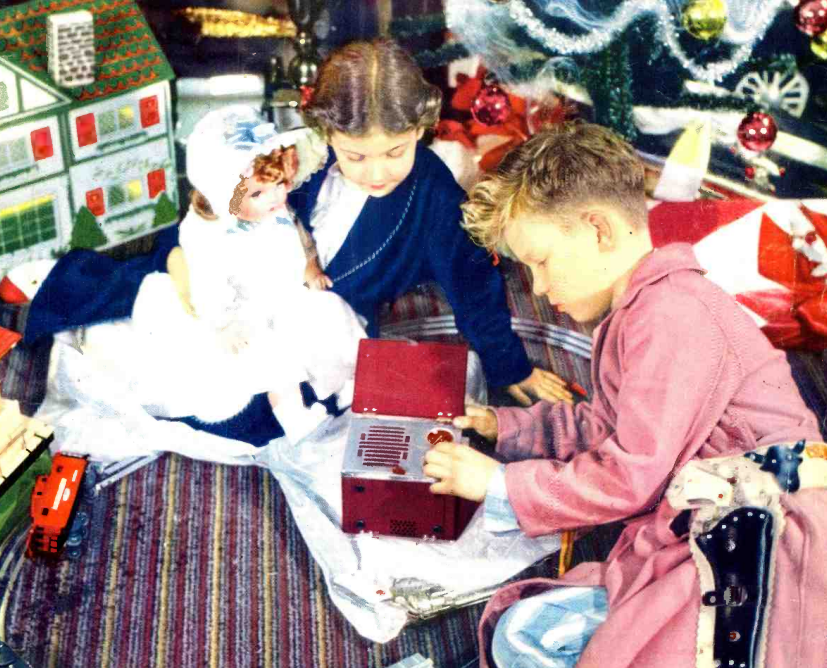
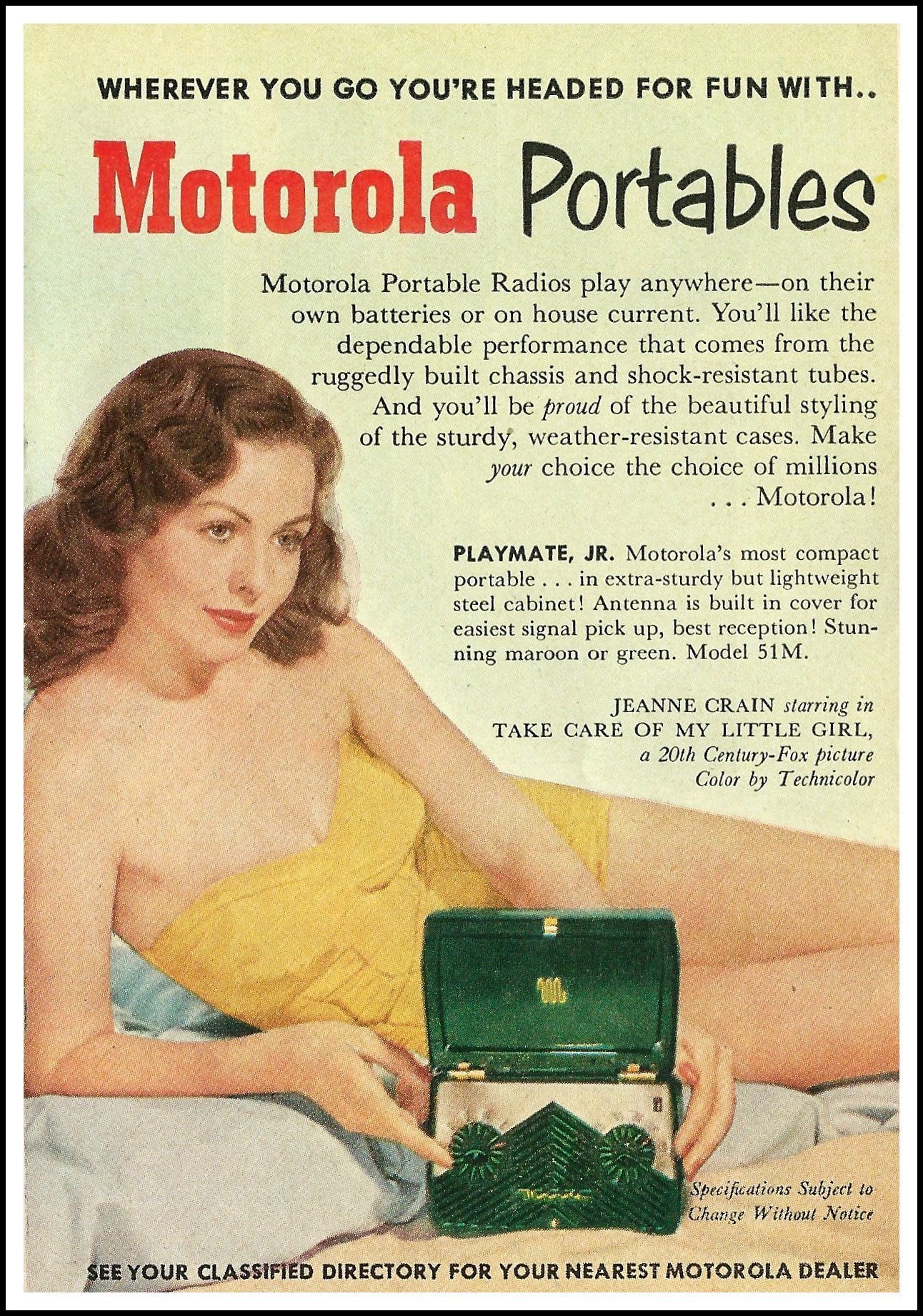
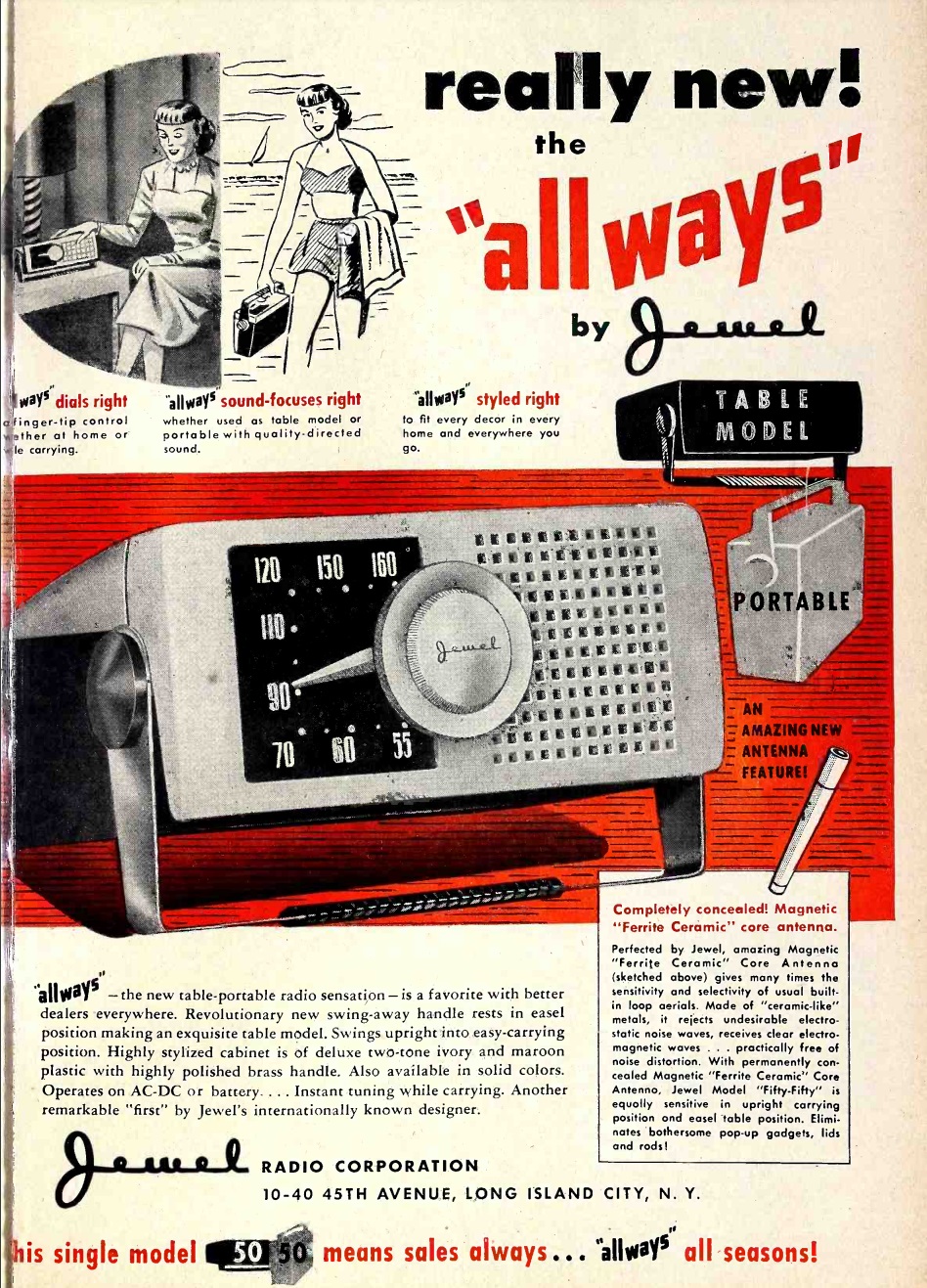
1946Oct3PghPressSeventy-five years ago today, the October 3, 1946, issue of the Pittsburgh Press carried this ad for the Emerson model 523, which tuned the broadcast band and would run off batteries or household current, with automatic switchover.

The set retailed for $47.20, which, according to this inflation calculator, works out to $662 in 2021 dollars, so the set was something that would be purchased by the well heeled.

The ad noted that other models started for $21.60, and also featured the model 512 radio and model 506 radio-phono.


1946 One Tube CW Transmitter

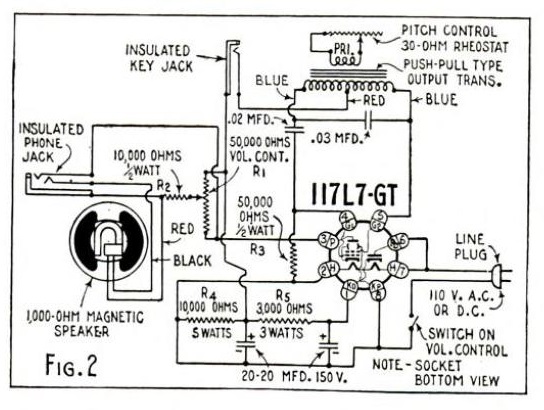
1946OctPS11946OctPS2Seventy-five years ago this month, the October 1946 issue of Popular Science showed how to put together this one-tube 80 meter CW transmitter. In the picture above, the transmitter is at the left. Not shown is an antenna matching unit. The two chasses are shown at left. Both the transmitter and matching unit have identical sets of coils and capacitors, and are connected by twisted lamp cord.

According to the article, the set can be put together for a few dollars, and fewer hours. It requires a power supply capable of supplying 250-300 volts. The set was said to be capable of real performance, despite its size. But the article noted that the 80 meter band was crowded with high power stations, so there would be a better chance of getting through during the relatively quiet hours.

1946OctPS3