Category Archives: Radio history

White & Boyer, 3NR/WJH, 1921

1921Dec03WashEveStarA hundred years ago today, the December 3, 1921 issue of the Washington Evening Star carried this ad for Radio Receiving and Transmitting Apparatus, “an ideal Xmas gift.” Receiving sets started at $7.50, which works out to about $116 in 2021 dollars, according to this online inflation calculator.

The ad was for White & Boyer, 812 13th St. NW, Washington.  Like many early radio retailers, the company was also a radio station, transmitting music on Tuesday and Friday evenings from 7:30 to 9:45 PM. Shortly after this ad appeared, the station’s call sign changed from 3NR to WJH.


1941 Five Tube Portable

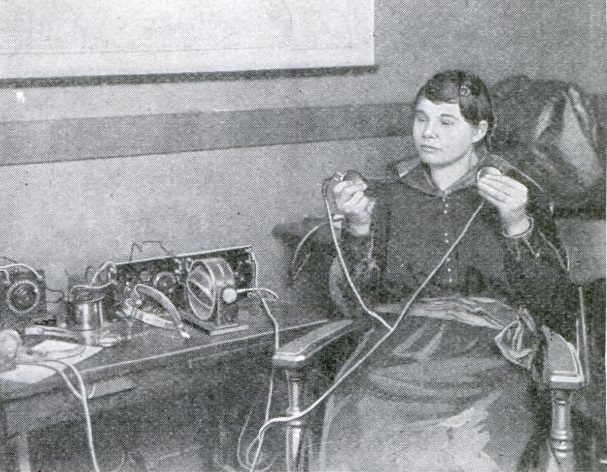
1941DecPSEighty years ago, this young woman is pulling in a favorite program with this camera-style portable radio. The brand is not stated, but it has five tubes, including the rectifier, and can operate either from battery or, as she is using it here, standard household current. It had the option of use with a separate window antenna to increase the sensitivity. It was finished with gray plastic, with a dark blue covering of simulated leather.

A few days after this picture appeared in the December 1941 issue of Popular Science, she was probably using the same set in a more somber mood to pull in the latest bulletins from Pearl Harbor.


1951 Volt-Ohm Meter

1951DecPMThese days, there’s really no excuse not to have a multitester. Even if you only rarely dabble with electronics, every household should have one, as it will tell you things such as whether your outlet voltage is OK or if an outlet is dead. You can check batteries. (Even if a voltmeter doesn’t have a specific battery testing option, if you just check the voltage, you can tell if a battery is completely dead. And if it shows more than 1.5 volts, you can be pretty sure that the battery is good.) In the car, you can diagnose many problems simply by seeing whether 12 volts appears at a certain spot. And they are cheap. The digital model shown below (whose price includes free shipping) rivals a fine laboratory instrument 70 years ago:

I am old school, and I prefer an analog meter movement, which is also available at a very reasonable price for a basic model, such as this one, which you can also get with free shipping on Amazon:

But it hasn’t always been this way, and 70 years ago, the December 1951 issue of Popular Mechanics pointed out that many beginning radio experimenters were temporarily handicapped by the inability to make measurements, since expensive test instruments were required. But fortunately, the magazine solved that problem by showing how to build test equipment, such as the volt-ohm meter shown above. An analog meter movement, a few resistors, a battery, and a few Fahnestock clips were all that were needed to make a fully functional meter suitable for most ordinary radio work. The magazine showed a similar design for a meter for AC voltage or checking capacitors. That meter also included a bridge rectifier, as well as a filament transformer for powering the capacitance meter.

The meter movement sold for $3.16, and was the most expensive component required.

Keep an eye open for coupons from the usual discount houses (the places with names such as Harbor Tool and Northern Freight). They often have the digital meters for free or practically free as a loss leader. If you need pointers on using your new meter, this classic book from Radio Shack is available on Amazon, and used copies are available at a reasonable price:


Some links on this site are affiliate links, meaning this site earns a small commission if you click on the link and make a purchase.

1961 Student-Built Radio Telescope

1961NovEISixty years ago this month, the November 1961 issue of Electronics Illustrated featured this radio telescope constructed by high school student H. Mark Wahl of Cheyenne, Wyoming. The rack containing the electronics was a school locker. The door of the locker was removed to form the door, and the equipment was mounted facing what used to be the back.

The equipment consisted of a standard FM broadcast receiver which had been converted to AM by eliminating the limiter and discriminator. A tuned RF amplifier, apparently for 108 MHz, was added to beef up the sensitivity. The IF output was connected to what looks like a Hallicrafters S-30B tuned to 10.7 MHz. This fed two recorders, one connected to the voice coil of the receiver’s speaker, and the other one connected to the S-meter. The recording of the audio output was accomplished with a pivoted wooden arm. The other end held a pen which recorded on a strip of paper driven by a motor.

The recorder hooked to the meter consisted of a straw from a broom, which recorded a trace on a soot-covered cylinder turned by a wind-up alarm clock, creating a 12 hour record.

The antenna consisted of two folded dipole antennas, probably made out of TV twin lead, mounted horizontally and parallel to each other, about a hundred feet apart. With identical lengths of feed line, the signals would arrive in phase, and be identical. The antenna pattern would have a number of lobes, one of which was straight up. However, if an additional half wavelength of feedline was added to one side, the two signals would arrive out of phase. The pattern would be similar, but the signal from straight up would be nulled out. By using the difference of these two signals, the interferometer was able to null out everything but the signal from straight up. Thus, any terrestrial interference would be eliminated, and the antenna would see only the cosmic noise coming in from directly overhead.

While we think of most radio astronomy taking place at higher frequencies, there’s no reason why frequencies just above the FM broadcast band can’t be used. For example, this 2014 experiment used 38 European radio telescopes to detect radio signals from a distant galaxy on 115 MHz. Those 38 dish antennas probably provided a better signal than two folded dipoles a hundred feet apart, but they used the same principles to combine the signals.

Unfortunately, the article doesn’t give too many practical details on the construction of the set. And other than the author’s assertion that it was “relatively simple, but it works,” there’s little detail on what observations he made.

We’ve previously written about another group of students in Britain who built a radio telescope in 1959.  This website specializes in science fair projects that a student and frazzled parents can whip together in one evening, and we have many that fit that category.  Building your own radio telescope is definitely not in that category. But students were doing so 60 years ago, and there’s really no reason why an advanced student (or maybe a student who’s not so advanced, but just likes to tinker with electronics) can’t do the same thing today.


Some links on this site are affiliate links, meaning this site earns a small commission if you click on the link and make a purchase.

1946 Electromatic Chairside Radio Bar

1946NovRadioRetailing3Seventy-five years ago this month, the November 1946 issue of Radio Retailing
carried this ad for the Electromatic model 609 Bar Radio. As you can see, the company sold the same style of radio-phonograph as either a chairside or tabletop model. It looks like they did a run without the phonograph, but there was a void under the lid where the phonograph was supposed to go. Who needs to listen to records if they have booze, so the logical thing to do with that spot was to turn it into a bar. The company reported that the model was selling faster than rare scotch.

You would want to be careful not to spill into the radio, although I suppose if the contents were high enough proof, they would do little other than give the chassis a good cleaning.

I’ve found references to the Model 608A and 607A, but haven’t found any evidence that any of the Model 609 Radio-Bars ever made it into production.


How to Become a DJ: 1961

1961NovBLSixty years ago this month, the November 1961 issue of Boys’ Life carried this article about what was probably the dream job of many a young man–a radio station DJ. The job meant odd hours and working weekends and holidays, but it was still a sought after position, and stations were hiring.

The author, DJ Arthur S. Harris, Jr., noted that in earlier years, the local station typically just carried network programs, with the staff announcer earning his pay merely by giving station ID. But programming was becoming local more and more, and the position of announcer often became that of DJ, spinning the records.

A few DJ’s in big cities could get salaries of over $25,000 per year, but starting pay was about $65 to $70 per week, which could probably grow to $150 a week.

To get started, the main advice was to practice. A tape recorder was an indispensible tool to record examples off the air to study, and to make practice tapes. Finally, audition tapes could be sent to radio stations. Schools and libraries might have a recorder that could be used, or a second-hand recorder could be had for about $50.


Make Big Money Charging Batteries: 1921

1921NovSciInvA century ago, there was big money to be made in charging batteries, and this ad in the November 1921 issue of Science & Invention told you how to get started. For just $20 down, you could purchase from Hobart Brothers Co. of Troy, Ohio, a battery charger.

The company would recommend the size of charger, from 6 to 70 batteries, to make the most money, and you could get started right away. The profits would allow you to pay the easy terms for the balance of the equipment’s price.

1962 Allied “DX’er” Regenerative Receiver Kit

AlliedDXerThe May 1962 issue of Electronics Illustrated showed this smart-looking regenerative receiver kit from Allied, the Knight Kit “DX’er”, a three-transistor regenerative receiver for the broadcast band and one shortwave band.  It operated with four penlight cells, and Allied touted the receiver as ideal for the fallout shelter.

It does seem like an ideal choice.  The set undoubtedly had a low current drain, and with a few extra sets of batteries stored away, it would probably be a good source of information for the duration of the stay.  The standard broadcast band could be used to pull in the local CONELRAD station, and the shortwaves would probably give some indication of what was going on in the outside world.

According to the magazine, the kit sold for $19.95, but in the 1963 Allied catalog, the price had been reduced to $14.95.

1921 Montgomery Ward Radio Equipment

MWStPaulA hundred years ago, Montgomery Ward was a supplier of just about everything the radio experimenter might need.  This ad appeared a hundred years ago this month in the November, 1921, issue of Radio News.

The St. Paul, MN, store with its iconic tower shown in the ad was a familiar landmark for me.  It was torn down in 1996, but for decades, it served as the distribution center in our area.  We lived in Minneapolis, and usually shopped at our local store.  But when we needed something more exotic, we knew that everything in their thick catalog would be available at that store.  Frequently, it was tires or auto parts.  We would drive to the big store, my dad would use the catalog to fill out the order form, he would hand it to the guy behind the counter, and a few minutes later, they would return with our order.  It was like having Amazon, but with immediate delivery.


1961 Distance Learning

1961NovRadioElecAs we’ve seen earlier, distance learning is nothing new, and sixty years ago this month, the November 1961 issue of Radio-Electronics carried a summary of the state of the art. It noted that television, either broadcast or closed-circuit, was the leading method in use at that time. The most famous was the NBC “Continental Classroom” program, which ran from 1958 to 1963, which offered college credit. While not mentioned in the article, a similar program, Sunrise Semester ran from 1957 to 1982.

And as we’ve previously covered, the article mentioned the Midwest Program on Airborne Television Instruction (MPATI), which broadcast from an airborne transmitter over much of the Midwest.

The most elaborate system in use, what we would call interactive, was that used by the New York Institute of Technology, shown above. The student listened to a recorded lesson, and then answered multiple-choice questions which were reviewed by the instructor. There was an intercom through which the student could ask questions of the instructor, and any visuals were shown to the student on a nearby TV monitor.

The magazine concluded by noting:

The exact methods that electronic instruction will follow in the future are not clear, but the question “Will it be a factor in future education?” has been answered. Make no mistake about it- electronic education is with us, and extending fast.